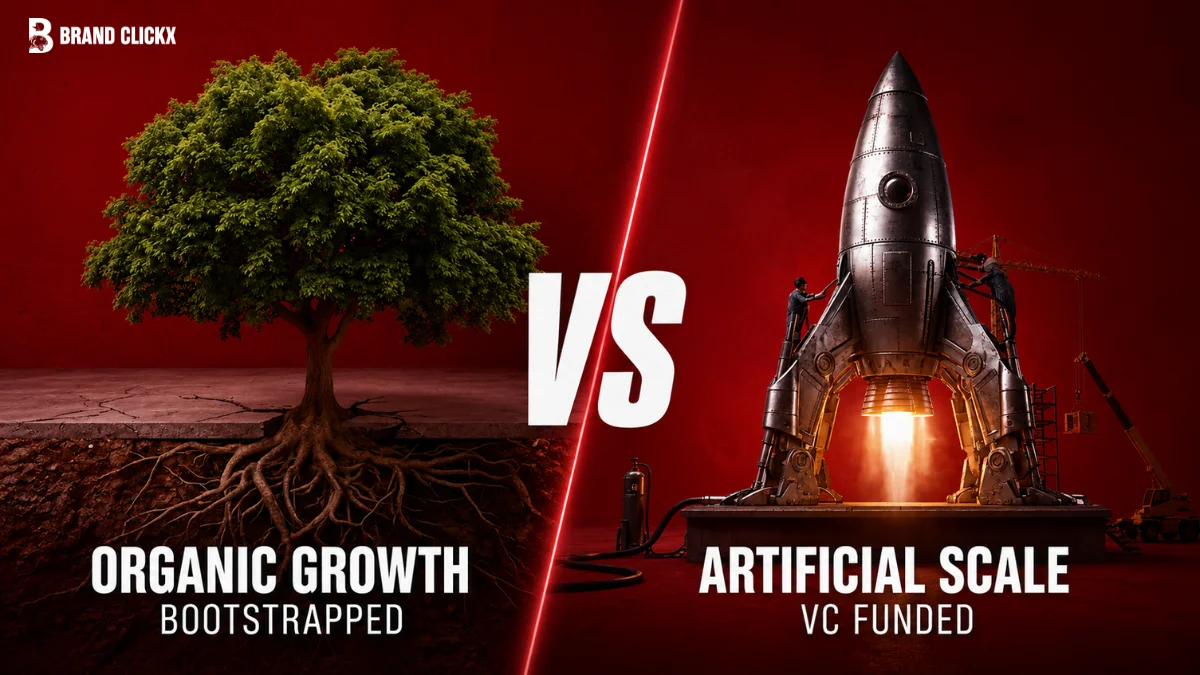
Bootstrapped vs. VC-Funded: Starting a business almost always comes down to one big question eventually: grow it with your own money, or bring investors in? That’s really where the whole bootstrapped-versus-VC conversation starts.
Bootstrapping means building the company mostly off the founder’s own money, whatever customers are already paying, and profits getting funneled straight back into the business. VC funding works differently, investors put money in, and in return they get a piece of ownership in the company.
Both paths can absolutely lead to successful companies, they just look completely different along the way. A VC-backed startup can usually hire faster, put more into marketing, and scale up quicker. A bootstrapped company grows slower, most of the time, but the founder holds onto control, and there’s nobody checking in every quarter demanding to see the growth numbers.
There’s no clean winner here, never really was. And looking at this over ten years makes that a lot clearer too, because whatever looks impressive in year one or two doesn’t always hold up as the thing that actually lasts.
Key Takeaways
- There’s no clean winner between bootstrapped and VC-funded, it’s genuinely not that simple.
- Bootstrapping usually means more control, tighter discipline around spending, and the founder keeps more of the company.
- VC money buys speed, hiring faster, expanding quicker, building the product out without waiting for revenue to catch up first.
- Funding type alone doesn’t decide whether a company survives long-term. Too many other things are in play.
- Only about a third of U.S. businesses started in 2013 were still around ten years later, and that’s regardless of how they were funded. Survival’s just hard, period.
- Bootstrapping tends to work well for capital-light businesses. VC funding earns its keep when fast scaling genuinely needs real money upfront.
- Really, the right choice comes down to matching the financing to the market, the capital needs, the growth goals, and honestly, what the founder actually wants out of this.
What Does Bootstrapped vs. VC-Funded Mean?

A bootstrapped business runs mostly on its own steam, personal savings, whatever customers are paying, early profits, maybe a small loan here and there, nothing that gives away ownership.
Bootstrapped vs. VC-Funded: A VC-funded startup takes a different route, money comes in from investors, and in exchange they get a piece of the company, plus an expectation that things grow fast and eventually lead to some kind of payoff, an acquisition, an IPO, something.
The real difference isn’t just where the money’s coming from though. It shapes almost everything downstream, who makes the calls, how much ownership stays with the founder, how aggressively the company hires and spends, what growth targets actually look like, and how much personal financial risk the founder’s carrying the whole way through.
How the Two Models Differ Over 10 Years

Growth Speed
VC funding basically buys a startup time, time to grow before revenue alone could ever pay for that growth. That money goes toward hiring, building the product out faster, pushing into new markets, spending more aggressively on customers than the bank account would otherwise allow.
Bootstrapped companies don’t get that luxury. Cash is tight, so founders end up having to prove people actually want what they’re building, and prove it early. Which, oddly enough, tends to build a healthier habit, chasing real paying customers instead of growth just for the sake of looking impressive on a pitch deck.
And here’s the thing research keeps circling back to: VC funding doesn’t automatically translate into better outcomes. A 2024 meta-analysis going through 102 different studies found the actual link between funding and performance moves around a lot, depending on the founder’s network, how much social capital they’re bringing to the table, and a handful of other conditions specific to each startup. No clean formula. Never really was one.
Bootstrapped vs. VC-Funded: Survival and Staying Power Over the Long Run
Survival’s one of the more useful things to look at when comparing businesses over a decade, but there’s a real limitation worth naming upfront, there’s no single, universal 10-year survival rate that cleanly separates bootstrapped startups from VC-backed ones. That comparison just doesn’t exist as one clean statistic.
What we do have is BLS data showing 34.7% of private-sector businesses started in 2013 were still running in 2023. And even within that, survival rates swing a lot by industry, somewhere between 40% and over 50% depending on the sector.
Which really points to something important: how a company’s funded is just one piece of a much bigger picture. Industry, business model, market conditions, how capital-intensive the business is, growth strategy- all of that shapes whether a company’s still standing at year ten.
A 2026 study on Indian startups found bootstrapped companies tended to show stronger financial sustainability, more founder autonomy, and better long-term survival, especially in capital-light sectors. But the same research also found VC-backed companies generally grew faster in the short and medium term. Different strengths really, not one clearly beating the other.
Ownership and Who’s Actually in Control
Ownership can look completely different a decade in, depending on which path a founder took.
A bootstrapped founder often keeps a large chunk of the company, simply because no equity ever went out the door to investors. That means more control over strategy, hiring, spending, and when to make the big calls.
VC funding shifts that balance. Every round tends to dilute the founder’s ownership percentage a bit more. In return, they get capital, investor networks, expertise, and sometimes connections that would’ve taken years to build otherwise.
For some founders, trading equity away is a fair price for building something much bigger, much faster. For others, holding onto control matters more than how fast the company scales. Neither instinct’s wrong, it just depends what the founder’s actually optimizing for.
Profitability: Does More Funding Mean More Profit?
Not necessarily. A company can raise millions and still be losing money hand over fist, pouring it into employees, tech, marketing, infrastructure, expansion, all of it adds up fast.
Bootstrapped companies tend to feel more pressure around cash flow, mostly because there isn’t always another big funding round waiting in the wings if things go sideways. That pressure often pushes toward more careful spending and paying attention to revenue sooner rather than later.
That’s not to say every bootstrapped business turns profitable quickly either. Some markets just need real investment before revenue can grow at all, and in those cases outside capital genuinely helps.
The real question isn’t whether a company raised money in the first place. It’s whether the way it’s financed actually fits the economics of the business it’s running.
Bootstrapped vs. VC-Funded: Risk After 10 Years
The Risk With Bootstrapping
The biggest risk here is pretty obvious: limited capital. A founder might have a genuinely strong product and still not have enough money to hire the right people, expand into new markets, or just survive a rough stretch when things slow down.
There’s personal risk too, especially when founders are putting their own savings on the line to keep things running.
That said, bootstrapping does cut down on a different kind of risk, you’re not depending on investors or the next funding round just to stay afloat.
The Risk With VC Funding
Bootstrapped vs. VC-Funded: VC-backed startups obviously have more resources to work with, but that money comes with real pressure attached. Investors put money in because they expect big returns, and that expectation tends to push companies toward aggressive hiring, fast expansion, constant fundraising, and valuation targets that have to keep climbing.
If growth slows down at all, the company might need to cut spending fast, or go raise more money under conditions that aren’t nearly as favorable as the first round.
So really, VC funding solves the early cash problem, but it trades that for higher expectations around growth and performance down the line.
What Happens to the Founder?
The founder experience is another major difference.
A bootstrapped founder generally has more freedom to choose the company’s direction. There may be fewer formal investor expectations, and decisions can often be made around long-term sustainability rather than the next funding milestone.
A VC-backed founder gains more than money. Investors can provide industry knowledge, recruitment support, partnerships, introductions, and strategic advice.
But investors also become stakeholders. Board involvement, reporting requirements, ownership dilution, and growth expectations can become part of the founder’s daily business decisions.
Neither path is automatically better. It depends on how much control, speed, capital, and external support the founder wants.
Which Model Performs Better After 10 Years?
The answer depends heavily on the type of company.
A capital-light software company with strong early revenue may have an excellent chance of growing through bootstrapping. A biotechnology company, hardware startup, or business requiring expensive infrastructure may need outside investment much earlier.
This is why broad statements such as “bootstrapped companies always survive longer” or “VC-backed companies always grow faster” should be treated carefully.
A 2026 study on startup growth and survival using more than 52,000 Dutch startups found that the relationship between growth and survival is more complicated than a simple “faster growth is always better” model. Its long-term analysis found higher survival likelihood among ventures with either low or high lifetime growth.
The lesson is simple: funding is a tool, not a guarantee.
Bootstrapped vs. VC-Funded: 10-Year Comparison
| Factor | Bootstrapped | VC-Funded |
|---|---|---|
| Initial capital | Usually limited | Usually much larger |
| Founder ownership | Generally higher | Reduced through dilution |
| Growth speed | Often gradual | Often faster |
| Investor pressure | Low | Higher |
| Decision control | Mostly founder-led | Shared with investors |
| Cash discipline | Usually strong | Can vary |
| Hiring capacity | More limited | Greater |
| Expansion | Usually measured | Often aggressive |
| Financial risk | Founder carries more | Risk is shared with investors |
| Best fit | Capital-light businesses | High-growth, capital-intensive startups |
Bootstrapped vs. VC-Funded: Note
A good comparison keeps facts separate from assumptions, that’s the starting point. There’s just no solid, universal dataset out there proving bootstrapped startups do better, or worse, than VC-backed ones over ten years. U.S. survival data looks at businesses broadly, it doesn’t split them out by how they were funded. Newer academic studies get more specific, but usually they’re focused on one country, one industry, one narrow sample, not something you can generalize from.
For founders, it’s more useful to compare funding paths on things you can actually measure: revenue growth, how much cash the business really needs, how much ownership gets given up, whether it’s profitable, what it costs to bring in customers, and how much capital it takes to reach the next stage.
If there’s one real lesson in all this, from BrandClickX read on it anyway, it’s that funding should support a business model that’s already working. It’s not a fix for one that isn’t. Money can speed up something good. It can’t manufacture demand where none exists.
FAQs
Is bootstrapping actually better than VC funding?
Depends on the situation. Bootstrapping works well when a company can grow off its own revenue and the founder wants to keep control. VC funding makes more sense when there’s a big market to capture and doing it fast actually requires real capital upfront.
Do VC-funded startups grow faster?
Usually they’ve got more resources to throw at growth, sure. But funding alone doesn’t guarantee anything; the research actually shows the relationship between VC backing and how well a startup performs varies a lot depending on the venture and the conditions around it.
Do bootstrapped companies last longer?
Some research points that way, particularly for capital-light businesses in certain settings. But there’s no clean, universal number, like some fixed 10-year survival rate, that proves bootstrapped companies always come out ahead of VC-backed ones. It’s really just not that simple.
Can a startup bootstrap first and raise VC later?
Definitely. A lot of companies start on founder money and early revenue, then bring in venture capital once they hit a point where more funding can actually accelerate what’s already working.
What kinds of businesses fit bootstrapping best?
Usually ones that can reach customers without a ton of upfront investment, software, consulting, agencies, digital products, that kind of thing. Capital-light models tend to grow this way more naturally.
What’s the biggest advantage VC funding actually gives you?
Real growth capital, mainly. It lets a startup hire faster, build out the product, push into new markets, chase opportunities that would just take too long to fund out of revenue alone.