
A business plan is a written guide that explains what your business does, who it serves, how it will make money, and how you plan to grow it.
It can help you prepare for investors, bank financing, partnerships, or simply running your business with a clearer direction. Writing one also forces you to examine your market, costs, competitors, customers, and potential risks before putting more money into the idea.
This guide explains how to write a business plan step by step. It covers the main sections, financial information, funding requests, common mistakes, and simple examples.
You can also use the template near the end as a starting point for your own plan.
What Is a Business Plan?
A business plan is a document that explains a company’s goals and how it intends to achieve them. It normally covers the business, market, customers, products or services, marketing strategy, management, funding needs, and financial outlook.
A business plan may be:
- A detailed document prepared for investors or lenders
- A shorter plan used for internal planning
- A simple one page plan for testing a new idea
Most traditional business plans are around 10 to 20 pages, although there is no fixed length.
Traditional Business Plan vs. Lean Business Plan
| Traditional Plan | Lean Plan |
|---|---|
| More detailed | Short and focused |
| Often used for lenders and investors | Useful for early planning |
| Includes detailed financial information | Uses key numbers and assumptions |
| Can take weeks to prepare | Can be created much faster |
| Usually 10 to 20 pages or more | Often one to a few pages |
If you are applying for a bank loan or seeking serious outside investment, a traditional plan is usually the safer choice.
Before You Start Writing
Do not start writing immediately.
First, decide who will read the plan. A bank wants evidence that you can repay a loan. An investor wants to understand the opportunity and potential return. If the plan is only for you, you can keep it more practical and flexible.
Gather the information you will need before writing:
- Market and industry research
- Competitor information
- Customer research
- Product or service costs
- Pricing information
- Startup expenses
- Sales estimates
- Financial records, if the business already operates
You should also check whether a lender, investor, grant program, or other organization has a required format.
The 9 Core Sections of a Business Plan
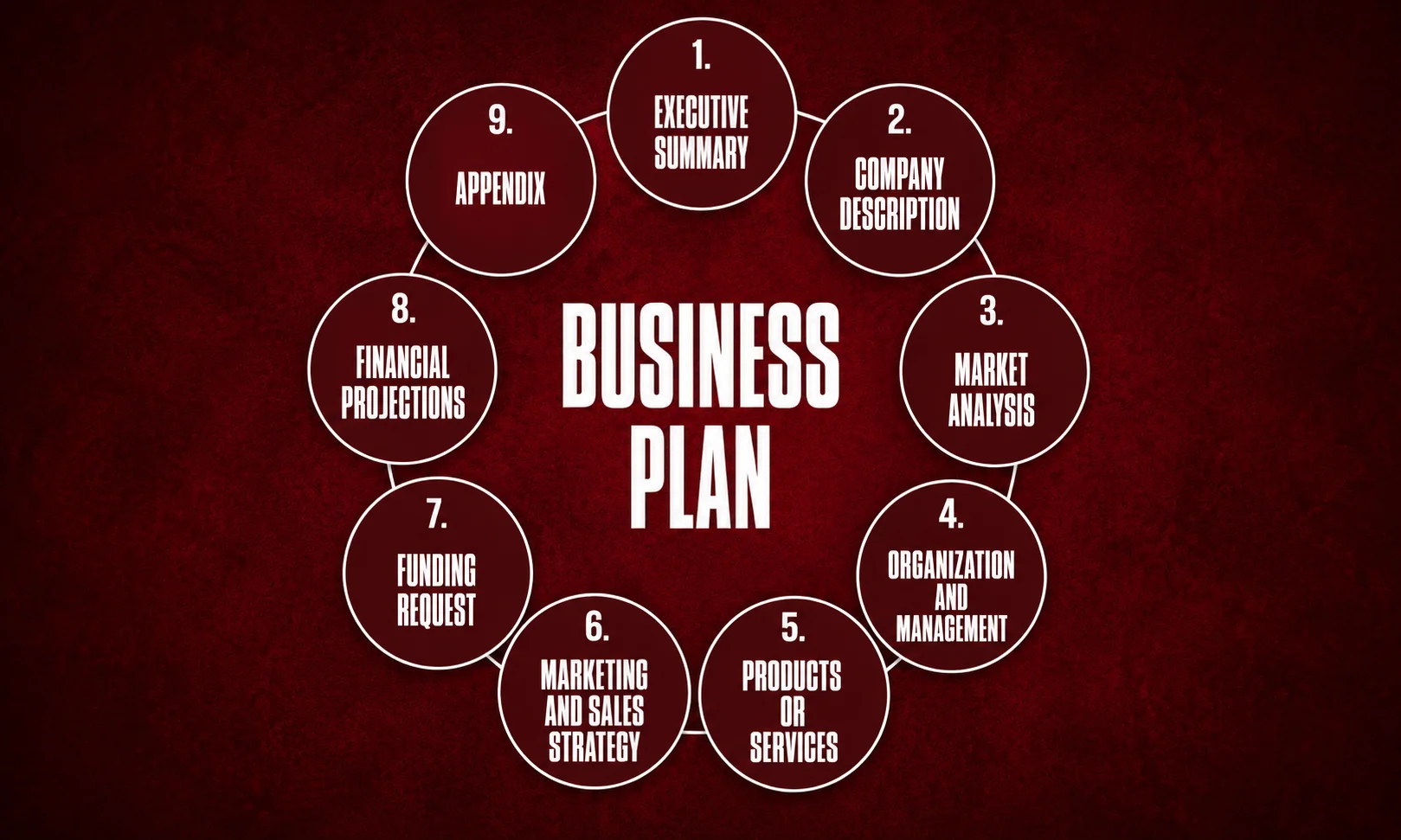
A traditional business plan normally includes these nine sections:
- Executive Summary
- Company Description
- Market Analysis
- Organization and Management
- Products or Services
- Marketing and Sales Strategy
- Funding Request
- Financial Projections
- Appendix
You do not necessarily need to write them in this order. In fact, the executive summary is usually easier to write after the rest of the plan is finished.
Step 1: Write the Executive Summary
The executive summary gives the reader a quick understanding of your entire business.
Although it appears first, write it last. By that point, you will know what the rest of your plan actually says.
What to Include
Keep the section focused on the most important information:
- Business name and location
- What the business sells
- Target customers
- Main competitive advantage
- Business goals
- Current financial position, if applicable
- Funding requirement, if applicable
How Long Should It Be?
For most small businesses, one or two pages is enough.
The reader should understand the business without needing to read the entire plan first.
Common Mistakes
Avoid vague claims such as “we will become the biggest company in the market.”
Instead, use specific information supported by research.
Do not introduce information in the executive summary that does not appear elsewhere in the plan.
Step 2: Describe Your Company
The company description explains what your business is and why it exists.
What to Include
Explain:
- Business name
- Business location
- Legal structure
- Founding date
- Ownership
- Business purpose
- Main products or services
- Current business stage
If you already operate, mention important achievements such as revenue growth, major customers, locations, or product launches.
Explain Your Purpose
A clear purpose tells the reader what problem your business is trying to solve.
For example, instead of saying “we provide food delivery,” explain what makes the service useful, such as faster delivery for customers in areas underserved by existing services.
Explain Your Business Model
Your business model describes how the company makes money.
Common models include:
- Direct product sales
- Subscriptions
- Advertising
- Service fees
- Commissions
- Licensing
- Memberships
Keep this section practical. Explain where revenue comes from and what customers pay for.
Step 3: Conduct Your Market Analysis
Market research shows whether there is a real opportunity for your business.
This section should be based on evidence rather than assumptions.
Research the Industry
Look at the size, growth, trends, regulations, and major changes affecting your industry.
Ask:
- Is demand growing or shrinking?
- What are customers buying?
- What trends are changing the market?
- Are new technologies affecting the industry?
- Are there regulatory issues to consider?
Define Your Target Market
Do not describe your customers as “everyone.”
Define the specific group most likely to buy from you.
Depending on the business, this may include:
- Age
- Location
- Income
- Occupation
- Business size
- Buying habits
- Needs and problems
A clear target market also makes your marketing strategy easier to build.
Analyze Your Competitors
Identify businesses offering similar or alternative solutions.
Compare them based on:
| Factor | Your Business | Competitor |
|---|---|---|
| Price | Your price | Competitor price |
| Product | Your offering | Their offering |
| Location | Your market | Their market |
| Customer service | Your approach | Their approach |
| Main strength | Your advantage | Their advantage |
Do not claim that you have no competition.
Even if no company sells exactly the same product, customers probably have another way to solve the same problem.
Use Reliable Market Data
Useful research can come from government statistics, industry associations, company reports, surveys, academic research, and reputable market databases.
Use recent information where possible, especially when discussing market size or growth.
Step 4: Explain Your Organization and Management
This section shows who owns the business and who will run it.
Legal Structure
Explain whether the business is a:
- Sole proprietorship
- Partnership
- Limited liability company
- Corporation
- Nonprofit organization
The available structures vary by country, so use the structure that applies to your jurisdiction.
Roles and Ownership
List the major owners and management team members.
Briefly explain their responsibilities and relevant experience.
For example:
| Role | Main Responsibility |
|---|---|
| Founder | Overall strategy |
| Operations Manager | Daily operations |
| Marketing Manager | Customer acquisition |
| Finance Manager | Budget and financial control |
You do not need to include every employee. Focus on people whose roles are important to the business plan.
Step 5: Describe Your Products or Services
Explain exactly what customers can buy from your business.
This section should answer a simple question:
Why would someone choose this product or service?
Explain Your Value
Describe the main benefit your customer receives.
For example, a software company may save customers time, reduce costs, improve security, or automate a difficult process.
Do not turn this section into an advertising pitch. Keep the claims specific and realistic.
Product Lifecycle
If relevant, explain where the product currently stands.
It may be:
- Still in development
- Newly launched
- Growing rapidly
- Established
- Being updated or replaced
You can also mention future products, intellectual property, patents, trademarks, or planned improvements when they are important to the business.
Step 6: Build Your Marketing and Sales Strategy

Your marketing strategy explains how you will reach customers. Your sales strategy explains how those customers will become buyers.
Choose Your Marketing Channels
Your channels should match your audience.
Possible options include:
- Search engines
- Social media
- Email marketing
- Content marketing
- Paid advertising
- Partnerships
- Events
- Direct sales
You do not need to use every channel.
Choose the ones that can realistically reach your target customers.
Explain the Sales Process
Describe what happens from first contact to purchase.
For example:
- Customer discovers the business
- Customer visits the website or store
- Customer compares the offer
- Customer contacts the business or adds a product to the cart
- Customer completes the purchase
- Business provides support and encourages repeat purchases
Include expected pricing, sales volume, customer acquisition costs, or conversion rates when reliable data is available.
Step 7: Write the Funding Request
This section is optional.
If you are not seeking outside funding, you can leave it out or briefly state that the business will be self-funded.
How Much Funding Do You Need?
State a specific amount and explain how you calculated it.
Do not simply say that you need “about $500,000.”
Explain what the money will accomplish.
How Will You Use the Money?
A simple table can make the request clearer.
| Use | Estimated Amount |
|---|---|
| Equipment | $50,000 |
| Marketing | $25,000 |
| Hiring | $75,000 |
| Working capital | $100,000 |
| Total | $250,000 |
Your numbers should match the financial projections later in the plan.
Debt or Equity?
Explain the type of funding you are seeking.
Debt means borrowing money that must be repaid.
Equity means giving an investor an ownership interest in the business.
If you are open to different funding structures, explain that clearly rather than making an unclear request.
Step 8: Build Your Financial Projections
Financial projections show whether your business could become financially sustainable.
This section can look complicated, but the basic purpose is simple: show expected revenue, costs, cash movement, assets, liabilities, and profitability.
Income Statement
The income statement shows revenue, expenses, and profit or loss.
A basic structure is:
Revenue minus expenses = profit or loss
Include realistic assumptions behind your revenue and expense estimates.
Cash Flow Projection
Cash flow tracks money entering and leaving the business.
A company can report a profit and still have cash problems if customers pay late or large expenses must be paid upfront.
Show expected:
- Cash coming in
- Operating expenses
- Loan payments
- Equipment purchases
- Other major payments
Balance Sheet
A balance sheet shows what the business owns and owes at a specific point in time.
It normally includes:
- Assets
- Liabilities
- Owner’s equity
Break Even Analysis
Break even is the point where revenue covers total costs.
For example, if your fixed costs are $10,000 per month and you earn $100 contribution per sale, you need 100 sales to cover those fixed costs.
The basic formula is:
Break even units = Fixed costs ÷ Contribution per unit
Use realistic assumptions. Avoid financial forecasts that grow rapidly without explaining why.
Step 9: Assemble the Appendix
The appendix contains supporting information that is useful but would make the main plan too long.
What to Include
Depending on your business, you may include:
- Resumes of key managers
- Licenses
- Permits
- Product images
- Contracts
- Research data
- Patents or trademarks
- Detailed financial statements
- Letters of intent
- Important legal documents
Only include documents that support the business plan.
Business Plan Template

Use the following simple structure as a starting point:
1. Executive Summary
Business name, idea, customers, goals, funding needs.
2. Company Description
Business purpose, ownership, location, legal structure, business model.
3. Market Analysis
Industry, target customers, market size, trends, competitors.
4. Organization and Management
Ownership, management team, roles, legal structure.
5. Products or Services
What you sell, customer benefits, pricing, product development.
6. Marketing and Sales
Target customers, marketing channels, sales process, pricing.
7. Funding Request
Amount needed, purpose of funding, funding type.
8. Financial Projections
Revenue, expenses, cash flow, balance sheet, break even.
9. Appendix
Supporting documents and additional evidence.
Business Plan Examples by Business Type
A business plan uses the same basic framework, but the details change depending on the business.
Service Business
A consulting company might focus heavily on:
- Client segments
- Service packages
- Hourly or project pricing
- Consultant experience
- Customer acquisition
- Expected billable hours
Product Business
A physical product company may focus more on:
- Product development
- Manufacturing
- Suppliers
- Inventory
- Distribution
- Retail or online sales
- Product margins
Nonprofit Business
A nonprofit plan may emphasize:
- Mission
- Community need
- Programs
- Beneficiaries
- Funding sources
- Grants
- Donations
- Impact measurement
The nine core sections can still provide the basic framework.
Common Business Plan Mistakes to Avoid
A good business plan does not need to be perfect, but it should be realistic and supported by evidence.
Avoid these common problems:
- Writing the executive summary before understanding the full plan
- Using unrealistic revenue forecasts
- Ignoring competitors
- Saying there is no competition
- Guessing market size
- Making unsupported claims
- Adding too much unnecessary information
- Using inconsistent financial numbers
- Failing to explain how the business will acquire customers
- Asking for funding without explaining how it will be used
The biggest mistake is treating the business plan as a document designed only to impress someone.
It should first help you understand whether the business makes sense.
How Long Should a Business Plan Be?
There is no universal word count.
Traditional Plan
A traditional plan is often around 10 to 20 pages, although complex businesses may require more.
Lean Plan
A lean plan can be one page or a few pages.
It works well when you are testing an idea and need to update your assumptions frequently.
What Investors Want to See
Investors generally want clarity rather than unnecessary length.
They need to understand:
- The opportunity
- The customer
- The product
- Competitive advantage
- Business model
- Growth potential
- Management team
- Financial outlook
- Funding requirement
A short plan with strong evidence is more useful than a long plan filled with vague statements.
Business Plans in 2026
Business planning has become more digital and easier to update.
AI Tools
AI tools can help brainstorm ideas, organize sections, improve wording, and identify questions that your plan has not answered.
However, you should verify financial figures, market research, legal information, and other important claims yourself.
AI should help with the process, not replace business judgment.
What Investors Expect
Investors increasingly look for clear evidence behind growth claims.
That means your plan should connect:
Market opportunity → customer demand → business model → revenue → costs → growth
The numbers should tell the same story as the written strategy.
Digital Business Plans
A business plan does not always need to be a static document.
Some businesses use digital plans with dashboards, updated financial models, customer data, presentations, and links to supporting documents.
This can make the plan easier to update as the business changes.
Frequently Asked Questions
What are the 9 parts of a business plan?
The nine common sections are the executive summary, company description, market analysis, organization and management, products or services, marketing and sales strategy, funding request, financial projections, and appendix.
How long should a business plan be?
A traditional business plan is often 10 to 20 pages, while a lean plan may be only one to a few pages. The right length depends on its purpose.
Do I need a business plan if I am not seeking funding?
Yes. A business plan can help you understand customers, costs, competition, pricing, and financial goals even when you are funding the business yourself.
What is the difference between a business plan and a business model?
A business model explains how a company creates and earns value. A business plan goes further by explaining the company’s strategy, market, operations, financial projections, and goals.
Can I write a business plan myself?
Yes. Many small business owners write their own plans. An accountant, business advisor, or other professional can review the financial and technical sections when necessary.
What financial documents do I need?
A typical plan may include an income statement, cash flow projection, balance sheet, startup budget, and break even analysis. Existing businesses should also use historical financial records where available.
How often should I update my business plan?
Review it at least once a year and update it whenever there is a major change in your market, strategy, finances, products, or business goals.
What software or tools can help me write a business plan?
Word processors, spreadsheets, financial modeling tools, business planning software, and AI writing tools can all help. Choose tools that make the plan easier to research, calculate, update, and present.
Final Thoughts
Writing a business plan is not simply about producing a document for a bank or investor. The real value is the thinking that happens while you create it.
You have to define your customer, study the competition, explain how the business will make money, estimate costs, and test whether your expectations are realistic.
Keep the plan clear, specific, and supported by evidence. Avoid filling pages with information that does not help explain the business.
If you are ready to start, use the nine section template above and build the plan one section at a time. You can always improve it as your research becomes better and your business develops.