
Customer Acquisition Cost Benchmarks cost is one of the more genuinely useful numbers for understanding how well a business turns marketing and sales spending into actual customers. But in 2026, there’s really no single figure you can point to and call “good” across the board. A $70 CAC might be way too expensive for a low-margin product, and yet be a great deal for a business pulling thousands out of each customer over time.
The latest industry data shows major differences between business models, customer segments, and acquisition channels. For example, recent 2026 benchmarks put B2B SaaS at around $239 in combined CAC in one widely cited industry dataset, while legal services reach about $749, financial services about $784, and education about $1,143.
This BrandClickX report walks through the latest customer acquisition cost benchmarks, and just as importantly, how to actually use them without turning industry averages into some fixed target you’re chasing blindly.
Key Takeaways
- CAC swings a lot depending on the industry, the business model, what a customer’s actually worth, and how complicated the sales process is.
- Recent B2B benchmarks put combined CAC at roughly $239 for SaaS, $387 for cybersecurity, $454 for IT and managed services, $749 for legal services, $784 for financial services, and $1,143 for education.
- Consumer businesses generally have lower absolute CAC than complex B2B businesses because purchases often require fewer sales steps.
- Paid acquisition is not always cheaper. In many B2B industries, published data shows higher CAC from paid channels than organic acquisition.
- A healthy CAC should always be compared with customer lifetime value (LTV), gross margin, retention, and payback period.
- A 3:1 LTV ratio is commonly used as a healthy operating benchmark, although the right target depends on the business model and growth stage.
What Is Customer Acquisition Cost?

Customer acquisition cost is the average amount a business spends to acquire one new paying customer. The basic formula is:
CAC = Total Sales and Marketing Costs ÷ Number of New Customers Acquired
For example, if a company spends $30,000 on marketing and sales during a month and gains 100 new customers, its CAC is $300.
A complete CAC calculation should not focus only on advertising. Marketing software, agency costs, content production, sales salaries connected to acquisition, promotional expenses, and other direct acquisition costs can also affect the real figure.
This is important because a business can appear to have a low CAC when it counts only its advertising bill while ignoring the sales and marketing resources needed to close customers.
Customer Acquisition Cost Benchmarks by Industry in 2026
There is no universal industry average because different research studies use different samples, customer types, and calculation methods. One of the more useful 2026 benchmark datasets separates B2B industries and compares organic and paid acquisition.
| Industry | Organic CAC | Paid CAC | Combined CAC |
|---|---|---|---|
| B2B SaaS | $205 | $341 | $239 |
| Cybersecurity | $345 | $512 | $387 |
| IT & Managed Services | $325 | $840 | $454 |
| Business Consulting | $410 | $901 | $533 |
| Software Development | $680 | $841 | $720 |
| Legal Services | $584 | $1,245 | $749 |
| Financial Services | $644 | $1,202 | $784 |
| Real Estate | $660 | $1,185 | $791 |
| Education | $862 | $1,985 | $1,143 |
The figures come from a First Page Sage dataset covering 29 B2B industries, with the 2026 version updated using client data through August 2025. Its combined figures use a weighted mix of organic and paid acquisition, so they should be treated as directional benchmarks rather than universal industry standards.
B2B SaaS
SaaS actually comes out with a fairly low combined CAC in this dataset, around $239. Organic sits near $205, paid runs higher at $341. Makes sense: product-led growth, free trials, content marketing, referrals, self-service signups- all of that gives SaaS companies more levers to keep acquisition costs in check.
That said, the number climbs fast once you’re selling to bigger organizations. Enterprise buyers want demos, security reviews, negotiations, sign-off from multiple people, and the whole thing just takes longer, which drives cost up right along with it.
Cybersecurity
Cybersecurity sits noticeably higher, around $387 combined, with organic near $345 and paid closer to $512. Not surprising really, these are products where buyers need real proof, security guarantees, compliance, reliability, and technical performance before they’ll commit to anything.
For cybersecurity companies, bringing CAC down isn’t just about generating more leads. Better-qualified leads and stronger conversion rates tend to move the needle a lot more than sheer volume ever would.
Legal Services
Legal services show a combined B2B CAC of about $749. Organic acquisition is around $584, while paid acquisition reaches approximately $1,245 in the cited dataset.
Legal marketing can become expensive because individual customers may have high lifetime value, while paid search competition can also be intense for valuable legal keywords. A firm should therefore compare CAC with the expected revenue and profit from each type of case.
Financial Services
Financial services have a combined CAC of about $784, with organic CAC around $644 and paid CAC around $1,202.
Trust, compliance requirements, longer decision processes, and competition for high-value customers can all increase acquisition costs. Financial businesses should measure CAC by customer segment rather than relying on one company-wide number.
Real Estate
The benchmark data puts real estate at around $791 combined CAC, with organic sitting near $660 and paid climbing to about $1,185.
Makes sense why it’s all over the place, though; real estate acquisition costs shift a lot depending on property type, location, what the customer’s actually worth, and whether the business is chasing buyers, sellers, investors, or commercial clients; each of those looks completely different.
Education
Education has one of the highest figures in the dataset, with a combined CAC of about $1,143. Organic CAC is estimated at $862 and paid CAC at $1,985.
The higher figure can be linked to longer consideration periods, multiple stakeholders, and the significant value of some education products and programs.
B2C Customer Acquisition Cost Benchmarks
Consumer businesses generally have different economics from B2B companies. A recent dataset covering 103 B2C agency clients reported organic and paid CAC figures across multiple industries.
| B2C Industry | Organic CAC | Paid CAC |
|---|---|---|
| Ecommerce | $64 | $68 |
| Home Services | $90 | $116 |
| Real Estate | $103 | $226 |
| Medical Practices | $120 | $176 |
| Financial Services | $146 | $173 |
| Automotive | $178 | $234 |
| Legal Services | $189 | $457 |
| Hotels & Resorts | $208 | $247 |
| Aviation | $475 | $708 |
The dataset was updated in July 2025 and covers customers acquired between 2021 and 2025, so it should be viewed as a recent baseline rather than a precise September 2026 price.
Ecommerce stands out because its reported CAC is much lower than industries with complex sales processes. However, a low CAC does not automatically mean higher profit. Product margins, repeat purchases, refunds, shipping costs, and average order value all influence whether that CAC is sustainable.
Why CAC Varies So Much Across Industries
The biggest driver here is customer value, plain and simple. A company selling a $20 product just can’t support the same acquisition cost as one selling a $20,000 annual contract, the math wouldn’t work.
The sales process matters too. Someone who buys online in two minutes costs way less to acquire than someone who needs a sales call, a demo, contract back-and-forth, a security review, and sign-off from three different departments before anything closes.
Competition plays a role as well. Expensive ad markets push up what it costs to reach people, while solid organic visibility can take some of that pressure off.
And retention changes everything. A customer who sticks around for years and keeps paying can absolutely justify a higher upfront CAC, the economics still work out fine over time.
How to Actually Calculate Your CAC
Pick a clear time window first, a month, a quarter, a year, whatever fits. Add up the sales and marketing costs tied directly to acquiring customers during that window. Divide by how many new customers you actually brought in.
So, say marketing and sales costs came to $50,000, and you brought in 125 new customers. That’s $50,000 divided by 125, a CAC of $400.
From there, compare that $400 against lifetime value. If the average customer only brings in $300 in gross profit, that math doesn’t work, the acquisition strategy’s losing money. But if they’re generating a few thousand dollars over time, that same $400 CAC is perfectly reasonable.
CAC vs. LTV, the Number That Actually Matters
CAC on its own doesn’t tell you much. Lifetime value is what shows how much a customer’s actually worth over the whole relationship.
A commonly cited benchmark is around 3:1. Below 1:1, acquisition is literally destroying value. Somewhere around 3:1 to 5:1 is generally considered healthy. And oddly enough, going well above 5:1 can sometimes mean a company’s being too cautious, leaving growth on the table instead of spending to capture more customers.
Say your CAC is $500 and lifetime value comes out to $1,500, that’s a 3:1 ratio right there.
That doesn’t mean every business needs to chase exactly 3:1 though. Early-stage companies might accept weaker numbers while they’re still figuring out the market, and mature businesses might target something different depending on where growth and cash flow priorities sit.
Ways to Actually Bring CAC Down
Cutting ad spend isn’t always the answer here. A lot of the time, fixing the customer journey itself does more.
Start with targeting, make sure budget’s reaching people who’d genuinely buy, not just anyone who happens to click. Better landing pages can lift conversions without needing more traffic at all. Stronger onboarding helps too, it improves retention, which makes whatever got spent acquiring that customer worth a lot more down the line.
Organic channels matter here as well, SEO, useful content, referrals, email, all of it chips away at how dependent a business stays on paid acquisition. Recent benchmark data backs this up too, organic CAC runs lower than paid across a lot of B2B industries, though it takes longer to actually build momentum.
Worth breaking CAC down by channel, product, customer segment, and campaign rather than staring at one blended number. A cheap channel bringing in low-quality customers might genuinely be worse than a pricier one that brings in people who actually stick around.
How to Use CAC Benchmarks Responsibly
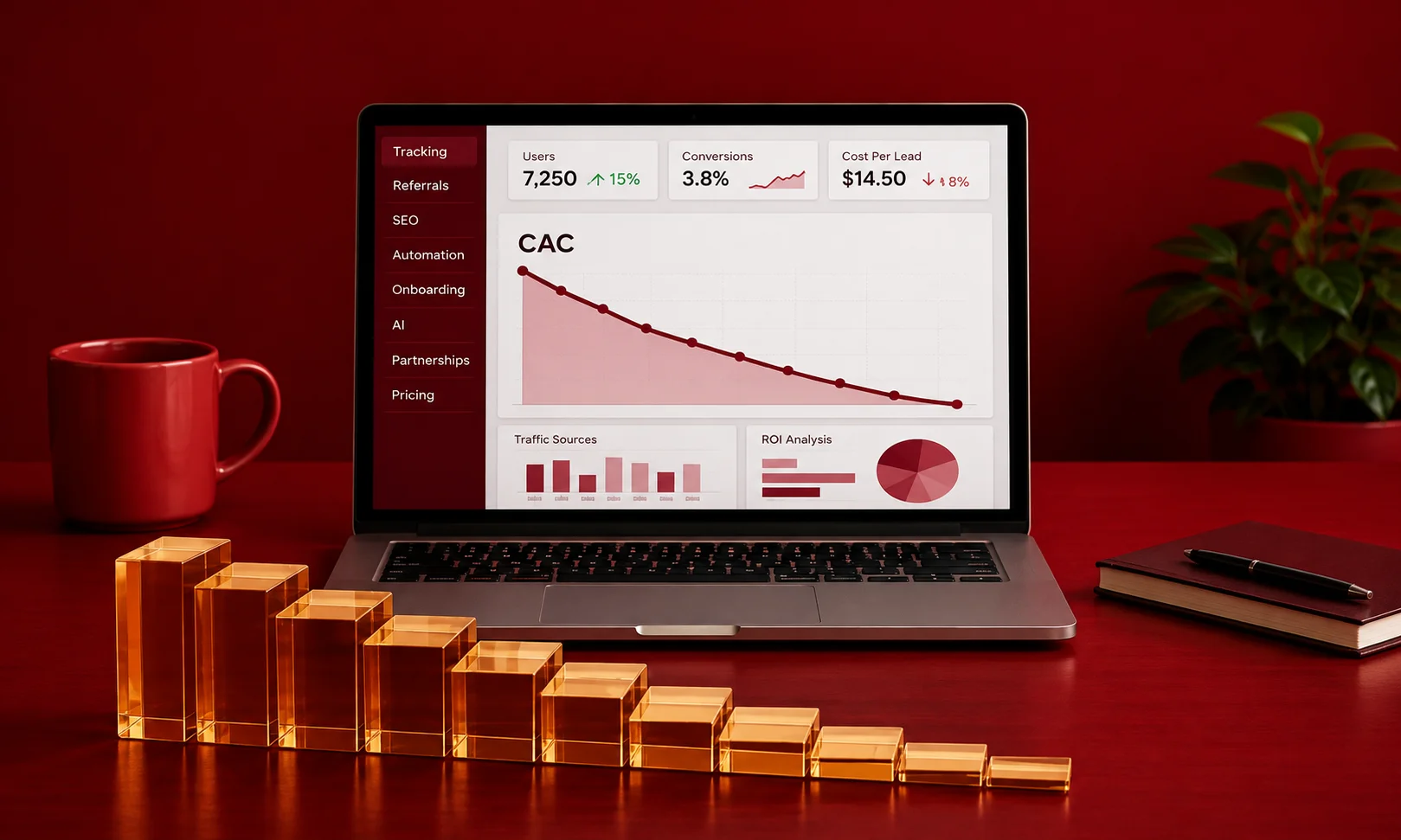
Look at your own CAC history alongside whatever external benchmark you’re comparing against. Your actual customers, your pricing, your conversion rates, your sales process- that stuff tells you way more than a generic industry number ever will.
Don’t judge acquisition off CAC alone either. Line it up against LTV, gross margin, retention, conversion rate, payback period; one number in isolation doesn’t really tell you if things are working.
If you’re sharing benchmark numbers with anyone, say where they came from, when they were collected, how they were actually measured, and whether it’s B2B or B2C, organic or paid, or some mix. Skip that context and the numbers don’t really mean much.
And treat any benchmark range as a rough direction, not something set in stone. Different datasets pull from different samples, use different methods, that’s exactly why two solid reports on the same industry can land on pretty different CAC figures and both still be right.
Frequently Asked Questions
What’s a good customer acquisition cost in 2026?
A 2026 benchmark put B2B SaaS CAC around $239 combined; organic came in cheaper at about $205, paid was pricier at $341. Enterprise deals cost way more to land than that, though, mostly because closing them takes longer and involves way more people and steps along the way.
What’s the average CAC for SaaS companies?
A 2026 B2B benchmark dataset put combined CAC around $239 for B2B SaaS overall, organic sitting closer to $205, paid landing higher at roughly $341. Enterprise SaaS blows past those numbers, though; bigger deals drag in longer, messier sales processes, and all of that just costs more to close.
Is a 3:1 LTV ratio actually good?
Generally, yeah, that’s the number people point to as healthy. But it’s not the whole story: gross margin, cash flow, what stage the company’s at, how long it takes to earn back the acquisition cost- all of that shapes whether the ratio actually means something good for a specific business.
Is organic acquisition really cheaper than paid?
Recent B2B data shows organic CAC coming in lower than paid across a lot of industries, so yeah, generally. The tradeoff is time, though: organic takes a while to build up, while paid can get traffic and leads moving a lot faster if you need results sooner.
Why does CAC run higher for enterprise customers?
Enterprise deals just come with more steps, more sales meetings, product demos, security reviews, negotiations, more people involved in the final decision. All of that eats up more time and resources per customer, which naturally pushes the cost up.
Should I just compare my CAC to industry benchmarks directly?
Treat benchmarks as a reference, not a target you’re chasing. Your own CAC trend over time, your LTV ratio, gross margin, retention, and payback period tell you a lot more about whether your acquisition strategy’s actually working than any outside number ever could.