Key Takeaways
- Kishida told Bloomberg TV on 5 August that intervention “could buy some time” but little more
- He pointed to a ¥370 trillion ($2.3 trillion) growth strategy as the real answer
- The programme runs 14 years across 17 strategic areas
- He chairs the ruling party group that advised Takaichi on it
- He brushed aside questions about how it will be funded
- Japan spent roughly ¥11.73 trillion unilaterally in April and May without warning
- The yen still reached a 40-year low in July
- The US and Japan intervened jointly on 31 July, confirmed 3 August
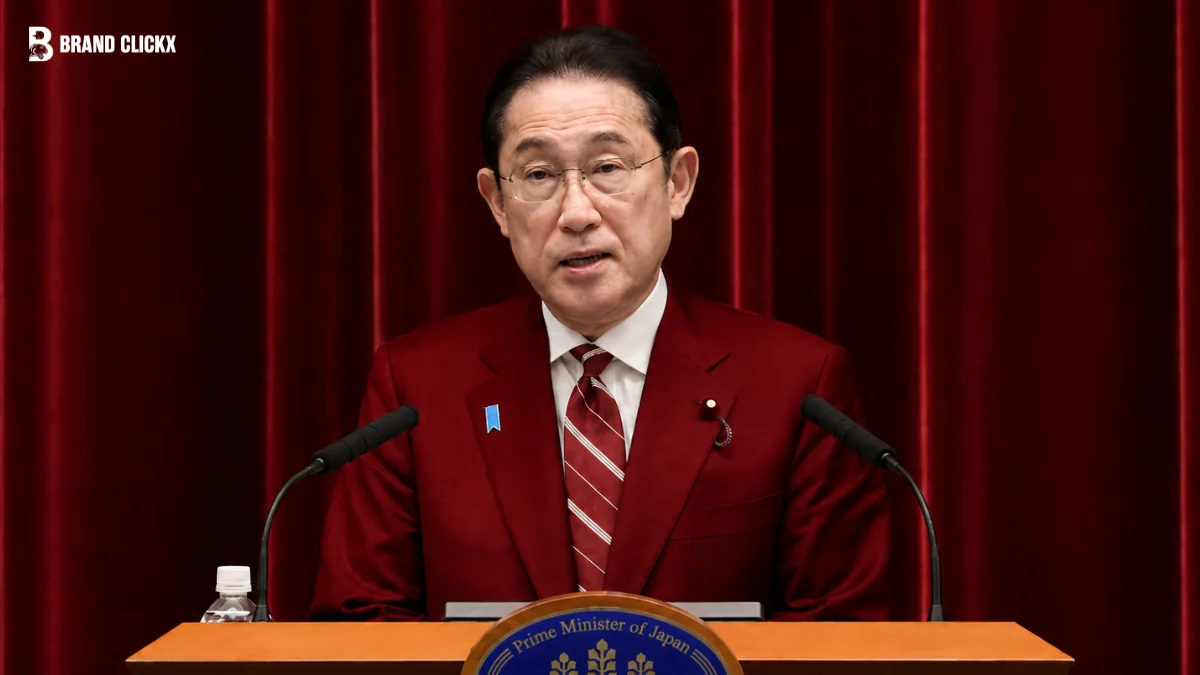
Japan’s former prime minister told Bloomberg the joint US-Japan operation is not a game-changer. The growth strategy he helped design would spend roughly 60% of annual GDP over 14 years and he brushed aside questions about funding it.
This is economic reporting, not investment advice. Currency markets move continuously. Consult a licensed adviser before making financial decisions.
Summary
Former Japanese Prime Minister Fumio Kishida said the joint US-Japan currency intervention announced this week supports the yen but does not change its trajectory, telling Bloomberg TV in Tokyo on Wednesday 5 August that it “could buy some time.” He pointed instead to a ¥370 trillion ($2.3 trillion) growth strategy spanning 14 years and 17 strategic areas, which he helped design for Prime Minister Sanae Takaichi.
What Kishida Said
His assessment of the intervention was measured rather than dismissive, and quite specific about its limits.
“In terms of the currency, it could buy some time, but it could end up doing no more than that unless the fundamental economic situation and the broader environment changes.”
That is a former prime minister, whose party designed the current government’s economic programme, publicly stating that the largest currency operation of the year is a holding measure.
On the strategy itself, Kishida pointed to Japan’s nascent semiconductor and artificial intelligence industries as examples of how the economy could grow at an accelerated pace.
On funding, he brushed aside concerns. That is the reporting’s word, and it is the part of the interview that matters most.
What the ¥370 Trillion Strategy Is
| Detail | |
| Value | ¥370 trillion (~$2.3 trillion) |
| Duration | 14 years |
| Scope | 17 strategic areas |
| Designed by | A ruling party group chaired by Kishida |
| Adopted by | Prime Minister Sanae Takaichi |
For scale: Japan’s annual GDP is roughly ¥600 trillion. This is a programme worth about 60% of one year’s output, spread across fourteen years meaning something in the region of 4% to 5% of GDP annually.
Kishida’s position is that this, rather than currency operations, is what changes Japan’s trajectory.
Why He Is Right About the Intervention
Every analyst quoted this week reached the same conclusion, and now a former prime minister has said it publicly.
The joint operation was announced on Monday 3 August, covering intervention conducted on Friday 31 July. It was the first coordinated US-Japan yen buying since 1998, and it followed the yen falling to its weakest against the dollar since 1986.
Both finance ministries said they would not hesitate to act again.
But intervention addresses speed, not level. Central banks can halt a disorderly move. They cannot durably set a price against sustained interest-rate differentials. The consistent analyst view has been that this buys time for the Bank of Japan until it can raise rates further.
Japan already tested the limits of the unilateral version. Reporting indicates the Finance Ministry spent ¥11.73 trillion roughly $73 billion in the two months to 27 May, without advance warning, in what was described as the largest sustained intervention in the country’s history. The yen surged as much as 3% on the first day.
It subsequently fell to a 40-year low anyway.
That is the strongest evidence for Kishida’s argument. Seventy-three billion dollars did not change the direction. There is little reason to expect a coordinated operation to do so either, absent something changing underneath.
The Problem With His Answer
A ¥370 trillion spending programme, funded by borrowing, in an economy whose currency is weak partly because of fiscal concerns.
This is the tension the interview did not resolve, and “brushing aside” funding questions does not make it go away.
The mechanism analysts have described runs like this: a weak yen pressures Japanese government bonds, JGB yields rise, and higher yields spill into global bond markets. State Street’s Masahiko Loo noted that Washington’s concerns about the yen likely extend beyond the currency itself for exactly this reason.
Large-scale fiscal expansion pushes in the same direction. More issuance means more supply of JGBs, which means upward pressure on yields, which depending on whether markets read it as growth or as deterioration can weaken the currency further.
The counter-argument is genuine, and Kishida is making it. If the spending produces actual productivity growth in semiconductors and AI, Japan grows into the debt rather than under it. Higher trend growth eventually supports the currency in a way no intervention can. That is the entire theory of the programme.
Which of those happens depends on execution over fourteen years, and neither an interview nor a currency operation settles it.
The Political Frame
Kishida chairs the ruling party group that advised Takaichi on the strategy. He is not a neutral commentator he is defending a programme he helped write, at a moment when the currency is making his government look reactive.
Takaichi’s position is genuinely difficult. She is managing three audiences at once: currency markets wanting stability, bond markets watching fiscal credibility, and households wanting relief from import-driven inflation. Policies that satisfy one can antagonise another.
If the yen stabilises and the BOJ retains credibility, the ¥370 trillion roadmap stays the foundation of her administration. If the yen keeps falling and yields keep rising, the same roadmap becomes the symbol of a government being tested by markets before it has implemented its agenda.
Timeline
| Date | Development |
| Apr–May 2026 | Japan spends ~¥11.73tn unilaterally without warning |
| 30 May 2026 | Finance Ministry confirms the total |
| 22–23 July 2026 | Yen at weakest in about 40 years |
| 30–31 July 2026 | BOJ policy meeting; rate-hike expectations build |
| 31 July 2026 | Coordinated US-Japan intervention |
| 3 August 2026 | Both governments confirm the operation |
| 5 August 2026 | Kishida’s Bloomberg TV interview |
Expert Analysis
Kishida’s diagnosis is correct and better sourced than most political commentary. His prescription is the contested part.
On the diagnosis: intervention that cost $73 billion unilaterally in April and May did not stop the yen reaching a 40-year low in July. A coordinated operation with Washington adds credibility and signalling value Japan’s stated plan to use the Fed’s FIMA repo facility tells markets it can raise dollars without selling Treasuries but the underlying rate differential is unchanged.
On the prescription: there are two coherent positions and Kishida holds one of them.
The growth case: Japan’s problem is two decades of low productivity growth, and no amount of currency management fixes that. Semiconductors and AI are genuine areas where Japan has capability and where global demand is expanding. Investment at scale is how a country changes its trajectory.
The fiscal case: Japan already carries the developed world’s heaviest debt burden. Adding roughly 60% of GDP in new commitments, at a moment when JGB yields are rising and the currency is under pressure, risks worsening the exact conditions the programme is meant to remedy.
The honest position is that both risks are real and the outcome depends on whether the spending produces measurable productivity gains rather than absorption. Fourteen-year programmes are difficult to judge at any point before their conclusion.
What is not contested is Kishida’s central point. The intervention bought time. Something has to happen with that time.
Conclusion
The most striking thing about Kishida’s interview is how closely his assessment of the intervention matches the analysts’. Everyone agrees it bought time.
The disagreement is about what to do with that time. Kishida’s answer is ¥370 trillion of investment in semiconductors and AI, on the theory that Japan’s currency problem is really a growth problem wearing a different hat.
He may well be right. But a programme worth 60% of annual GDP, defended by brushing aside how it will be paid for, arriving while bond yields rise and the currency sits near 40-year lows, is a large bet placed at an awkward moment.
The BOJ’s rate path will decide the yen this year. The growth strategy is arguing about the decade.
Frequently Asked Questions
What did Kishida say about the yen intervention?
That it could buy some time but might do no more than that unless the fundamental economic situation and broader environment change. He made the comments in a Bloomberg TV interview in Tokyo on Wednesday 5 August 2026.
What is the ¥370 trillion growth strategy?
A 14-year programme covering 17 strategic areas, worth about $2.3 trillion. Kishida chairs the ruling party group that advised Prime Minister Sanae Takaichi on drawing it up. It targets areas including semiconductors and artificial intelligence.
How large is that relative to Japan’s economy?
Japan’s annual GDP is roughly ¥600 trillion, so the programme is worth about 60% of one year’s output spread over fourteen years — in the region of 4% to 5% of GDP annually.
Has Japan intervened before this year?
Yes. Reporting indicates the Finance Ministry spent approximately ¥11.73 trillion, around $73 billion, in the two months to 27 May 2026 without advance warning, described as the largest sustained intervention in Japan’s history.
Did that earlier intervention work?
Only temporarily. The yen surged as much as 3% on the first day, but subsequently fell to a 40-year low against the dollar in July, prompting the coordinated operation with the United States at the end of that month.
Why do fiscal concerns affect the yen?
A weak yen pressures Japanese government bonds and pushes yields higher, which can spill into global bond markets. Large-scale borrowing adds to bond supply, which can compound that pressure depending on how markets read it.
Is Kishida a neutral commentator?
No. He chairs the ruling party group that designed the growth strategy he is advocating, and is defending a programme central to the current government’s economic agenda.
What would actually strengthen the yen durably?
Analysts consistently point to tighter Bank of Japan monetary policy narrowing the interest-rate differential with the United States. Intervention addresses the speed of currency moves rather than their level.