Oracle raised over $100 billion in debt in roughly 60 days, spent $55.7 billion in capex, and turned free cash flow negative by $23.7 billion. The stock is down more than 55% from its peak. Whether that is a bubble or a build-out depends on one customer.
Published: Monday, 3 August 2026 | BrandClickX News Desk
This is financial news reporting, not investment advice. Figures are drawn from Oracle’s own filings and published reporting, and market values change continuously. Consult a licensed financial adviser before making investment decisions.
Disclosure: This article discusses Anthropic, which is referenced by analysts as a potential source of compute demand. Anthropic makes Claude, which was used to write this article.
Summary
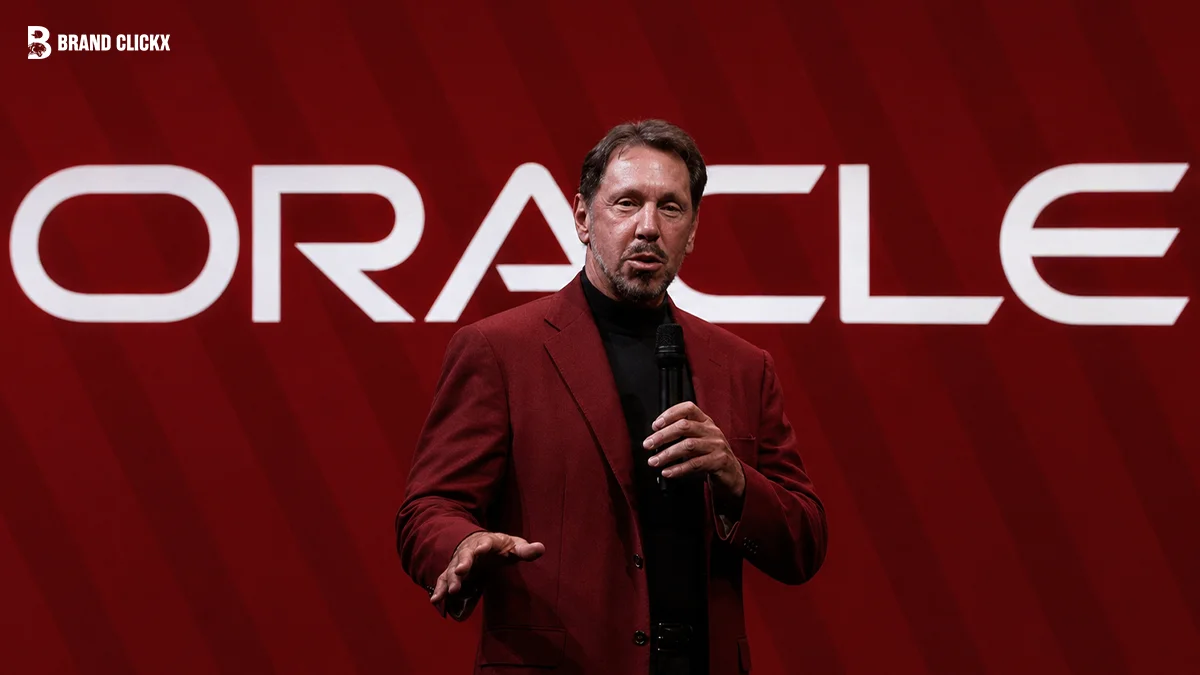
Oracle chairman Larry Ellison briefly became the world’s richest person in September 2025 after his company signed a $300 billion deal with OpenAI. Since then Oracle shares have fallen more than 55% from their peak, erasing roughly $494 billion in market value, and Ellison’s net worth has dropped by an estimated $207 billion. S&P Global has downgraded Oracle’s credit rating. The outcome now depends heavily on OpenAI.
Key Takeaways
- Oracle’s fiscal 2026 capex hit $55.66 billion, above $50 billion guidance
- Free cash flow turned negative by $23.7 billion
- Total borrowings reached roughly $130 billion at fiscal year end
- The stock is down more than 55% from its September 2025 peak
- Roughly $494 billion in market value has been erased
- Ellison’s fortune has fallen by an estimated $207 billion
- S&P Global downgraded Oracle’s credit rating
- Remaining Performance Obligations stand at $638 billion per Oracle’s Q4 8-K
- OpenAI’s IPO has slipped to 2027
The Numbers
Oracle’s fiscal 2026, ended 31 May 2026, is the clearest picture available.
| Metric | Figure |
| Capital expenditure | $55.66 billion (guidance was $50bn) |
| Capex growth | +162% year over year |
| Free cash flow | –$23.7 billion |
| Total borrowings at year end | ~$130 billion |
| Debt outstanding in the Bloomberg US Corporate Bond Index | ~$117 billion |
| Remaining Performance Obligations | $638 billion, up 363% |
| Bonds raised, February 2026 | $50 billion |
| Related borrowing, first two months of 2026 | $58 billion |
Oracle is now second only to Amazon among non-financial issuers in the Bloomberg US Corporate Bond Index.
A significant data conflict. Oracle’s Q4 8-K reported Remaining Performance Obligations of $638 billion. At least one site reports RPO as $98 billion a discrepancy too large to reconcile, and the lower figure appears on a low-quality aggregator. We have used the 8-K figure, which is a filed primary source, but recommend verifying against Oracle’s investor relations page before publishing any RPO number.
What Ellison Actually Bet On
Project Stargate: up to $500 billion in AI data centres over four years.
The venture was announced in the Oval Office in January 2025, with President Trump flanked by the leaders of Oracle, OpenAI and SoftBank. Individual facilities target over 500,000 square feet, with a combined power goal of 10 gigawatts.
In September 2025, Oracle signed a $300 billion deal with OpenAI. The stock rose 36% in a single day briefly making Ellison the world’s richest person, with estimates of his net worth ranging from $388 billion to $400 billion.
The transformation was genuine. Oracle went from an enterprise software company to something closer to a hyperscaler, hosting AI workloads for OpenAI, xAI, Cohere and NVIDIA on Oracle Cloud Infrastructure.
And parts of it are real and operating. OpenAI confirmed in July 2025 that portions of Stargate I in Abilene, Texas were running, with Oracle delivering NVIDIA GB200 racks and early training and inference workloads underway. The Oracle partnership added 4.5 gigawatts of planned US capacity.
What Has Gone Wrong
The stock closed at $121.38 on 20 July 2026 more than 55% below its September 2025 peak of $345.72.
Roughly $494 billion in market value has been erased. Ellison’s personal fortune has fallen by an estimated $207 billion, according to Bloomberg’s index.
S&P Global downgraded Oracle’s credit rating, warning that the build-out might pay off in the long term but could weaken the company’s near-term financial position.
S&P’s stated concern is specific and worth quoting in substance: if OpenAI has trouble raising money or meeting its contracts, Oracle could be left holding data centre obligations built for demand that does not arrive on schedule.
Melius Research raised the same question whether Oracle’s spending plans hold if OpenAI or Anthropic scale back compute demand.
Compounding it: OpenAI’s IPO has slipped to 2027, delaying the most obvious route to the capital that underwrites those contracts.
Reports also indicate bondholders have filed lawsuits related to AI financing deals connected to OpenAI.
The Personal Exposure
This is what distinguishes Ellison from other executives making large AI bets.
He holds roughly 42% of Oracle’s equity. His fortune is not diversified away from the outcome it substantially is the outcome.
Two further commitments amplify it:
- Ellison personally guaranteed $40.4 billion for his son David’s media merger, backed by Oracle shares now worth roughly half their value when the guarantee was signed
- Ed Zitron, a prominent AI-sceptic writer, has reported that Ellison holds over $20 billion in personal loans collateralised by over $60 billion in Oracle shares, raising margin-call risk if the stock falls further
A source note: the loan figure comes from Zitron’s subscription newsletter. He is an outspoken critic of the AI industry and his work is analysis rather than filed disclosure. The claim is plausible and has circulated widely, but we have not verified it against a primary source and it should be attributed if used.
The Bull Case
It deserves a fair hearing, because the bear case has dominated coverage.
The backlog is enormous. Remaining Performance Obligations of $638 billion, up 363%, represent contracted future revenue. Even heavily discounted for risk, that is a substantial forward book.
The revenue is growing. Oracle Cloud Infrastructure revenue grew 48% year over year in the most recent quarter, and the company posted $17.2 billion in quarterly revenue for the period ending 28 February 2026, with cloud services up 44%.
The infrastructure is being built and used. Stargate I is partially operational. These are not paper commitments.
Capital-intensive infrastructure always looks like this early. Negative free cash flow during a build-out phase is what building looks like. Railways, telecoms and cloud computing all had periods where the spending arrived years before the returns.
The demand may be real. If AI compute demand continues growing, capacity secured now at today’s prices becomes an asset rather than a liability.
The Bear Case
Four specific objections, and they are not vague.
Concentration. The bet rests heavily on one customer whose own finances depend on continued fundraising. S&P named this directly.
Depreciation. GPUs are on an annual upgrade cycle. Critics argue much of the capacity being built today will be commercially obsolete well before the contracts run out meaning the assets depreciate faster than the debt amortises.
Timing. Remaining Stargate sites are reported to be barely under construction, with completion unlikely before the end of 2028. The debt is being serviced now.
Scale of the wider bubble. Analyst Julien Garran contends the AI investment frenzy is 17 times larger than the dot-com bubble, arguing only NVIDIA is generating genuine profit. That is a striking claim from a single analyst, and it should be treated as one voice rather than a consensus finding.
Timeline
| Date | Development |
| Jan 2025 | Stargate announced at the White House |
| Jul 2025 | OpenAI confirms parts of Stargate I operating in Abilene |
| Sept 2025 | $300bn OpenAI deal; stock +36% in a day; Ellison briefly world’s richest |
| Feb 2026 | Oracle raises $50bn in bonds, plus $58bn related borrowing |
| 28 Feb 2026 | Quarterly revenue $17.2bn; cloud services +44% |
| 31 May 2026 | Fiscal year ends: capex $55.66bn, FCF –$23.7bn |
| 2026 | S&P downgrades Oracle’s credit rating |
| 20 Jul 2026 | Stock closes at $121.38, down 55%+ from peak |
| 2 Aug 2026 | Ellison’s fortune down an estimated $207bn from peak |
| 2027 | OpenAI IPO, delayed from earlier expectations |
| End 2028 | Earliest expected completion of remaining Stargate sites |
Expert Analysis
The honest position is that this is genuinely unresolved, and anyone claiming certainty in either direction is selling something.
Some of them literally are. Several articles covering Oracle’s decline carry affiliate stock-picking promotions in the same breath as the analysis. That does not make their figures wrong most trace to Oracle’s own 8-K but it should inform how much weight the interpretation carries.
What is not in dispute: the capex, the negative free cash flow, the debt load, the credit downgrade and the share price. Those come from filings and market data.
What is contested: whether AI compute demand justifies the build-out on the timeline the debt requires.
The most useful frame is the mismatch between three clocks. The debt is being serviced now. The data centres complete around 2028. The GPUs inside them depreciate annually. The contracts run for years. If demand arrives on the contracts’ schedule, Ellison is vindicated. If it arrives late, the interest payments do not wait.
The concentration risk is the sharpest single point. Oracle’s position is unusually dependent on OpenAI’s ability to keep raising capital — and OpenAI’s IPO has already slipped a year.
On the “face of the bubble” question: Oracle has become the market’s chosen proxy for AI infrastructure risk, which is partly a function of visibility rather than fundamentals. It carries more debt relative to its cash generation than Microsoft, Amazon or Google, and it made a louder, more concentrated bet. That makes it the clearest test case, not necessarily the weakest company.
Frequently Asked Questions
How much has Larry Ellison lost?
An estimated $207 billion from his September 2025 peak, according to Bloomberg’s billionaires index. His fortune peaked near $388 billion when Oracle traded at $345.72 and he briefly became the world’s richest person.
Why has Oracle stock fallen?
Investors have grown concerned about the debt taken on to fund AI data centres, negative free cash flow, and heavy dependence on OpenAI. S&P Global downgraded Oracle’s credit rating over near-term financial pressure.
What is Project Stargate?
A venture announced in January 2025 by Oracle, OpenAI and SoftBank, committing up to $500 billion to US AI infrastructure over four years. Individual sites exceed 500,000 square feet, targeting 10 gigawatts of combined capacity.
How much debt does Oracle have?
Roughly $130 billion in total borrowings at the end of fiscal 2026, with about $117 billion outstanding in the Bloomberg US Corporate Bond Index second only to Amazon among non-financial issuers.
Is Oracle’s AI investment paying off?
Not yet in cash terms. Oracle Cloud Infrastructure revenue grew 48% year over year and the contracted backlog stands at $638 billion, but capital spending drove free cash flow to negative $23.7 billion in fiscal 2026.
What is Oracle’s exposure to OpenAI?
Substantial. Oracle signed a $300 billion deal with OpenAI in September 2025. S&P has warned that if OpenAI struggles to raise money or meet its contracts, Oracle could hold data centre obligations built for demand that does not materialise.
Is the AI boom a bubble?
Views diverge sharply. Analyst Julien Garran argues the AI investment frenzy is 17 times larger than the dot-com bubble. Others point to growing revenue, real operating capacity and a large contracted backlog as evidence of genuine demand.
What happens next for Oracle?
Key variables are OpenAI’s 2027 IPO, whether remaining Stargate sites complete on schedule around 2028, and whether compute demand grows fast enough to service the debt already taken on.
Conclusion
Larry Ellison made the single largest concentrated bet of the AI era, and he made it with borrowed money and his own equity.
Everything factual about the downside is now visible in filings: the capex overrun, the negative cash flow, the debt, the downgrade, the share price. Everything about the upside remains contracted rather than realised a $638 billion backlog that converts to cash over years, not quarters.
Whether he becomes the face of the AI bubble or the person who built the infrastructure everyone else needed is not knowable yet. It depends on whether demand arrives on the schedule the debt assumes.
The uncomfortable part, for Oracle, is that most of that schedule belongs to somebody else.