

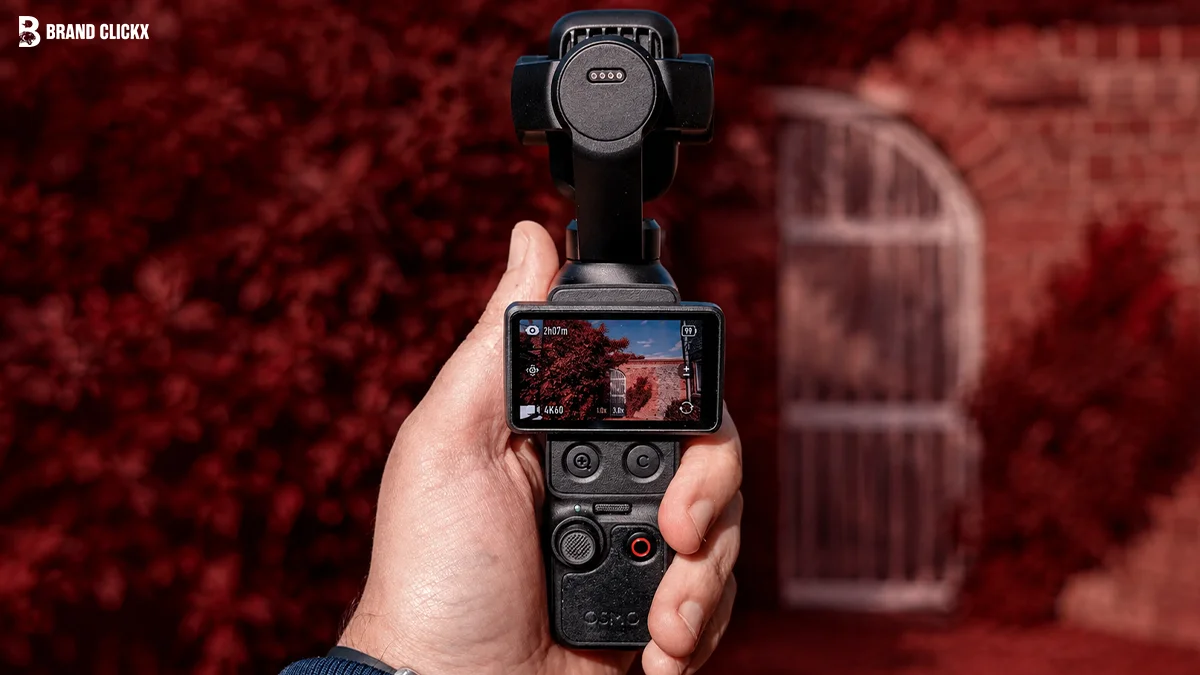
CineD’s lab test recorded 16 stops at SNR 2 from the DJI Osmo Pocket 4P’s wide camera the highest the outlet has ever measured. The caveats matter, and so does the fact that Americans can’t buy it.
Published: Friday, 31 July 2026 | BrandClickX News Desk
Attribution note: All measurements in this article come from CineD’s published lab test, conducted by Gunther Machu using the outlet’s IMATEST pipeline and Xyla21 chart. BrandClickX has not independently verified them. The full methodology and test footage are on CineD’s site.
Summary
CineD published lab measurements for the DJI Osmo Pocket 4P on 30 July 2026, recording 16 stops of dynamic range at SNR 2 and 17.2 stops at SNR 1 from the camera’s 1-inch wide-angle sensor the highest figures the outlet says it has ever measured. Exposure latitude reached nine stops. The camera costs around $704 and is not available in the United States.
What the Lab Test Found
The wide camera posted numbers CineD has not previously recorded from any camera.
| Measurement | Wide camera (1-inch LOFIC) | Telephoto (1/1.28-inch) |
| Dynamic range at SNR = 2 | 16 stops | 11.6 stops |
| Dynamic range at SNR = 1 | 17.2 stops | 12.9 stops |
| Exposure latitude | 9 stops | 8 stops |
| Rolling shutter | 11 ms | 9.4 ms |
| Profile | 10-bit D-Log 2, native ISO 1600 | 10-bit D-Log, native ISO 400 |
Lab tester Gunther Machu described the wide camera’s result as “the best result we ever saw since we test cameras.”
On exposure latitude, CineD reported that even its strongest studio light could not clip the red channel on the test subject’s forehead. Cross-referencing the Xyla21 waveforms showed more than a stop of headroom still available beyond four stops of overexposure meaning more than five stops over base without clipping.
Underexposed by four stops and pushed back, the image required no noise reduction at all.
The Comparison Everyone Is Quoting
Nine stops of exposure latitude was, until recently, the preserve of cameras costing vastly more.
CineD noted the figure was matched last year only by the Canon EOS R1 shooting RAW, the Sony a9 III, and the RED lineup.
On dynamic range, the 16-stop measurement puts the Pocket 4P above the ARRI ALEXA 35 in CineD’s testing a camera costing roughly a hundred times more.
But read the next line carefully. The ALEXA 35 still wins on exposure latitude at 12 stops, because it records 13-bit ARRIRAW. Dynamic range and latitude are different measurements, and the headline comparison only holds for one of them.
The Caveats That Qualify the Headline
Three things temper this, and none of them appear in the viral version.
- The 10-bit codec is the real ceiling. DJI’s marketing claims 17 stops. CineD measured 16 at the industry-standard SNR 2 threshold. More importantly, the 10-bit codec caps usable exposure latitude at around ten stops before posterisation appears. The sensor can capture more than the file can carry.
- Rolling shutter is fine, not exceptional. At 11 ms on the wide camera, CineD called it “solid rather than spectacular”, noting it has measured 7 ms and even 5 ms elsewhere. On a gimbal-stabilised camera this is largely academic. It also explains why the high frame rate modes switch to a different subsampling readout 4K at 200 fps would require roughly 5 ms.
- The two cameras are not equals. D-Log 2 records only on the wide lens, capped at 4K60. The telephoto uses standard D-Log and tops out around 14 stops. It allows three stops of overexposure before the red channel clips, roughly two stops less headroom than the wide. At six stops underexposed the image breaks apart, and CineD reported that DaVinci Resolve’s AI Ultra noise reduction could not recover it.
CineD’s practical note is more useful than any of the numbers: DJI does not overdo internal noise reduction, so footage from the two cameras intercuts better than expected.
What LOFIC Actually Is
The wide camera’s sensor uses a different architecture from the dual-gain designs common across the industry.
LOFIC lateral overflow integration capacitor handles highlight capture differently from the dual-gain approach most manufacturers use to extend dynamic range. That is why CineD flagged the camera as worth measuring rather than assuming the marketing numbers would collapse under testing.
DJI’s stated figures for the system are a theoretical maximum dynamic range of 19.4 EV and highlight latitude up to 11.3 EV. Theoretical maximums rarely survive contact with a test bench, which is what makes a measured 16 stops notable.
The company also says a simple hue transform adapts D-Log 2 footage into an ARRI ALEXA 35 LogC4 workflow.
Independently, ProVideo Coalition reported that a separate lab, Gamut, measured ten stops above middle grey the same figure it records from an ARRI ALEXA Mini LF. Different metric, different lab, same direction of travel.
The Rest of the Camera
| Specification | Detail |
| Design | Dual lens: 20mm equivalent wide, roughly 60mm equivalent telephoto at about f/1.8 with 3x optical zoom |
| Weight | 230 g (8.1 oz) |
| Wide camera frame rates | 4K up to 240 fps for 8x slow motion |
| Telephoto frame rates | 4K up to 200 fps |
| Standard modes | 4K and 1080p, 24–60 fps, plus vertical 3K and 1080p |
| D-Log 2 base ISO | 100 (D-Log uses 400) |
| Price | Around $704 |
One practical limitation worth knowing before purchase: D-Log 2 does not support Auto ISO, and uses a lower base ISO than standard D-Log. It is effectively a manual mode, and you will want ND filters to control shutter speed. Reviewers have described it as best suited to controlled situations rather than run-and-gun shooting.
Because of tone mapping, the new sensor improves dynamic range across all modes, including the non-Log Normal profile.
The Part That Isn’t About Optics
The Pocket 4P launched worldwide and skipped the United States.
This is the second consecutive Osmo Pocket release unavailable to American buyers, a consequence of the regulatory framework built around DJI’s drone business.
DroneXL made the argument pointedly: the Covered List and FCC scrutiny were presented publicly as a drone security measure. The Pocket 4P does not fly and captures no aerial imagery. The practical effect, in its assessment, has been to hand the US compact dual-lens segment to Insta360 also a Shenzhen company without requiring it to compete on sensor performance.
Whatever your view of the policy, the outcome for American buyers is that the camera at the top of the measurement charts is not one they can purchase.
A Note on Conflicting Reports
At least one aggregator published, after CineD’s test went live, that the lab test was still pending.
That article stated the measurements had been delayed by stray-light interference affecting the wide-angle lens inside the IMATEST rig a real technical issue CineD had previously described and that no publication date had been given.
CineD published the completed test hours earlier.
If you are researching this camera, check publication timestamps carefully. The lab data went from “pending” to “published” inside a single news cycle, and both versions are currently circulating.
Expert Analysis
The measurement is real and the significance is genuine, but the framing needs discipline.
What CineD recorded is that a 1-inch sensor in a 230-gram gimbal camera now captures a dynamic range that, on one specific metric at one specific threshold, exceeds a professional cinema camera. That is a legitimate landmark and it says something real about where sensor architecture has got to.
What it does not mean is that the Pocket 4P replaces an ALEXA 35. Latitude still favours the ARRI by three stops. The 10-bit codec limits what survives grading. There is no RAW, no interchangeable lens, no professional monitoring or audio infrastructure, and the telephoto sits in an entirely different performance class from the wide.
The most interesting implication is architectural. CineD’s own conclusion gestured at it: a 1-inch LOFIC sensor with internal RAW in a body with an interchangeable lens mount would be a genuinely disruptive product, in the way the original Blackmagic Pocket Cinema Camera was. Nobody has built that yet.
For buyers, the honest summary is that this is an exceptional camera for its size and price, its best performance is confined to one lens and one profile, and the numbers being shared online describe a laboratory result rather than a shooting experience.
Key Takeaways
- CineD measured 16 stops of dynamic range at SNR 2 from the wide camera, its highest ever result
- 17.2 stops at SNR 1; exposure latitude reached nine stops with no noise reduction required
- The telephoto measured 11.6 stops at SNR 2 and eight stops of latitude
- Rolling shutter was 11 ms on the wide camera and 9.4 ms on the telephoto
- The ARRI ALEXA 35 still leads on exposure latitude at 12 stops via 13-bit ARRIRAW
- The 10-bit codec caps usable latitude at around ten stops before posterisation
- D-Log 2 is wide-lens only, capped at 4K60, with no Auto ISO
- The camera costs around $704 and is not available in the United States
Frequently Asked Questions
How many stops of dynamic range does the Osmo Pocket 4P have?
CineD measured 16 stops at SNR 2 and 17.2 stops at SNR 1 from the 1-inch wide camera in D-Log 2. The telephoto measured 11.6 and 12.9 stops respectively.
Does it really beat the ARRI ALEXA 35?
On dynamic range in CineD’s testing, yes. On exposure latitude, no the ALEXA 35 leads at 12 stops thanks to 13-bit ARRIRAW, against nine stops for the Pocket 4P.
What is the rolling shutter measurement?
11 ms on the wide camera in D-Log 2, including at 60 fps, and 9.4 ms on the telephoto. CineD described this as solid rather than exceptional, noting it has measured 5 to 7 ms elsewhere.
What is a LOFIC sensor?
A sensor architecture using a lateral overflow integration capacitor to handle highlights, differing from the dual-gain designs most manufacturers use to extend dynamic range. It is what enables the Pocket 4P’s headline figures.
Can I use D-Log 2 on both lenses?
No. D-Log 2 records only on the wide-angle camera and is capped at 4K60. The telephoto uses standard 10-bit D-Log with a lower ceiling, around 14 stops.
Why is there no Auto ISO in D-Log 2?
DJI has not fully explained it. D-Log 2 also uses a lower base ISO of 100 versus 400 for standard D-Log, which makes it effectively a manual mode requiring ND filters for shutter control.
Is the Osmo Pocket 4P available in the US?
No. It launched globally but skipped the United States, the second consecutive Osmo Pocket release to do so, as a consequence of the regulatory framework built around DJI’s drone business.
Does the dynamic range help in normal shooting modes?
Yes. Because of tone mapping, the new sensor improves dynamic range across all profiles including the non-Log Normal mode, not only in D-Log 2.
Conclusion
The number everyone will repeat is that a $704 pocket camera out-measured a cinema camera costing a hundred times more. On one metric, in one lab, that is accurate.
The number worth remembering is ten the point at which the 10-bit codec, rather than the sensor, becomes the limiting factor. Everything above that exists in the measurement and not in the file.
That is not a criticism of the camera. It is the difference between a lab result and a workflow, and it is the distinction most of the coverage this week has skipped.