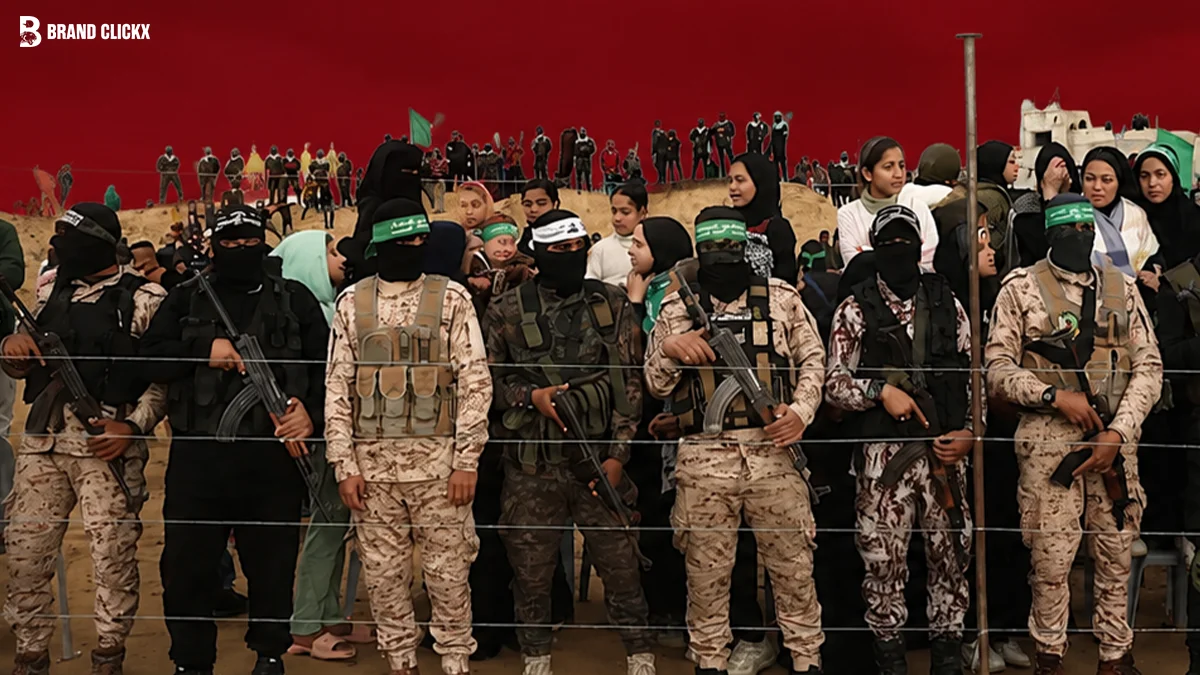
Trump called it a “monumental step.” The document says no arms go to Israel or any non-Palestinian body. Israel has reportedly demanded exactly that.
Published: Friday, 31 July 2026 | BrandClickX News Desk
⚠ DEVELOPING STORY. This account reflects reporting as of publication. Israel had not issued a public response, and Hamas had not confirmed the agreement publicly, at the time of writing. For live updates, follow Al Jazeera, Reuters or the Associated Press directly.
Summary
US President Donald Trump announced on Thursday 30 July 2026 that his Board of Peace had reached an agreement for what he called the complete disarmament of Hamas and all armed groups in Gaza. Under the document, weapons would be handed to a Palestinian National Committee inside Gaza not to Israel with a detailed roadmap due within 14 days. Israel has not publicly responded.
Key Takeaways
- Trump announced the agreement on Thursday 30 July 2026 via Truth Social
- Hamas accepted the final text through mediators, per US and Board of Peace officials
- Hamas had not publicly confirmed at the time of the announcement
- Weapons would go to a Palestinian National Committee inside Gaza
- The document rules out transferring arms to Israel or any non-Palestinian body
- Israel has reportedly demanded weapons be removed from Gaza entirely
- A detailed roadmap is due within 14 days, with extensions permitted
- The full process is estimated at seven to eight months
- Israel had not publicly responded at the time of writing
What Was Announced?
Trump said on Truth Social on Thursday evening that the Board of Peace had secured agreement on disarming Hamas and every other armed group in Gaza.
He described it as “a monumental step toward lasting PEACE and SECURITY.”
The Board of Peace is the international governing and oversight body established under Trump’s 20-point Gaza plan, unveiled in October 2025. Trump chairs it. It was created alongside the ceasefire declared that month.
US and Board of Peace officials told reporters that Hamas had communicated through mediators that it accepted the final text, including the clause covering the decommissioning of weapons.
A senior Hamas official confirmed acceptance to the BBC. But as of Thursday evening, Hamas had issued no public statement, and Israel had not commented publicly.
What the Agreement Actually Says
Al Jazeera obtained a copy of the document. Its terms are more specific and more conditional than the announcement suggested.
| Provision | Detail |
| Roadmap deadline | A precise disarmament plan must be prepared within 14 days |
| Extensions | Possible, subject to an international verification body and agreement of all parties |
| Who receives the weapons | A Palestinian National Committee, inside Gaza |
| Who does not | No weapons to Israel or any non-Palestinian body |
| Sequencing | Police weapons handed over first, then those of armed factions |
| Oversight | The National Committee runs inventory and storage; an international committee observes |
| Trigger | Process begins when the National Committee and International Stabilisation Force enter Gaza |
| Israeli withdrawal | Tied to disarmament progress, in phases |
Hamas would relinquish any role in governing Gaza. A new National Committee for the Administration of Gaza would take over civilian and security functions, positioned as an alternative to both Hamas and the Palestinian Authority.
A Board of Peace official told Axios the committee “will work for the people of Gaza.”
Axios reported the full process would require roughly seven to eight months of reciprocal steps, each independently verified.
The Contradiction at the Centre of It
The agreement says weapons remain in Gaza under Palestinian control. Israel has reportedly demanded they be removed from Gaza entirely.
This is the single most important thing to understand about Thursday’s announcement.
Israeli media reported that the agreement does not address Israel’s core concerns. According to a diplomatic source cited by the Jerusalem Post, Israel has demanded complete disarmament including the removal of weapons from Gaza and full demilitarisation of the territory as a precondition for any withdrawal.
The document does the opposite. It specifies that the National Committee will be the sole body holding weapons within Gaza, and explicitly rules out transferring them to Israel or any non-Palestinian entity.
Those two positions cannot both be satisfied by the same agreement.
The Sequencing Problem
Each side appears to believe the other moves first.
Ghazi Hamad, a member of Hamas’s negotiating delegation, told Al Jazeera the talks had been demanding: “These negotiations were difficult and hard.”
He then added the condition that matters. Hamas would not implement any part of the agreement if Israeli forces failed to meet their obligations. Disarmament, he said, depends on Israel’s withdrawal from Gaza and on progress in reconstruction.
Israel’s reported position is that withdrawal follows disarmament.
The agreement attempts to resolve this by phasing both arms handed over in stages, Israeli forces withdrawing in stages, each verified. Per Axios and Jerusalem Post reporting, the Israeli military would first pull back to the Yellow Line, the position it held after the October 2025 ceasefire, with any further withdrawal contingent on complete disarmament.
Israel would also reportedly halt targeted killings of Hamas members, except where facing an imminent threat.
Whether that phasing satisfies either party’s definition of “first” remains untested.
Where This Fits in the Wider Process
The October 2025 framework was split into two phases during talks last autumn.
Phase one the release of hostages and a ceasefire was implemented in October 2025.
Phase two decommissioning Hamas’s weapons and redeploying Israeli forces was deferred. That is what Thursday’s announcement addresses.
US officials described the new document as turning the 20-point plan into a working framework to be refined over the coming weeks, rather than a finished implementation schedule.
Trump thanked Egypt, Qatar and Turkey for their mediation. Officials said Jordan, Saudi Arabia, the United Arab Emirates and other regional states were consulted, describing implementation as a regional effort.
On the Palestinian Authority, officials said there is consultation and coordination but that the PA “needs to carry out reforms” before integration is considered.
The Ceasefire Has Not Been Quiet
More than 1,200 Palestinians have been killed in Israeli strikes since the ceasefire took effect in October 2025, according to Gaza health officials.
Strikes and militant attacks have both continued through the period. That context matters for assessing how much a signed framework changes conditions on the ground.
Timeline
| Date | Development |
| Oct 2025 | Trump unveils the 20-point Gaza plan |
| Oct 2025 | Ceasefire declared; Board of Peace established with Trump as chairman |
| Oct 2025 | Phase one implemented: hostage releases and ceasefire |
| Oct 2025 – Jul 2026 | Strikes continue; Gaza officials report over 1,200 killed |
| 30 Jul 2026 | Trump announces the disarmament agreement |
| Within 14 days | Detailed disarmament roadmap due |
| ~7–8 months | Estimated duration of the full verified process |
What the Sceptics Say
Doubt is coming from several directions, including from people who would like the deal to succeed.
Israeli officials remain deeply sceptical that Hamas will actually surrender its weapons, according to Axios.
Political scientist Rajan Menon told Newsweek he was “puzzled” by Trump’s claim, given the absence of confirmation from Hamas at the time of the announcement.
Newsweek and CNN both noted that Hamas had not publicly confirmed the agreement, even as officials briefed that acceptance had been communicated through mediators.
Practical questions also remain unanswered:
- How is disarmament verified across a territory with extensive tunnel infrastructure?
- What happens to factions that refuse, given the agreement covers “all other armed groups”?
- Who staffs and funds the International Stabilisation Force?
- What enforcement exists if either side judges the other in breach?
Expert Analysis
The gap between the announcement and the document is where the story sits.
What is genuinely new: Board of Peace officials say this is the first time Hamas and other Palestinian factions have agreed in writing to demilitarise Gaza and transfer both security and civilian responsibility to a technocratic body. If that holds, it is a significant shift from previous positions, and it would remove Hamas from governing the territory.
What is unresolved: the destination of the weapons. An agreement in which arms are consolidated under a Palestinian committee inside Gaza is a fundamentally different proposition from one in which they leave the territory. Israel has reportedly insisted on the latter and has not signed anything.
What the 14-day clause really means: this is a framework to produce a plan, not the plan itself. The detailed roadmap the part that specifies which weapons, on what schedule, verified by whom has yet to be written. Extensions are already permitted in the text.
The historical caution: phase one of this framework was implemented, and more than 1,200 people have still been killed since. Signature and implementation have not previously been the same thing here.
The most accurate reading of Thursday is that a difficult negotiation produced a document both mediators and Hamas can accept, and that the party whose forces are in Gaza has not yet said whether it accepts it too.
Frequently Asked Questions
What did Hamas actually agree to?
According to US and Board of Peace officials, Hamas accepted the final text of a framework including the disarmament clause, communicated through mediators. It would hand weapons to a Palestinian National Committee and relinquish any governing role in Gaza.
What is the Board of Peace?
An international governing and oversight body established under Trump’s 20-point Gaza plan in October 2025, chaired by Trump. It directs transitional administration, security arrangements and economic reconstruction in post-conflict Gaza.
Who would receive Hamas’s weapons?
A Palestinian National Committee operating inside Gaza. The document explicitly states no weapons may be handed to Israel or any non-Palestinian body, and that the committee would be the sole force holding arms in the territory.
Has Israel agreed to this?
Not publicly. Israel had issued no comment at the time of writing. Israeli media reported the agreement does not address Israeli concerns, and Israel has reportedly demanded weapons be removed from Gaza entirely.
How long will disarmament take?
Axios reported the process would require roughly seven to eight months of reciprocal, independently verified steps. A detailed roadmap must be prepared within 14 days, though extensions are permitted under the agreement.
What is the National Committee for the Administration of Gaza?
A proposed technocratic Palestinian body that would take over civilian and security functions in Gaza, positioned as an alternative to both Hamas and the Palestinian Authority. Hamas would have no governing role under the agreement.
Has the ceasefire been holding?
Only partially. Gaza health officials report more than 1,200 Palestinians killed in Israeli strikes since the ceasefire took effect in October 2025. Strikes and militant attacks have both continued through the period.
Who mediated the agreement?
Egypt, Qatar and Turkey, all thanked by Trump in his announcement. Officials said Jordan, Saudi Arabia, the United Arab Emirates and other regional states were also consulted on implementation.
Conclusion
A framework exists that Hamas has, through mediators, accepted. Officials say that is the first time Palestinian factions have committed in writing to demilitarising Gaza and stepping back from governing it.
What does not yet exist is a plan. The roadmap is due in fourteen days, and the agreement already allows for that deadline to slip.
What also does not exist is Israeli agreement. The document keeps the weapons in Gaza under Palestinian control. Israel has reportedly asked for them to leave. Until that is reconciled, Thursday’s announcement is a commitment between some of the parties, not all of them.