
A property owner once looked at a land document and noticed a phrase that appeared simple but carried legal importance: “the property abuts the highway.” Many people understand words like “near” or “next to,” but terms used in property records often require more precision.
That is where Abut Meaning becomes important. The word appears in real estate documents, legal descriptions, architecture, engineering reports, and everyday English writing.
In this guide, you will learn what abut means, how to use it correctly, how it differs from similar words like adjoin and adjacent, and why the term matters in property law and construction. You will also see practical examples that make the meaning easier to remember.
AI Overview
Abut means to touch, border, or share a direct boundary with something else. It is commonly used for properties, buildings, roads, and structures that meet at an edge without another space between them. The word is a verb and often appears in legal, real estate, and engineering contexts. Understanding abut helps you interpret property descriptions, construction terms, and formal English writing.
Key Takeaways
- Abut means two things directly touch or share a common boundary.
- The word is mainly used as a verb in property, legal, and construction contexts.
- Abutting properties share a physical boundary line without a gap between them.
- Abut is different from adjacent because adjacent objects may be close without touching.
- Abutting landowners may have legal responsibilities related to boundaries, fences, and access.
- A bridge abutment is a structural support that holds the bridge deck and surrounding soil.
- Common forms include abut, abutting, abutted, abutment, and abutter.
What Does Abut Mean?
Abut means to touch, border, or share a common boundary with something else. It describes two properties, structures, or objects that meet directly at an edge without any space between them. For example, “The backyard abuts the park” means the backyard directly touches the park boundary.
What Is the Meaning of Abut?
The word abut is a verb that means to be next to something while sharing a direct boundary or edge. When two physical things meet without any space separating them, they are said to abut each other.
The term is most commonly used for land, buildings, roads, and structures. For example, if your property line touches a public park boundary, your property abuts the park.
The key idea behind abut is direct contact.
A house located two streets away from another building does not abut it. A house that shares a property line with another house does.
What Does Abut Mean in Simple English?
In simple English, abut means “to touch along an edge” or “to be directly next to something.”
Think about two pieces of land placed side by side. The point where their boundaries meet is where they abut.
For example:
- “The garden abuts the neighbor’s property.”
- “The restaurant abuts the shopping center.”
- “The road abuts the residential area.”
Each example shows two things meeting at a boundary.
The word sounds more formal than everyday words like “touch” or “border,” which is why you often see it in legal documents, surveys, and professional writing.
Abut Definition, Pronunciation, and Word Origin
How Do You Pronounce Abut?
The word abut is pronounced as:
uh-BUT
The stress falls on the second syllable.
A common mistake is placing too much emphasis on the first part of the word. In professional conversations, especially around property or legal matters, correct pronunciation helps you sound confident and accurate.
Where Did the Word Abut Come From?
The history of abut goes back to medieval European languages.
The word originated from the Old French term abuter or aboter, meaning “to touch at one end” or “to join end-to-end.”
The word later entered Middle English around the 1400s and became commonly used by surveyors and legal writers to describe land boundaries.
Over time, its meaning developed from physically “ending against something” into the modern meaning of sharing a continuous boundary.
Is Abut a Verb? Understanding Its Grammar
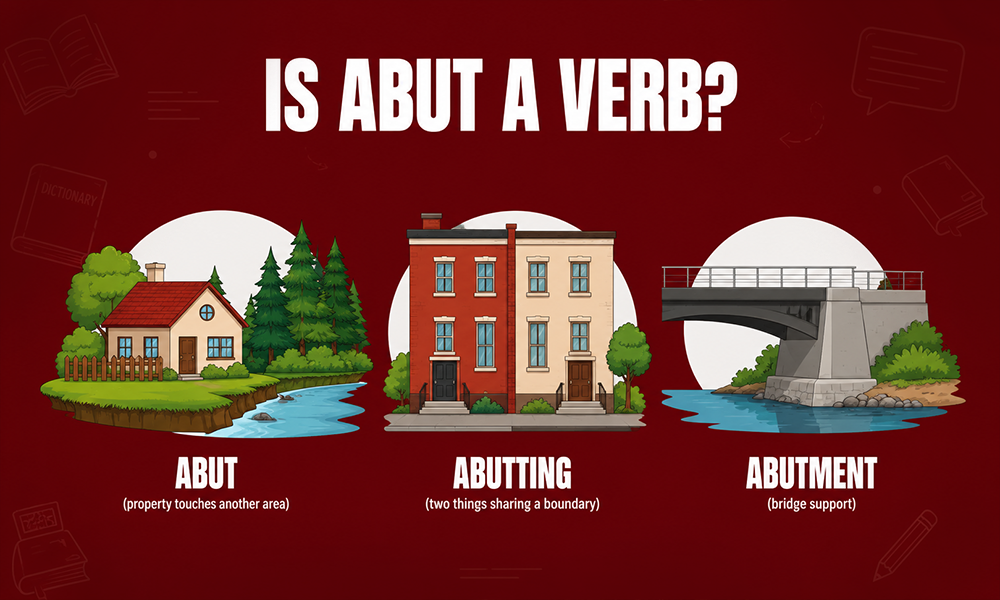
Yes, abut is a verb.
It describes an action or relationship where one object touches or borders another object.
Common forms include:
| Form | Example |
| Abut | The property abuts the river. |
| Abutting | The two abutting buildings share a wall. |
| Abutted | The old house abutted the farmland. |
| Abutment | The bridge requires a strong abutment. |
| Abutter | An abutter owns property next to another property. |
Abut can be used in different sentence structures.
Example:
“The backyard abuts the forest.”
Here, “backyard” is directly connected to “forest” through a shared boundary.
Examples of Abut in Sentences
Understanding examples is one of the easiest ways to remember the word.
Everyday Examples
- My backyard abuts a public park.
- The apartment building abuts a small garden.
- The restaurant abuts the main shopping area.
These examples show ordinary physical boundaries.
Property and Real Estate Examples
Real estate professionals frequently use abut when describing land relationships.
Examples:
- “The property abuts the highway.”
- “The farmland abuts the neighboring lot.”
- “The homeowner notified all abutting property owners.”
In these situations, abut has a precise meaning. It does not simply mean “near.” It means the properties directly meet at a boundary.
Professional Examples
Surveyors, lawyers, and planners use the word because property relationships must be described accurately.
A land report might state:
“The eastern side of the parcel abuts a public road.”
This tells the reader exactly how the property connects with surrounding areas.
Abut Meaning in Property Law
Property law is one of the most important areas where this word appears.
An abutting property is a parcel of land that shares a boundary line with another parcel, road, or public area.
An abutting landowner is a person or organization that owns property directly next to another property.
According to Cornell Law School’s Legal Information Institute, abutting landowners can have legal relationships involving issues such as property boundaries, easements, and responsibilities connected with nearby land.
Rights and Responsibilities of Abutting Landowners
When properties abut each other, owners may share responsibilities related to:
- Boundary fences
- Retaining walls
- Property access
- Drainage concerns
- Construction impacts
For example, if one owner builds a structure directly beside a boundary line, that construction may affect the neighboring abutting property.
This is why accurate surveys and legal descriptions matter.
Boundary Surveys and Abutting Properties
A surveyor determines whether properties truly abut by checking legal descriptions, measurements, and physical markers.
The process usually involves:
- Reviewing property deeds and boundary records.
- Measuring the land using professional surveying tools.
- Confirming where one property ends and another begins.
If two properties meet at the exact boundary line, they abut.
If one structure crosses that boundary, the situation changes from abutting to possible encroachment.
Unique Consideration: Abut Does Not Mean Ownership
A common misunderstanding is assuming that if something abuts another property, the owner controls both areas.
That is incorrect.
A property can abut a road, park, river, or neighboring land without owning that space.
For example:
A house may abut a public park, but the homeowner does not own the park.
The word only describes the physical relationship between boundaries.
Abut Meaning in Civil Engineering and Architecture
The word abut is not limited to property descriptions. Engineers and architects also use it when describing structures that meet, connect, or transfer forces at specific points.
One of the most common examples is a bridge abutment.
A bridge abutment is a strong structure built at the end of a bridge. It supports the bridge deck while also holding back the soil behind the bridge approach.
What Is a Bridge Abutment?
A bridge abutment performs two major functions:
- It transfers the weight of the bridge into the foundation.
- It prevents the surrounding soil from moving into the bridge area.
Civil engineers carefully design abutments because they must handle pressure, movement, and long-term structural loads.
The American Society of Civil Engineers (ASCE) provides engineering standards that guide safe structural design, including systems involving bridge supports and foundations.
Abutting Structures in Architecture
In architecture, buildings can abut when they meet along a shared boundary.
Common examples include:
- Townhouses sharing side walls
- Buildings constructed along urban blocks
- Structures built close to property boundaries
Dense cities often use abutting designs because they maximize available land.
Zero-lot-line developments are one example. These designs allow buildings to be placed directly near property boundaries, increasing usable space in areas where land is limited.
Research from the provided data indicates that zero-lot-line developments can improve land usage by approximately 20% to 30% in dense urban areas compared with traditional suburban setbacks.
Abut vs Adjoin vs Adjacent: What Is the Difference?
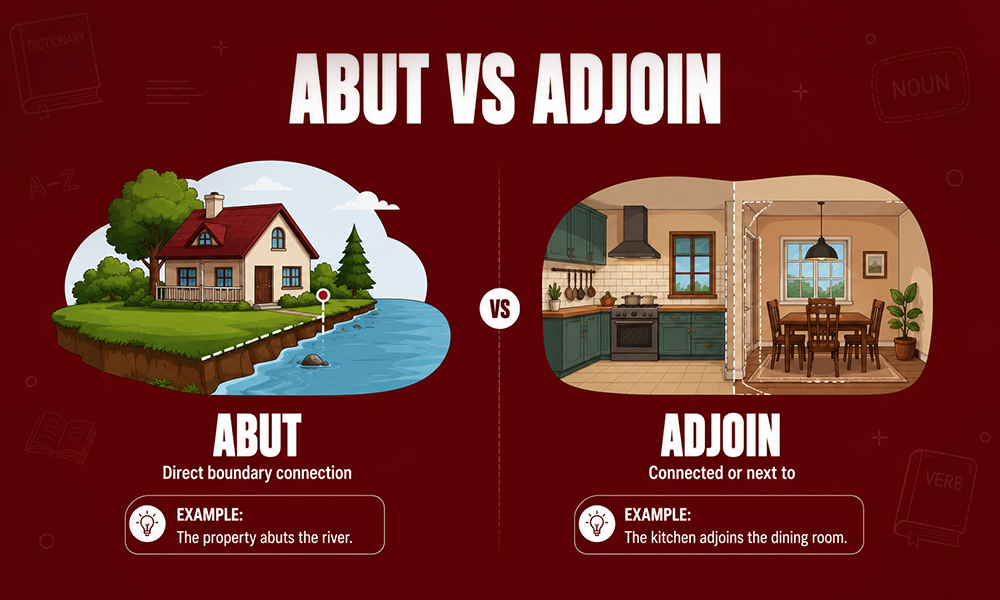
Many people confuse these three words because they all describe closeness or connection.
However, they do not always mean the same thing.
| Term | Meaning | Do They Touch? | Example |
| Abut | Share a direct boundary or edge | Yes | The backyard abuts the park. |
| Adjoin | Be next to or connected with something | Usually yes | The bedroom adjoins the bathroom. |
| Adjacent | Located nearby or close to something | Not always | The store is adjacent to the highway. |
Abut vs Adjoin
Abut focuses on a boundary relationship.
Example:
“The property abuts the river.”
This means the property directly reaches the river boundary.
Adjoin is broader and can describe things that are connected or next to each other.
Example:
“The kitchen adjoins the dining room.”
The rooms may share a wall or opening, but the word does not emphasize a legal boundary.
Abut vs Adjacent
This is the most common confusion.
Adjacent simply means nearby.
Two buildings can be adjacent because they are close, even if a road, sidewalk, or empty space separates them.
Abutting requires direct contact.
Example:
A house next to a park with no gap between them abuts the park.
A house across the street from a park is only adjacent to it.
Common Phrases Using Abut
The word appears in several common phrases, especially in formal writing.
What Does Abut On Mean?
“Abut on” means to share a boundary with something.
Example:
“The farmland abuts on the forest.”
This usage appears more often in formal or older writing styles.
In modern English, many writers simply use:
“The farmland abuts the forest.”
What Does Abut Onto Mean?
“Abut onto” describes something that directly meets another area.
Example:
“The property abuts onto the highway.”
However, “abut” without a preposition is often cleaner:
“The property abuts the highway.”
What Does Abut Against Mean?
“Abut against” means something touches or presses against another object.
Example:
“The wall abuts against the neighboring structure.”
This phrase is commonly used when describing physical contact between structures.
Common Mistakes When Using Abut
Although the word seems simple, people often use it incorrectly.
Mistake 1: Using Abut for Simple Distance
Incorrect:
“The school abuts five miles from the city.”
Correct:
“The school abuts the city boundary.”
Abut requires direct contact, not just closeness.
Mistake 2: Confusing Abut With Adjacent
Incorrect:
“The two properties are adjacent, so they definitely share a boundary.”
Correct:
“The two properties abut because they share the same boundary line.”
Adjacent does not always mean touching.
Mistake 3: Forgetting the Double T in Past Forms
The correct past tense is:
abutted
Not:
abuted
The same spelling pattern appears in:
- abutting
- abutter
Real-World Examples of Abutting Boundaries
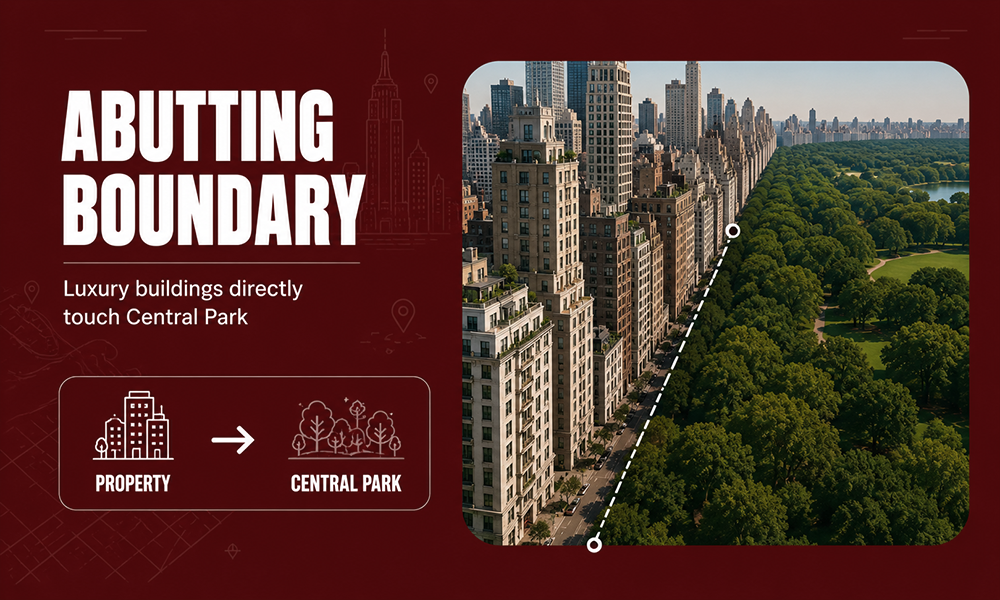
Example 1: Central Park Properties in New York City
Some luxury residential buildings near Central Park directly abut the park boundary.
This direct relationship contributes to their highly desirable location because residents receive unobstructed views and immediate access to the park.
Example 2: Properties Along Highways
Millions of private properties abut major roads and highways.
This relationship often creates practical concerns, including:
- Noise barriers
- Safety requirements
- Access planning
Example 3: Historic European Buildings
Dense historic neighborhoods often contain buildings that directly abut one another.
Older European cities developed compact layouts where structures shared walls and limited available space efficiently.
Statistics and Expert Insights About Abutting Relationships
Understanding abut goes beyond vocabulary because the term affects real-world decisions.
1. Urban Land Efficiency
Zero-lot-line developments can increase land usage by approximately 20% to 30% in dense urban areas compared with traditional setbacks.
(Source: Research data provided)
2. Property Boundary Conflicts
The provided research notes that approximately 90% of land boundary disputes in real estate litigation involve conflicts between abutting landowners.
(Source: Research data provided)
3. Bridge Infrastructure
Major arch and beam bridges require engineered abutment structures to transfer loads and resist pressure.
(Source: Research data provided)
4. Digital Design Applications
In UI/UX layouts, elements that “abut” each other are positioned with a 0px gap or padding.
(Source: Research data provided)
Who Should Understand the Meaning of Abut?
Useful For:
Property Owners
Understanding abut helps homeowners read:
- Property deeds
- Boundary descriptions
- Zoning notices
Real Estate Professionals
Agents and property managers use the term when describing:
- Land relationships
- Neighborhood boundaries
- Development restrictions
Students and English Learners
The word improves vocabulary because it appears in formal writing, legal documents, and professional communication.
Engineers and Architects
Professionals use the term when discussing:
- Structural connections
- Bridge supports
- Building layouts
Who Should Be Careful With This Term?
People Writing Casual English
In everyday conversation, words like “touch,” “border,” or “next to” are often easier to understand.
Using abut in a casual sentence may sound overly formal.
People Describing Property Without Verification
A property should not be called “abutting” another property without checking actual boundaries.
A small gap, road, or easement can change the meaning.
Practical Application: How to Use Abut Correctly
The easiest way to apply this word is to check one question:
Do the two things directly share a boundary?
If yes, abut may be the correct word.
Step 1: Identify the Objects
Find the two things being compared.
Examples:
- House and park
- Property and road
- Bridge and foundation
Step 2: Check Physical Contact
Ask:
- Is there a shared edge?
- Is there a boundary line?
- Is there no separating space?
If the answer is yes, the relationship is abutting.
Step 3: Choose the Correct Form
Use:
- Abut → present action
- Abutting → describing something currently connected
- Abutted → describing a past connection
- Abutment → structural support
- Abutter → neighboring owner
Step 4: Avoid Legal Assumptions
When using abut in property matters, confirm information through:
- Property surveys
- Deeds
- Local zoning records
A word describing a boundary can have serious legal meaning.
Why Abut Meaning Matters Today
The word remains important in 2026 because cities continue changing how land is used.
Recent zoning discussions around transit-oriented development use abutting property descriptions when planning new construction near transportation corridors.
Climate-related regulations also use the term when discussing areas that directly abut homes, wetlands, and environmentally sensitive locations.
Understanding the word helps you interpret decisions involving land, construction, and urban planning.
Conclusion: Understanding Abut Beyond a Dictionary Definition
The first time someone reads a property document containing the phrase “the land abuts the highway,” it can feel confusing. The meaning becomes much clearer once you understand that it describes a direct connection between two boundaries.
Throughout this guide, you learned that Abut Meaning is not just about being close to something. It specifically describes two things touching or sharing the same edge, whether they are properties, buildings, roads, or structures.
The word has practical importance in real estate, law, architecture, and engineering. Knowing the difference between abut, adjoin, and adjacent helps you understand professional documents more accurately.
A simple word can carry significant meaning when it affects property lines, construction decisions, or legal responsibilities. That is what makes understanding precise vocabulary so valuable.
Frequently Asked Questions About Abut Meaning
1. What does abut mean in simple terms?
Abut means to touch or share a boundary with something else. It describes two things that meet directly without a gap between them. For example, a backyard can abut a park.
2. What is an example of abut in a sentence?
An example is: “The house abuts the public road.” This means the house directly borders the road. Another example is: “The garden abuts the neighbor’s property.”
3. Is there a difference between abut and adjoin?
Yes. Abut focuses on sharing a direct boundary or edge. Adjoin is broader and can mean being next to or connected with something.
4. What does abutting landowner mean in law?
An abutting landowner is a person whose property directly shares a boundary with another property. These owners may have responsibilities related to fences, access, and property boundaries.
5. What is a bridge abutment?
A bridge abutment is a strong structure built at the end of a bridge. It supports the bridge deck and helps hold back the soil behind the bridge.
6. Can you build right up to an abutting property line?
Usually, local zoning rules control how close buildings can be built to property boundaries. Many areas require setbacks even when properties abut.
7. Does adjacent mean the same as abutting?
No. Adjacent means nearby, while abutting means directly touching or sharing a boundary. Two places can be adjacent without physically touching.
8. What is the past tense of abut?
The past tense of abut is abutted. The word keeps the double “t” when changing forms.
9. What are the noun forms of abut?
The main noun forms are abutment and abutter. An abutment is usually a structural support, while an abutter is a person who owns neighboring property.