You need free high-res images. You opened Unsplash. Same photos as last week. That girl with the MacBook. The desk with succulents on it. Cool.
This isn’t going to be another list ranking Unsplash, Pexels, and Pixabay in different orders.
What you’ll get below is 18 sites I actually keep bookmarked. Some are huge. Some are tiny. One of them is basically one Czech guy who photographs food on weekends and uploads it. They all give you free high-res images with licenses that won’t get a takedown letter sent to your client six months from now.
Heads up before we start: licenses get changed without warning. Everything here checked out in 2026. Still, glance at the license page before using anything for a paid job.
What “High-Res” Even Means Now
Reality check first.
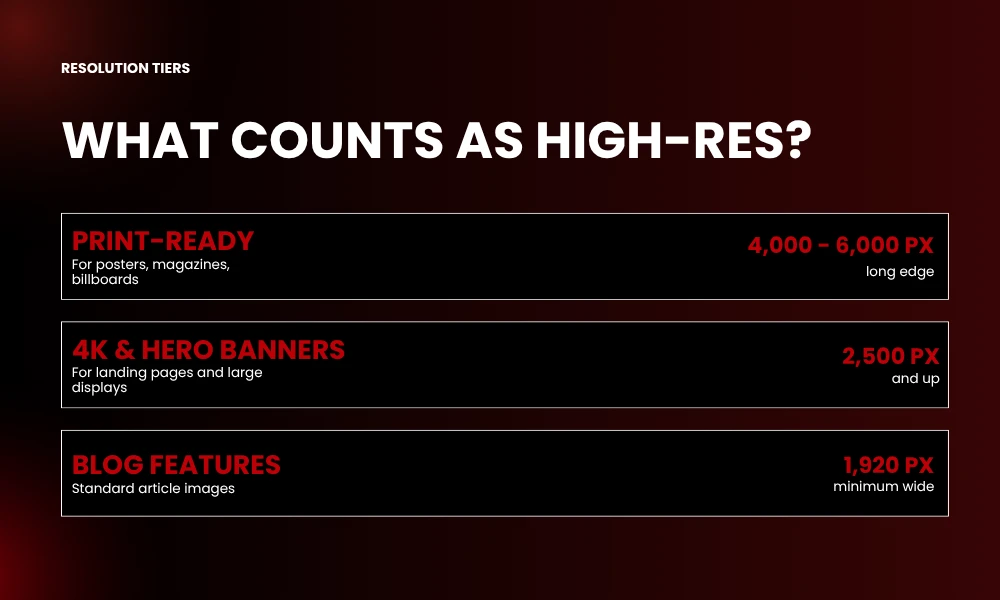
1200×800. That’s not high-resolution anymore. Not on a 2026 Retina display. Not on anything that needs to be sharp.
Here’s what actually works:
Blog feature image. Minimum 1920 pixels wide.
Hero banner or anything for 4K. Push 2500 and up.
Print. Pull the original full-size file. Usually somewhere between 4000 and 6000 pixels long edge.
Every site below gives you that. A few hand over weirdly massive originals (Unsplash regularly delivers 5000+ pixel shots). None of them pull the freemium trick where they show you a gorgeous preview and then deliver a 600px thumbnail at checkout.
1. Unsplash
Default. Like it or don’t.
Over 3 million photos now, contributed by photographers all over. The license lets you use anything commercially, modify it, skip attribution if you want. Credit the photographer when you can though. Takes ten seconds and it’s just decent behavior.
The problem with Unsplash being the default? Certain photos are toast. That “team brainstorming with sticky notes” shot has appeared on something like four million startup landing pages by now. Search a popular term, you’ll see the same five photos every blog in your niche is already running. Scroll deep, like page 3 or 4. The less-burned stuff is back there hiding.
License: Unsplash License (commercial OK, no attribution)
Best for: Blog heroes, presentations, general use
URL: unsplash.com
2. Pexels
Closest thing to a real Unsplash rival. Sometimes better.
Run this test. Type “team meeting” into both. Pexels gives you a more diverse pool of actual humans in spaces that look like real offices. Unsplash gives you a bunch of suspiciously good-looking 25-year-olds in glass-walled rooms with too much natural light.
Pexels also runs a stock video library that nobody talks about enough. 4K clips, free, no watermark, no signup hoop to jump through.
License: Pexels License (free, commercial OK)
Best for: Diverse people shots, free video, social
URL: pexels.com
3. Pixabay
Workhorse. Over 4 million photos plus vectors, illustrations, even music tracks. Interface is ugly. Doesn’t matter.
Reason I keep Pixabay around is the filtering. Orientation, pixel dimensions, dominant color, and (this one matters now) a toggle to turn off AI-generated images. A ton of “free image” sites have been silently flooded with AI slop in the past two years. Pixabay lets you skip it.
Quality across the library is all over the place though. Magazine-grade photos sitting next to someone’s blurry beach trip.
License: Pixabay Content License (commercial OK)
Best for: Vector art, color filtering, dodging AI images
URL: pixabay.com
4. Burst by Shopify
Shopify made it for their merchants. Everybody else gets to use it free.
Curation skews ecommerce hard. Product flat lays, workspace shots that actually look like 2026 instead of 2017, lifestyle scenes holding modern phones instead of iPhone 6s. If you write for SaaS brands, agencies, or any product-related niche, this should be your second tab.
Most images are CC0. Some are under Shopify’s own free license. Both let you do whatever commercially.
License: Mostly CC0, some Shopify license
Best for: Ecommerce, product blogs, SaaS
URL: burst.shopify.com
5. Kaboompics
Probably the best-kept secret on this list.
Karolina Grabowska runs the whole thing. One Polish designer-photographer. Every single one of the 8,000+ photos on the site is hers. The variety is wild but the consistency in light and tone is exactly what makes designers obsessive about it.
Here’s the trick nobody else does. Every photo on Kaboompics ships with an auto-generated color palette pulled from the image. Five hex codes right under the photo. Building a brand mood board? Pulling a palette from a photo for a client? Saves you hours.
License: Kaboompics License (commercial OK)
Best for: Interiors, lifestyle, food, brand colors
URL: kaboompics.com
6. Rawpixel
What I open when I need diverse people shots that don’t scream “diversity stock photo.”
Free library runs on CC0. You also get free mockups, photo composites, public domain vintage artwork, and some genuinely beautiful botanical illustrations from old archives. There’s a paid tier. Never needed it for client work.
You’ll need a free account to download in high-res. Five-second signup, nothing intrusive.
License: CC0 for free content
Best for: Diverse models, mockups, vintage illustrations
URL: rawpixel.com
7. Gratisography
Just weird.
Ryan McGuire has been running it for years. The style defies category. Surreal humans in costumes. A guy hugging a tree like the tree owes him rent. A woman wearing a pineapple as a hat. You’ll know it when you see it.
Library is small, maybe a few hundred photos. But for any post that needs a visual punchline, nothing else comes close. I’ve used Gratisography shots for blog posts on office culture, weird AI behavior, and one for a client titled “Why Your Marketing Reads Like a Robot Wrote It.” That one worked too well actually.
License: Gratisography Free License (commercial OK)
Best for: Humor pieces, quirky editorial, attention-grabbing
URL: gratisography.com
8. Reshot
Their pitch: “handpicked, non-stocky images.” They deliver on it.
Icons8 owns Reshot. Curation is tight. Real faces with real expressions, actual locations instead of weirdly perfect generic interiors, lighting that looks like someone walked outside instead of building a softbox setup.
Library isn’t huge. That’s literally the point. Every photo earned its spot.
License: Reshot Free License (commercial OK, no redistribution)
Best for: Editorial blogs, brand work, anti-stock visuals
URL: reshot.com
9. Picjumbo
Viktor Hanáček built Picjumbo in 2013 because paid stock sites kept rejecting his work for being “too creative.” Funny how that played out.
The free section delivers. Business shots, food, fashion, abstracts, technology. Nothing flashy. Reliable daily-use material. There’s a Premium tier with curated bundles and bigger originals but the free side handles most blog work.
License: Picjumbo License (personal and commercial)
Best for: Business blogs, abstract backgrounds, general stock
URL: picjumbo.com
10. StockSnap.io
Hundreds of new photos every week. Not every month. Every week.
That’s the main pitch and it actually holds. Library stays fresh in a way the older free sites just don’t. If you’re producing a lot of content, going back to StockSnap every couple weeks means you’re never digging through the same recycled photos.
Filters are simple, work fine. Trending, popular, most-downloaded. Everything’s CC0. No attribution. No account needed.
License: CC0 (Public Domain)
Best for: Weekly-refreshed content, high-volume work
URL: stocksnap.io
11. ISO Republic
Mix of free and premium. The free section alone is worth bookmarking.
Visual style trends modern and minimal. Lots of tech, urban shots, travel, and lifestyle. Their free B-roll video clips are honestly underrated.
Clean interface, no signup, downloads work first click.
License: ISO Republic License (commercial and personal)
Best for: Tech, travel, urban shots, modern minimal
URL: isorepublic.com
12. Life of Pix
Leeroy Creative Agency in Montreal runs this. New batch of photos every week donated by their photographer network, plus a “Photo of the Week” highlight.
What sets it apart is editorial sensibility. Life of Pix shots look like they came out of a print magazine. Strong composition, real moods, less Instagram-pretty, more “this could front a New York Times piece.”
License: Public domain
Best for: Editorial features, magazine-style blogs, travel
URL: lifeofpix.com
13. FoodiesFeed
You write about food. Stop reading. Go bookmark it.
Run by another Czech food photographer (apparently the Czech Republic has a whole industry I didn’t know about). The collection is laser-focused on food. Thousands of shots. Natural light that doesn’t look staged. Zero iStock-style fake-smiling chefs holding oversized plates of pasta. Just genuinely beautiful food.
For recipe sites, restaurant content, kitchen products, anything edible, this beats every general-purpose stock site put together.
License: FoodiesFeed License (commercial OK)
Best for: Food blogs, restaurants, recipe content
URL: foodiesfeed.com
14. New Old Stock
Now the niche stuff.
New Old Stock pulls vintage photos from public archives. Most of the collection sits between the 1900s and the 1970s. Everything described as “free of known copyright restrictions,” which is the legal way of saying go ahead.
This is the site you open when you’re writing about history, doing retro design, running a throwback marketing campaign, or working on anything that needs to feel like a different decade. Nothing modern can pull off the visual time-shift these photos do.
License: No known copyright restrictions
Best for: Vintage content, history, retro design
URL: nos.twnsnd.co
15. Negative Space
Name fits the aesthetic. Lots of breathing room in the photos. Clean compositions, neutral backgrounds, open space ready for text overlay.
New images added weekly. All CC0. Categories actually organized properly instead of the messy auto-tagged systems other free sites use. Homepage features curated collections that are actually curated.
Where Negative Space wins: hero banner work. If you need an image to lay text on top of without fighting visual chaos, this is the first place to check.
License: CC0 (Public Domain)
Best for: Text-overlay heroes, minimal aesthetics, backgrounds
URL: negativespace.co
16. Freerange Stock
One of the older free stock sites. Still chugging along. Different business model from the rest, which is interesting.
Photographers on Freerange earn ad revenue when their photos get downloaded. So contributors stay active and the library keeps growing. Trade-off is curation is looser than Reshot or Kaboompics. More volume, less polish.
You need a free account to download. Where Freerange genuinely shines is on oddly specific search terms. Try a niche query on Unsplash, you get tangentially-related results. Try the same on Freerange, you’ll often hit exactly what you were after.
License: Freerange Equalicense (commercial OK)
Best for: Niche searches, weird topic coverage
URL: freerangestock.com
17. SplitShire
Daniel Nanescu’s site. Italian photographer with a really distinct moody style.
Shots feel cinematic. Closer to film stills than stock photos. Urban scenes, portraits, food, abstracts with heavy color grading. If your blog has any editorial weight to it, SplitShire fits in a way the bigger libraries don’t.
Library isn’t large. For finding that one striking image to anchor a feature piece, it’s perfect.
License: SplitShire License (commercial OK)
Best for: Cinematic editorial, feature posts, moody work
URL: splitshire.com
18. Vecteezy
Mixed site, free plus premium. The free collection is huge and the search is genuinely the best one on this whole list.
Filters you don’t get anywhere else. Filter by exact hex code. Orientation. Photo style. Number of people in the frame. Even approximate age of the models. For brand work where the image has to match a palette, this filter alone is worth bookmarking.
Vecteezy also does something most free sites skip entirely. They manually review every submission and provide signed model and property releases for their free photos. That part matters more than most people realize. Lots of “free” stock sites quietly skip the legal paperwork, which leaves you exposed if you ever use those photos commercially. Vecteezy actually handles it.
License: Free Vecteezy License (attribution on free tier); Pro removes attribution
Best for: Brand colors, legally safe commercial use, vectors
URL: vecteezy.com
Quick Comparison Table
| Site | Best Use | Attribution? |
|---|---|---|
| Unsplash | Blog heroes | No |
| Pexels | Diverse people, video | No |
| Pixabay | Vectors, color filter | No |
| Burst | Ecommerce, SaaS | No |
| Kaboompics | Brand palettes | No |
| Rawpixel | Mockups, diverse shots | No |
| Gratisography | Quirky humor | No |
| Reshot | Editorial authenticity | No |
| Picjumbo | Daily stock | No |
| StockSnap | Weekly fresh | No |
| ISO Republic | Tech, travel | No |
| Life of Pix | Magazine feel | No |
| FoodiesFeed | Food only | No |
| New Old Stock | Vintage | No |
| Negative Space | Text overlay heroes | No |
| Freerange | Niche queries | Account |
| SplitShire | Cinematic | No |
| Vecteezy | Brand colors, legal safety | Yes (free) |
How to Actually Pick One Without Wasting an Hour
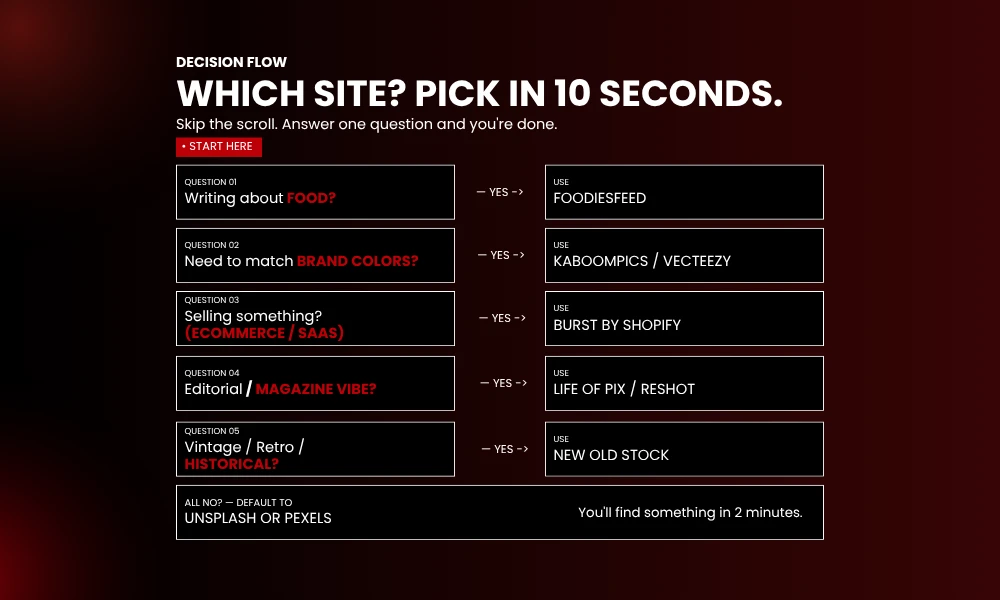
Eighteen options is too many. Shortcut version:
Need a blog header in five minutes? Unsplash or Pexels.
Ecommerce or SaaS content? Burst.
Brand work where colors have to match? Kaboompics for the palettes, Vecteezy for hex code filtering.
Food anything? FoodiesFeed. Don’t waste time checking the others first.
Editorial writing with print-magazine weight? Life of Pix or Reshot.
Vintage, retro, historical? New Old Stock.
Real human faces that don’t scream stock model? Reshot, Rawpixel, or Pexels deeper pages.
Stuff I’ve Picked Up the Hard Way
A handful of rules from too many years pulling images for client work.
Recheck the license the day you download. Sites silently update terms. What was CC0 last year could be “free with attribution” now and nobody emails you about it.
Skip page one of any popular search. That’s where the burned-out photos live. The ones already on a thousand competitor blogs.
Edit every image at least a little. Crop differently. Add a soft overlay. Bump the contrast or shift the hue. Takes thirty seconds. Makes your version of a common stock photo look distinctly yours.
Watch the backgrounds. Just because the photo is CC0 doesn’t mean the brand logo on the t-shirt or the famous painting on the wall behind the model is.
Track where every image came from. Sounds annoying. Saves you the day a client asks “wait, where did that photo come from again?”
Frequently Asked Questions
Are free high-res images actually free for commercial use?
Most of them, yes. Not every license is identical though. CC0 photos are fully free for any use including commercial, modification, and redistribution. Custom licenses like Unsplash’s or Kaboompics’ usually allow commercial use but might restrict things like redistributing the image itself or feeding it into AI training.
Do I need to credit the photographer?
Legally, no for most of these sites. CC0 has zero attribution requirement. Unsplash, Pexels, Pixabay, FoodiesFeed, and most others on this list don’t require it either.
Can I edit or modify free high-res images?
Yes for almost all of them. CC0 explicitly allows it. Most custom licenses do too. Where you’d run into limits is if you’re heavily modifying an image and reselling it as part of a product, like a template pack.
What’s the actual difference between CC0 and royalty-free?
CC0 is full public domain. Do almost anything with it. Royalty-free means you pay once (or grab it free) and reuse it as many times as you want without paying again, but there are usually still some restrictions like no resale, no use in offensive material, or print run limits.
Will Google penalize my blog for using stock photos?
No. Google doesn’t penalize stock photo use directly. What hurts your content is using the same overused images everyone in your niche is already using. Doesn’t tank rankings but it makes your blog look forgettable next to competitors.
Wrap Up
18 sites. Millions of free high-res images combined. No more excuses for boring or recycled visuals on your blog.
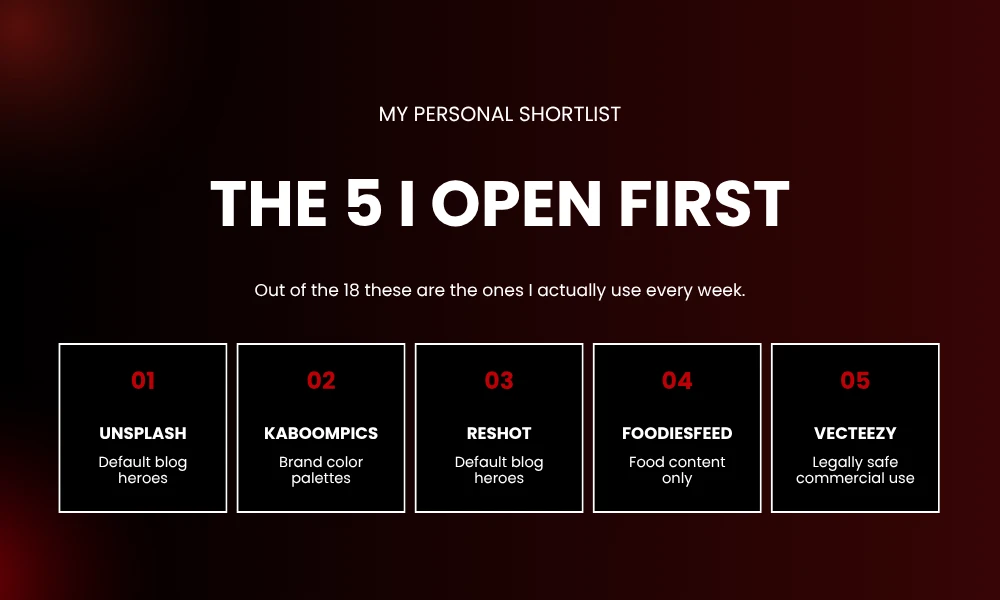
Realistically? Nobody uses all 18. You’ll find two or three that fit your style and keep rotating between them. For most of my work it’s Unsplash, Kaboompics, and Reshot. Then FoodiesFeed and New Old Stock get pulled in when a project needs them.
Bookmark this. Pick three sites you’ve never tried. Test them next time you need a blog image and see what you’ve been missing.Stay tuned with BrandClickX for further info.