
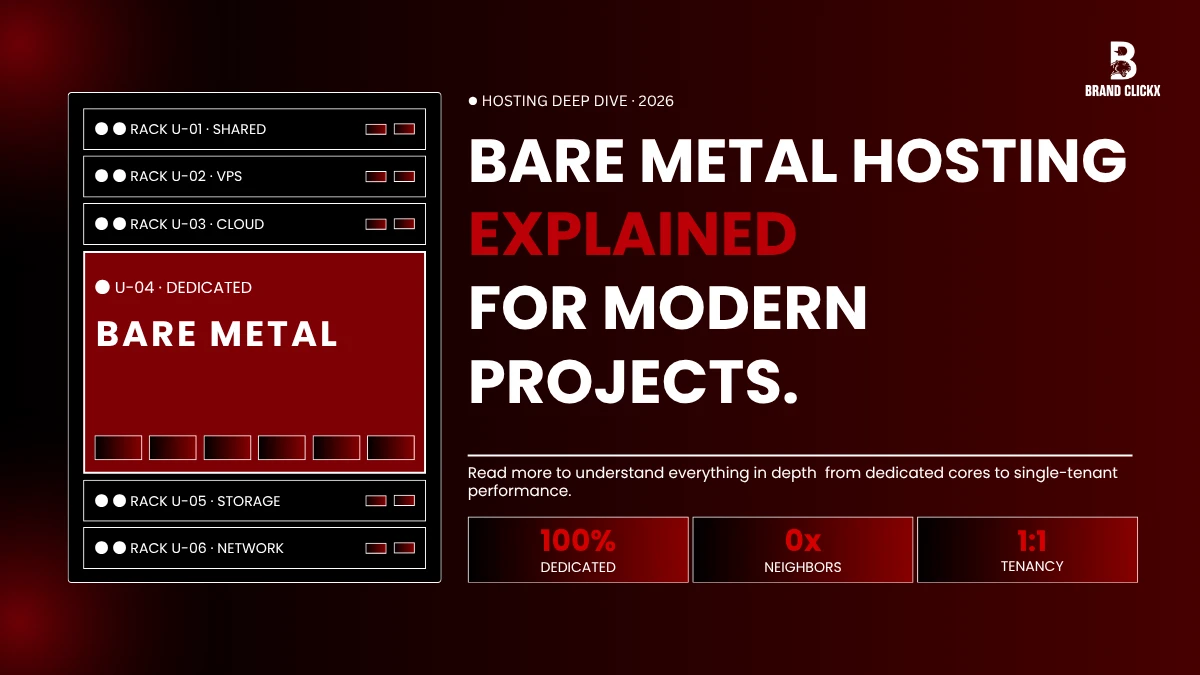
Many tech professionals, out of inertia, confuse dedicated server rental with the now-obsolete infrastructure management methods of the early 2010s. For modern projects focused on microservices, containerization, and high-load APIs, this type of hosting has become a tool for achieving maximum performance.
Bare metal is essentially a physical server completely devoid of the virtualization software layer (hypervisor). This means your application, operating system, and database have direct, unrestricted access to the hardware’s power.
The Architecture of Transparency
The main architectural difference between a physical server and a virtual instance is the transparency of command flow. In the cloud, every system call from your application must be intercepted, verified, and translated by the hypervisor into instructions for the physical processor. This process inevitably introduces latency and resource overhead. On dedicated hardware, data flows through direct hardware channels, radically changing the operating dynamics of the entire system.
Technical benefits of architectural transparency:
- Direct instruction execution. The processor executes your code’s instructions instantly, without emulating hardware interrupts;
- Zero overhead. Saving up to 10% of CPU and RAM resources, which in the cloud are spent on maintaining the virtual environment itself;
- Predictable memory topology. Direct communication between processor cores and RAM banks eliminates delays due to virtual address mapping;
- Maximum cache efficiency. The entire processor cache (L1/L2/L3) is used exclusively by your processes, accelerating complex calculations;
- No software jitter. Eliminates micro-fluctuations in response time that are inevitable when context switching between virtual machines.
Bare Metal and Containers
Modern development is unthinkable without Docker and Kubernetes. However, running containers inside a virtual machine is essentially “virtualization within a virtualization”. This approach creates double the overhead of the network stack and disk operations. Using physical servers as nodes for your clusters allows containers to run with the efficiency of a native OS process.
The synergy of physical hardware with a modern stack:
- Bare-metal containers. Minimal latency between pods thanks to direct access to the host network interface;
- Efficient orchestration. A single high-performance server can achieve the same level of orchestration as dozens of smaller cloud nodes, thus providing a more streamlined approach to managing Kubernetes clusters;
- Resource forwarding (SR-IOV). The ability to allocate physical network queues directly to specific containers for extreme throughput;
- Image build acceleration. CI/CD processes on physical hardware are faster due to the absence of disk limits on cloud platforms;
- Simplification of network topology. The absence of unnecessary layers of packet encapsulation reduces the load on the central processor under high traffic.
Provisioning and Automation
There’s a myth that physical servers are slow and require manual labor. Today, such solutions are fully integrated into the Infrastructure as Code (IaC) paradigm. You can manage a fleet of physical machines as easily and automatically as virtual instances, using familiar automation tools.
Aspects of modern automation:
- API management and IPMI/Redfish. Servers can be rebooted and BIOS settings altered remotely using APIs without needing physical access to the server;
- Environment standardization. By creating standard “golden images” of systems, multiple identical configurations can be quickly deployed;
- Integration with Terraform and Ansible. To document physical infrastructure as code, you can maintain a record of different versions of your environments in addition to providing their fast recovery;
- Software-based networking (SDN). The ability to combine physical servers into isolated private networks with a single click in the control panel;
- Hardware-level monitoring. Receiving telemetry on the status of disks, fans, and temperature conditions through standard monitoring protocols.
Performance Economics
When you conduct a cost analysis, you can make a mistake by comparing instance prices with physical cores. For projects with a constant baseline workload, cloud elasticity can be an unjustifiably expensive perk.
Bare metal cost-effectiveness details:
- No hidden fees. Fixed rental price, independent of the amount of data transferred or API requests;
- Reduced TCO. Drastically reduces the cost of infrastructure ownership with long-term planning;
- Efficient resource utilization. You pay for real hardware that works for you 24/7, not for “elasticity” that sits idle most of the time;
- Budget predictability. No month-end surprises due to sudden traffic spikes or background tasks;
- High ROI for demanding workloads. Maximum return on investment when working with video rendering, big data, or complex databases.
Why Modern Tech Leads Choose Namecheap for Bare Metal Deployments
Choosing a platform for hosting physical infrastructure is a matter of trusting the quality of the equipment and the provider’s expertise. Namecheap offers enterprise-class servers designed for seamless integration into the most complex modern development pipelines.
Namecheap’s advantages for modern projects:
- Only the latest hardware. Using the latest generations of Intel Xeon and AMD EPYC processors with support for the latest security and acceleration technologies;
- High-speed storage. Servers are equipped with enterprise-class NVMe drives for instant application response;
- Global connectivity. Direct connections to the largest Internet exchange points ensure minimal latency worldwide;
- DevOps-grade support. Their specialists understand the technical requirements of modern engineers and speak their language.
Conclusion
Physical servers today are not a step back to their roots, but a conscious choice in favor of quality, control, and maximum return on every line of your code. When your project grows beyond the sandbox stage, it requires an environment capable of handling real-world traffic and computational complexity. Bare metal hardware gives you the confidence you can’t achieve in shared cloud environments.
Take the step toward professionalism today. Stop hiding your product’s potential behind virtualization layers that only consume resources and introduce latency. Entrust your most ambitious ideas to Namecheap’s experts to build the future of your project on a truly solid, fast, and predictable foundation.