
Customer segmentation can produce a beautiful presentation and leave the business unchanged.
The groups have names. Each has a color, a portrait and a description. One values convenience, another seeks quality and a third supposedly loves discovery. Then the team tries to use the work—and nobody can explain how to identify the groups in practice or what should happen differently for each.
The problem is rarely a shortage of labels.
Customer segmentation groups customers by defined characteristics relevant to a business decision. Its usefulness depends on whether the distinctions are supported by evidence, identifiable when needed and capable of informing a worthwhile action.
A group does not become commercially meaningful because a statistical model or workshop gave it a name.
Key Takeaways
- Begin with the decision the segmentation should support.
- Distinguish a market segment from a CRM tag, cohort or persona.
- Check whether the necessary information exists when the business must act.
- Do not assume people with similar demographics have identical needs.
- Test the effect of the proposed action, rather than relying on a segment’s existing response rate.
- Use customer understanding without automatically restricting the brand to its current heaviest buyers.
What Is Customer Segmentation Supposed to Change?
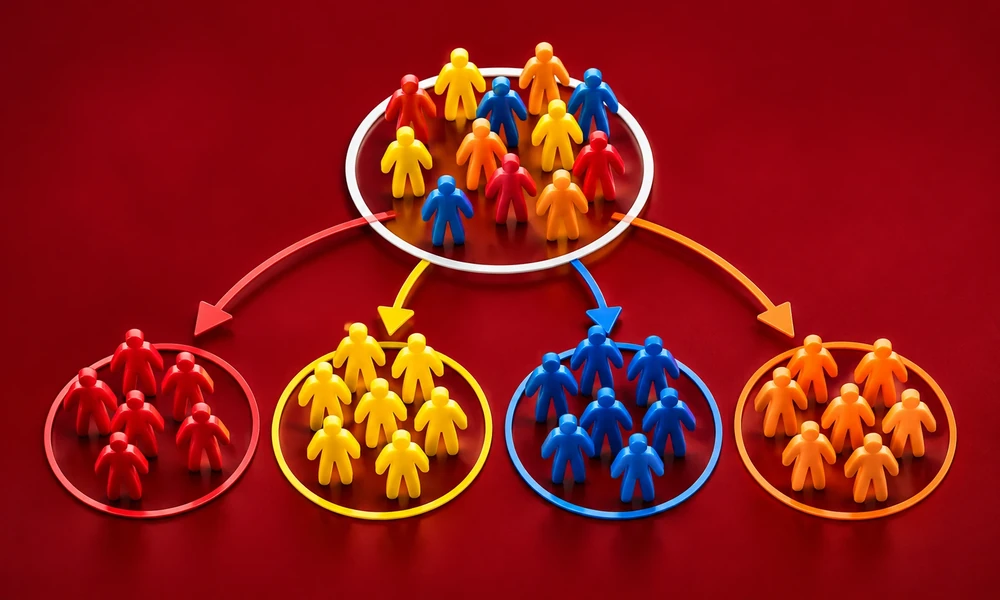
It might help a company design onboarding, investigate unmet needs, structure a service package or choose how to support customers at different stages.
Those are different jobs. A grouping useful for customer service may be irrelevant to media planning. A transaction-based segment may help manage existing accounts while saying little about prospective buyers the business has not reached.
Write the intended decision first, followed by the action the team might take. Then identify the information needed to distinguish relevant customers.
This creates a useful constraint: if every proposed group receives the same offer, process and communication for the decision under review, ask whether the additional segmentation changes anything worthwhile.
The broader brand positioning strategy can remain coherent while the business adapts particular tasks or services to different needs.
How Is a Segment Different From a Persona or Cohort?
A segment defines a group using specified rules or an analytical method. A persona communicates an evidence-based picture of users and their circumstances. A cohort usually groups people by a shared event or period, such as customers acquired in the same month.
A CRM tag might record a status, preference or action. It can be used in a segmentation rule without representing a complete segmentation strategy.
For example, “purchased in October” defines a time-based cohort. It does not automatically explain motivations. A persona called “Practical Priya” does not establish how many people share the described needs or how to identify them.
Government Digital Service guidance emphasizes understanding user needs through research rather than assumptions. That discipline matters when profiles begin to include personality details that make them memorable but contribute little to a real decision.
Use the format that helps people understand the evidence. Avoid adding fictional certainty to make the presentation feel complete.
Which Customer Segmentation Approaches Can Be Useful?
Choose the information according to the decision, rather than treating one approach as universally superior.
| Approach | Possible basis | Decision it might support | Limitation to investigate |
| Demographic | Age range, household structure or other relevant characteristics | Investigating access, life-stage needs or communication requirements | Similar profiles can conceal different priorities |
| Geographic | Location, service area or local conditions | Delivery, availability or market operations | Location may not explain why people choose |
| Firmographic | Organization size, industry or operating structure | B2B eligibility, implementation or account support | Companies with similar profiles may have different workflows |
| Behavioral | Observed purchases, usage or interactions | Onboarding, engagement or service processes | Past behavior can change and may reflect access or exposure |
| Needs-based | Tasks, desired outcomes or constraints identified through research | Product and service design | Needs may overlap or be difficult to identify operationally |
| Attitudinal | Reported beliefs, preferences or priorities | Investigating perceptions and message relevance | Reported attitudes do not necessarily predict behavior |
| Lifecycle | Defined stages in a customer relationship | Different information or assistance at each stage | Stages need clear definitions and can be mistaken for fixed traits |
Combining variables can improve usefulness, but also increases complexity. A detailed grouping is not automatically a better one.
Qualtrics’ segmentation guidance emphasizes practical criteria such as measurement and actionability, and cautions against groups becoming too small or rigid. Treat those criteria as questions requiring evidence in your own business.
How Do You Build Segments Around a Real Decision?

Start with an uncertainty and gather evidence appropriate to it.
Suppose a fictional software company wants to improve onboarding. Its existing records divide customers by organization size. Yet implementation may depend more directly on whether the customer is migrating historical data, integrating with another system or starting from scratch.
Those are hypotheses to investigate. Research could show that company size still matters, that several conditions interact or that one process improvement helps most customers.
Describe the distinction before naming the group
Write the observable or reported characteristics first. Avoid beginning with a catchy label and then selecting evidence that fits it.
For an onboarding group, specify the relevant conditions, how they are established and when they are reviewed. “Complex customer” leaves too much interpretation to the employee applying the label.
Keep overlapping needs visible
A customer may need both data migration and accessibility support. Forcing that person into a single exclusive category could hide a necessary service.
Some decisions work better with several independent flags than with a partition that places everyone in exactly one segment. Choose according to the task, and explain the structure.
A useful value proposition should reflect the value the offer can deliver, rather than becoming a collection of incompatible promises assigned to different labels.
Can You Identify the Segment When You Need It?
This is a practical test that presentations often overlook.
A research survey may classify respondents using detailed answers. A sales team might have only a short inquiry form. A website may have no reliable way to infer those answers at all.
Document which information will be available at the decision point and how classification will work. If the necessary evidence is missing, leave the status unknown or ask an appropriate question. Do not silently substitute a convenient proxy.
Watch for circular rules
A segment called “customers likely to buy” is not useful if membership is assigned only after the purchase. Likewise, judging a prediction using information that became available after the predicted event makes performance look better than an operational system could achieve.
Use data available at the time the business would act. Keep the observation window and decision date explicit.
The same principle applies to apparently descriptive analysis: someone who becomes a frequent buyer later should not automatically be treated as though that status was known at acquisition.
How Should You Validate a Segmentation?
Test both the grouping and the action it is meant to support.
A statistical method can identify patterns in a dataset. The business still needs to know whether those patterns are stable enough, understandable enough and relevant to a decision.
Inspect missing information, inconsistent definitions and sensitivity to reasonable analytical choices. Where appropriate, assess the rules on later or separate data. Explain how new customers will be assigned and how uncertain cases are handled.
Then evaluate the proposed change: different onboarding, a package, a message or a promotion. A segment’s existing performance does not establish that the change helps it.
Why is response rate different from incremental value?
Consider an invented experiment with two customer groups. Within each group, assume comparable eligible customers are randomly assigned to an offer or a control condition, with 1,000 customers in each arm.
In Group A, 200 control customers purchase, compared with 240 receiving the offer. The rates are 20% and 24%: a four-percentage-point observed difference.
In Group B, 50 control customers purchase, compared with 110 receiving the offer. The rates are 5% and 11%: a six-percentage-point observed difference.
Group A has the higher purchase rate among offer recipients. Group B has the larger observed increase relative to its own control.
These fictional figures do not establish a statistically reliable result or a profitable intervention. They show that ranking groups by response rate can answer a different question from ranking them by the apparent effect of the offer.
Include the economics of the intervention
A discount affects purchases that would have happened without it as well as any additional purchases it generates. Compare contribution under the treatment and control conditions, including relevant offer and delivery costs.
Do not assume a group with high revenue or frequent purchasing should receive more discounts. The business needs evidence of the action’s effect.
This also matters when evaluating brand pricing power. A group’s willingness to buy at one price and the effect of changing that price are related but distinct questions.
Does Segmentation Mean You Should Narrow All Marketing?

No. Understanding differences in needs does not automatically justify excluding everyone outside a preferred profile.
Ehrenberg-Bass commentary distinguishes different purposes for targeting and cautions against focusing only on likely or heavy buyers at the expense of broader reach. That perspective raises an important question: does the proposed decision help the brand serve or reach more relevant buyers, or merely concentrate attention on people it already knows well?
The answer depends on the business, category and constraints. A specialist service still has genuine limits on who it can serve. Those limits should be grounded in the offer and evidence, not assumed from a colorful persona.
Separate service adaptation from market exclusion
A company can adapt onboarding to a customer’s task without making that customer group its entire addressable market.
Similarly, a business might investigate an underserved use case while maintaining a broad, understandable proposition. A single segmentation model does not need to govern every product, advertising and service decision.
Keep the purpose attached to the rules so a useful operational tool does not become an unsupported growth restriction.
When Do Segments Become Misleading?
One warning sign is when labels are treated as permanent identities.
The same customer may buy differently for a gift, an urgent replacement or a planned purchase. A business customer’s requirements can change after expansion, a system migration or a staffing change.
Review how conditions change and whether membership should update. Distinguish a genuine change in behavior from a change in measurement or classification.
Avoid treating averages as individual instructions
A group-level pattern does not describe every member. Preserve routes for customers to express their actual needs and correct an inappropriate classification.
Be particularly cautious about inferring preferences, affordability or service requirements from demographic proxies. Collect relevant information where appropriate and examine who the rules might overlook.
Count the cost of maintaining the system
More segments can mean more versions, rules, content, reporting and quality checks. Benefits must justify that work.
If two groups lead to the same decision under the conditions you care about, consider whether combining them would be more useful. If one group contains materially different service needs, investigate whether a simpler set of task-based flags would work better.
What Should a Useful Segment Record Include?
Document the purpose, membership rule, data source and the moment at which the rule is applied. Include unknown cases, overlap, review triggers and the limitations of the available evidence.
Record the action proposed for the group and how its effect will be evaluated. Name an owner who can update the rules and address misclassification.
A good record should let another employee explain why a customer belongs in the group and what the business is justified in doing differently. If that requires the original analyst to interpret every case, the segmentation is not yet ready for routine use.
What Is a Practical Customer Segmentation Checklist?
Before adopting the groups, ask:
- Which decision will change because of this segmentation?
- Are the distinctions based on evidence rather than attractive labels?
- Do the variables describe relevant needs, behavior or conditions?
- Can membership be established when the action must occur?
- Are overlapping needs and unknown cases handled explicitly?
- Has validation avoided information available only after the outcome?
- Is the proposed action tested separately from baseline group performance?
- Are contribution, customer outcomes and implementation costs considered?
- Does the model preserve opportunities to reach relevant new buyers?
- Are ownership, correction routes and review triggers clear?
A useful segment earns its place through a better decision. When the group becomes harder to explain than the action it supports, simplify the system and return to the underlying customer need.
Frequently Asked Questions
How many customer segments should a business have?
There is no universal number. Use enough distinction to support the decision and justify the cost of implementation. More groups do not necessarily produce more useful understanding.
Is demographic segmentation ineffective?
Not inherently. Demographics can be relevant to access, life stage or other decisions. The limitation is assuming they explain needs or behavior without evidence.
Can customers belong to several segments?
Yes, depending on the design. Some models use exclusive groups; others use overlapping needs or attributes. Define the rules and avoid forcing exclusivity where it hides important information.
Does a cluster analysis prove the segments are useful?
No. It identifies a grouping under the selected data and method. Validate the patterns and test whether acting on them improves the intended decision or outcome.