I’ve seen this happen more than once: a team builds an AI feature, the first results look promising, and then someone says, “Maybe we should fine-tune the model.”
Sometimes that is exactly the right move. But quite often, the real problem is much simpler. The prompt is weak, the model is missing company information, or nobody has properly tested where the failures are coming from.
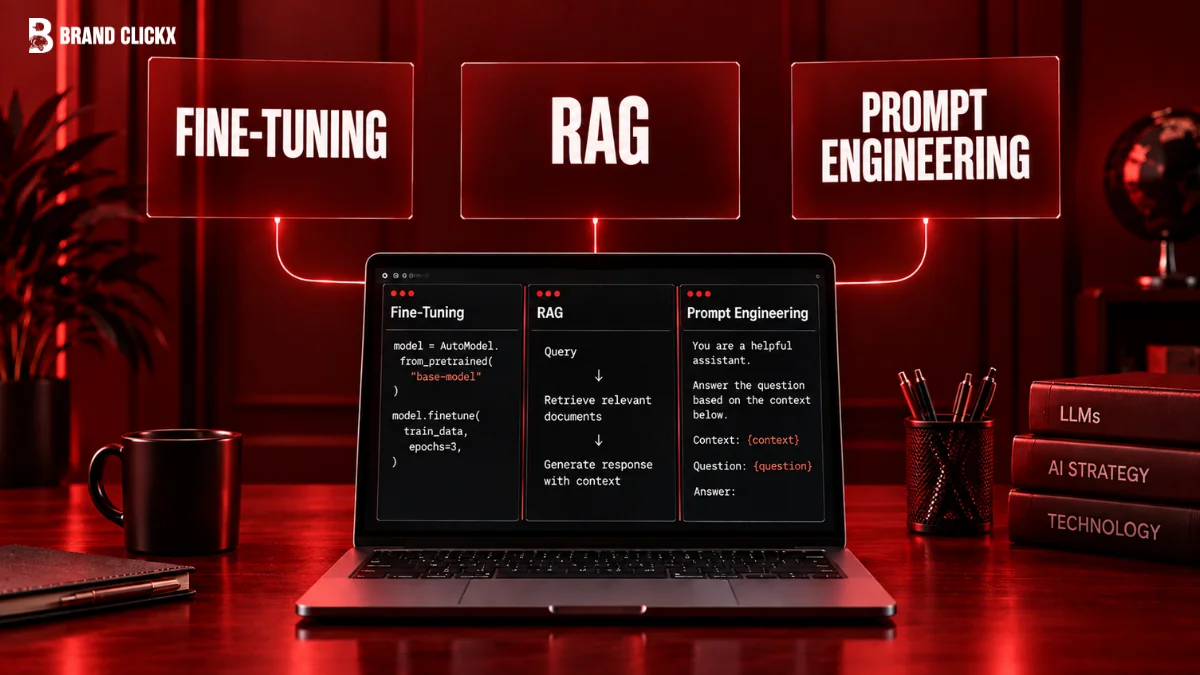
That is why fine-tuning vs. RAG vs. prompt engineering is not really a question of picking one winner. These three methods solve different problems. Prompt engineering changes the instructions you give the model. RAG brings outside or private information into the request. Fine-tuning changes the model’s learned behavior.
The mistake is using the expensive option before understanding the problem.
AI Overview: Fine-Tuning vs. RAG vs. Prompt Engineering
Start with prompt engineering when the model already has the knowledge you need but needs better instructions, examples, formatting, or guardrails.
Use RAG (Retrieval-Augmented Generation) when the model needs information it does not have, especially private, changing, or citation-required information.
Use fine-tuning when the model needs to behave consistently in a specific way and prompting alone is not enough. In many real applications, the best solution combines all three rather than choosing only one.
Key Takeaways
- Prompt engineering comes first because it is the quickest and simplest thing to test.
- RAG is mainly for knowledge, such as company documents, policies, product information, and changing data.
- Fine-tuning is mainly for behavior, such as consistent tone, formatting, classification, or a narrow task.
- Fine-tuning is usually a poor way to keep changing facts inside a model.
- RAG does not automatically solve hallucinations. Bad retrieval can still produce bad answers.
- LoRA and other parameter-efficient methods have made fine-tuning more practical, but you still need good training data and proper evaluation.
- A mature AI application may use prompting + RAG + fine-tuning together, with each layer doing a different job.
The 40-Second Answer: Which One Should You Choose?
Here is the simple rule I use:
If the model knows the answer but gives it in the wrong way, improve the prompt.
If the model does not have the information, use RAG.
If the model has the information and understands the task, but still cannot perform it consistently at the required scale, consider fine-tuning.
This sounds simple, but it prevents one of the most expensive mistakes in AI development: training a model when what you really needed was better context.
Recent 2026 decision guides are reaching a very similar conclusion. The recommended sequence is generally prompt first, add retrieval when knowledge is the problem, and fine-tune the remaining behavioral gap when there is evidence that prompting and retrieval are not enough.
And there is another thing worth understanding before you spend money on any of them: RAG and fine-tuning are not replacements for prompts.
Even a fine-tuned model still receives instructions. A RAG system still needs a prompt to tell the model what to do with the retrieved information. In production, these approaches are better thought of as layers than as competing technologies.
Fine-Tuning vs. RAG vs. Prompt Engineering: What Actually Changes?
The easiest way to understand these three methods is to stop thinking about them as three versions of the same thing.
They work at different levels.
Prompt engineering changes the instructions. RAG changes the information available to the model. Fine-tuning changes the model’s learned behavior.
That one distinction clears up most of the confusion.
Prompt Engineering: Change the Instructions
A prompt tells the model what you want it to do.
You can give it a role, rules, examples, output formats, constraints, or even tell it what to avoid.
For example, imagine you have an AI assistant writing product descriptions.
A weak prompt might say:
“Write a description for this product.”
A better prompt could tell the model who the audience is, how long the description should be, which details to include, what tone to use, and what format to return.
Nothing about the model itself has been retrained. You have simply given it better instructions.
This is why prompting should normally be your first test. It is fast to change, easy to compare, and doesn’t require a new training pipeline.
There is also a bigger lesson here. Prompt engineering is not just about finding a clever sentence. Modern prompting increasingly involves examples, structured outputs, context selection, tool instructions, and testing different prompt versions.
Recent research is even looking at prompt robustness as a serious engineering problem, because changing the wording of a prompt can still produce large changes in model performance.
RAG: Give the Model the Information It Needs
Now imagine your customer asks:
“What is your refund policy for an order delivered more than 30 days ago?”
Your model may be very good at language, but that doesn’t mean it knows your company’s current refund policy.
You could put the entire policy into the prompt every time. That works for a small experiment, but it becomes messy very quickly.
RAG gives you another option.
The system searches your approved information source, finds the relevant section, and places that information into the model’s context before generating the answer.
So instead of asking the model to remember your refund policy, you let it retrieve the policy when it needs it.
That basic idea goes back to the 2020 NeurIPS paper that introduced Retrieval-Augmented Generation. The researchers combined a language model’s internal knowledge with an external searchable index for knowledge-intensive tasks.
This is why RAG is a strong choice for information that changes.
Company policies change. Product prices change. Regulations change. Inventory changes. Internal documentation changes.
You generally don’t want to retrain a model every time one of those things changes.
Fine-Tuning: Change How the Model Behaves
Fine-tuning is different.
Instead of giving the model new information for one request, you train it on examples so that a particular behavior becomes more consistent.
Say you have 50,000 customer messages and you want an AI system to classify them into your exact internal categories.
You could write a very complicated prompt with dozens of examples.
But if the same behavior is needed thousands or millions of times, training a smaller model for that specific task may make more sense.
Fine-tuning can also help with consistent formatting, specialized response patterns, classification, extraction, and certain domain-specific behaviors.
The important part is behavior.
Fine-tuning can contain knowledge from your training examples, but that does not make it a great replacement for a live knowledge system.
If your company’s return policy changes next month, you don’t want your only solution to be retraining the model again.
That is where RAG and fine-tuning can work together.
A Simple Comparison
| Method | Main job | Best for | Information freshness | Changes model weights? |
| Prompt engineering | Give better instructions | Tone, rules, format, task instructions | Depends on supplied context | No |
| RAG | Retrieve useful information | Private, current, changing knowledge | High when the source is updated | No |
| Fine-tuning | Teach consistent behavior | Classification, style, format, narrow tasks | Usually lower | Yes |
| Hybrid | Combine the three | Production AI systems | Can be high | Sometimes |
Think of it this way:
Prompt = tell the model what to do.
RAG = give the model the information to work with.
Fine-tuning = teach the model a repeatable way of doing the job.
Once you see it this way, the “which is better?” question becomes much easier to answer.
Why Teams Often Choose the Wrong Approach
The biggest problem isn’t usually a lack of AI tools.
It is diagnosing the failure incorrectly.
A team sees an inaccurate answer and immediately thinks, “We need to fine-tune the model.”
But inaccurate answers can come from completely different causes.
Maybe the model already knows the subject but misunderstood your instruction.
Maybe the information is private and was never available to the model.
Maybe the information was retrieved, but the wrong document was retrieved.
Or perhaps the task is narrow and repetitive enough that a fine-tuned model would genuinely perform better.
These are four different problems.
A useful troubleshooting approach is:
The model knows it, but answers badly → improve the prompt.
The model doesn’t have the information → add RAG.
The right information is available, but the system repeatedly struggles with a narrow behavior → test fine-tuning.
More than one problem exists → build a hybrid system.
That last situation is extremely common.
The 2026 Decision Framework
If you’re building an AI feature today, I would not start by asking, “Should we use RAG or fine-tuning?”
Start with a much more boring question:
Why is the current system failing?
Then move through the options in this order.
Step 1: Start With Prompt Engineering
Build a strong baseline before changing the architecture.
Use a clear system instruction, a few useful examples, explicit constraints, and a structured output format when needed.
Then test it against real examples.
Don’t judge the prompt using one impressive demo. A model can look amazing in five examples and fall apart on the next fifty.
A small evaluation set of real user cases will tell you much more.
Step 2: Add RAG When Knowledge Is the Problem
If your evaluation shows that the model simply doesn’t have the right information, retrieval is the next logical step.
This is especially useful when you need:
- Internal company documents
- Product information
- Customer records
- Current policies
- Technical documentation
- Regulations and legal material
- Frequently updated databases
- Answers with supporting sources
But don’t make the mistake of thinking that adding a vector database automatically gives you good RAG.
Retrieval quality matters.
If the system retrieves the wrong chunk, the language model can still produce a very confident answer from bad context. Research into RAG systems continues to treat retrieval and generation as separate parts of the overall pipeline for exactly this reason.
Step 3: Fine-Tune the Remaining Behavior
Only after prompting and retrieval have been tested should you ask whether fine-tuning solves a remaining problem.
Maybe your model needs to follow a complicated output pattern every time.
Maybe you are running a very high-volume classification task.
Maybe a smaller model can perform the job well enough after training, reducing the need for a larger model on every request.
That’s where fine-tuning becomes much more interesting.
And you don’t always need to fully retrain a huge model.
Parameter-efficient methods such as LoRA and QLoRA can adapt models while keeping much of the original model frozen. The QLoRA research demonstrated that quantization plus low-rank adapters could substantially reduce the memory requirements of fine-tuning large models.
Prompt vs. RAG vs. Fine-Tuning: A Real Example
Let’s take a customer-support assistant because it shows the difference very clearly.
A customer asks:
“Can I return this product, and what happens if it arrived damaged?”
The prompt might tell the assistant:
- Be polite.
- Answer in three short paragraphs.
- Never invent a policy.
- Escalate unusual cases.
- Return the answer in a specific format.
The RAG system retrieves:
- Current return policy
- Damaged-item policy
- Order information
- Relevant exceptions
The fine-tuned model, if needed, could be trained to consistently recognize escalation cases and produce your preferred support response format.
Now each method has a clear job.
Trying to make fine-tuning perform all three jobs would be unnecessarily complicated.
Can You Use RAG and Fine-Tuning Together?
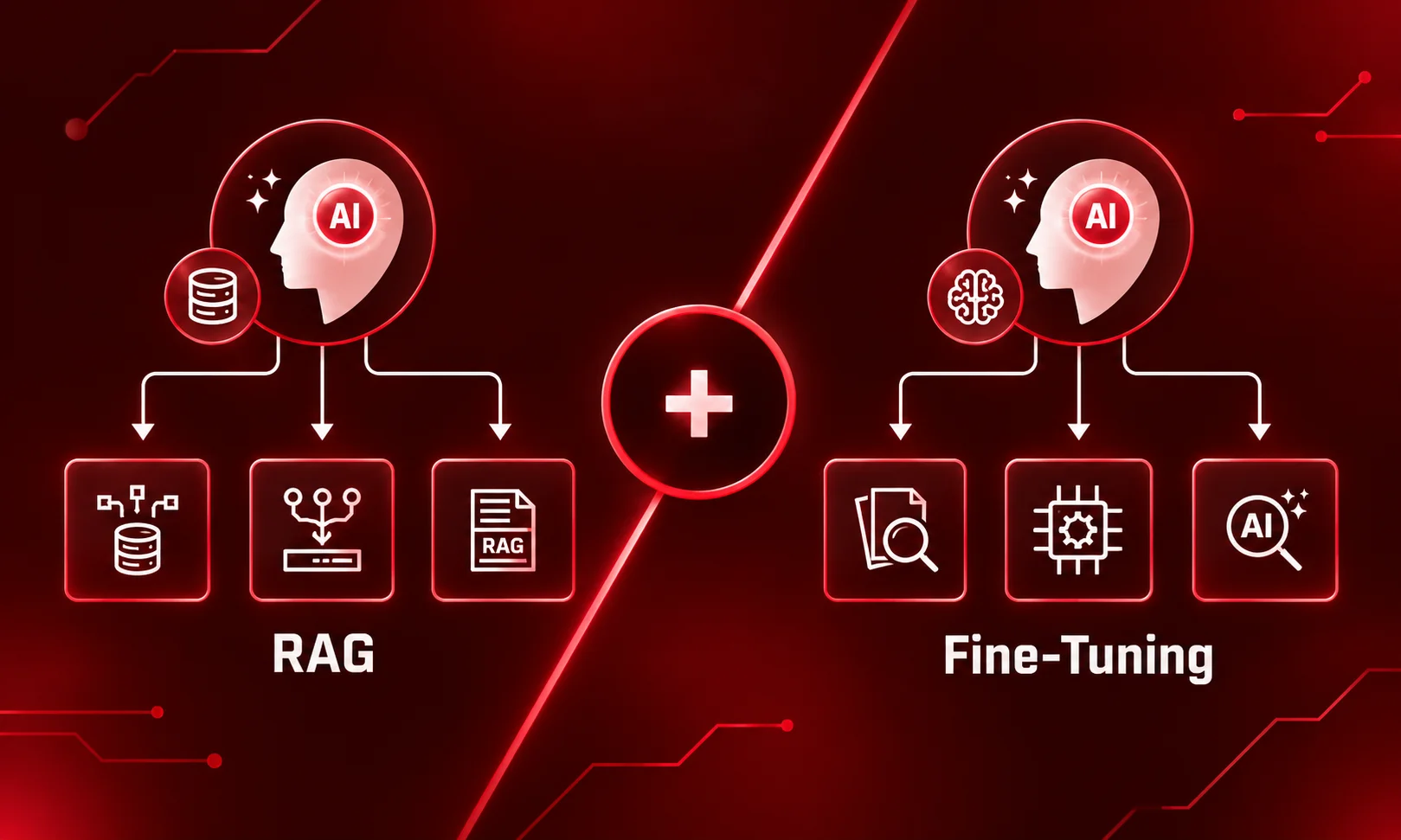
Yes. In fact, this is often the more sensible production setup.
Imagine a legal AI assistant.
You could fine-tune the model to follow your preferred clause structure and drafting style.
Then use RAG to retrieve the latest statutes, regulations, internal playbooks, and approved clauses.
Finally, the prompt can control things like jurisdiction, output format, citation requirements, and safety rules.
So the architecture becomes:
Prompt → controls the task
RAG → supplies the evidence
Fine-tuning → improves repeatable behavior
This hybrid approach is especially useful when your application has both changing knowledge and stable behavioral requirements.
The key is not to add every technology just because you can. Each layer should solve a problem that you can actually measure.
The Cost Question: Which One Is Cheapest?
There isn’t one universal price tag.
Prompt engineering is usually the cheapest place to start because you don’t need model training or a retrieval infrastructure. Your main cost is engineering time and, at scale, the extra tokens used by longer prompts.
RAG introduces infrastructure costs. You may need document processing, embeddings, storage, retrieval, reranking, access controls, monitoring, and evaluation.
Fine-tuning adds another type of cost: preparing high-quality training data, running training jobs, evaluating the resulting model, deploying it, and maintaining the training pipeline.
So don’t think only about the cost of the GPU.
Data preparation and testing can easily become the bigger part of a fine-tuning project.
For a small prototype, prompting may be enough.
For a company knowledge assistant, RAG will often make more sense.
For a high-volume, narrow task where consistency and inference efficiency matter, fine-tuning can become attractive.
And for mature systems, you may eventually use all three.
How to Know When Prompting Has Reached Its Limit
This is one of the most useful questions to ask before fine-tuning.
If you keep adding instructions and examples but the same failure keeps coming back, you may be reaching the point where another approach is needed.
Some warning signs include:
- The prompt has become extremely long.
- Small prompt changes break other behaviors.
- The model repeatedly ignores a required format.
- You need the same examples in almost every request.
- The model needs information that isn’t available in its context.
- Token costs are becoming a problem.
- Performance is inconsistent across a large test set.
Don’t treat any one of these as automatic proof that you need fine-tuning.
First identify whether the actual problem is instructions, missing knowledge, retrieval quality, model capability, or repeatability.
That diagnosis is more valuable than the technology choice itself.
What I Would Test Before Spending Money
Before building a complicated AI stack, create a small evaluation set.
Start with around 50–100 real examples covering normal requests, difficult cases, edge cases, and known failures.
Run your baseline prompt against them.
Record where it fails.
Then change one thing at a time.
If the problem is missing information, test RAG.
If the problem is retrieval, improve chunking, metadata, search, or reranking.
If the problem remains a consistent behavioral issue after those changes, test a fine-tuned model.
This gives you something many AI projects are missing: evidence for why a particular architecture was chosen.
And that matters because the best AI system isn’t necessarily the one with the most sophisticated technology.
It is the one that solves the actual problem without creating five new problems behind it.
Where Each Approach Works Best in 2026
Once you understand the difference between knowledge and behavior, choosing the right approach becomes much easier.
The use case matters more than the technology label.
1. Customer Support AI
For a support assistant, RAG is usually the starting point.
The system can retrieve current refund policies, product documentation, shipping rules, order details, and previous support information before answering.
Prompt engineering then controls the tone and rules.
Fine-tuning can make sense later if you need highly consistent escalation decisions or response patterns across a very large volume of tickets.
This is a good example of why the three methods are not really competitors. They can each have a different job.
2. Legal AI
Legal applications are another strong example.
You may want a model to consistently structure a contract clause or follow your preferred drafting style. That is a behavioral problem, so fine-tuning may help.
But laws, regulations, court decisions, and company policies can change.
Those belong in a retrieval system where the source material can be updated and checked.
For this kind of workflow, fine-tuning for behavior + RAG for current information + prompting for instructions is often more sensible than trying to put everything inside the model.
3. Internal Knowledge Assistants
Imagine employees asking:
“What’s our parental leave policy?”
“What is the process for approving a new vendor?”
“Where is the latest security procedure?”
The model doesn’t need to memorize all of this.
It needs access to the correct company information.
That makes RAG the obvious candidate.
The harder part is actually permissions. An employee should not receive documents simply because the retrieval system found them.
So enterprise RAG needs access controls, metadata, document ownership, and monitoring—not just a vector database.
4. Product Question Answering
For an ecommerce or SaaS business, product information changes constantly.
Prices, specifications, availability, shipping rules, and product versions can all change.
RAG can retrieve the latest approved information, while prompting controls how the answer is presented.
Fine-tuning might still be useful for a narrow classification or extraction task behind the scenes.
5. High-Volume Classification
This is one area where fine-tuning becomes much more attractive.
Suppose you’re processing hundreds of thousands of support tickets, invoices, emails, or documents.
The task is narrow and repetitive.
If a smaller fine-tuned model can perform that job reliably, you may not need to send every request to a much larger model.
That can make the economics interesting at high volume.
The important word is narrow.
Fine-tuning a model just because you have a lot of data isn’t automatically a good idea. The data needs to teach a behavior you actually want the model to repeat.
The Biggest Mistakes Teams Make

I’ve noticed that most bad architecture decisions come from starting with the technology instead of the problem.
Here are the ones I’d watch most closely.
Mistake 1: Fine-Tuning Too Early
Someone sees inconsistent answers and immediately suggests training the model.
But if a better prompt fixes the problem, the fine-tuning project was unnecessary.
Current 2026 guidance continues to recommend testing prompting first, then RAG, before treating fine-tuning as the next step.
Mistake 2: Using Fine-Tuning as a Database
This is probably the easiest mistake to explain.
Your company’s information changes.
You fine-tune the model using that information.
Six months later, the information changes again.
Now your model contains outdated information.
For changing facts, retrieval is generally a better fit because you can update the source without retraining the model.
Mistake 3: Assuming RAG Means Accurate
RAG can improve factual grounding, but it doesn’t magically make an AI system correct.
If your documents are poorly organized, your chunks are badly created, or the retriever selects irrelevant information, the model may still produce a convincing wrong answer.
The retrieval layer needs its own evaluation.
Mistake 4: Building a Huge Prompt
Prompt engineering has another trap.
When a model fails, teams often keep adding instructions.
Then the prompt becomes hundreds or thousands of words long.
Eventually nobody knows which instruction is helping and which one is causing a new failure.
A shorter, well-tested prompt is often better than a giant prompt full of exceptions.
Mistake 5: Not Having an Evaluation Set
This one causes a lot of wasted work.
Without a fixed test set, every architecture change becomes an opinion.
One engineer says the new RAG system is better.
Another says the fine-tuned model feels better.
Neither can prove it.
A shared evaluation set gives you something concrete to compare.
How to Test the Three Approaches Before Committing
You don’t need to build a massive AI infrastructure project on day one.
Start small.
Take 50–100 real examples from the task you want the AI to perform.
Include easy requests, difficult requests, edge cases, and examples where your current system fails.
Then create a baseline using prompt engineering.
Measure things that actually matter to your application:
- Accuracy
- Format compliance
- Hallucination rate
- Citation quality
- Response time
- Cost per request
- Escalation or failure rate
Next, add RAG if the evaluation shows a knowledge problem.
Test the retrieval separately.
Did the system find the right document?
Did it find the right section?
Did the model use that information correctly?
Only after that should you test fine-tuning for a remaining behavioral problem.
This gives you a much cleaner answer to the question, “Do we really need fine-tuning?”
Prompt Engineering vs. RAG vs. Fine-Tuning: Cost and Maintenance

There is no universal price because model choice, traffic, infrastructure, and team size change the numbers dramatically.
Still, the general pattern is clear.
Prompt engineering has the lowest setup burden.
You mainly spend engineering time testing prompts and examples, plus normal model usage costs.
RAG adds infrastructure.
You may need embeddings, a vector or search database, document ingestion, retrieval logic, reranking, permissions, monitoring, and evaluation.
Fine-tuning adds a training lifecycle.
You need good examples, data cleaning, training runs, evaluation, deployment, versioning, and eventually retraining when requirements change.
Current 2026 comparisons generally place prompting at the low end of setup complexity, RAG in the middle, and fine-tuning higher because of training data and model-management requirements.
One thing I would not do is copy a cost number from another company’s article and treat it as your budget.
For AI projects, engineering time is often a bigger variable than the raw GPU bill.
A Practical 4-Week Rollout
If you’re building a new AI feature, here’s a much safer sequence.
Week 1: Build the Baseline
Start with the strongest model you can reasonably test.
Create the system prompt, add a few examples, define the expected output, and build your evaluation set.
Don’t worry about making the architecture perfect yet.
You are trying to understand the problem.
Week 2: Fix the Easy Problems
Review the failures.
If the model misunderstood the instructions, fix the prompt.
If the output format is inconsistent, tighten the format requirements.
If the model simply doesn’t have the required information, move toward RAG.
Week 3: Test Retrieval
Connect your trusted documents or data sources.
Measure whether the right information is being retrieved before worrying too much about how beautifully the final answer is written.
This is where many teams discover their real problem isn’t the LLM at all. It’s poor source data.
Week 4 and Beyond: Consider Fine-Tuning
If the model still struggles with a narrow, repeatable behavior, now you have a much stronger reason to test fine-tuning.
Start with a parameter-efficient method such as LoRA when it fits the model and task.
Compare it against your existing baseline using the same evaluation set.
If it doesn’t produce a meaningful improvement, don’t force it into production just because you’ve already invested time in training.
When Fine-Tuning Is Actually Worth It
Fine-tuning makes the most sense when several of these conditions are true:
- Your task is narrow and repetitive.
- You have enough high-quality examples.
- You need consistent behavior.
- Prompting has already been tested properly.
- RAG cannot solve the main problem.
- You run the task at enough volume to justify the training effort.
- A smaller specialized model could replace a more expensive general model.
For example, imagine an invoice-processing system that needs to return the same structured fields every time.
That’s much closer to a fine-tuning problem than a knowledge-retrieval problem.
On the other hand, if the system needs to answer questions about invoices using the latest company records, RAG becomes important too.
The distinction is subtle but very useful:
Fine-tuning teaches the pattern.
RAG supplies the current information.
What About Long Context Instead of RAG?
This is an interesting middle ground in 2026.
If you have a relatively small amount of information and the model can comfortably handle it, you may not need a complicated retrieval system.
You can sometimes place the relevant context directly into the prompt.
That can be easier to build and easier to debug.
But once your information becomes large, frequently changing, permission-sensitive, or expensive to send with every request, retrieval becomes much more attractive.
So don’t build RAG simply because everyone says RAG is the standard.
Ask whether retrieval actually solves a problem you have.
The Future: Will Hybrid AI Become the Default?
My expectation is yes, although this is a forecast rather than a settled fact.
As AI applications become more specialized, it makes sense to separate responsibilities.
A model can be fine-tuned for a narrow behavior.
A retrieval system can handle changing knowledge.
A prompt can control the request, safety rules, output format, and tool behavior.
That gives developers more control without forcing one technology to do everything.
We’re already seeing 2026 decision frameworks describe hybrid systems as a practical production pattern rather than an unusual architecture.
The bigger change may be less about choosing between RAG and fine-tuning and more about better evaluation and context management.
Teams are getting better at asking where a piece of information should live:
In the prompt?
In the retrieval system?
In the model weights?
That is a much better architecture question than simply asking which technology is “best.”
Final Takeaway
The first question should not be “Should I use RAG or fine-tuning?”
Ask something more useful:
“What exactly is going wrong with my AI system?”
If the instructions are the problem, fix the prompt.
If the knowledge is missing or changing, retrieve it.
If the behavior needs to become consistent across a narrow task, test fine-tuning.
And if your application needs all three, there is nothing wrong with that.
The mistake is not using multiple techniques. The mistake is using them without knowing what problem each one is solving.
That’s also why I wouldn’t start an AI project by buying GPUs or designing a complicated RAG pipeline. Start with real examples, measure the failures, and let those failures tell you what to build next.
Prompt first. RAG when knowledge is the gap. Fine-tune the remaining behavior.
That simple sequence will save you a surprising amount of time.
Frequently Asked Questions
What is the main difference between RAG and fine-tuning?
RAG gives the model external information at request time, while fine-tuning changes the model’s learned behavior through training. RAG is usually better for private or changing information, while fine-tuning is better suited to consistent behavior, style, classification, or narrow tasks.
Can I use RAG and fine-tuning together?
Yes. This is often a sensible production setup. Fine-tuning can handle a stable behavior while RAG supplies current documents, policies, product information, or other changing knowledge.
Is prompt engineering still important with stronger AI models?
Yes. A stronger model can follow instructions better, but it still needs clear goals, constraints, context, and output requirements. Good prompting is also useful when you combine the model with RAG, tools, or a fine-tuned adapter.
Is RAG cheaper than fine-tuning?
Usually, RAG has a lower training burden because you don’t have to train model weights, but it introduces retrieval infrastructure and ongoing maintenance. Fine-tuning can become economically attractive for high-volume, narrow tasks, so total cost should be measured across the whole system rather than only the initial setup.
How much data do I need for fine-tuning?
There is no universal number. Some tasks can work with relatively small datasets, while more demanding applications need hundreds or thousands of high-quality examples. Quality, consistency, and coverage of the examples matter more than simply collecting a huge dataset.
Does RAG completely remove hallucinations?
No. RAG can improve grounding by giving the model relevant source information, but the system can still retrieve the wrong content or misunderstand the retrieved material. You need to evaluate both retrieval and generation.
When should I choose fine-tuning instead of RAG?
Choose fine-tuning when the main problem is repeatable behavior rather than missing information. If your model needs to consistently classify, extract, format, or respond in a specialized way at high volume, fine-tuning may be worth testing.
What is the safest order to use these techniques?
For most projects, start with prompt engineering and an evaluation set. Add RAG when you have a knowledge problem, then consider fine-tuning if a measurable behavioral problem remains after the first two steps.