
If you have been following AI for a while, you have probably noticed something changing. AI is not living inside the text box anymore.
You can give a model a screenshot and ask what is wrong. You can talk to it instead of typing. You can upload a PDF with charts, tables and images and ask questions about the whole thing. Some models can even work with video and audio as part of the same conversation.
This is where multimodal AI comes in.
The basic idea is not complicated. Instead of making AI understand only one kind of information, multimodal AI allows it to work with different types of information together — such as text, images, audio and video.
But there is a detail here that is easy to miss.
Being able to accept an image does not automatically make an AI system good at understanding images. And accepting five types of data does not automatically make it smarter.
That is the part I think gets lost in a lot of explanations online.
So in this guide, I want to keep things practical. We will look at what multimodal AI actually means, how it works behind the scenes, how it is different from generative AI and LLMs, where it is being used, and where its limits start to show.
AI Overview: What Is Multimodal AI?
Multimodal AI is artificial intelligence that can process and connect information from multiple types of data, including text, images, audio, video and, in some systems, sensor or 3D data.
A traditional AI system might be built mainly for one job.
A speech model understands audio. A computer vision model works with images. A language model works with text.
Multimodal AI brings these different kinds of information into the same problem.
For example, imagine a customer sends a company a photo of a damaged product and writes, “This arrived broken. Can I get a replacement?”
The useful answer depends on both things:
- the photo tells the AI what appears to be damaged
- the text explains what the customer wants
The real advantage is not that the AI can read a message and look at a picture separately.
It is that it can connect the two.
That is the foundation of multimodal artificial intelligence.
Key Takeaways
- Multimodal AI works with more than one type of information.
- Text, images, audio and video are the most common modalities.
- The important part is connecting information across those modalities.
- Multimodal AI is related to, but not the same as, generative AI or LLMs.
- It can be useful for documents, customer support, healthcare, e-commerce, manufacturing and video analysis.
- More modalities do not always mean better results.
- Reliability still depends heavily on the model and the specific task.
What Does “Multimodal” Actually Mean?

The word sounds more technical than it really is.
A modality simply means a type or form of information.
Text is one modality.
An image is another.
Audio is another.
Video is another.
So when we say multimodal AI, we are basically talking about an AI system that can work across multiple forms of information.
For example:
Text + Image
You upload a screenshot and ask, “Why is this error appearing?”
Text + Audio
You speak to an AI assistant and ask it to help you with something.
Text + Video
You upload a product demonstration and ask, “What steps did the person follow?”
Text + Image + Audio + Video
The system has access to several sources and can use them together when answering.
This sounds simple, but technically it is a pretty big step.
The computer does not naturally “see” a picture or “hear” a voice the way we do. The information has to be converted into representations the model can work with.
That brings us to how multimodal AI actually works.
How Does Multimodal AI Work?
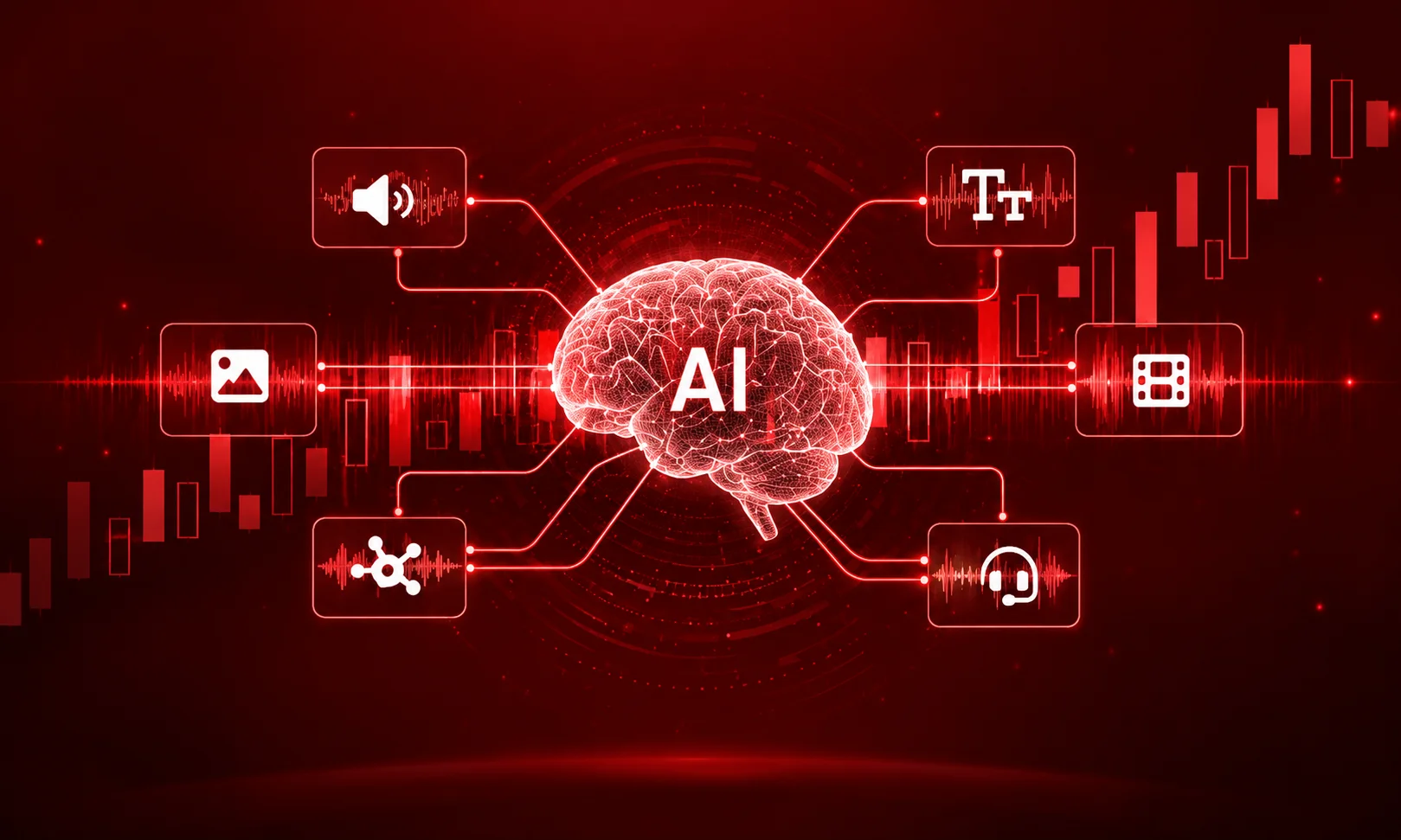
You will find some very complicated diagrams if you search for multimodal AI architecture.
For understanding the basic idea, you don’t need all of them.
Think about the process in four stages:
Input → Encoding → Fusion → Output
1. The AI receives different inputs
The first step is getting the information into the system.
Text is represented as tokens.
Images can be broken into visual patches or other representations.
Audio can be processed into smaller pieces of information across time.
Video is more difficult because it contains both visual information and time.
So before the model can reason about anything, these different inputs have to be represented in a form the AI can process.
2. The information is converted into representations
This is where embeddings and other representations come into the picture.
You can think of an embedding as a mathematical way of representing information so that a model can understand relationships between pieces of data.
For example, an image of a red car and the words “red car” can be represented in a way that lets the system recognize their relationship.
This ability to connect different modalities is one of the important building blocks of multimodal AI.
3. The modalities are combined
Next comes multimodal fusion.
There are several ways to do this.
With early fusion, information from different modalities is brought together relatively early.
With mid-level fusion, each type of information can be processed for a while before being combined.
With late fusion, different modalities are processed more independently and the results are combined later.
Modern multimodal systems can use much more advanced transformer and attention-based mechanisms.
But the basic question stays the same:
How should the model connect what it sees, hears and reads?
That is where much of the real intelligence of the system comes from.
4. The model produces an answer
Finally, the model uses the combined information to produce an output.
That output could be:
- text
- audio
- an image
- video
- a classification
- a recommendation
- an action
And this is why multimodal AI feels different from older AI tools.
You are not always forced to turn everything into text before the system can work with it.
Multimodal AI Architecture in Simple Terms
At a high level, you can picture a multimodal AI architecture like this:
Different inputs → Encoders/representations → Shared information → Cross-modal reasoning → Output
The actual architecture changes from one model to another.
Some systems rely more heavily on separate components for different modalities. Others are designed to bring those modalities together much earlier.
This is worth knowing because there is no single “multimodal AI architecture” that every company uses.
The technology is still moving quickly.
What is becoming more common, though, is the idea of models that can work natively across several modalities instead of simply adding separate AI tools together.
What Types of Information Can Multimodal AI Understand?
The most common modalities today are text, images, audio and video.
Text
This includes normal written information such as:
- emails
- articles
- contracts
- instructions
- questions
- code
- reports
Images
AI can work with photographs, screenshots, diagrams, charts, scanned documents and product images.
This is especially useful when important information is visual and would be difficult to describe completely with words.
Audio
Audio can include conversations, meetings, voice commands, interviews and other recordings.
A transcript is useful, but it does not always contain everything present in the original audio.
Video
Video adds another layer because the AI has to understand change over time.
A single frame can tell you what something looks like.
A video can tell you what happened.
That difference becomes important in areas such as manufacturing, security, training and product demonstrations.
Multimodal AI vs Generative AI
These two terms are often used together, but they are not the same thing.
Generative AI is about creating new content.
It can generate text, images, audio, video or code.
Multimodal AI is about working across different types of information.
A model can be both.
For example, you might upload an image and ask a multimodal generative AI system to explain what it sees.
So an easy way to remember it is:
Multimodal = different types of information.
Generative = creating new information.
They overlap, but one does not replace the other.
Multimodal AI vs LLMs
Large language models, or LLMs, were originally focused mainly on language.
Multimodal models extend that capability to other types of information.
That is why you can now see AI systems that understand a written question and an image in the same interaction.
The line is getting less clear as newer models become multimodal by default, but the distinction is still useful when learning the technology.
Multimodal AI vs Machine Learning
Machine learning is the much larger field.
It covers systems that learn patterns from data for prediction, classification, recognition, recommendation and generation.
Multimodal AI is an area within modern artificial intelligence and machine learning.
So these aren’t really competing technologies.
It is more like comparing a large category with one of the technologies inside that category.
Multimodal AI Models
The model landscape changes very fast.
One month you may see a new model release and a few months later the comparison has already changed.
Major companies and research groups working on multimodal models include OpenAI, Google DeepMind, Anthropic and Alibaba’s Qwen family, among others.
When comparing these models, don’t look only at the name or a benchmark score.
Look at what you actually need:
- Does it understand images well?
- Can it process audio?
- How much video can it handle?
- How large is its context window?
- How fast is it?
- What does the API cost?
- Does it work reliably on your documents?
- What are its privacy controls?
- Can you use it in your existing workflow?
A model that wins a benchmark is not automatically the best model for your business.
Your own data and your own task are the better test.
Real-World Multimodal AI Applications
This is where multimodal AI stops being just an interesting AI concept.
Document Understanding
A business document is rarely just a block of text.
There may be tables, charts, signatures, images, scanned pages and different layouts.
Multimodal AI can help understand these elements together.
That can be useful in legal, finance, insurance and administrative workflows.
E-commerce
Imagine a customer uploads a picture of a product and asks:
“Can you find something similar but cheaper?”
The AI can use the image to understand what the customer is looking for and combine that with product information.
That is a much more natural search experience than asking the customer to describe every visual detail.
Customer Support
A customer doesn’t always know how to explain a technical problem.
They may simply take a picture.
A multimodal support system can potentially combine:
Photo + customer message + order information + product documentation
That gives the AI much more context than the message alone.
Healthcare
Healthcare contains huge amounts of visual and written information.
Medical images, reports, notes and previous records can all provide different pieces of the picture.
Multimodal AI can help connect these sources for tasks such as analysis, summarization and information retrieval.
It still needs proper human oversight, especially when the output can affect patient care.
Manufacturing
Factories can generate images from inspections, machine readings, maintenance records and written reports.
A multimodal system can potentially bring these sources together to help identify problems or support quality control.
Video Analysis
There is also a huge amount of useful information sitting inside video that nobody has time to watch manually.
Multimodal AI can help summarize footage, search for events or answer questions about what happened.
But long video is not a free lunch.
Processing hours of footage can become expensive, and sampling the video too aggressively can cause the model to miss important events.
Why Is Multimodal AI Important?
There is one simple reason I think this technology matters:
The real world is not text-only.
We see things.
We hear things.
We read things.
We watch things happen.
Businesses have product photos, PDFs, phone calls, videos, diagrams, spreadsheets and sensor data.
For a long time, getting AI to work with this information often meant converting it into a format that a particular model could handle.
Multimodal AI is moving toward a different approach.
Instead of forcing everything into text first, the AI can work with the original forms of information more directly.
That can preserve useful details that might otherwise disappear during conversion.
But Multimodal AI Is Not Magic
This is probably the part I would pay the most attention to.
A model can look at an image and still get something wrong.
It can miss tiny text.
It can count objects incorrectly.
It can misunderstand a chart.
It can lose important details in a long video.
It can struggle when several people are speaking at the same time.
And sometimes the model does something even more concerning: it ignores part of the input and still gives you a confident answer.
That is why “it supports images” is not enough when evaluating a multimodal AI system.
The better question is:
Does it reliably understand the specific information my task depends on?
That is a much more useful way to judge the technology.
Should You Use Multimodal AI?
Not every AI project needs it.
If your workflow is completely text-based, adding images, audio and video may just make the system more complicated and expensive.
But if important information exists in different formats, multimodal AI can make a lot of sense.
Good examples include:
- customer messages + product photos
- contracts + exhibits
- reports + charts
- audio + transcripts
- product images + product databases
- video + written instructions
The goal shouldn’t be to use the most advanced AI available.
The goal should be to solve the problem better.
What’s Next for Multimodal AI?
Understanding the technology is only the first step.
The more difficult part begins when you want to use it in a real organization.
How do you connect a multimodal model to company documents? How does multimodal RAG work? When should you use a multimodal AI agent? What does it cost? How do you protect sensitive images and audio? And how do you test whether the model is actually reliable?
Those questions are less about what multimodal AI is and more about how to build a strategy around it.
That is why we are treating this as two connected articles.
If this article helped you understand the technology, the next guide goes one level deeper:
Multimodal AI Strategy: RAG, Agents, Costs & Business Use
Frequently Asked Questions
What is multimodal AI in simple words?
Multimodal AI is artificial intelligence that can work with different types of information, such as text, images, audio and video, and connect that information when solving a task.
What are examples of multimodal AI?
Examples include AI that analyzes photos, understands documents with charts and tables, summarizes videos, works with voice conversations, or combines product images with written product information.
Is multimodal AI the same as generative AI?
No. Multimodal AI describes the types of information an AI can work with, while generative AI describes AI that creates new content. A system can be both.
Is ChatGPT multimodal?
Modern ChatGPT models can support multiple types of input and output, depending on the model and available features. This makes multimodal interaction possible in supported experiences.
Is multimodal AI better than normal AI?
Not always. It is most useful when your task depends on more than one type of information. For a simple text-only task, a multimodal system may add unnecessary complexity.
Final Thoughts
Multimodal AI is often explained as “AI that can see, hear and read.”
That’s not wrong, but it is only the starting point.
The bigger change is that AI systems are becoming better at connecting information that comes in different forms.
A picture can give context to a question. A chart can change how we understand a report. Audio can contain information that a transcript misses. Video can show a sequence of events that a single image never could.
That is where the real opportunity is.
But I would not get too carried away by the demos.
The useful multimodal AI systems will not simply be the ones that accept the most file types. They will be the ones that reliably connect the right information to the right task.
And for businesses, that distinction matters a lot more than the word “multimodal” itself.