
A single number can make a complicated industry look simple. “$100 billion” sounds definitive, but the public evidence does not support treating that figure as a confirmed measurement of one clearly defined U.S. personal-injury market.
That is the first thing you should know about Inside America’s $100 Billion Personal Injury Industry. The personal-injury sector is real and economically significant, but the exact $100 billion figure is not established by a single public government dataset or a transparent market definition.
The picture becomes clearer when you look at what sits behind injury claims: personal-injury law firms, insurers, medical providers, experts, courts, litigation-support businesses, and commercial-truck litigation.
Large-truck crashes also give the subject a serious public-safety dimension. In 2024, 5,340 people died in crashes involving large trucks in the United States.
This article separates what can be verified from what remains disputed, explains how commercial truck claims work, examines the money and institutions involved, and looks at the regulatory issues shaping the sector in 2026.
AI Overview: Inside America’s $100 Billion Personal Injury Industry
The U.S. personal-injury sector is a large legal and economic ecosystem, but there is no publicly confirmed government measure showing that it is exactly a $100 billion industry.
Publicly surfaced estimates for the narrower personal-injury lawyers and attorneys market differ, while the broader U.S. law-firm industry is considerably larger.
Commercial-truck litigation forms an important specialized part of personal-injury practice because cases can involve drivers, carriers, insurers, maintenance providers, manufacturers, brokers, and federal safety requirements. Hours-of-service rules, electronic records, medical evidence, insurance coverage, and state tort law can all affect an individual case.
Key Takeaways
- The $100 billion description should be treated as a headline shorthand, not a confirmed measurement of one defined U.S. market.
- Publicly surfaced estimates put the narrower personal-injury legal-services market at roughly $58–62 billion for 2025–26, although the underlying detailed market data is not publicly available for independent verification.
- The broader U.S. law-firm industry is estimated at $422.4 billion in 2026 by IBISWorld.
- 5,340 people died in U.S. crashes involving large trucks in 2024, according to the Insurance Institute for Highway Safety.
- Federal hours-of-service rules generally apply to covered commercial motor vehicle drivers and carriers operating in interstate commerce.
- Federal minimum financial-responsibility requirements generally include $750,000 for many interstate property carriers, with higher requirements for certain hazardous-material operations.
- H.R. 8218 proposes raising the federal property-carrier minimum to $5 million, but a proposed bill is not the same thing as enacted law.
Is the U.S. personal injury industry really worth $100 billion?

There is no publicly confirmed government figure showing that America’s personal-injury industry is exactly worth $100 billion. Publicly surfaced estimates for the narrower personal-injury lawyers and attorneys market are closer to $58–62 billion for 2025–26, while broader figures include the entire U.S. law-firm sector and therefore cover many areas beyond personal injury.
What Does the Personal Injury Industry Actually Include?
Personal-injury law is part of civil law. It generally concerns claims alleging that another person or organization caused legally recognized physical injury, emotional harm, or death.
Depending on the facts and applicable state law, a claim can involve medical expenses, lost income, pain and suffering, property loss, or punitive damages in circumstances where such damages are legally available.
The phrase personal injury industry, however, describes more than lawyers.
It can include plaintiff-side and defense law firms, liability insurers, medical providers, lien holders, expert witnesses, courts, mediators, litigation-support companies, case-management platforms, advertising businesses, referral networks, and sometimes litigation funders.
That distinction matters because combining all of these activities into one dollar figure can produce a very different market size from counting only personal-injury legal services.
The $100 Billion Question: What Can Actually Be Proven?
The strongest point you can make from the available evidence is also the simplest: $100 billion is not a confirmed single-market measurement.
Publicly surfaced reporting based on IBISWorld data has placed the narrower U.S. personal-injury lawyers and attorneys market around $57.8 billion in 2025 and $61.7 billion in 2026.
At the same time, IBISWorld estimates the entire U.S. law-firm industry at $422.4 billion in 2026. That broader figure includes many types of legal services, not just personal injury.
So these numbers cannot simply be added together.
The $100 billion figure may be intended to describe a broader ecosystem involving legal services and related activities. However, the research available here does not provide a transparent public methodology proving that exact total.
That is why presenting $100 billion as an established fact would be misleading.
Why Commercial Truck Litigation Matters So Much
Commercial-truck litigation is a specialized part of personal-injury law involving crashes with commercial motor vehicles.
Cases may involve tractor-trailers, semitrailers, delivery fleets, buses, construction vehicles, and other business-operated trucks.
The human stakes are substantial. IIHS reports that 5,340 people died in large-truck crashes in 2024. Passenger-vehicle occupants accounted for 62% of those deaths, while truck occupants represented 17% and pedestrians, bicyclists, and motorcyclists represented 19%.
IIHS also reports that large-truck crashes accounted for 14% of all U.S. motor-vehicle crash deaths in 2024. Deaths in large-truck crashes were 58% higher than in 2009, the low point in the long-term data series.
These figures do not tell you how much a particular lawsuit is worth. They show why commercial-truck safety and the resulting civil claims receive sustained attention.
What Makes a Truck Case Different?
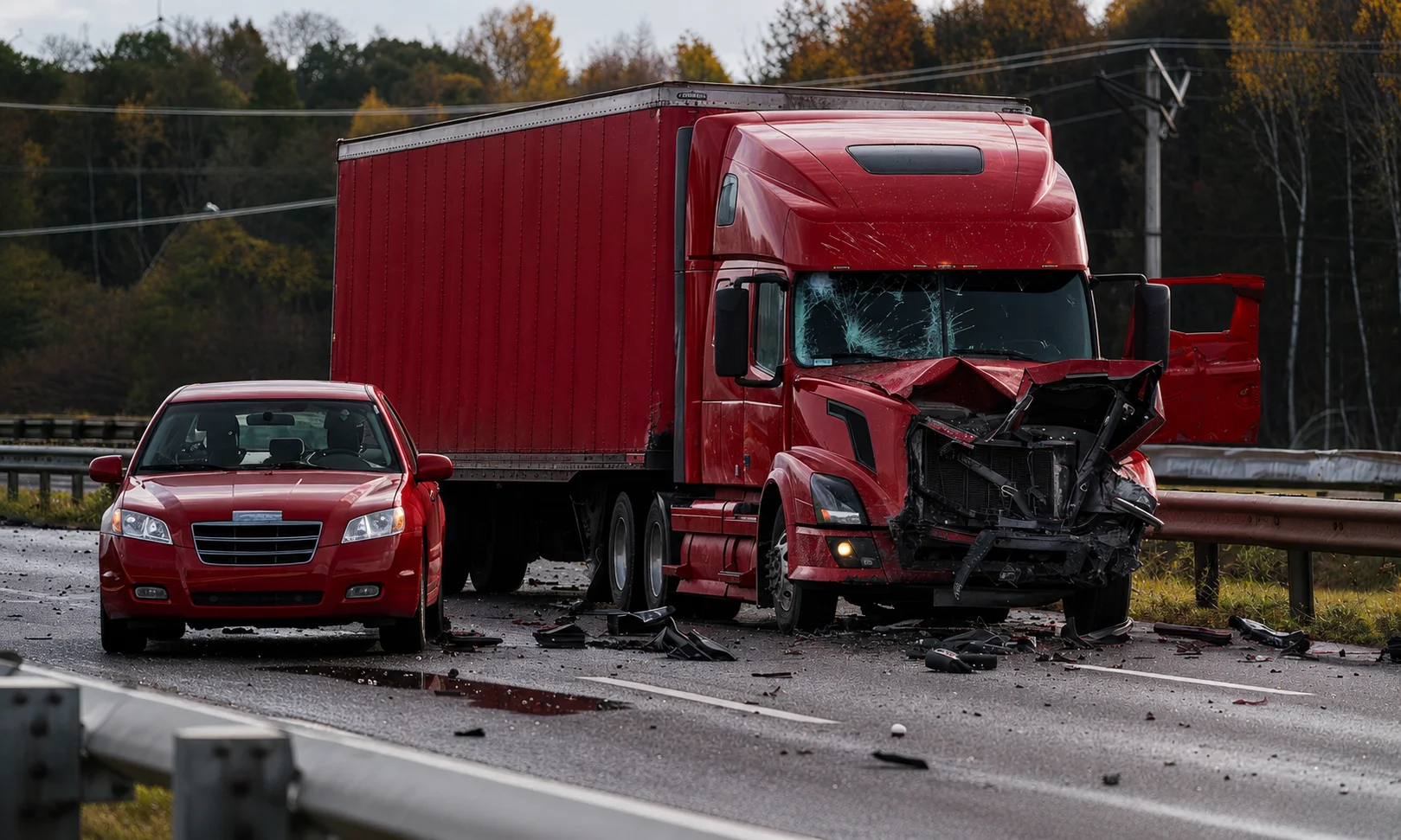
A normal passenger-car collision may center on driver conduct, photographs, witnesses, medical records, and insurance.
A commercial-truck case can involve a much wider evidence trail.
Depending on the circumstances, investigators may examine:
- Driver qualification records
- Hours-of-service records
- Electronic logging information
- Dispatch communications
- Maintenance records
- Vehicle inspection information
- Cargo documentation
- Camera footage
- Telematics
- Drug-and-alcohol testing records
- Accident-reconstruction evidence
- Medical and vocational evidence
Not every truck has every type of data, and the existence, retention, discoverability, and admissibility of evidence depend on the facts and applicable law.
How a Commercial Truck Personal Injury Claim Works
There is no single nationwide procedure that determines every case. State law controls many important issues, while federal trucking regulations can add another layer.
Still, the process often follows a recognizable pattern.
1. Medical care comes first
After a crash, the immediate priority is safety and appropriate medical treatment.
Medical records can later become important evidence concerning the nature of an injury, treatment, recovery, and claimed losses.
2. Evidence needs attention early
Crash photographs, reports, witness information, vehicle records, and other evidence can become important as a claim develops.
A lawyer may send a preservation or spoliation letter asking another party to preserve potentially relevant material. Such a letter does not automatically prove liability or guarantee that evidence will be preserved.
3. The parties investigate
The investigation can examine the driver, carrier, vehicle, maintenance history, insurance, road conditions, cargo, and other potentially relevant circumstances.
Experts may become involved when accident reconstruction, medical causation, economics, vocational loss, or trucking practices require specialized analysis.
4. The insurance claim develops
A claimant or lawyer may present a demand to an insurer or defendant.
The insurer can investigate the claim, dispute liability, question causation, challenge damages, or negotiate a settlement.
5. A lawsuit may follow
If negotiations do not resolve the dispute, the claimant may file suit.
Filing a lawsuit does not establish that the defendant is liable. The claimant still has to satisfy the applicable legal requirements.
6. Discovery begins
During discovery, parties can request documents, take depositions, exchange information, and use expert testimony where appropriate.
Disputes can arise over relevance, privilege, preservation, and admissibility.
7. The case may settle or reach trial
A case can resolve through negotiation or mediation.
If the parties do not reach an agreement, a judge or jury may determine liability and damages, followed in some cases by post-trial proceedings or an appeal.
How Federal Trucking Rules Enter the Picture
Federal safety requirements can become relevant in commercial-truck litigation.
FMCSA says most commercial motor vehicle drivers must comply with federal hours-of-service requirements, subject to the applicable rules and exceptions. Its current guidance covers qualifying commercial vehicles involved in interstate commerce and other specified operations.
The significance is straightforward: hours-of-service records can provide evidence about a driver’s duty and driving periods.
But a violation does not automatically mean a trucking company loses a lawsuit.
Civil liability still depends on the governing law, the facts, causation, admissibility, and the legal elements of the particular claim.
Who Can Be Responsible After a Truck Crash?
One of the less obvious features of commercial-truck litigation is that the driver is not necessarily the only party investigated.
| Potential party | Why the party may matter |
| Driver | Driving conduct, fatigue, distraction, impairment, or other alleged errors |
| Motor carrier | Hiring, supervision, dispatch, maintenance, insurance, and driver management |
| Vehicle owner | Ownership and maintenance responsibilities may become relevant |
| Maintenance provider | Inspection or repair work may be investigated |
| Shipper or broker | Selection, contracting, cargo, or operational relationships may matter |
| Manufacturer | A defective component may create a product-liability issue |
| Government entity | Road design or roadway conditions may be relevant in some cases |
| Insurer | Coverage and claims handling can affect the financial side of a dispute |
The important distinction is between investigating a potential party and proving that party is legally responsible.
A company appearing in the investigation does not, by itself, establish negligence.
What Is the Federal Minimum Trucking Insurance Requirement?
Federal financial-responsibility requirements are another major part of the discussion.
The research provided states that interstate property carriers generally face a federal minimum of $750,000 in liability coverage, while certain hazardous-material operations can require $5 million. States may impose higher requirements.
That $750,000 figure has become particularly relevant to policy debates.
H.R. 8218, the Fair Compensation for Truck Crash Victims Act, was introduced in Congress with a proposal to raise the federal property-carrier minimum from $750,000 to $5 million and adjust future increases based on medical-care inflation.
The crucial point is that a bill is not law merely because it has been introduced.
Therefore, you should not describe the proposed $5 million minimum as the current federal requirement.
What Evidence Can Make or Break a Truck Case?
A truck case is rarely decided by one document.
Instead, different pieces of evidence can fit together to establish what happened.
Potentially relevant evidence includes crash-scene photographs, police reports, witness accounts, medical records, vehicle information, driver logs, dispatch records, maintenance documents, camera footage, and expert analysis.
Electronic records can be especially useful when they help establish timing or operational activity.
However, electronic evidence is not automatically decisive. Questions about authenticity, retention, interpretation, relevance, and admissibility can still arise.
One Overlooked Issue: Evidence Is Not the Same as Liability
This distinction is easy to miss when reading highly publicized trucking cases.
Finding a safety violation does not automatically establish that the violation caused the crash.
Likewise, finding a potentially responsible company does not establish that the company is legally liable.
The strongest cases still depend on connecting the evidence to the legal elements that must be proven.
The Money Behind Personal Injury Claims

The economics of personal-injury litigation extend beyond the final settlement or verdict.
A case can involve lawyers, insurers, medical providers, expert witnesses, court costs, investigators, technology vendors, and other service providers.
Contingency-fee arrangements are also common in personal-injury practice. Under such an arrangement, the lawyer’s fee generally depends on obtaining a recovery, with the precise percentage and treatment of expenses determined by the written agreement and applicable rules.
Third-party litigation funding is another part of the broader ecosystem.
It involves outside financing of litigation or related legal expenses, although its structure, disclosure requirements, and legal treatment can vary.
The research does not establish that litigation funding is responsible for a particular percentage of insurance increases or verdict growth. Those stronger claims should not be presented as settled facts.
The “Nuclear Verdict” Debate Needs Context
The term nuclear verdict is widely used in legal and business commentary to describe exceptionally large civil jury awards.
It is important, however, not to turn the phrase into a statistical conclusion.
A large verdict does not represent the average personal-injury case. It may be reduced, settled after trial, appealed, or affected by other legal proceedings.
Likewise, a settlement announcement does not necessarily tell you the full financial terms or establish what a jury would have awarded.
This is one of the most important limitations when reading headlines about multimillion-dollar trucking cases.
Five Real-World Truck Litigation Examples Reported in 2026
Publicly reported cases illustrate the range of outcomes, but these examples should not be treated as average results.
- A January 2026 Missouri Lawyers Media report described a $475,000 settlement following a commercial-truck rear-end collision.
- A March 2026 press-release publication reported an $8.25 million settlement involving a commercial-truck collision.
- An April 2026 announcement reported a $2.75 million recovery in commercial-truck and automobile litigation.
- PRWeb reported a $10,024,171 jury award that later resolved for $7.5 million in a commercial-vehicle negligence case.
- A July 2026 firm announcement reported a $4.5 million pretrial settlement involving victims of a truck crash.
These are reported case outcomes, not independent evidence of what another claimant should expect.
That distinction matters because injury severity, liability evidence, insurance, jurisdiction, damages, and many other factors can produce dramatically different results.
Three Things Headlines Often Get Wrong
1. A market estimate is not an official government total
The biggest example is the $100 billion claim itself.
Without a clearly defined market and transparent methodology, you should not present that number as an established measurement.
2. A large verdict is not an average settlement
A $99.9 million reported verdict may attract attention, but it tells you very little about the value of an ordinary injury claim.
Case outcomes depend on individual facts and applicable law.
3. A federal safety violation is not automatic civil liability
FMCSA rules provide regulatory standards for qualifying operations.
Whether a violation establishes negligence, supports another legal theory, or has a particular evidentiary effect depends on the jurisdiction and circumstances.
Practical Application: How Should You Evaluate a Truck Injury Claim?
If you are trying to understand a commercial-truck claim, start with facts rather than the size of a headline.
First, establish the basic event. Identify the vehicles involved, where the crash occurred, who was driving, and whether law enforcement created a report.
Next, preserve what you already have. Keep photographs, medical records, bills, insurance correspondence, witness information, and other documents connected to the crash.
Then, identify the potentially relevant evidence. Depending on the case, this can include driver logs, dispatch information, vehicle records, maintenance documents, camera footage, and other operational data.
After that, separate facts from allegations. A lawsuit’s complaint contains allegations. A settlement announcement describes a negotiated result. Neither should automatically be treated as a judicial finding that every allegation was true.
Finally, check the law where the crash occurred. Statutes of limitation, comparative-fault rules, damages rules, insurance requirements, and procedural requirements differ across jurisdictions.
That final step is especially important because there is no single nationwide rule for every personal-injury claim.
Who Should Use This Information?
This information is useful if you are researching the U.S. personal-injury market, studying commercial-truck litigation, comparing legal-industry claims, or trying to understand how trucking safety rules intersect with civil lawsuits.
It can also help journalists, students, business researchers, insurance professionals, and readers who want to separate verified facts from industry talking points.
Who Should Not Rely on It Alone?
You should not use a general article as a substitute for legal advice about your individual case.
A real claim can turn on state-specific deadlines, evidence, insurance policies, employment relationships, medical records, comparative fault, and other facts that cannot be resolved from a general overview.
What Could Change the Industry Next?
Several developments deserve attention in 2026.
H.R. 8218 proposes raising the federal minimum liability requirement for property carriers to $5 million. Whether that proposal becomes law cannot be predicted from its introduction alone.
FMCSA’s February 2026 final rule concerning non-domiciled commercial driver’s licenses is another current regulatory development. The agency announced eligibility changes involving specified nonimmigrant statuses and verification requirements.
Meanwhile, electronic operational records will remain relevant wherever they exist and can legally be obtained and used.
The broader debate is likely to continue around compensation for crash victims, insurance affordability, trucking costs, litigation finance, and safety regulation.
Those are policy questions, not settled predictions.
Inside America’s $100 Billion Personal Injury Industry: What the Evidence Really Says
The opening number is the easiest part of this story to remember, but it is not the safest fact to repeat.
There is a genuine, large personal-injury legal market in the United States. Yet the available public evidence does not establish that one clearly defined industry is worth exactly $100 billion.
Commercial-truck litigation shows why the broader ecosystem is complicated. A single case can involve a driver, carrier, insurer, medical providers, experts, electronic records, federal safety rules, state tort law, and potentially several other parties.
The public-safety numbers also put the legal discussion into perspective. IIHS recorded 5,340 deaths in large-truck crashes in 2024, with passenger-vehicle occupants accounting for 62% of those deaths.
So, when you read about Inside America’s $100 Billion Personal Injury Industry, the most useful question is not simply whether the headline sounds impressive. It is whether the number, the legal claim, and the reported outcome can actually be traced back to evidence.
That habit is more valuable than any dramatic industry statistic.
FAQ:
Is the personal injury industry really worth $100 billion?
There is no publicly confirmed government figure establishing exactly $100 billion as the value of one defined U.S. personal-injury industry. Publicly surfaced estimates for the narrower personal-injury lawyers and attorneys market are closer to $58–62 billion for 2025–26. The broader U.S. law-firm industry is much larger because it includes many legal specialties beyond personal injury.
What is considered a personal injury case?
A personal-injury case generally involves a civil claim alleging that another person or organization caused legally recognized physical injury, emotional harm, or death. Common examples include vehicle crashes, truck crashes, defective products, unsafe premises, and other injury-producing events. The legal requirements vary by state.
Why are commercial truck cases different from car accident cases?
Commercial-truck cases can involve more parties and more specialized evidence than an ordinary passenger-vehicle collision. Driver qualification records, maintenance information, dispatch records, hours-of-service data, cargo information, and commercial insurance can become relevant. Federal trucking rules can also add a regulatory layer to the case.
How much insurance must a trucking company carry?
Federal requirements generally call for at least $750,000 in liability coverage for many interstate property carriers, while certain hazardous-material operations have higher requirements. State requirements can be higher. The amount of insurance available in an individual case also depends on the applicable policies, coverage, and circumstances.
Is the proposed $5 million trucking insurance minimum already law?
No. The research identifies H.R. 8218 as introduced legislation proposing to raise the federal property-carrier minimum from $750,000 to $5 million. A bill introduced in Congress does not become law unless it completes the required legislative process and is enacted.
What evidence is important in a truck accident case?
Potentially important evidence includes crash photographs, police reports, witness statements, medical records, driver logs, dispatch communications, maintenance records, camera footage, vehicle information, and expert analysis. Which evidence matters most depends on the facts. Courts can also restrict evidence based on relevance, privilege, authenticity, admissibility, and other legal rules.
Do FMCSA violations automatically prove negligence?
No. An FMCSA violation can be relevant evidence, but it does not automatically establish civil liability in every case. The legal effect depends on the jurisdiction, the particular rule, causation, admissibility, and the facts surrounding the crash.
How long does a personal injury lawsuit take?
There is no reliable nationwide timeline. Some claims may resolve through insurance negotiations, while complex litigation involving serious injuries, multiple parties, discovery, expert disputes, trial, or appeals can take substantially longer. Legal deadlines can arrive before a case itself is resolved, so jurisdiction-specific advice matters.
Can you recover money if you were partly at fault?
Possibly, but the answer depends on the state’s negligence rules. Some states use comparative-negligence systems, while others apply different thresholds or contributory-negligence rules. The percentage of fault and the applicable state law can therefore materially affect recovery.
What is a nuclear verdict in personal injury law?
“Nuclear verdict” is a commonly used term for an exceptionally large civil jury award. The phrase is not a reliable measure of the typical personal-injury settlement or verdict. A highly publicized award should therefore never be treated as a prediction of what another case will produce.