
Key Takeaways
- How AI Is Reshaping Personal Injury Law is already visible in medical-record review, document analysis, drafting, research, and case preparation.
- AI can turn large collections of records into searchable and organized information.
- Medical chronologies can be prepared more efficiently with specialized tools.
- Demand-letter preparation can be accelerated by extracting information from case documents.
- Evidence analysis can help lawyers find inconsistencies and important facts.
- Accident reconstruction and digital modeling can support complex cases when reliable underlying evidence is available.
- AI can assist with legal research, but every important authority should be verified.
- Confidentiality and data security should be considered before uploading client information.
- AI-generated evidence and AI-generated material may create discovery and authentication questions.
- Human lawyers remain responsible for strategy, judgment, advocacy, verification, and client representation.
How AI Is Reshaping Personal Injury Law in Everyday Practice
Personal injury work contains many repetitive tasks that require careful attention but do not necessarily require a lawyer to perform every step manually.
That makes the field a natural fit for carefully designed AI systems.
Current legal technology is moving beyond simple chatbots toward tools built around particular legal workflows. In 2026, the ABA describes three broad categories: general-purpose AI, task-specific tools, and broader platforms designed to support an entire case.
The difference matters.
A general AI assistant may help create a basic draft or summarize text. A specialized legal platform can instead connect case documents, medical information, timelines, evidence, and drafting workflows.
Medical Records Can Be Turned Into Usable Timelines

Medical records are often among the most time-consuming parts of a personal injury file.
A case may contain records from emergency departments, primary-care doctors, specialists, physical therapists, imaging centers, and other providers. Important details can be spread across documents created months or even years apart.
AI can help bring those details together.
For example, a legal team can use an AI system to identify treatment dates, diagnoses, procedures, complaints, medications, imaging, future-care recommendations, and references to previous or later injuries.
The ABA’s current guidance also describes using AI to identify treatment gaps, inconsistencies, pre-existing conditions, subsequent injuries, prognosis information, and medical billing details.
That gives lawyers a faster starting point for understanding the medical history.
It does not mean the AI-created chronology should automatically become the official version of events. Important findings still need to be checked against the original records.
OCR Makes Old Records Easier to Search
There is another piece of technology working behind the scenes: optical character recognition, commonly called OCR.
Many medical records and legal documents arrive as scanned PDFs or image files. A person can read them, but a computer may not be able to search their contents until OCR converts the visible text into machine-readable information.
The ABA notes that OCR can make scanned medical records, police reports, court filings, and other image-based documents searchable and more useful to legal AI systems.
This may sound like a small technical improvement, but it can make a major difference when a case contains hundreds or thousands of pages.
AI Can Speed Up Settlement Demand Preparation
Preparing a demand package traditionally involves pulling information from several different parts of a case.
A legal professional may need to review the accident facts, medical treatment, bills, wage-loss information, supporting documents, and other evidence before preparing the final package.
AI can help bring these pieces together.
Current personal injury legal technology can generate first drafts of demand letters and settlement packages from case-specific information. Thomson Reuters, for example, describes its CoCounsel Legal platform as being able to use police reports, medical summaries, and other case documents when preparing demand materials.
The advantage is not simply that a computer can type faster.
The bigger benefit is that relevant information can be pulled from a structured case file instead of repeatedly searching through separate folders.
A lawyer can then spend more time reviewing the argument, checking the facts, and deciding what the evidence actually supports.
AI Does Not Decide What a Claim Is Worth
This distinction is important.
AI systems may organize damages information, identify medical expenses, summarize wage records, or help lawyers examine factors relevant to a claim.
That does not mean an algorithm can reliably decide the final value of every personal injury case.
The value of a claim can depend on liability, causation, medical evidence, future treatment, lost income, applicable law, credibility, insurance coverage, and many other case-specific circumstances.
AI can support that analysis. It should not be treated as an automatic settlement authority.
Evidence Analysis Is Becoming More Sophisticated
Personal injury cases are not limited to medical records.
A lawyer may also need to examine photographs, surveillance video, accident reports, vehicle information, electronic records, witness statements, social media material, and other evidence.
Technology has already been used to help lawyers gather and visualize evidence. The ABA has discussed applications including data analytics, computer simulations, 3D accident models, drones, and online information gathering in personal injury matters.
AI adds another layer to this process.
Accident Reconstruction and Digital Evidence
Accident reconstruction can involve large amounts of information.
Depending on the case, relevant material might include camera footage, vehicle data, scene measurements, photographs, telematics, or other technical evidence.
AI and related analytical technologies can help organize or examine this material, while specialized reconstruction systems can create visual models of an accident.
However, the technology does not magically establish liability.
A model is only as useful as the evidence and assumptions behind it. Lawyers and qualified experts still need to examine whether the underlying information is accurate and whether the resulting analysis is appropriate for the case.
AI Can Compare Documents and Spot Possible Inconsistencies
Another interesting application is cross-document comparison.
Imagine a case containing a client’s medical history, accident report, deposition testimony, and statements from different witnesses.
A legal AI system can help identify places where dates, descriptions, or other details appear inconsistent.
That does not prove that someone is lying.
It simply gives the legal team something worth investigating.
This distinction is crucial because credibility remains a human judgment. AI can identify differences between documents, but it cannot reliably determine someone’s honesty, emotional state, or intent merely from text.
Legal Research Can Become Faster
Research is another area where AI is changing legal work.
Instead of searching through legal databases using only traditional keywords, lawyers can increasingly use natural-language questions to locate potentially relevant authorities and legal information.
Specialized systems can also connect research with case documents.
For personal injury lawyers, that may help with issues involving negligence, causation, damages, procedural requirements, evidence, and other legal questions.
Still, legal research requires verification.
An AI system can produce an incorrect citation or misunderstand the meaning of an authority. The ABA’s Formal Opinion 512 places responsibility on lawyers to review and verify AI-generated work rather than assuming that fluent output is accurate.
That principle is simple but important:
AI can accelerate legal research. It does not remove the lawyer’s duty to check it.
AI Is Changing Deposition and Trial Preparation

The technology is also moving beyond paperwork.
Some legal AI systems can help lawyers prepare deposition questions by examining case materials and identifying potential areas for questioning.
Current personal injury platforms advertise capabilities for generating witness-specific deposition and examination questions from case information.
This can help a legal team notice issues it might otherwise overlook.
For example, a lawyer could ask an AI system to identify inconsistencies between a witness statement and the medical timeline, then decide whether those issues deserve further investigation.
The final questioning strategy remains the lawyer’s responsibility.
AI Has Limits That Matter
The excitement surrounding legal AI can sometimes make its limitations easy to overlook.
A personal injury case is not simply a collection of documents. It involves people, emotions, credibility, negotiation, judgment, and sometimes difficult decisions about risk.
AI cannot replace those human elements.
| What AI can assist with | What still requires human judgment |
|---|---|
| Medical record organization | Evaluating medical evidence |
| Timeline creation | Deciding what matters legally |
| Document searching | Determining legal strategy |
| Drafting assistance | Finalizing legal arguments |
| Evidence comparison | Assessing credibility |
| Research assistance | Verifying legal authorities |
| Data organization | Negotiation and advocacy |
| Deposition preparation | Conducting the examination |
This is why How AI Is Reshaping Personal Injury Law should not be described simply as automation replacing lawyers.
The more accurate picture is collaboration between technology and legal professionals.
AI Hallucinations Remain a Serious Risk
One of the biggest problems with generative AI is that it can produce information that sounds convincing but is incorrect.
In legal work, that can be especially dangerous.
A fabricated case citation, incorrect legal rule, wrong date, or inaccurate summary could damage a case if nobody catches it.
The ABA’s current guidance for personal injury firms specifically recommends looking for systems that provide source citations, links to underlying records, and review mechanisms that make errors easier to identify.
This is one reason specialized legal AI can be preferable for certain tasks.
The goal is not merely to generate an answer. The goal is to make the answer traceable back to reliable source material.
Confidentiality and Client Data Need Careful Handling
Personal injury files can contain extremely sensitive information.
Medical histories, financial records, employment information, identification details, photographs, and private communications may all appear in one case.
Sending that information to an AI system without understanding how the provider handles data can create confidentiality concerns.
The ABA’s guidance emphasizes the need for lawyers to understand AI providers’ data practices and protect confidential client information.
For that reason, a law firm should examine issues such as data retention, security, access controls, contractual protections, model-training policies, and applicable privacy obligations before introducing an AI system into its workflow.
AI Could Also Create New Evidence Issues
There is an unexpected side effect of generative AI.
The technology can help lawyers analyze evidence, but it can also make digital evidence harder to authenticate.
AI-generated images, audio, video, and other synthetic material can look realistic enough to create questions about whether a digital file accurately represents an actual event.
That means evidence verification is becoming increasingly important.
Lawyers may need to examine the source of a file, metadata, chain of custody, corroborating material, and expert analysis when authenticity is disputed.
AI is therefore changing both sides of the evidence equation: it can help discover information while simultaneously making some information more difficult to trust.
AI-Generated Material Can Become Relevant in Discovery
There is another development worth watching.
AI conversations and generated materials may themselves become relevant evidence in litigation depending on the facts and applicable procedural rules.
The ABA’s 2026 Litigation Journal discusses the growing importance of preserving AI conversations and specifically argues that litigation preservation requests may need to identify AI platforms and their associated chat histories rather than relying only on broad electronic-document categories.
That could become increasingly relevant when an AI interaction relates directly to the subject of a dispute.
The exact discovery obligations will depend on the jurisdiction, case, court orders, and applicable rules. Nevertheless, the development shows how quickly AI is becoming part of ordinary litigation infrastructure.
The Human Lawyer Still Matters
Technology can process information.
A lawyer has to decide what that information means.
That difference is particularly important in personal injury law.
A client may be dealing with physical pain, financial pressure, uncertainty about recovery, or major changes to everyday life. Understanding those circumstances requires communication and judgment that cannot be reduced to a document summary.
Likewise, negotiation is not simply a mathematical exercise. A lawyer may need to understand another party’s position, identify weaknesses in an argument, decide when to push harder, or determine when settlement makes sense.
AI can provide information that supports those decisions.
It cannot take responsibility for them.
What a Good AI Workflow Looks Like
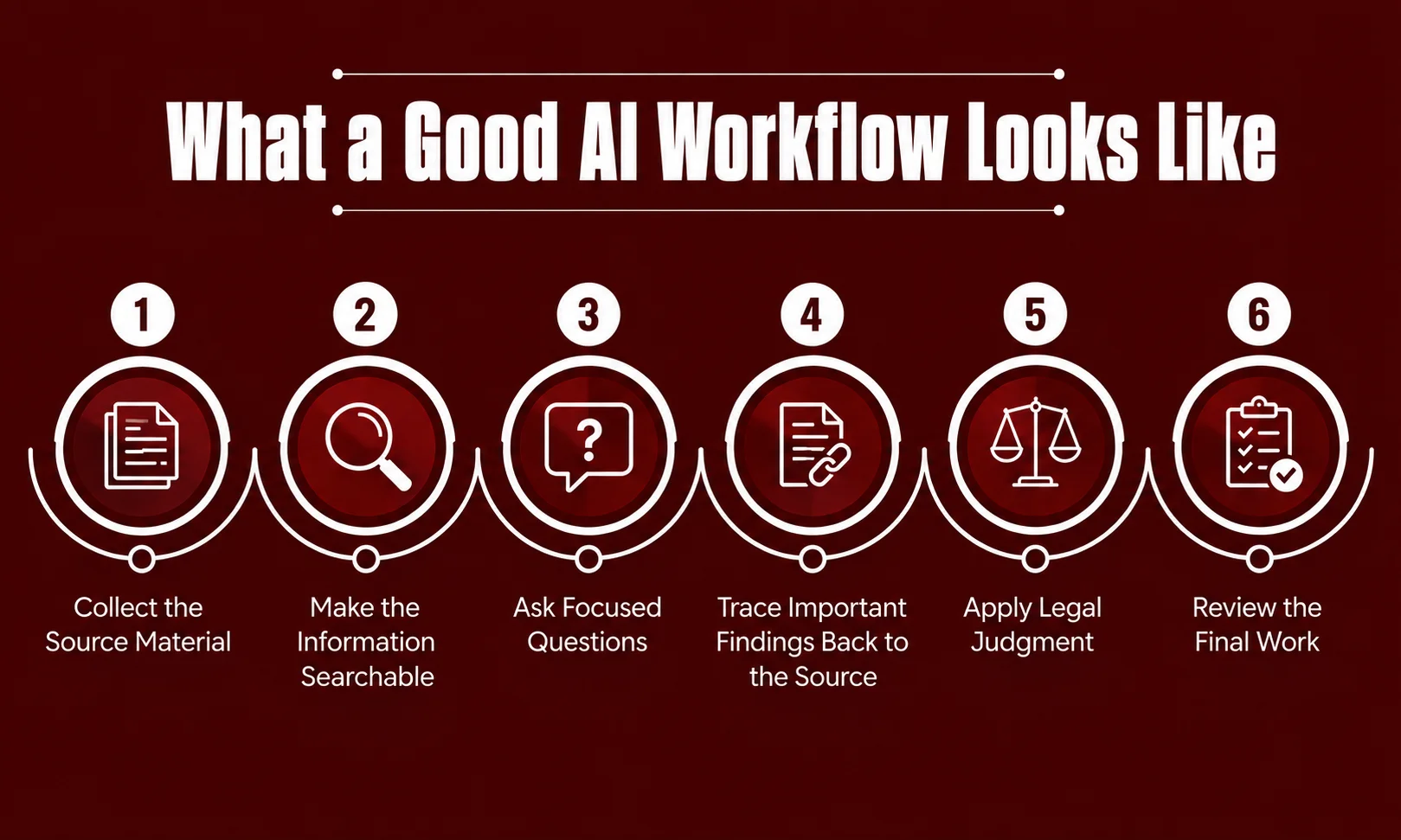
The strongest approach is not to give an AI system an entire case and accept whatever it produces.
A better workflow looks more like this:
1. Collect the Source Material
Gather the relevant medical records, bills, reports, photographs, correspondence, and other evidence.
2. Make the Information Searchable
Where necessary, OCR can convert scanned documents into searchable text before AI analysis begins.
3. Ask Focused Questions
Instead of requesting a vague summary, lawyers can ask the system to identify specific dates, treatment gaps, diagnoses, billing information, prior injuries, or other relevant details.
4. Trace Important Findings Back to the Source
Important conclusions should be checked against the underlying document.
5. Apply Legal Judgment
The lawyer decides whether the information is relevant, accurate, admissible, strategically useful, or in need of further investigation.
6. Review the Final Work
Nothing important should go to a client, opposing counsel, insurer, or court simply because an AI system generated it.
This human-review layer is what turns AI from a potential source of risk into a useful professional tool.
Benefits and Risks at a Glance
| Area | Potential advantage | Main concern |
| Medical records | Faster organization | Incorrect summaries |
| Demand letters | Faster first drafts | Unsupported statements |
| Legal research | Faster searching | Wrong authorities |
| Evidence review | Finds relevant material | Missing context |
| Accident analysis | Helps organize complex data | Faulty assumptions |
| Case management | Less repetitive work | Data security |
| Depositions | Identifies possible questions | Overreliance on AI |
| Discovery | Better document organization | Preservation and privacy issues |
Common Mistakes Lawyers Should Avoid
Treating AI Output as Final
AI-generated material should be treated as work product requiring review, not as an unquestionable answer.
Uploading Sensitive Information Without Checking the Tool
A firm’s first question should not be “How powerful is this AI?”
It should also be “How does this system handle confidential client information?”
Trusting a Citation Without Checking It
Every important authority should be independently verified.
Assuming a Summary Contains Everything Important
A summary can hide details. Original records remain important when a particular fact matters to the case.
Using AI Without a Clear Workflow
Buying an AI tool does not automatically improve a law firm.
The firm needs to identify the actual bottleneck, test the system against real work, and establish a review process.
Conclusion
How AI Is Reshaping Personal Injury Law is ultimately a story about changing workflows rather than eliminating lawyers.
The technology can take on some of the most repetitive parts of a case, from organizing medical records to preparing preliminary timelines and drafting documents. As a result, legal professionals can potentially spend more of their time on investigation, strategy, communication, negotiation, and advocacy.
At the same time, the technology has clear boundaries. AI can misunderstand evidence, produce inaccurate information, miss important context, and create confidentiality concerns if it is used carelessly.
The strongest approach is therefore neither to ignore AI nor to trust it blindly.
Instead, personal injury firms can use specialized technology for the work it handles well, verify important findings against reliable source material, protect confidential information, and keep qualified professionals responsible for the decisions that matter.
That is the practical meaning of How AI Is Reshaping Personal Injury Law: machines are becoming better at handling information, while the human side of legal practice remains essential.
Frequently Asked Questions
How Is AI Reshaping Personal Injury Law?
AI is changing personal injury practice by helping lawyers organize medical records, prepare timelines, review evidence, conduct research, draft documents, analyze case information, and prepare for litigation.
Can AI review thousands of pages of medical records?
Yes, specialized systems can process large medical-record collections and help create chronologies, identify treatment gaps, and extract relevant information. Human verification remains essential.
Can AI write a personal injury demand letter?
AI can assist with first drafts of demand letters and settlement packages using information from case documents. Thomson Reuters currently describes this capability for its personal injury legal AI offering.
Can AI determine who caused an accident?
AI can help organize and analyze evidence, but it should not automatically be treated as the final decision-maker on liability. Accident reconstruction depends on the quality of the underlying evidence and the assumptions used in the analysis.
Can AI replace a personal injury lawyer?
AI can automate or accelerate certain tasks, but it does not replace professional legal judgment, advocacy, negotiation, credibility assessment, or responsibility for the final legal work.
Is AI safe for confidential legal information?
That depends on the specific system, its security controls, contractual terms, data-retention practices, and the applicable professional and privacy requirements. Lawyers should evaluate those issues before entering confidential client information.
What is the biggest advantage of AI in personal injury law?
For many firms, the biggest opportunity is handling information-heavy work more efficiently. Medical records, evidence, bills, and other documents can be organized faster, giving legal professionals more time for tasks that require human judgment.