AI Summary
This is a practical guide to hack squat foot placement the single most important variable on one of the gym’s most misunderstood machines. It walks through every foot position (low and narrow, low and wide, middle standard, high and narrow, high and wide, single-leg), explains exactly which muscles each one targets, when to use each variation, common mistakes that quietly ruin your results, and a suggested foot-position rotation for anyone serious about balanced leg development.
Written for anyone who has been using the hack squat with the same foot placement for months and wondering why one part of their legs keeps growing while the other stays flat.
The Short Version
You’ve been using the hack squat.
You’ve been using the same foot position every time.
You’re wondering why your quads are getting bigger but your glutes aren’t. Or your glutes are working but your knees hurt. Or nothing is growing at all.
Here’s the answer.
It’s your feet.
Key Takeaways
- Foot placement changes which muscles the hack squat trains. Same machine, same weight, completely different workout.
- Feet low and narrow builds quads. This is the classic bodybuilder position.
- Feet high and wide builds glutes and hamstrings. The single best foot position for glute development on any leg machine.
- Feet in the middle at shoulder width is the general-purpose position. Safe, balanced, and where most beginners should start.
- Wide stances hit inner thighs and glute medius. Narrow stances hit outer quads.
- Rotating positions weekly is the fastest way to build balanced leg development.
- Foot placement changes knee stress. The wrong position for your body can quietly damage your knees over time.
Why Foot Placement Is the Whole Game
Here’s what nobody tells you.
The hack squat isn’t one exercise. It’s a family of exercises. And the only thing that changes between them is where you put your feet.
Move your feet three inches forward — different muscles.
Move them three inches wider — different muscles.
Turn your toes out fifteen degrees — different muscles.
Same machine. Same weight. Same movement pattern. But completely different training effect.
This is why some people build incredible quads on the hack squat while others build glutes and yet others build nothing at all. It’s not the machine. It’s not their genetics. It’s their foot placement.
Once you understand this, the hack squat becomes one of the most versatile tools in the entire gym.
What Actually Changes When You Move Your Feet
Two things determine which muscles work when you squat.
Knee travel — how far forward your knees move over your toes.
Hip travel — how far back your hips move behind your ankles.
When your knees travel a lot, your quads work harder. When your hips travel a lot, your glutes and hamstrings work harder.
Foot placement controls both.
Feet low on the platform force your knees to travel forward, which loads your quads. Feet high on the platform push your hips back and reduce knee travel, which loads your glutes and hamstrings.
That’s the whole underlying mechanism. Every foot position is just a different combination of these two variables.
The Six Main Foot Positions
1. Low and Narrow (The Quad Killer)
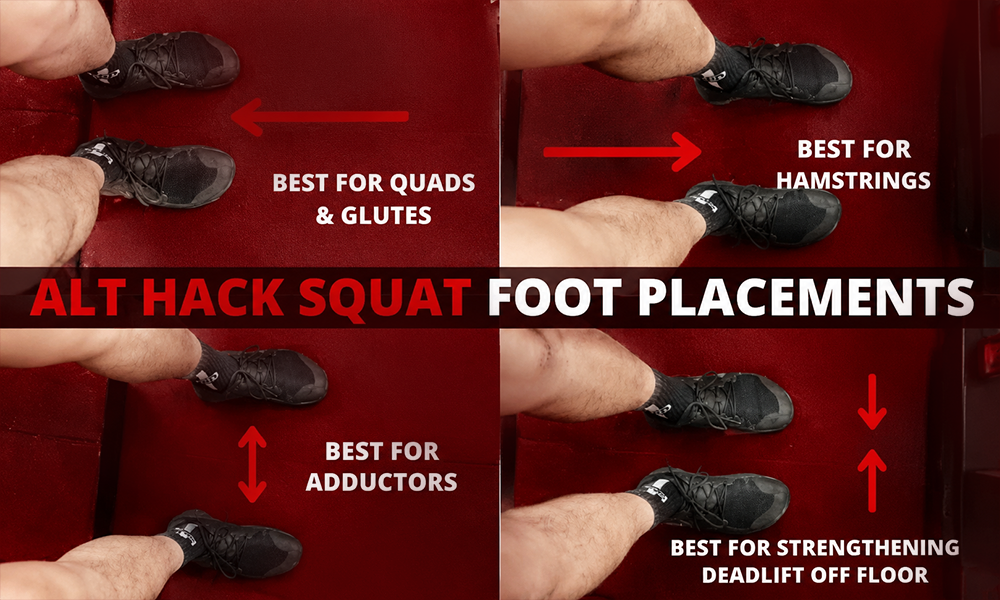
Position: Feet at the bottom of the platform, about shoulder-width apart or slightly closer.
What it trains: Quads. Almost exclusively.
Why it works: With your feet low, your knees have to travel far forward to complete the squat. That forward knee travel is what forces your quads to do all the work.
When to use it: When your quads are your primary training goal. When you want that teardrop shape on the front of your thighs. When you’re building the classic bodybuilder look.
Warning: This position puts real stress on your knees. If your knees hurt, don’t force it. Start with the standard middle position and work your way down.
2. Low and Wide (The Outer Quad Sweep)
Position: Feet at the bottom of the platform, wider than shoulder-width. Toes turned out about 20 degrees.
What it trains: The outer sweep of your quads (the vastus lateralis), plus your inner thighs and glute medius.
Why it works: The wide stance recruits your inner thighs and outer glutes. Combined with the low position, it targets the outer part of your quad that gives your legs that flared, dramatic shape.
When to use it: When you want quad width, not just quad size. When your legs look narrow from the front and you want them to fill out.
3. Middle Standard (The Balanced Default)
Position: Feet in the middle of the platform, at shoulder width. Toes pointed slightly out.
What it trains: Everything. Quads, glutes, hamstrings, inner thighs.
Why it works: This is the position the machine was designed around. It balances knee travel and hip travel evenly, which trains every major leg muscle roughly equally.
When to use it: As your default. If you’re new to the hack squat, start here. If you’re doing a general leg workout, come back here. If you’re not sure what you want to work, this is the answer.
4. High and Narrow (The Hamstring Hit)
Position: Feet at the top of the platform, about shoulder-width apart.
What it trains: Hamstrings and quads together, with less isolation than the middle position.
Why it works: Feet high reduce knee travel, which shifts some work off the quads. The narrow stance keeps the movement centered rather than emphasizing the glutes.
When to use it: When you want to train hamstrings without a dedicated hamstring machine. When your knees are sore and you need less knee stress. As a variation to break up your normal routine.
5. High and Wide (The Glute Builder)
Position: Feet at the top of the platform, wider than shoulder-width. Toes turned out 20 to 30 degrees.
What it trains: Glutes. Primarily. Then hamstrings. Then quads last.
Why it works: High feet minimize knee travel, which reduces quad involvement. Wide stance forces your hips to work harder to control the descent. Turned-out toes recruit your outer glutes fully.
When to use it: When glutes are the priority. When you want to build the shape and roundness that hip thrusts also build. When you want a glute exercise that lets you go genuinely heavy.
This is the position most people should be using more often. Glute development lags for most gym-goers because they never train it directly. The high-and-wide hack squat fixes that.
6. Single Leg (The Balance Test)
Position: One foot in the middle of the platform. The other foot floating or resting on the sled.
What it trains: Whatever position you set the working foot in but harder, because there’s no other leg to help.
Why it works: Single-leg training forces the working leg to do 100% of the work. It also exposes imbalances between your two legs most people have one leg stronger than the other, and single-leg work quietly fixes that.
When to use it: Once or twice a month. Not every workout. Use much lighter weight than you’d use for both legs.
The Mistakes People Actually Make
Mistake 1: Never Changing Foot Position
The most common mistake. Someone tries one position, decides it feels comfortable, and never changes it again.
Six months later, they’ve built one part of their legs and completely neglected the others.
Rotate positions. Every workout. Or at least every other workout. That’s how you build balanced legs.
Mistake 2: Letting Your Heels Come Up
If your heels lift off the platform during the descent, your foot position is either wrong for your body or the weight is too heavy.
Heels lifting means your ankles don’t have enough mobility for that specific position. Try a slightly higher foot position. Or take some weight off.
Mistake 3: Locking Your Knees at the Top
Every foot position benefits from a slight bend at the top. Locking your knees puts all the load on the joint instead of the muscle.
Keep tension in the working muscles the entire rep.
Mistake 4: Going Too Deep With Feet Low
The low-foot position already stresses your knees. Going super deep (thighs well below parallel) in this position amplifies that stress.
If you want to go deep, use the middle or high position. Save the low position for controlled reps to just below parallel.
Mistake 5: Not Warming Up Into the Position
Your first working set shouldn’t be your first set in that foot position. Do a light warm-up set in whatever position you’re planning to use.
Your muscles need a chance to feel the movement pattern before you load them heavy.
A Weekly Rotation That Actually Builds Balanced Legs
Here’s what a serious hack squat rotation looks like across four weekly leg sessions.
Monday: Middle standard position. Three sets of eight reps, heavy.
Wednesday: High and wide. Three sets of ten reps. Moderate weight.
Friday: Low and narrow. Three sets of six reps. Heavy.
Sunday: Single leg, middle position. Three sets of eight per leg. Light.
This rotation hits every major muscle in your legs across the week without overtraining any single one. Most people who follow this pattern for three months see dramatic changes in the shape and balance of their legs not just size.
The Question Nobody Asks
Why does anyone care about foot placement?
Because the difference between someone whose legs look great and someone whose legs look average usually isn’t training volume. It isn’t genetics. It isn’t even nutrition.
It’s variation.
The person with great legs has trained every angle. Quads from the front. Quads from the outer sweep. Hamstrings. Glutes. Inner thighs. Glute medius.
The person with average legs has trained one angle for years.
Foot placement on the hack squat is the fastest, cheapest way to add variation to your leg training. No new equipment. No new exercises. Just three inches of foot movement changes what your body builds.
That’s why this matters.
FAQs
Where should I place my feet on the hack squat?
Start with the middle of the platform at shoulder width. Once you’re comfortable, rotate through low-and-narrow (for quads), high-and-wide (for glutes), and other positions to train every muscle group.
Does foot placement really change which muscles work?
Yes, significantly. Low foot position increases quad activation. High foot position increases glute and hamstring activation. Wide stances hit inner thighs. Narrow stances hit outer quads. Same machine, different muscles.
Which foot position is best for glutes?
High and wide, with toes turned out about 20 to 30 degrees. This minimizes quad involvement and forces your glutes to control the descent.
Which foot position is best for quads?
Low and narrow, feet at the bottom of the platform at shoulder width. This forces your knees to travel forward, which is what activates your quads.
Is it bad for my knees to change foot position?
No as long as you don’t force a position your body isn’t ready for. Low positions stress the knees more than high ones. If a position causes pain, move higher on the platform and rebuild strength gradually.