


Chief Marketing Officer tenure is becoming shorter with changes in the marketing job. The latest CMO tenure statistics show that the average CMO tenure is 4.1 years in S&P 500 companies. The figure is based on 346 named CMOs with data collected up to June 30, 2026.
The wider C-suite has an average of 5.0 years. Only Chief Operating Officers have a shorter average of 3.3 years. So why are CMOs leaving so quickly? The answer is simple. Some CMOs leave for bigger jobs. Others leave when the company changes what it expects from marketing. The bigger issue is the amount of time a CMO gets to prove that a strategy works.
Key takeaways
- The average CMO tenure at S&P 500 companies is 4.1 years.
- The wider C-suite has an average tenure of 5.0 years.
- 62% of exiting S&P 500 CMOs moved to a similar or bigger role.
- Older studies show different numbers because they looked at different companies and time periods.
- The CMO remit keeps getting wider while companies want results faster.
- Short-term results are easier to measure than long-term brand growth.
- Clear goals can give CEOs and CMOs a better way to judge marketing performance.
What the CMO tenure statistics actually say
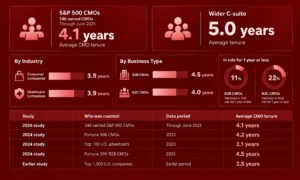
The latest CMO tenure statistics show an average of 4.1 years for 346 named CMOs at S&P 500 companies. The data runs through June 30, 2025. The wider C-suite has an average tenure of 5.0 years.
The number also changes by industry. Consumer companies have an average CMO tenure of 3.5 years, while healthcare companies come in at 3.9 years. Older studies show different results.
| Study | Who was counted | Data period | Average CMO tenure |
| 2026 study | 346 named S&P 500 CMOs | Through June 2025 | 4.1 years |
| 2024 study | Fortune 500 CMOs | 2023 | 4.2 years |
| 2024 study | Top 100 U.S. advertisers | 2023 | 3.1 years |
| 2024 study | Fortune 500 B2B CMOs | 2023 | 4.5 years |
| Earlier study | Top 1,000 U.S. companies | Earlier period | 3.5 years |
The numbers also differ between business-to-business (B2B) companies and business-to-consumer (B2C) companies.
- B2B CMOs: Chief Marketing Officers at companies that sell to other businesses had an average tenure of 4.5 years.
- B2C CMOs: Chief Marketing Officers at companies that sell directly to consumers had an average tenure of 4.0 years.
- B2C CMOs: 22% had been in their role for 1 year or less.
- B2B CMOs: 11% had been in their role for 1 year or less.
These figures come from 2023 data published in 2024 and cover Fortune 500 companies.
So when you compare CMO tenure numbers, check the year and the companies included in the study. Different studies can give different results because they look at different groups.
Why does the average keep falling?

There isn’t one reason behind CMO turnover. The job itself has changed. Companies now expect marketing leaders to deal with growth while also handling brand work, customer needs, digital channels, and business results. That creates pressure from several directions.
The CMO remit keeps moving:
The CMO responsibilities used to have a clearer shape at many companies. Today, a CMO may be responsible for brand strategy, demand generation, customer experience, digital marketing, data, and revenue growth. The exact mix changes from one company to another.
That makes the job harder to measure. A 2025 survey of Fortune 1000 leaders found that only about half of CMOs said marketing leaders were involved in strategic planning. When marketing has a seat at the table but doesn’t have a clear role in business planning, the CMO can end up chasing whatever the company needs that month.
Boards want results quickly:
The timing problem gets serious here. A paid campaign can produce leads or sales within weeks. Building a stronger brand can take much longer. CEOs still need to see business results. CMOs need to show those results while they work on projects that might take years to pay off.
Research has found a gap between the measures CEOs use and the measures CMOs use. About 70% of CEOs in one 2025 survey said they measure marketing through year-over-year revenue growth and margin. Only 35% of CMOs listed those as their top measures. That gap can turn into a problem when the CMO’s scorecard changes halfway through the job.
The CMO role is splitting:
The old CMO title now sits beside several newer roles. Companies use titles such as chief growth officer, chief revenue officer, chief customer officer, chief digital officer, and chief commercial officer.
Russell Reynolds Associates tracked 2,062 publicly announced go-to-market leadership appointments during the first 6 months of 2021. The appointments covered several different leadership roles across marketing, growth, customer,r digital, commercial, and revenue functions.
The reason is easy to understand. Companies want someone to own growth or customer results. The problem starts when nobody owns the whole picture.
Performance channels show results faster:
Short-term marketing has an obvious advantage in a board meeting. The numbers arrive quickly. You can show clicks, leads,s sales conversion rates,s or advertising returns from a recent campaign. Brand work takes longer.
Share of voice is one example. A company can increase its presence in a market over time, but the business effect may not show up in the next quarterly report. Research into hundreds of UK campaigns found that short-term activation can create a quick lift while longer-term business effects build over a longer period. That difference matters when a CMO has only a few years to prove the work.
CEO expectations keep shifting:
CMOs also have to keep up with what the CEO wants from marketing. One survey found that the share of CEOs who said marketing’s role was clearly understood by the C-suite fell from 90% to 70%. Only 31% of CMOs in the same survey said their CEOs were comfortable with modern marketing.
Those figures point to a basic problem. The CEO and CMO need to agree on what marketing is supposed to deliver before they can judge whether the CMO is doing the job.
What does short tenure mean for brand building?
Short CMO tenure creates a timing problem for long term brand building. A new CMO may change the strategy. They may bring in a new agency or change the way the company measures marketing. Then another CMO arrives 3 or 4 years later and changes it again. Some change is healthy. Markets move. Customers change. Companies change.
The problem comes when a strategy gets replaced before the company has enough time to see what it can do. One useful idea here is category entry points. These are the situations that make people think of a particular category and then think of a brand. It could be buying a quick meal or replacing an old phone or planning a holiday.
Brands need repeated exposure to build those links. That takes time. Research into 996 UK campaigns found that business effects grew as campaigns ran for longer periods. Short-term activation produced a quicker lift but that effect faded faster. This creates a clear tension with a 4.1-year CMO clock.
A CMO may spend part of that time setting the strategy. Then the company may change leadership before the full effect appears. There isn’t enough evidence to say short CMO tenure directly causes weaker brand performance. The timing problem is real though.
Why are CMO roles being split or renamed?

The CMO title is changing because companies are changing how they organize marketing. The latest data found that 31% of S&P 500 companies didn’t have an enterprise CMO. Some companies give marketing responsibilities to a chief growth officer. Others use a chief customer officer or chief revenue officer.
Software companies may put more responsibility under revenue. Retail companies may give more control to customer leadership. Hospitality companies may use a chief commercial officer. Each setup changes who owns marketing. A chief growth officer may focus heavily on revenue. A chief customer officer may focus on the customer experience. A chief commercial officer may bring sales and marketing closer together.
These structures can work. They can also create gaps if brand work customer experience,e and revenue are managed by separate leaders with different goals. That is why the title itself doesn’t tell you much. Look at the actual job.
What can help extend CMO tenure?
No single habit guarantees a longer CMO tenure. But a few practical steps can make the job easier to judge.
1. Set the scorecard early
The CEO and CMO should agree on the main measures at the start. Put them in writing. The scorecard can include short-term business numbers as well as longer-term brand measures. That gives everyone the same target.
2. Connect marketing to revenue
CMOs need to understand the numbers the rest of the business uses. Revenue growth matters. So does margin. Brand measures still have a place. The point is to show how marketing supports the wider business.
3. Work closely with finance
The CFO relationship matters because marketing budgets eventually face financial questions. CMOs should be able to explain where money is going and how the company will judge the results. A shared measurement system can make those conversations easier.
4. Track short-term and long-term results
Don’t make the scorecard entirely about this quarter. Track sales and leads alongside measures that show progress in brand strength and customer demand. That gives the company a longer view of marketing performance.
How should you read a CMO tenure statistic?
Before you quote any CMO tenure statistics, check 4 things.
Who was counted?
A study of 346 S&P 500 CMOs is different from a study of the 1,000 largest U.S. companies.
Is the figure an average or a median?
An average can be pushed up by a small number of very long tenures. A median can tell you where the middle CMO sits. The figures used here are averages.
What happened with interim roles?
Check the study method. Some reports don’t make this clear.
What year does the data cover?
The latest 4.1-year figure uses data through June 2025. Older studies use earlier periods. This matters more than it sounds. A move from 3.5 years to 4.1 years doesn’t automatically mean CMO tenure has changed by 0.6 years. The companies counted may be different.
The read
The Chief Marketing Officer seat remains one of the shorter jobs in the C-suite. The latest figure sits at 4.1 years. That’s close to the numbers seen in several earlier studies. I expect the role to keep changing as companies move marketing work into growth, customer revenue,e and commercial teams. The bigger issue is the clock. Brand building can take years. CMOs are often judged much sooner.
A company can deal with that by agreeing on the scorecard before the CMO starts. Give the leader short-term business measures alongside longer-term brand measures. Then everyone knows what success looks like. For the next quarter, there’s one useful place to start: sit down with the CFO and agree on the numbers that will be used to judge marketing. Keep that list short. Then give the CMO enough time to actually work against it.
Frequently Asked Questions
What is the average CMO tenure in 2026?
The latest average CMO tenure is 4.1 years at S&P 500 companies. The figure covers 346 named CMOs with data through June 30, 2025. The wider C-suite has an average tenure of 5.0 years. Only COOs have a lower average of 3.3 years.
Why do CMOs have such short tenures?
CMO tenure is affected by changing job responsibilities, pressure for quick results, and different expectations between CEOs and CMOs. Companies are also creating new growth, customer revenue and commercial roles. Some turnover comes from career moves since 62% of exiting S&P 500 CMOs moved to a similar or bigger role.
Is CMO tenure shorter in B2C or B2B?
Older data from 2023 shows a shorter average tenure for B2C CMOs. B2C CMOs averaged 4.0 years while B2B CMOs averaged 4.5 years. The same data found that 22% of B2C CMOs had been in their role for 1 year or less, compared with 11% of B2B CMOs.
Does short CMO tenure hurt brand performance?
The research doesn’t prove that short CMO tenure directly causes weaker brand performance. It does show a timing issue. Short-term marketing can create quick results while brand-building effects take longer. Frequent changes in strategy can make it harder to keep a consistent message in the market.
What jobs are replacing the CMO?
Companies now use titles such as chief growth officer, chief customer officer, chief revenue officer, chief digital officer and chief commercial officer. Some companies keep a CMO alongside these roles. Others move traditional CMO responsibilities into one of these positions.
How long does brand building take to pay back?
There isn’t one fixed payback period for brand building. Results depend on the company’s marketing budget and strategy. Research on hundreds of campaigns shows that longer-term business effects can build over time, while short-term activation tends to create a faster response.