
You brief the same creator for the fourth time. You explain the product again, repeat the approval rules and wait for the same questions you answered last month. The work keeps restarting even though the relationship already exists.
Building an always on creator programme keeps a standing roster of creators working on a regular cadence rather than rebuilding the relationship for every campaign. The practical work sits in six areas: choosing the roster, recruiting people, setting the operating cadence, briefing at volume, managing approvals and payments, then measuring the programme over time.
The creative gets attention, but the operating system determines if the programme can keep running or not.
Key Takeaways
- Use an always-on creator program when content demand is recurring. A standing roster works best when you regularly need creator content rather than running occasional campaigns.
- Build the roster around roles and performance. Use core, rotating, and trial creators, then review audience fit, content quality, reliability, and compliance before deciding who stays.
- Create a repeatable operating system. Weekly work, monthly performance reviews, and quarterly roster resets keep the program organized and prevent repeated administrative work.
- Standardize briefs, approvals, and payments. A standing brief reduces repeated explanations, while clear approval timelines and payment terms help creators work consistently with the brand.
- Measure the program, not just individual posts. Track roster retention, cost per usable asset, content contribution, creator performance over time, and engagement quality to judge whether the program is becoming more valuable.
When a roster beats campaigns
A roster only makes sense when creator work happens often enough to justify keeping the relationship active. As a working planning rule, consider a roster when you expect at least 8 to 10 creator assets every month for three or more consecutive months. That is a workload threshold, not an industry benchmark.
If your expected volume sits well below it, rebuilding around individual campaigns may take less effort. The category matters too. Food, beauty, consumer products and apps can have regular reasons to create new content. A product with one major launch every six months has a different workload.
The same applies to audience demand. If you need fresh creator content every month for paid social, organic channels, product education or retail activity, a standing roster gives you a repeatable pool to work from.
If you only need three creators for a launch, a campaign structure is usually easier to manage. You can brief, approve, pay and close the work without maintaining an ongoing relationship. An always on creator program starts making operational sense when the work keeps coming back.
Part one: who is on it

The roster should follow your content requirement rather than an arbitrary creator count. A useful influencer program structure has three groups:
| Roster group | Working role | What happens |
| Core | Reliable repeat creators | Regular briefs and longer relationships |
| Rotating | Proven creators | Added or reduced according to content needs |
| Trial pool | New candidates | Small assignments before longer commitments |
The core group can also become part of an ambassador program. These creators have enough experience with the brand to understand the product, approval process and audience without needing the same level of onboarding every time.
The rotating group keeps the roster from becoming stale. A creator can move out when content quality falls, communication becomes unreliable or the audience stops fitting the brief. Someone from the trial pool can move into the active group when repeated work proves the relationship is worth keeping.
For tenure, a three-to-six-month review cycle is a useful starting point. It gives you enough activity to judge the relationship without treating a creator as permanent. The trigger for rotation should be evidence from the programme: missed deadlines, poor audience fit, weak engagement quality, repeated compliance problems or a sustained decline in useful content.
Your tier choices can sit alongside this structure. Use the separate tier comparison when deciding how creator levels differ.
Part two: finding and recruiting
Your first recruiting source should usually be people who already have some connection to the brand.
Start with people you already know
Customers can become strong candidates because they already use the product and can speak from experience. They may produce fewer options than a large discovery pool, but some can become long term ambassador program partners.
Previous campaign creators are another useful source. You already have evidence of their communication, delivery and ability to work with your approval process. Platforms and wider creator discovery give you scale. They also create more screening work, so treat discovery as the beginning of the process rather than the selection itself.
Vet the relationship, not just the audience
Follower count tells you how large an audience is. It doesn’t tell you whether that audience is useful for your brand. Check audience relevance, content history and engagement quality. Look for whether people actually respond to the creator’s content and whether the interaction appears relevant to the subject.
Then review brand safety. Look at recent and older content rather than checking a single post. You need to know what a creator has publicly associated with before putting the brand beside their work.
Reliability matters just as much. Check delivery history, communication and willingness to work under recurring terms. The final question is simple: would you want to brief this person again next month?
Part three: the operating cadence
An always on creator program either becomes manageable or turns into a collection of repeated admin tasks here. The easiest way to run it is to give every activity a place on the calendar.
Weekly: keep work moving
Every week, briefs go out, content comes in, approvals happen and approved content gets scheduled or posted. For a roster of 20 active creators, a reasonable planning model is 6 to 8 programme-management hours per week. Treat this as a working staffing estimate rather than a market benchmark.
The hours cover brief preparation, creator questions, content checks, approval follow ups and status updates. If every creator receives a completely different brief, the workload rises quickly.
Monthly: decide who stays active
Once a month, review performance and delivery across the roster. Check who produced usable assets, who missed deadlines, which creators need more or less work and whether the upcoming month needs different coverage. Run the payment process at the same point in the cycle.
A working planning allowance is another 4 to 6 hours per month for roster review and reporting.
Quarterly: reset the programme
Every three months, step back from individual posts. Review the roster, creator tenure, rights that need renewal, content requirements and rotation decisions. This is also the right point to change the roster mix if your content needs have shifted.
Allow roughly 6 to 8 hours per quarter for this programme-level review before adding any major contract or strategy work.
The exact hours will vary by approval layers, creator count and asset volume. The useful point is that the work needs scheduled ownership. If nobody owns the weekly queue, monthly review and quarterly reset, the roster becomes another campaign workflow.
Part four: briefing at volume
The biggest briefing mistake is writing a new full brief for every piece of content. A standing brief should hold the information that rarely changes:
- Product and positioning facts
- Tone and voice
- Do and don’t rules
- Disclosure and compliance basics
- Approval route
- Asset specifications
- Approved claims and product language
Then give creators a short monthly update. That update can cover a new offer, product news, a seasonal angle and one or two content priorities. The creator should have enough information to understand what changed without reading a ten-page document again.
Give creators room to create
The brand should set the boundaries. The creator should decide how the story works for their audience. That means the standing brief can define the product facts and compliance requirements while leaving format, voice and storytelling choices with the creator.
This also reduces unnecessary revisions. If the brand has already agreed what claims are allowed and who approves the work, the creator has a clearer starting point. If paid amplification or whitelisting is part of the wider programme, keep the rights and amplification process in its dedicated workflow rather than adding it to every creative brief.
Part five: approvals and payment
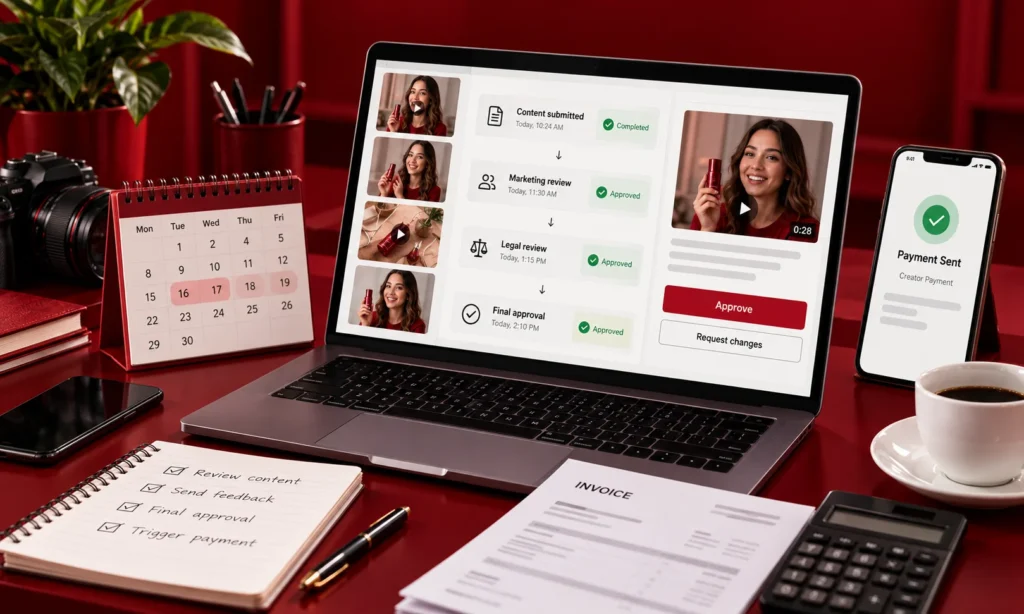
A creator can finish an asset quickly and still have the programme stall inside the brand.
Put a clock on approvals
As a working operating target, aim to complete standard creator approvals within one to two business days. Keep the normal process to two approval layers or fewer. More layers can be necessary for regulated categories, but they shouldn’t become the default for every post.
The standing brief should settle routine questions before content arrives. Product claims, required disclosures, visual rules and escalation points can be agreed once and reused.
When an approval sits with one person for several days, the creator’s production schedule starts moving around the brand’s internal calendar.
Treat payment as part of the relationship
Set the payment window before recruiting the roster. A practical operating target is 15 to 30 days after the agreed payment trigger, with the exact term confirmed in the creator agreement. The payment process should connect approval, invoice intake and the scheduled payment run so finance doesn’t have to rebuild the same information each month.
A brand operating on a 60-day payment cycle should not quietly impose that process on a creator roster and expect the relationship to work the same way. Change the internal payment arrangement for creators, create a separate payment route or use a campaign model until the payment process can support recurring work.
This is part of talent management. Creators remember whether the brand pays when it said it would.
Part six: measuring the programme rather than the posts
A programme needs measures that show whether the roster is becoming easier and more useful to manage over time.
Track four programme measures
- Roster retention shows whether creators continue working with the brand.
- Cost per usable asset shows what the programme costs for content that actually clears the required standard.
- Share of total content from the roster shows whether the standing group is producing a meaningful part of the creator output.
- Performance trend over creator tenure shows whether a relationship becomes more or less useful as the creator works with the brand for longer.
- Post-level reach and engagement still matter. A single post can perform unusually well or poorly for reasons that have little to do with the quality of the relationship.
- That is why engagement quality works better as a trend than as a single-post target. Look at how the creator’s audience responds across several pieces of work.
Measure the cost of keeping the relationship
Creator licensing can change the cost of each usable asset because the payment covers more than production. Rights duration, channels and permitted uses can affect what the brand pays and how long it can use the work.
Keep those terms visible when calculating programme costs rather than comparing creator fees alone. The same applies to talent management. If the roster needs heavy manual follow-up, repeated briefing and constant approval chasing, the creator fee is only part of the programme cost.
Final Verdict For Building an Always On Creator Programme
An always on creator program makes sense when creator content is a recurring business requirement and the brand can support the operating work behind it. It becomes harder to justify when content demand is occasional or internal approval and payment processes are too slow. The first investment should therefore be operational.
Set the approval owner, payment route, standing brief and review calendar before you recruit the roster. Then add creators in manageable groups and let performance, reliability and audience fit determine who stays.
If an agency will run the programme for you, the agency selection process should test its ability to manage this operating cadence rather than simply present a creator database. For more practical guidance, continue through the Creator Economy content hub and join the newsletter for new coverage.