A channel review can turn against Pinterest quickly. A campaign shows a weak seven-day return, the budget moves elsewhere and the team never finds out what the later conversions would have shown.
That is a problem with Pinterest advertising when it is judged using social metrics built around immediate response. Pinterest can behave more like a planning and search channel. People arrive with an idea, search for possibilities, save what they like and may return weeks later when they are ready to buy.
The channel can therefore look weak before its job is finished. That is why the real question is not simply whether Pinterest converts. It is whether the measurement window is long enough to see the conversion.
Key Takeaways
- Pinterest can behave more like a search and planning channel than a typical social feed.
- A short attribution window can miss purchases that happen weeks after discovery.
- Match the measurement window to the customer’s real buying journey and use incrementality to check true impact.
- Pinterest works best for categories where people research, collect ideas and compare visual options before buying.
- Use saveable creative, durable organic content and paid promotion together to support the full customer journey.
Why it behaves like search
Pinterest is classified as social media, but the way people use it can look very different from a conventional feed. A feed user can open an app to pass time and react to whatever appears. A Pinterest user can arrive with a problem to solve, a product to find or a future purchase to plan.
The user starts with a purpose
The difference starts with intent. Someone planning a kitchen may search for layouts before choosing cabinets. Someone preparing for a wedding can collect dresses and decoration ideas before contacting a retailer. A traveller can save destinations long before deciding where to book. That makes the first interaction part of a longer decision rather than proof that the customer is ready to buy.
Current platform guidance reflects this behavior. Pinterest says its usage is generally deeper and less frequent than social and messaging platforms and that viewing content is more common than clicking. It also advises advertisers with longer purchase consideration periods to use longer measurement windows.
A save can come before the purchase
A save is not a sale, but it can be a useful signal of future intent. Published research examining nearly three million Pinterest users found that users showing longer-term purchase intent tended to save and click more content as they moved toward a purchase. The pattern matters because it shows how activity can build before the transaction rather than appearing only at the final click.
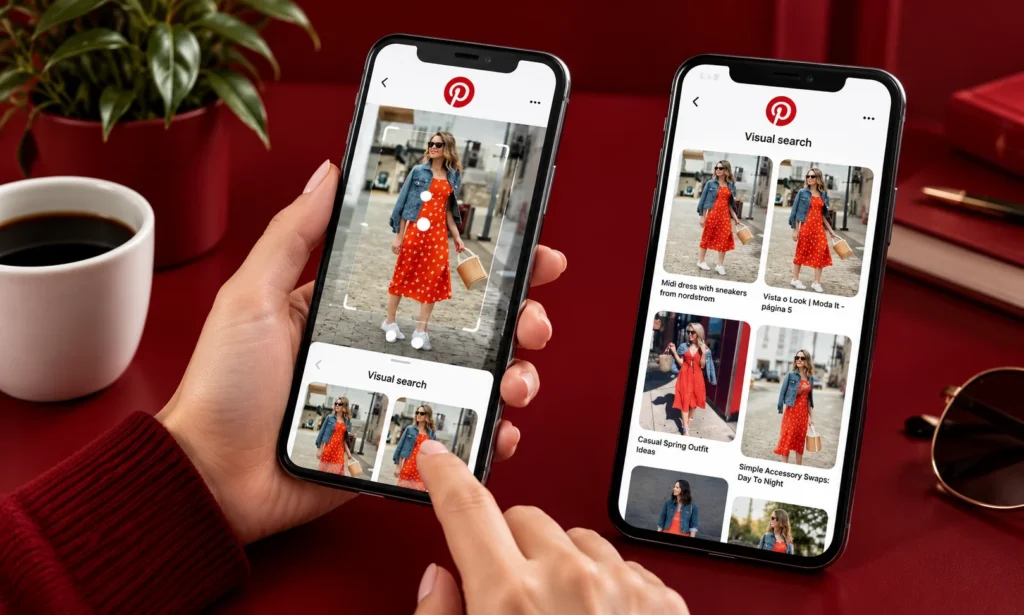
Visual search commerce becomes important here. The customer can begin with an image or broad idea rather than a specific product name, then move gradually toward a product decision. The journey can look like:
search → discover → save → compare → return → purchase
That is much closer to search and planning behavior than a simple scroll-and-react feed.
What the attribution window does to it
An attribution window decides how long after an ad interaction a conversion can still be associated with that interaction. Pinterest currently supports 1-day, 7-day and 30-day lookback windows for its standard conversion and attribution settings.
Its guidance specifically says that businesses with longer purchase consideration periods should choose a longer window. Pinterest can become easy to undercount here.
The same campaign can produce different answers
Take one campaign with the same spend and the same customers. If the team reviews it after seven days, it sees the conversions that happened quickly. At 30 days, more of the purchase journey has matured.
A 90-day view can add another useful perspective, but it needs to be labelled correctly. It should be a longer cohort or analytics view rather than presented as a native 90-day Pinterest attribution setting.
| Measurement view | What it shows | What it can miss |
| 7 days | Immediate response | Slower consideration |
| 30 days | A broader conversion journey | Purchases that take longer |
| 90-day cohort view | Longer-term behavior around the campaign | It is not a native 90-day attribution setting |
The point is not that the 90-day number should always win. It is that a seven-day number should not automatically decide whether a channel deserves another dollar.
Pinterest’s current reporting guidance says a longer attribution window can better measure how the platform influences decision-making and recommends a 30-day click and 30-day view window for reporting.
A longer window has risks too
Longer measurement is not a free pass. The further a conversion sits from the original interaction, the harder it can become to establish what actually caused the sale. Other channels may influence the customer in between. Some purchases may have happened without Pinterest.
A longer window can also delay optimisation because marketers have to wait longer to gather enough conversion data. That means the right answer is not “always use the longest window.”
Match the window to the actual purchase cycle, then use another method, such as incrementality testing, to determine whether the additional conversions represent genuine business impact. For Pinterest advertising, that distinction can be the difference between finding a useful commerce channel and cutting one before its customer journey has matured.
Who it actually works for
Pinterest is not a universal answer for every category. It works best where customers naturally research, gather ideas or compare visual options before making a purchase.
Where the planning cycle fits
Home and interiors: People often collect room ideas before choosing furniture, finishes or décor.
Weddings and events: The planning process can involve months of visual research across dresses, venues, flowers and decorations.
Fashion: Seasonal looks and outfit ideas can influence what a shopper wants before they select a particular product.
Food: Recipes and meal ideas can create product and ingredient discovery before the shopping trip.
Travel: Destination research can begin well before a booking decision.
Beauty: Looks, routines and product combinations give customers something to explore before they choose what to buy.
The common factor is not simply that these categories are attractive in images. It is that the customer can build a preference before making the purchase.
Where the fit is weaker
Pinterest is less naturally suited to products where there is little planning involved. Urgent purchases, low-interest products and situations where customers do not need visual inspiration offer less opportunity for the platform’s discovery behavior to influence the decision.
A simple test is useful: Does your customer plan the purchase and gather ideas visually before deciding where to buy? If yes, Pinterest deserves a serious test. If the answer is no, a short-cycle channel may be easier to justify.
For categories where the product itself inspires the search, Pinterest Shopping ads can then connect that discovery with a direct product path rather than asking the customer to make the jump alone.
The formats and what each is for
Pinterest’s formats make more sense when they are grouped by the job they perform rather than treated as a long feature list. Current advertising options include image, video, carousel, collections and shopping formats, with different formats suited to different campaign goals.
| Customer job | Format role | What it should do |
| Inspiration and awareness | Image or video | Introduce an idea or product clearly |
| Exploration | Carousel | Show related products, variations or steps |
| Deeper discovery | Collections | Combine a main visual with supporting products |
| Purchase | Shopping formats | Connect product discovery with product information |
| Re-engagement | Retargeting | Bring previous product interest back into the journey |
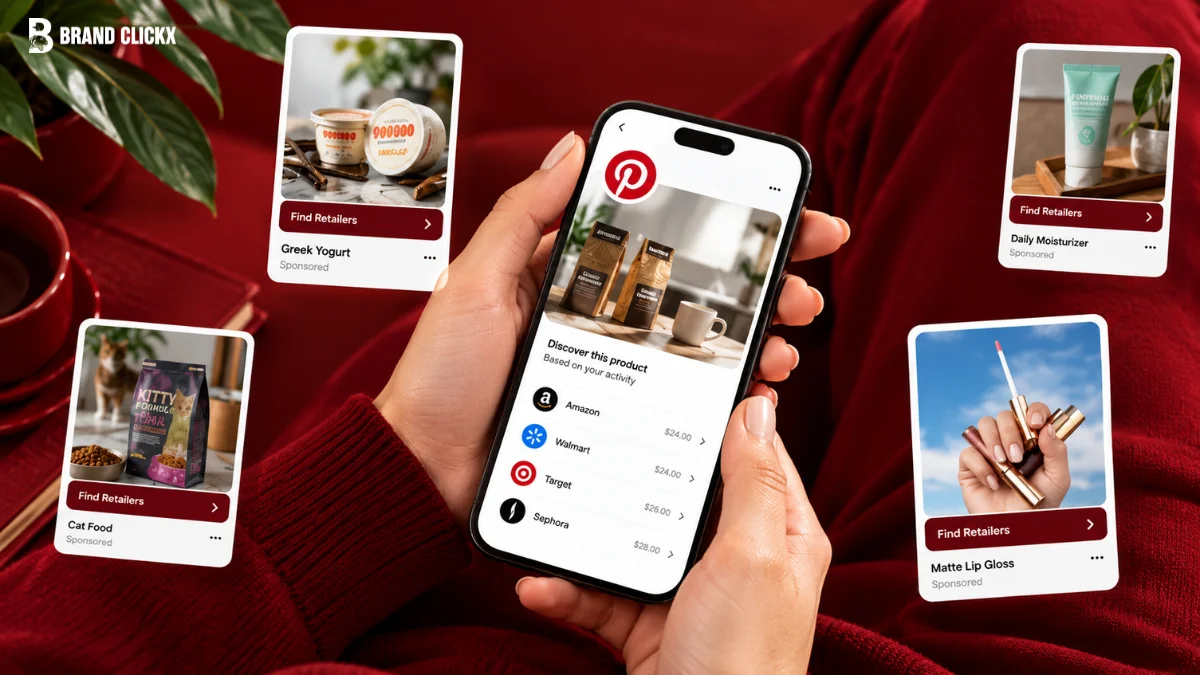
Pinterest shopping ads are particularly useful when the product is already part of the discovery process. Product information can be pulled from a product feed so the ad can show details such as pricing alongside the creative.
The platform also supports shopping and retargeting approaches that can move a customer from discovery toward action without pretending that every person is ready to buy at the first impression.
The customer does not always begin by searching for a product. They may begin with a room, an outfit, a recipe or a travel idea. That is why visual search commerce matters. The image can help the customer define what they want before the product becomes the focus.
The strongest format therefore does not just display the item. It helps the customer understand why that item belongs in the idea they are already exploring.
What the creative has to do differently
Pinterest creative has to earn more than an impression. It needs to be useful enough to save and clear enough to make sense when the person returns later.
Make it saveable, not disposable
A strong Pin can show the product in context, explain the idea quickly and give the viewer a reason to keep it. That makes useful context more important than a creative approach built only around stopping the scroll.
A home product can be shown inside a complete room. A beauty product can be connected to a finished look. A travel product can sit inside a destination idea. The product remains visible, but the idea gives the customer a reason to care.
Creative fatigue works differently here
Creative fatigue still matters, but Pinterest’s longer content life changes the problem. A feed ad can lose attention quickly because the audience sees it repeatedly in a short period. Pinterest content can continue to surface through discovery and saves long after its original publication.
That does not mean every old Pin remains effective. It means marketers should build a library of useful creative rather than assuming every asset has a short shelf life. Algorithmic reach also matters. Pinterest’s distribution is connected to relevance and discovery, so creative needs to match what people are looking for rather than simply being new.
That makes creative volume useful when it creates more relevant ideas rather than simply producing more versions of the same ad.
The organic and paid relationship

Pinterest is unusual because organic content can continue contributing after the original publishing moment. That makes the relationship between organic and paid different from platforms where organic visibility has become increasingly dependent on paid distribution.
Build a durable organic base
A useful Pin can continue being discovered long after it was published. Large-scale analysis of Pinterest content has also found that a substantial share of saves can come from Pins more than a year old, supporting the platform’s unusually long content life.
That creates an opportunity for brands to build a library rather than treating every post as disposable. The contrast is organic reach decline across other major social environments, where brands have increasingly had to rely on paid distribution to maintain visibility.
Pinterest should not be treated as immune to algorithm changes. But its discovery model gives strong content more opportunity to keep working.
Let paid widen what earns attention
The practical split is straightforward. Organic builds the durable base. Paid accelerates it. A brand can learn which ideas attract saves and sustained discovery organically, then use paid distribution to reach more relevant people with those ideas.
This also gives algorithmic reach a practical role. Paid should not be used simply to rescue content that customers consistently ignore. It should help useful ideas travel further and connect them with commercial goals.
How to measure it honestly
The strongest measurement approach starts with the customer’s purchase journey rather than whichever reporting window makes the campaign look best.
Choose the window from real purchase behavior
If customers usually buy within days, a short window may be reasonable. If they routinely spend weeks researching, a longer window is more appropriate.
Current platform guidance explicitly links window selection to purchase cycle and says longer windows are especially important for products that take longer to decide on. The finance report should therefore show the same campaign across different views rather than hiding everything behind one number. A practical layout is:
7-day attributed result + 30-day attributed result + 90-day cohort result + purchase lag + incrementality result. The 90-day number should remain clearly labelled as a cohort or analytics measure rather than a native attribution setting.
Test whether the long window is actually incremental
This is the safeguard against over-crediting Pinterest. A holdout or geographic test can help determine whether people exposed to Pinterest actually produce more business than comparable customers who were not exposed.
Self-reported attribution can add another useful check. A post-purchase question such as “How did you hear about us?” will not replace controlled testing, but it can reveal discovery that click-based systems miss.
The ad auction adds another reason to be careful. The auction prices opportunities based on the signals available to it, so a bidding strategy judged only on seven-day conversions can favor fast responders even when the business depends on customers who take longer to decide.
That is why Pinterest should be compared on business outcomes rather than benchmark costs alone. The paid social benchmark piece can handle cost ranges, while this analysis should focus on whether the measurement window changes the business decision. The goal is not to make Pinterest look stronger. It is to make the measurement harder to misread.
Conclusion
Pinterest remains easy to undervalue because the media plan calls it social while the customer journey can behave more like search and planning. That matters when reporting defaults are shorter than the buying cycle. A seven-day result can tell a useful story about immediate response, but it cannot automatically explain what happens when customers save an idea today and purchase weeks later.
For Pinterest advertising, the practical change is simple: add a 90-day cohort view beside the seven-day result for the same campaign, then put both beside the 30-day view and an incrementality measure. If Pinterest still does not create enough value after that, cut it.
But if the verdict changes when the clock changes, the problem was never necessarily Pinterest. It was the way the channel was being measured.