
A competitive-analysis deck used to take an agency three days: pulling data, drafting slides, chasing revisions. With AI in the workflow, the same deck can come together in three hours, and most of that time goes to deciding what it should say. The invoice, though, was written for the old world. Twenty-four hours at the agreed rate no longer describes what happened, and billing three hours describes it too well.
That gap is the subject of agency AI pricing: how agencies charge for work that AI made faster, and what clients believe they should pay for it. The billable hour was always a proxy for value, and AI has weakened the link between effort and value. This piece separates what agencies say they charge from what they actually bill, because the two are further apart than conference stages admit.
Key Takeaways
- Hourly billing is not finished, but it is no longer the default at large brands. In a survey of 69 multinational advertisers, labor-based models fell to 17% in 2026 from 33% in 2022.
- Fixed-fee and output models (35%) and hybrids (23%) are now more common than time-based billing in that survey.
- Outcome pricing is still rare. At WPP, one client, Jaguar Land Rover, has adopted it.
- Clients want a share of the saving and agencies cite tool costs and human judgment. The real dispute is who keeps the difference.
- The defensible way to price now: define the deliverable, price the judgment, fix the scope, and write down what triggers repricing.
Why the hour stopped working
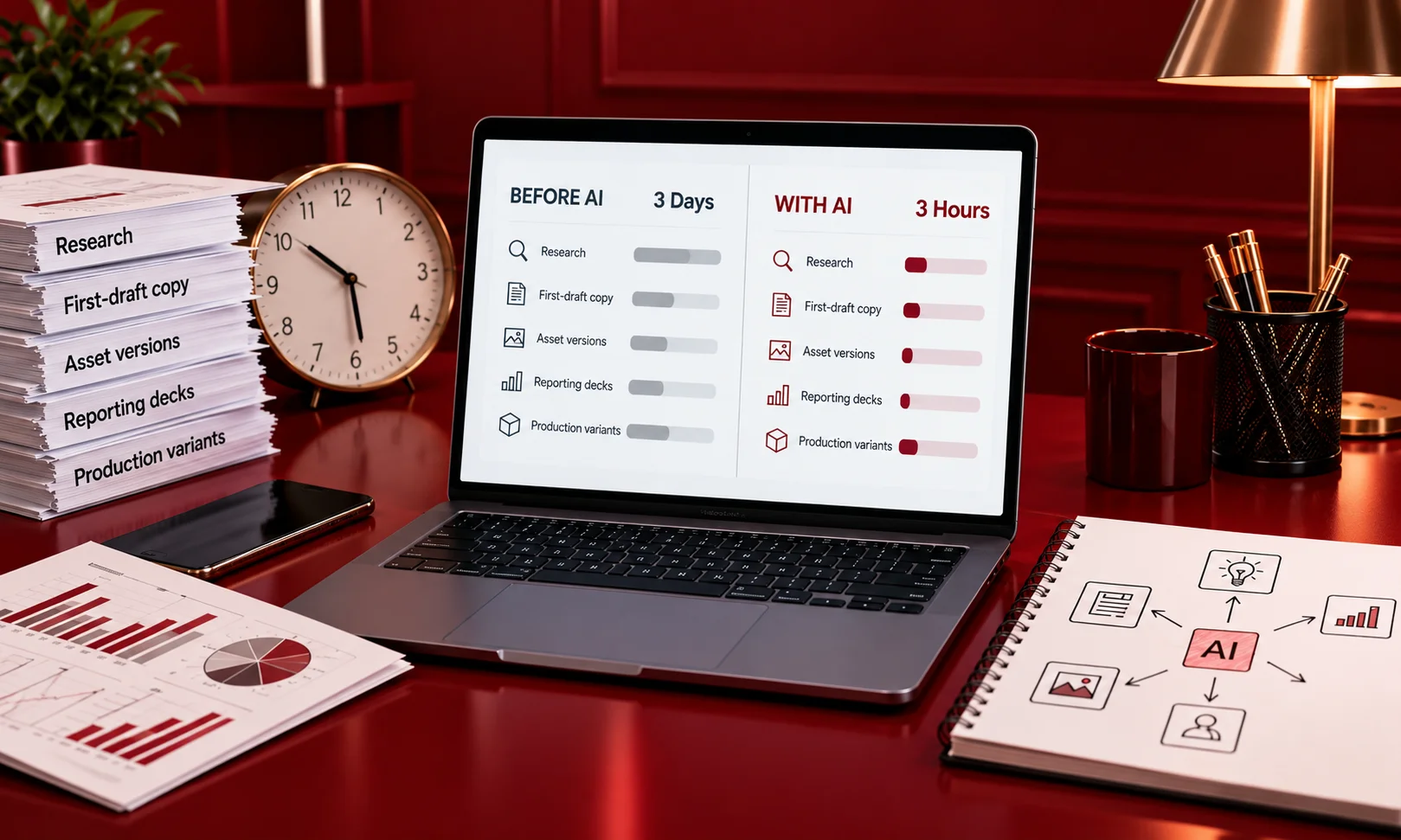
An hourly rate is a price for effort. It worked as a proxy for value because the two moved together: a better strategy took more senior hours, and a bigger campaign took more production hours. An agency rate card was, in effect, a menu of what those hours cost at each level of seniority. Clients could not inspect quality directly, so they inspected time.
Generative AI breaks that link unevenly. The work hit first has a clear format and heavy repetition: first-draft copy, resizing and versioning assets, reporting decks, research summaries, and production variants. Brand strategy, senior creative direction, and client counsel have changed far less, and now carry the added job of checking machine output.
So the rate card still lists the inputs, but those inputs no longer predict what the client receives. WPP CEO Cindy Rose told Digiday that time and materials is “probably not sustainable in the long term” because AI will let the company work faster with fewer people. Faster is not the same as worth less, and that distinction is where every pricing argument starts.
The agency AI pricing models actually in use
Five structures cover nearly everything in circulation. The table compares them, and the notes underneath say where each one fails.
| Model | How it works | Effect on agency margin | Client relationship | Breaks down when |
| Time and materials | Hours billed at agreed rates | Revenue falls as AI removes hours, unless rates rise | Transparent, easy to audit | The client asks for AI-adjusted hours |
| Output / deliverable | Fixed fee per defined deliverable | Agency keeps the efficiency gain if the price holds | Predictable budget | Scope disputes over what counts as one deliverable |
| Capacity retainer | Monthly fee for a block of team capacity | Stable revenue; margin depends on utilization | Simple to budget | The “unit” is an hour with a new label |
| Value / outcome | Fee tied to a business result | Highest upside and widest variance | Aligns incentives on paper | Results depend on factors the agency does not control |
| Hybrid | Base fee plus variable or performance component | Base covers cost, variable shares the gain | Flexible, but complex | The base fee reopens the hours debate |
Time and materials bills hours at agreed rates, so every hour AI removes comes straight off revenue. It is transparent, which is also why clients scrutinize it. Output based pricing sets a fixed fee per defined deliverable, such as a localized asset set or a monthly report. The agency keeps the efficiency gain if the price holds, but loses it if the client stretches the definition of “one deliverable.”
Capacity retainers sell a block of team time each month. They are easy to budget, but a capacity unit is usually an hour under a new name, and clients will ask what a unit now buys. Outcome pricing ties the fee to a result such as sales or leads. It has the highest upside and the widest variance, because results also depend on media, product, pricing, and competitors.
Hybrids pair a base fee that covers cost with a component tied to performance. The design work is in defining exactly what the base covers, since a vague base invites the hours conversation back in.
What is being used vs. what is being talked about
The best available evidence on adoption is a survey, not an invoice review. WFA and Agency Mania Solutions polled 69 multinational advertisers representing $147 billion in combined marketing spend. The share of brands using labor-based models fell from 54% in 2011 to 33% in 2022 and 17% in 2026, while fixed-fee and output models rose from 20% to 35% and hybrids from 9% to 23%. Is the billable hour finished? Not by these numbers, but it has stopped being the default.
Outcome pricing looks different. WPP has made outcome-based pay central to its turnaround, yet Rose said in August that Jaguar Land Rover is so far the only client paying that way and that broader adoption will take a few years. Rose also said moving off time and materials frees her from staffing plans, which is the agency headcount argument.
Three cautions apply to agency AI pricing evidence. Only 20% of surveyed brands are changing remuneration because of AI today, though 61% intend to, and 58% expect to use more performance-based pay, which is intent, not billing. The survey also records model labels, not how fees are built, so a fixed fee may still be priced from hours underneath. I looked for published tenders and procurement guidance disclosing AI-adjusted rates and found none, and I have no invoice-level data.
The client side of the argument
Should clients get the AI efficiency saving? The client’s case is straightforward. If the cost of producing a deliverable falls and the price does not, the whole gain goes to the seller while the buyer receives the same output. Clients will also point out that their briefs, data, and category history are part of why fast first drafts are possible.
The agency’s counterargument is also fair. Tools and tokens are a new cost line, and WPP CFO Joanne Wilson says the business now runs on people costs and technology costs together. Training and quality control fall on the agency, and Grant Thornton’s audit leader noted that quality still depends heavily on expert human judgment.
Both sides are arguing about agency margin: who owns the gap between the old cost of a deliverable and the new one. My read is that the gap is real for production work, contested for analysis, and small for strategy. Not all margin runs on hours either; Digiday reports that rising demand for principal media buying underpins WPP’s turnaround plan. What the tools cost is covered in our agency AI stack analysis.
What happens to the rate card
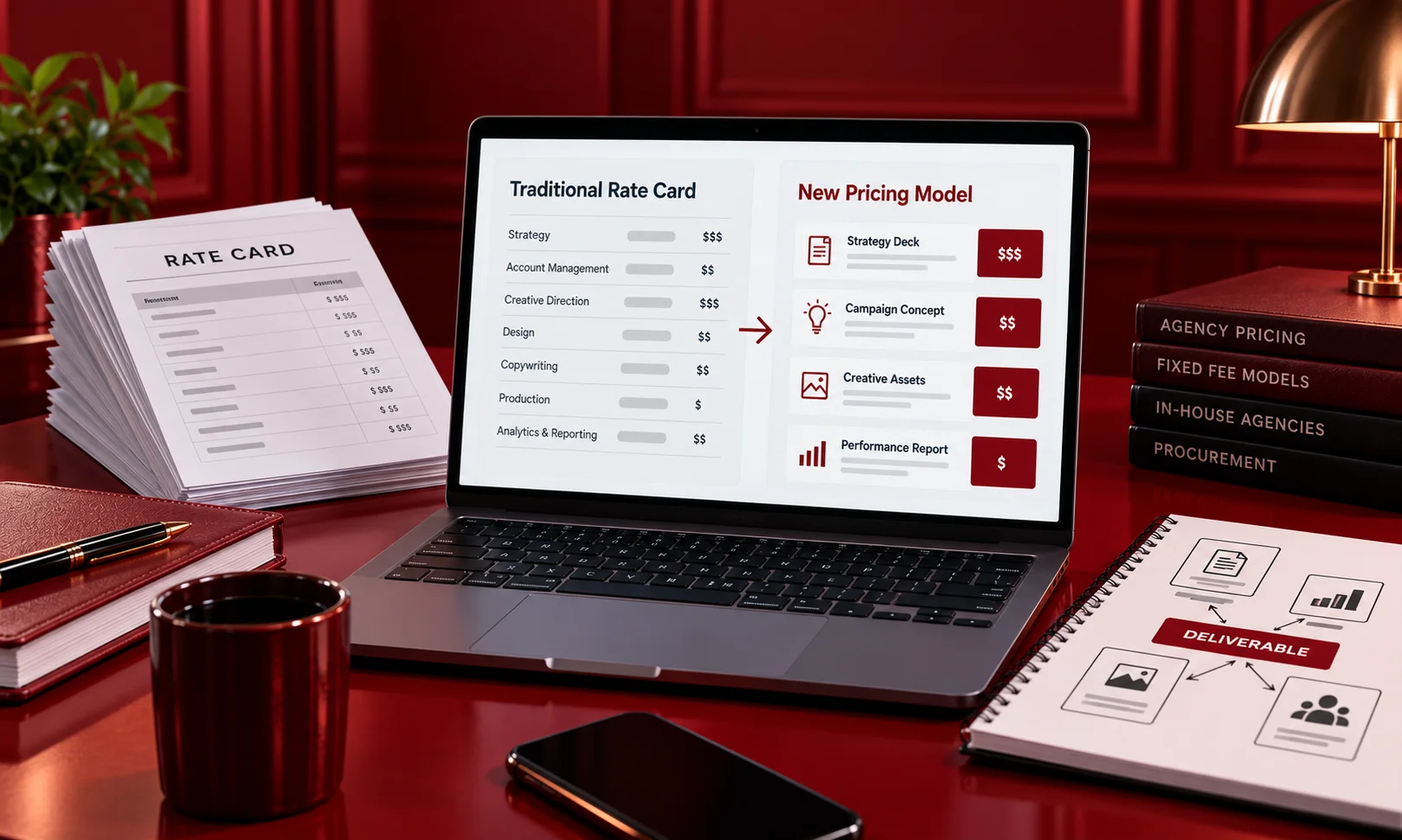
Do agencies still publish rate cards? I could not find a source counting them, and every rate figure I found sat on aggregator blogs rather than in tenders or procurement documents, so I am not printing any. Rate cards have historically lived in pitch responses and contracts, which is why the public record is thin.
What is changing is the job the rate card does. It becomes a costing reference behind a price per deliverable, consistent with the rise of fixed-fee and output models in the WFA data. Procurement then compares agencies on unit prices and the assumptions behind them. The pitch-process article covers how that plays out in a competitive review.
The in-house comparison matters because it gives buyers a benchmark. The ANA reported in 2023 that more than 80% of major brands run in-house agencies, as summarized in a 2026 Piscari report, which argues that AI makes in-housing easier. Consolidation adds a second effect: WPP is moving from hundreds of operating companies to four units, so holdco consolidation may let one group quote a single price across disciplines.
How to price a piece of work now
- Define the deliverable. Name what the client receives, in what format, to what quality bar, with how many revision rounds included.
- Price the judgment, not the production time. Split the job into what the machine produces and what a senior person decides, checks, and signs off. Price the second at its value and the first as a unit price a client could compare with doing it in-house.
- Set a scope boundary. State the unit (per asset, per market, per report), the volume band, and what counts as a new deliverable.
- State what triggers repricing. Volume outside the band, a changed brief, a new market, or a scheduled review at renewal where unit prices are reset as production cost changes.
- Make assumptions explicit. Write down what you assumed about AI use, review time, data access, and client turnaround, so a disagreement is about an assumption and not about the invoice.
The read
The evidence supports one conclusion about durability: output based pricing inside a hybrid structure. Fixed-fee and output models have grown across fifteen years of WFA data, and they work without attributing sales to the agency. Outcome pricing is unproven at scale, with one WPP client on record, and capacity retainers survive only if the unit is defined.
Time-based billing will persist where scope is genuinely unknowable. In your next proposal, replace the headcount or hours line with a priced deliverable list, a volume band, and one written repricing trigger.