
The CMO says LinkedIn is too expensive. The demand-gen manager says the leads are expensive but better. Sales says only a handful were actually worth calling. Finance asks the only question that really matters: “Did any of this turn into revenue?”
That is the problem with most conversations about linkedin ads for b2b. Everyone is using a different unit.
One person is looking at CPC. Another is looking at CPM. Someone else is defending the campaign with lead volume.
For high-ticket B2B, those numbers can be useful diagnostics, but they are poor decision rules on their own. The more useful question is: What can we afford to pay for a qualified opportunity, given what one closed deal is worth?
That changes the calculation completely.
Key Takeaways
- LinkedIn’s premium only makes economic sense when deal value and funnel conversion can absorb it.
- Cost per qualified opportunity is more useful than CPC or raw CPL for high-ticket B2B.
- A qualified lead is not the same thing as a sales opportunity; define the difference before measuring performance.
- LinkedIn is particularly useful when you need precise access to companies, functions, seniority levels, or buying committees.
- If the math does not work below your required acquisition threshold, LinkedIn may simply be the wrong channel.
Why LinkedIn Ads for B2B Cost What They Cost
LinkedIn does not charge a fixed premium simply because it is LinkedIn. Its advertising prices are determined through an auction in which advertisers compete for members who match their targeting criteria.
The audience itself affects the price. If multiple advertisers want the same senior finance leaders at large technology companies, they are competing for the same limited inventory. LinkedIn says auction outcomes depend on factors including bid, audience, objective, bidding strategy, and ad relevance.
That is why targeting a very specific B2B audience can become expensive. You are not buying access to “people who like marketing.” You may be competing for a relatively small group of VP-level buyers at companies that fit a particular size, industry, geography, or account list.
There is another important piece: relevance.
LinkedIn’s platform ranking does not simply reward whoever bids the most. Ad relevance is also considered, with signals such as engagement helping determine how competitive an ad is in the auction. LinkedIn states that more relevant advertising can reduce the price required to compete.
So the premium has a rational explanation. You are paying to reach a professional audience with unusually granular B2B attributes, while competing with other advertisers who often want the same people.
The question is not whether that premium exists.
The question is whether your economics can support it.
The Unit Everybody Uses And Why It Is Wrong
“What’s a good cost per lead on LinkedIn?” sounds like a reasonable question.
It isn’t enough.
A $200 lead can be excellent if 1 in 5 becomes a $100,000 opportunity. The same $200 lead can be terrible if most of the leads are students, vendors, job seekers, or companies outside your serviceable market.
LinkedIn itself has moved further in this direction. Its qualified leads optimization can use CRM or Conversions API data to help optimize toward leads that meet a company’s qualification criteria, and LinkedIn explicitly recommends focusing on cost per qualified lead and lead quality rather than CPL alone.
But “qualified lead” still needs a business definition.
For one company, it might mean an ICP-fit contact who books a meeting. For another, it might mean an account with an active project, the right budget, and a sales-accepted buying need.
A qualified opportunity should be even stricter: an opportunity that sales has accepted into the pipeline because there is a credible commercial need and a realistic path to purchase.
Agree on that definition before looking at the numbers.
Otherwise, marketing and sales can spend months arguing about whether LinkedIn generated “good leads” when they were never measuring the same thing.
The Threshold Calculation
The simplest way to test LinkedIn is to work backward from the value of a closed deal.
Start with:
Average contract value → win rate → expected opportunity value → allowable acquisition cost → lead-to-opportunity rate → allowable CPL
The critical point is that your allowable acquisition cost must come from your own economics.
For the example below, assume the company is willing to spend 10% of contract value on customer acquisition. That 10% is an illustration, not a universal B2B benchmark.
Now assume:
- Average contract value: $100,000
- Opportunity-to-close win rate: 25%
- Lead-to-opportunity rate: 20%
- Allowable acquisition cost: 10% of contract value
The calculation
- Expected revenue from 1 opportunity
$100,000 × 25% = $25,000 - Allowable cost per opportunity
$25,000 × 10% = $2,500 - Allowable CPL
$2,500 × 20% = $500
So:
$100,000 ACV × 25% win rate × 20% lead-to-opportunity rate × 10% allowable acquisition cost = $500 allowable CPL
That produces the threshold.
If LinkedIn is consistently generating leads at $400 under these assumptions, the acquisition math can work.
If it is generating them at $800, it does not automatically mean LinkedIn is bad. But it does mean the campaign is above this particular economic threshold and needs a better conversion rate, lower acquisition cost, higher deal value, or a different channel.
This is also why asking “What is a good CPL on LinkedIn?” misses the point. There is no universal good CPL. Your allowable CPL is a function of your own deal economics.
And if your average contract value is too low to support the cost of reaching and converting your audience, LinkedIn may genuinely be the wrong channel.
What Actually Works on the Platform
The current LinkedIn advertising system gives B2B marketers several routes through the funnel, including Brand Awareness, Website Visits, Engagement, Video Views, Lead Generation, and Website Conversions. LinkedIn also supports formats such as single-image, video, document, carousel, event, and Thought Leader Ads.
For high-ticket B2B, the useful distinction is not “which format is best?” It is which format matches the buying stage.
Lead Generation can make sense when the offer has enough intent behind it to justify a form. LinkedIn now also supports a Qualified Leads optimization goal, using qualified-lead signals from a CRM or Conversions API.
Website Conversions can make more sense when qualification happens on the website or when the conversion requires more context than a native form provides.
At the earlier stages, Thought Leader Ads and Video Ads can help distribute useful expertise rather than immediately asking a cold buyer to book a meeting. LinkedIn describes Thought Leader Ads as a way to sponsor posts from executives or other trusted voices, while Video Ads can be used for objectives ranging from awareness to lead generation and website conversions.
The targeting advantage matters just as much.
LinkedIn supports combinations of attributes such as job function, seniority, job title, company characteristics, skills, and matched audiences. Its own guidance recommends avoiding audiences built around only a handful of job titles and instead using broader relevant title sets where appropriate.
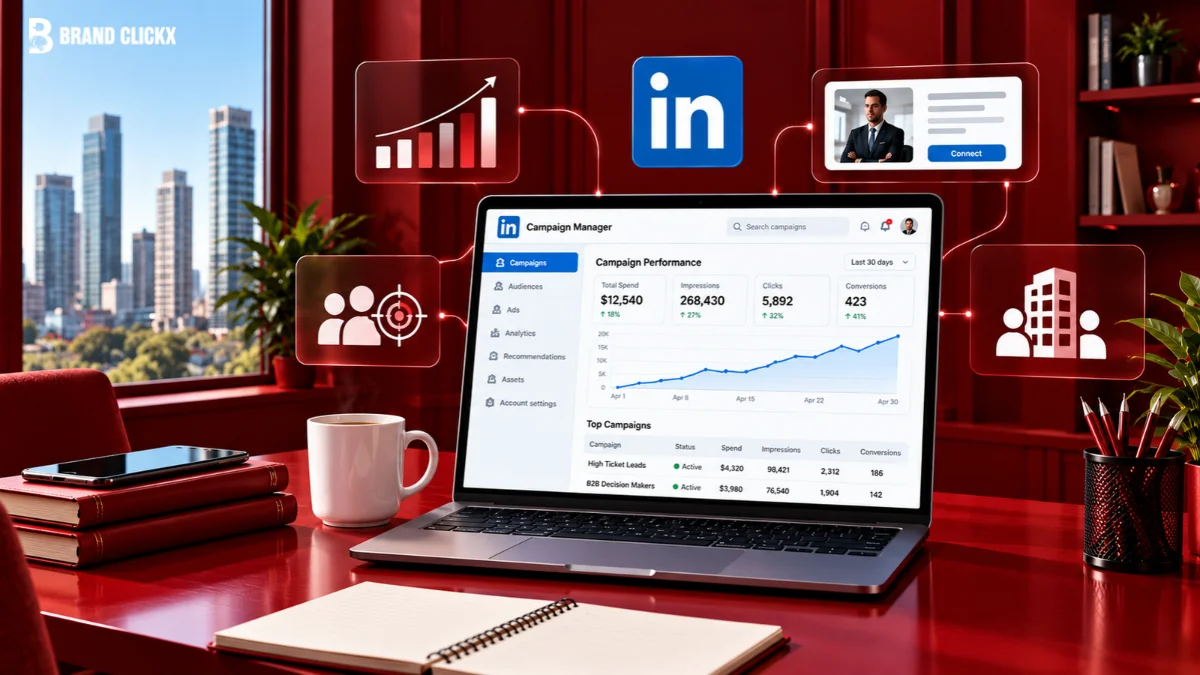
That granularity is where LinkedIn Campaign Manager can become strategically useful: not because every campaign should be there, but because some B2B audiences are difficult to reproduce elsewhere with the same professional context.
What Does Not Work And Keeps Getting Tried
The easiest way to make an expensive platform look worse is to give it a cheap-channel job.
Broad awareness can be difficult to justify when every impression carries a premium and the company has no clear reason to believe those impressions will eventually influence valuable accounts.
The same problem appears with gated content.
A whitepaper can generate hundreds of form fills while producing very little pipeline. If the asset is designed to maximize downloads rather than attract the right buying audience, the campaign can look efficient in b2b paid social reporting while quietly creating a sales-qualification problem.
There is nothing inherently wrong with Lead Gen Forms. LinkedIn says they can pre-fill member information and reduce friction when someone responds to an ad.
The mistake is treating the form submission as the business outcome.
A second mistake is assuming better targeting automatically fixes weak positioning.
It does not.
If the offer is generic, the creative sounds like every other B2B ad, and the landing experience gives buyers no reason to trust the company, precise targeting simply helps you spend money more precisely.
That is not efficiency.
It is precision waste.
Creative on a Platform Where Everyone Looks the Same
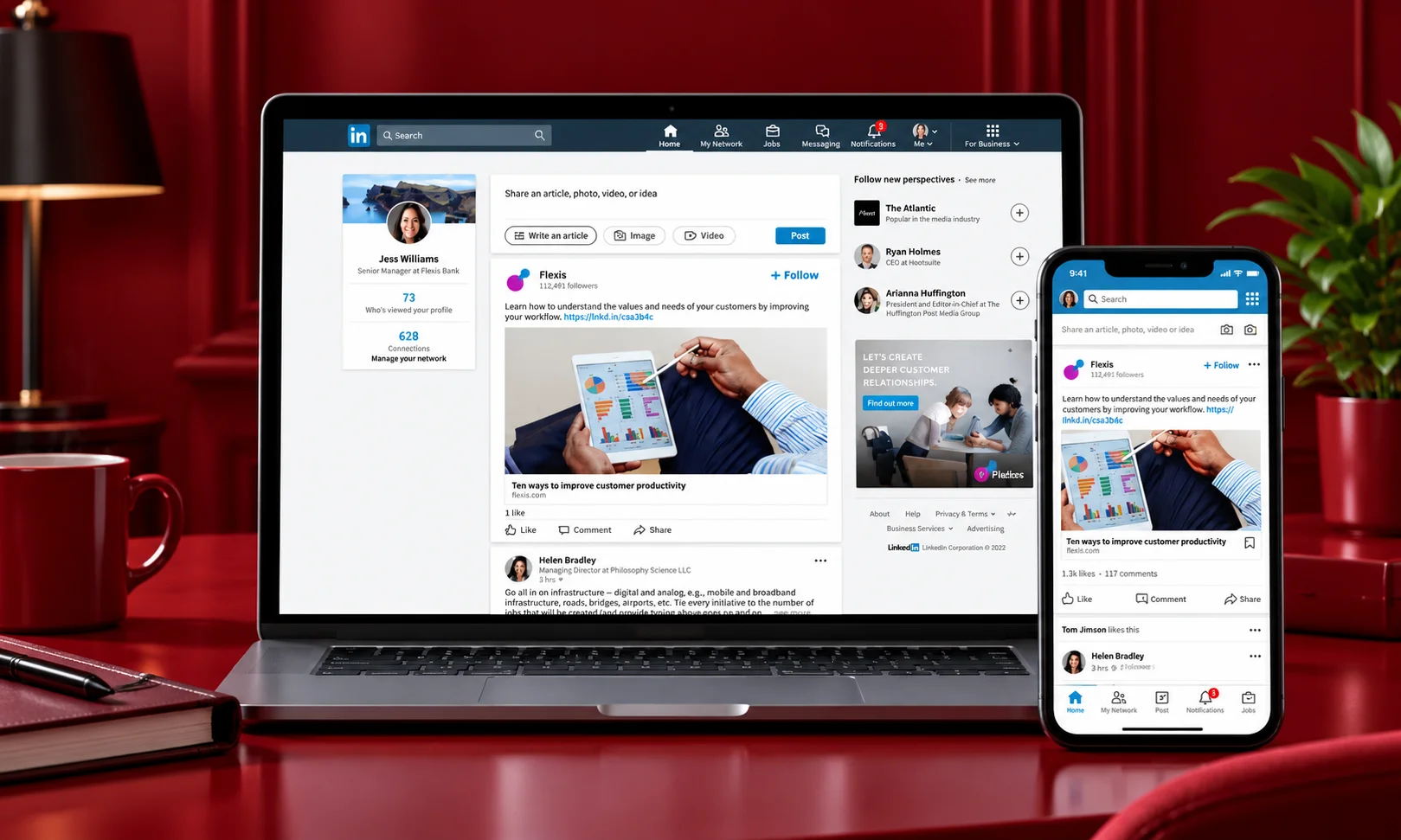
B2B advertising has a creative problem: it converges.
Blue gradient. Stock photograph. “Unlock your growth.” White paper. “Book a demo.” Another executive smiling beside a chart.
When enough advertisers compete for the same audience, sameness becomes expensive because the audience has already seen the pattern.
Creative needs to give the auction something useful to work with, but it also needs to earn attention from people who have no reason to stop scrolling. LinkedIn says ad relevance is part of auction competitiveness, meaning creative quality is not completely separate from media economics.
This is where specificity becomes more valuable than polish.
A real customer problem. A surprising benchmark from your own data. A strong opinion backed by evidence. A product demonstration. An executive explaining something buyers genuinely struggle with.
Short form video can help because it gives the advertiser more room to demonstrate expertise or show the product rather than compressing everything into a headline.
LinkedIn’s current Video Ads support videos from 3 to 30 seconds, while Thought Leader Ads can also amplify video posts.
But small audiences create another problem: creative fatigue.
If the same 20,000 people are repeatedly exposed to the same message, frequency rises and the creative stops feeling new. In a narrow B2B audience, replacing the creative may be more important than endlessly adjusting the bid.
How to Measure LinkedIn Ads Honestly
Long B2B sales cycles make last-click reporting particularly misleading.
Dreamdata’s current research puts the average B2B customer journey at 272 days, while its benchmark work also shows that journeys can involve many touchpoints across several channels.
That means a LinkedIn impression in January can contribute to a deal that closes in September without being the final click.
LinkedIn has responded by expanding its own measurement beyond lead-level reporting. Its Companies Hub can combine paid and organic engagement with CRM-based revenue data, including pipeline value and closed-won revenue when CRM data is connected.
For high-ticket B2B, prioritize:
- Cost per qualified opportunity
- Pipeline generated or influenced
- Opportunity-to-close rate
- Revenue and gross margin from LinkedIn-influenced accounts
- Time from first touch to opportunity and revenue
- Account engagement across multiple stakeholders
Platform reporting still matters. It tells you what happened inside the advertising system.
It just should not be treated as the entire buying journey.
Self-reported attribution can help fill the gaps. Asking “How did you hear about us?” is crude, but it captures something analytics systems often miss: the buyer’s own memory of what introduced or influenced them. Research from HockeyStack has argued that self-reported attribution should be considered alongside, rather than replaced by, other attribution models.
The goal is not perfect attribution.
The goal is a less misleading view of whether the channel is creating valuable demand.
The Read
LinkedIn’s premium can remain economically sustainable for some high-ticket B2B businesses, even as auction competition rises. But the threshold will not be the same for every company.
A $500 CPL is meaningless without knowing whether those leads become $10,000 deals or $100,000 deals. A $2,000 opportunity cost can be excellent for one business and disastrous for another.
The companies most likely to defend the premium are those with high contract values, clear qualification criteria, strong conversion rates, and audiences that LinkedIn can identify better than cheaper channels. The calculation to run this week is simple:
ACV × opportunity win rate × lead-to-opportunity rate × allowable acquisition-cost percentage = allowable CPL.
Then compare that number with your actual qualified-lead economics. If the threshold is below what LinkedIn can realistically deliver, don’t argue with the platform. Change the channel.