
The programmatic supply chain in 2026 still has a money-tracing problem. Major studies show that a meaningful share of advertiser spend goes to technology fees, transaction costs and media losses before it becomes useful media. In 2026, better supply path data and tighter contracts are giving buyers more ways to see where that money goes.
In the ANA’s 2023 study, only 36 cents of every dollar entering a DSP was classified as effectively reaching the consumer. The study covered $123 million in ad spend from 21 marketers and used log-level data from the open web. Of the other 64 cents, 29 cents went to transaction costs and 35 cents went to media productivity losses such as non-viewable or invalid traffic.
The programmatic supply chain is the route an advertiser’s money takes through agencies, DSPs, exchanges or SSPs and publishers before an ad reaches a user. Data, identity and verification services can sit beside that route and add their own costs.
I followed the money through the major studies and compared what each one actually measured. The numbers don’t all describe the same part of the chain, but together they show where the dollar goes and what buyers can still control.
Key takeaways
- The ANA’s 2023 study found 36 cents of each dollar entering a DSP reached the consumer effectively.
- The 2020 ISBA and PwC study found 51% of advertiser spend reached publishers.
- Its unknown share was 15% before falling to 3% in the 2022 study.
- Supply path optimization can remove weak routes, but a curation fee still needs scrutiny.
- Buyers can ask for log-level data, fee disclosure and audit rights before a campaign starts.
What the programmatic supply chain in 2026 looks like, step by step
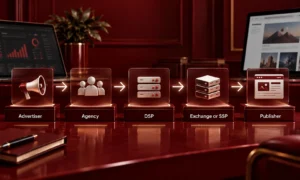
The route starts with the advertiser and ends with a publisher delivering an impression. A common path looks like this:
Advertiser → Agency → DSP → Exchange or SSP → Publisher
The agency may handle the media relationship. The DSP receives the buying instructions and bids on available impressions. The exchange or SSP connects demand with publisher inventory. Several services can sit beside those steps. Verification checks things such as viewability and invalid traffic. Data providers supply audience information. Identity resolution connects signals across approved environments.
The technical trail also contains tools such as ads.txt, sellers.json and the SupplyChain object. These help buyers identify authorized sellers and see which companies appear in a transaction. That still leaves a basic problem. Seeing the route doesn’t always mean seeing the full bill. The ANA’s 2023 study found that advertisers were using more than 40,000 websites in some cases. It recommended working with roughly 75 to 100 trusted sellers and using direct supply paths where possible.
Where the money actually goes
The clearest way to understand supply path economics is to start with $1.
What happens to $1 in programmatic
The 2020 ISBA and PwC study examined 1.3 billion impressions across 15 advertisers, 12 publishers, 8 agencies, 6 SSPs and 5 DSPs in the UK programmatic market. Publishers received 51% of advertiser spend. The study also found 15% of spend that could not be attributed to a specific part of the chain.
| Where the dollar went | Share in the 2020 study |
| Agency fee | 7% |
| DSP core fee | 8% |
| Demand-side technology fee | 10% |
| Unknown delta | 15% |
| SSP fee | 8% |
| Supply-side technology fee | 1% |
| Publisher revenue | 51% |
| Total | 100% |
So $1 from the advertiser became about $0.51 for the publisher under that study.
Why the 2020 study left 15% unattributed
The 15-cent unknown delta was the part buyers couldn’t assign to a named cost. That doesn’t mean the money disappeared. It means the study could not match it to a specific transaction in the available records.
What changed by 2022
The next ISBA and PwC study used data from September and October 2022. It analyzed another 1.3 billion impressions. The match rate rose from 12% to 58% and the unknown delta fell from 15% to 3%. Publisher revenue rose from 51% to 65% under the study’s defined scope.
There is a catch. The 2022 study focused on premium advertisers, agencies, technology vendors and publishers. ISBA says the results shouldn’t be treated as a picture of the entire programmatic market.
Why the studies show different numbers
The ANA study asks a different question. Its 2023 work used $123 million in spend from 21 marketers and 12 supply-chain companies. It found 29% of each dollar went to transaction costs while 35% went to media productivity losses. Only 36% reached the consumer effectively.
These studies aren’t interchangeable. One follows publisher revenue and unknown spend. The other measures transaction costs and media productivity. That distinction matters when someone quotes a single “ad tech tax” number as if it applies to every campaign.
Why the ad tech tax survives
The ad tech tax is the collection of fees paid to the technology companies and intermediaries involved in a programmatic transaction.
What counts as an ad tech fee
DSPs need infrastructure to process bids. SSPs need systems to manage publisher inventory. Verification companies inspect media quality. Data providers supply audience signals. The fees become harder to judge when several commercial arrangements sit inside the same purchase.
Where extra fees can enter the deal
Bundled contracts can hide individual charges. Rebates can affect commercial incentives. Principal-based buying can create another margin when an agency buys media and resells it to its client.
Who gets paid along the supply chain?
The ANA’s 2023 study found information gaps between buyers and sellers and called for stronger access to log-level data. It also recommended direct contracts with primary supply-chain partners such as DSPs, SSPs and ad verification vendors.
Who gains from the tax depends on the deal. A technology company earns its stated fee. An agency can earn a fee or margin. A data company earns for its data. A verification vendor earns for checking the media.
What buyers can ask for
The buyer’s job is to know which one is being paid and why.
Curation and supply path optimization: fix or new fee?

Supply path optimization means choosing which routes a buyer uses to reach publisher inventory. The goal is to remove duplicate sellers, reduce unnecessary hops and put more spend through paths that provide usable transaction records.
Curated marketplaces take that process further. A curator can select inventory, apply audience rules or group publishers into a package that a buyer can access through a defined deal. That work can have real value. It can also add another fee.
The 2022 ISBA and PwC study found a 3% unknown delta across its sample. It also found a difference between open marketplaces and private marketplaces, with the latter showing an unknown delta below 1% in the study. Before paying for a curated deal, use this 5-point curation check:
- Who owns the inventory?
- How many sellers sit between you and the publisher?
- What does the curator add?
- What fee does the curator charge?
- Can you inspect the transaction records?
A shorter path can help. A new fee can still be worth questioning.
What cookie deprecation and identity work changed
Cookie deprecation moved more attention toward first-party data, identity resolution and clean rooms. That changed the services around the media transaction. Publishers can package their own audience signals. Identity companies can help connect approved signals. Clean rooms can let companies compare data under controlled conditions.
The cost moved with the work. Identity resolution can carry a fee. Data onboarding can carry a fee. Clean-room services can carry a fee. IAB Tech Lab has also worked on standards for curated audiences that can work without third-party cookies or mobile identifiers. For a buyer the useful question is simple: what signal am I paying for and what does it change about the impression? If the answer is hard to get from the seller, then the fee deserves another look.
What a buyer can actually control
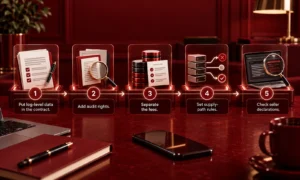
Advertisers can control more of the supply chain when they put the requirements into the contract.
The 5-step buyer checklist
- Put log-level data in the contract.
State which fields you need and when they must be delivered. - Add audit rights.
Specify who can inspect transaction records and how the audit will work. - Separate the fees.
Ask for DSP, SSP, data, verification and other charges as separate lines. - Set supply-path rules.
Declare which sellers and routes are allowed. Require approval when the route changes. - Check seller declarations.
Compare ads.txt, sellers.json and SupplyChain information with campaign records.
A large advertiser has more room to negotiate direct contracts and regular audits. A mid-market advertiser may have less leverage but can still ask for fee schedules and transaction records.
The ANA’s 2023 report also recommended that buyers cut the number of sellers they work with. It suggested a starting group of 75 to 100 trusted sellers and said 5 to 7 SSPs could provide access to close to the full supply in its analysis.
The point is control. A buyer can’t inspect 40,000 sites and every route behind them with the same attention.
The read
I think transparency is improving because buyers now have better tools for tracing the money. The 2022 ISBA and PwC study is a good example: its unknown delta fell to 3% and its impression match rate reached 58%, compared with 15% and 12% in the 2020 study. But that progress came from better data access and audit work. It didn’t happen because the supply chain became simple.
The next step depends on contracts. Buyers need the right to obtain the records before they need them. Put log-level supply-chain data and audit rights into the next media contract. Then use those records to check what each dollar actually paid for.
Frequently Asked Questions
What is the programmatic supply chain?
The programmatic supply chain is the route an advertiser’s money and ad request take through agencies, DSPs, exchanges or SSPs and publishers. Data, identity and verification companies can sit alongside these steps. Each participant can add a service and a cost.
What is the ad tech tax?
The ad tech tax refers to the fees paid to technology platforms and intermediaries involved in programmatic buying. DSPs, SSPs, data providers and verification companies can each charge for their part of a transaction. The total varies by the buying arrangement and services included.
How much of an ad budget reaches the publisher?
It depends on the study and its scope. The 2020 ISBA and PwC study found that 51% of advertiser spend reached publishers. Its 2022 study found 65% under its defined scope. The 2022 research also reduced the unknown share from 15% to 3%.
What is supply path optimization?
Supply path optimization is the process of choosing which routes a buyer uses to reach publisher inventory. Buyers can reduce duplicate sellers and focus spend on routes with clearer records about the transaction.
What is a curated marketplace?
A curated marketplace groups selected publisher inventory for buyers based on defined audience or media rules. The curator can filter inventory and sellers before the buyer bids. Buyers should check what the curator adds and what fee sits on top of the existing supply path.
Can advertisers audit the programmatic supply chain?
Yes. Advertisers can put audit rights into their contracts and request the records needed to trace transactions. ISBA’s audit work found that log-level data and standardized access improved impression matching and reduced the unknown share in its 2022 study.
Sources used
- ANA, Q2 2026 Programmatic Transparency Benchmark
- ANA, Q1 2026 Programmatic Transparency Benchmark
- ANA, Programmatic Media Supply Chain Transparency Study, 2023
- ISBA/PwC, Second Programmatic Supply Chain Transparency Study
- IAB Tech Lab, Supply Chain and Curation Standards
- ANA, Media Transparency Guidance