Last updated : September 2026
Chinese robotics maker Unitree Robotics made history on Wednesday, August 19, 2026. The Hangzhou-based company began trading on Shanghai’s STAR Market under ticker 688836. This listing marked mainland China’s very first initial public offering (IPO) by a humanoid robot company.
The public listing sparked an immediate rush among investors. Unitree raised 6.1 billion yuan (about $904 million), easily beating its initial regulatory goal of 4.2 billion yuan.
Shares opened at 1,100 yuan, leaping 629 percent above the issue price of 150.80 yuan. The stock finished its first day up between 450 percent and 460 percent. At its peak opening price, Unitree was valued at 445 billion yuan ($66 billion), briefly passing major tech giants like Baidu and JD.com before settling near $50 billion.
The Massive Retail Buying Wave
Everyday investors rushed to buy shares in unprecedented numbers. Total retail bids reached between 7.07 trillion and 8.1 trillion yuan ($1.1 trillion to $1.2 trillion). This demand surpassed the recent record set by memory chipmaker CXMT.
Because retail orders exceeded available shares by 5,500 to 8,000 times, the chance of winning an allocation fell to between 0.018 percent and 0.02 percent. This left retail applicants with odds of roughly 1 in 5,500.
The surge also turned Unitree’s 36-year-old founder, Wang Xingxing, into an overnight multibillionaire. His 31.29 percent post-listing stake was valued at approximately $15.9 billion to $16 billion.
Big Tech and Pre-Market Excitement
Strong demand was visible before official trading began. Pre-IPO futures contracts jumped more than 64 percent.
Investors viewed the IPO as an easy way to buy into “embodied AI” robots that use artificial intelligence to move and work in the real world.
Chinese AI firm DeepSeek supported the IPO with an investment of 140.8 million yuan. Unitree also entered the public market with backing from tech giants such as Alibaba, Ant Group, Tencent, and several government funds.
Offering Snapshot
| Offering Metric | Recorded Outcome | Source Reference |
| Listing Venue & Code | Shanghai STAR Market (688836) | |
| Final Offering Price | 150.80 yuan per share | |
| Capital Raised | 6.1 billion yuan (~$904M) | |
| Peak Day-One Pop | 1,100 yuan (+629%) | |
| First-Day Closing Gain | +450% to +460% | |
| Baseline IPO Valuation | 61 billion yuan (~$9.04B) | |
| Peak Opening Valuation | ~445 billion yuan (~$66B) | |
| Retail Subscription Volume | 7.07T to 8.1T yuan ($1.1T–$1.2T) | |
| Retail Allocation Rate | 0.018% to 0.02% (~1 in 5,500) |
Company Finances and Low-Cost Production
Unlike many robotics startups that lose money, Unitree entered public markets with fast-growing profits.
In 2025, revenue reached 1.71 billion yuan ($235 million to $252 million), a 335 percent jump from 393 million yuan in 2024. The company reported a net profit of 278 million yuan, an adjusted profit of 600 million yuan, and gross profit margins above 60 percent.
By comparison, major international rivals like Boston Dynamics are still unprofitable.
A Shift to Humanoid Machines
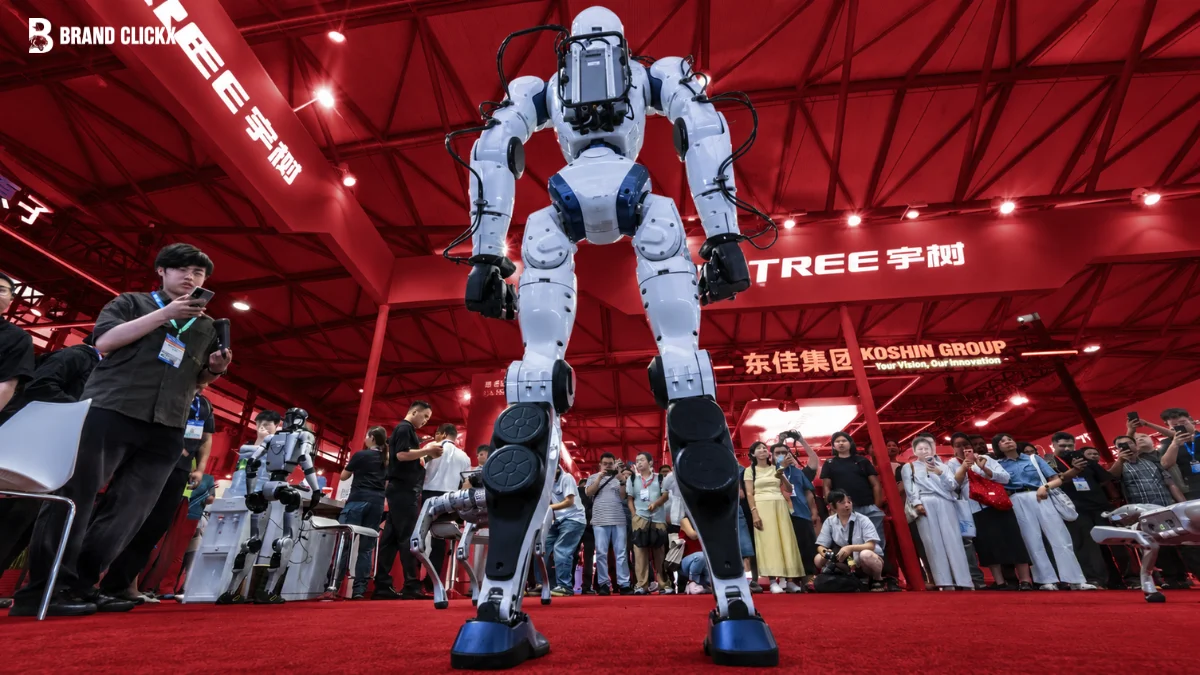
Unitree first became famous for its four-legged robotic dogs. However, two-legged humanoid robots quickly became its primary sales driver in 2025, accounting for roughly 51.5 percent to 52 percent of total revenue.
Domestic parts manufacturing gave Unitree a big cost advantage. The company designs and builds its own motors, reducers, and sensors in Hangzhou.
This local supply chain allowed Unitree to sell its G1 humanoid robot for roughly $16,000, far below the prices of Western alternatives.
Government Support and Global Competition
Beijing has named humanoid robotics a strategic priority in its national 15th Five-Year Plan. Regional authorities and state-owned companies have responded by offering grants, testing sites, and public contracts.
Across China, embodied AI startups raised over 34.5 billion yuan ($4.7 billion) in the first half of 2026 alone.
Robot shipments are growing rapidly worldwide. Global humanoid shipments jumped 272 percent year-over-year in early 2026 to 19,100 units, according to Smart Analytics Global.
Unitree shipped 5,632 humanoid robots in 2025, taking a 32.4 percent global share. It also held a 52 percent share in four-legged robot dogs.
Competition is growing at home as well. By the first half of 2026, rival maker Agibot from Shanghai delivered 8,400 humanoid units to grab 44 percent of the market, placing Unitree in second place with 5,900 units and a 31 percent share.
Industry Benchmarks
| Market and Operational Indicator | Performance Benchmark | Source Reference |
| Cumulative Quadruped Deliveries | 33,294 units (through 2025) | |
| 2025 Humanoid Deliveries | 5,632 units (Ranked #1, 32.4% share) | |
| H1 2026 Humanoid Deliveries | 5,900 units (Ranked #2, 31% share) | |
| Agibot H1 2026 Deliveries | 8,400 units (Ranked #1, 44% share) | |
| JPMorgan Humanoid Forecast | 18K (2025) to 60K (2026) to 1.75M (2030) | |
| International Sales Share | ~45% of total 2025 revenue |
Financial institutions expect major growth over the next decade. JPMorgan predicts global humanoid shipments will rise from 18,000 units in 2025 to 1.75 million by 2030, with China driving more than half of all purchases.
Morgan Stanley estimates that by 2050, the world could see 1 billion humanoid robots generating $5 trillion every year.
Software Obstacles and Warnings from the Founder
Despite the wild market rally, Unitree’s leadership delivered a cautious message. Speaking at the 2026 World Robot Conference in Beijing just after the IPO, CEO Wang Xingxing warned that software remains a difficult challenge.
Wang noted that the robotics industry is moving toward a “ChatGPT moment,” but machines that can work completely on their own in unfamiliar settings are still years away.
Robots face physical problems that text-based AI models do not experience. Small mistakes of just a few millimeters or centimeters compound quickly, causing physical tasks to fail.
Wang estimated that having robots finish 80 percent of tasks in unfamiliar places via simple voice commands will take two to three years in a best-case scenario, or five to ten years under normal conditions.
Even though Unitree is spending 4.2 billion yuan of its IPO funds on physical AI models and research, Wang openly admitted the company still lags in real-world AI software. Georg Stieler, an automation consultant, noted that Wang’s grounded remarks stood in sharp contrast to the massive stock frenzy.
High Valuations and Future Risks
Unitree’s high valuation has raised concerns among financial analysts. At its IPO issue price, the company traded at 219 times 2025 earnings and nearly 36 times revenue. Typical domestic machinery firms trade at around 38 times earnings.
At the opening peak, Unitree’s valuation briefly touched 857 times expected 2026 earnings before the stock fell 11 percent the next day. Wei-Sern Ling, an analyst at Union Bancaire Privée, warned that the initial leap was driven by retail hype rather than proven financial results.
In contrast, early backer Yu Wenchao of Dunhong Asset defended the price, arguing that the valuation is reasonable when compared to private robotics startups abroad.
Day-to-day operations and foreign trade also carry risks. Real-world training remains slow and costly. At a training center in Liuzhou, trainers sometimes needed hundreds of practice tries just to teach a robot a single motion.
Furthermore, international sales brought in roughly 45 percent of Unitree’s 2025 revenue. New foreign trade restrictions or rules on robot imports could threaten this overseas income.
Unitree’s public listing will serve as a key benchmark as competitors like Agibot plan Hong Kong listings and Boston Dynamics explores a Nasdaq IPO. To protect its high valuation, Unitree must show that its robots can move beyond simple demonstrations and perform dependable work.
Frequently Asked Questions
What company launched China’s first humanoid robot IPO?
Hangzhou-based Unitree Robotics (registered as Yushu Technology Co.) launched the IPO on Shanghai’s STAR Market under ticker 688836 on August 19, 2026. The company is widely known for both its quadruped robot dogs and its low-cost humanoid models like the G1.
Why did Unitree’s stock price jump so much on its first day?
The stock surged up to 629 percent due to overwhelming retail interest, heavy government support for robotics, and the company’s rare profitability. Retail orders exceeded available shares by over 5,500 times, creating intense buying demand.
How much money did Unitree raise, and how will it be spent?
Unitree raised 6.1 billion yuan (around $904 million), well above its original 4.2 billion yuan target. The company plans to spend 4.2 billion yuan on developing physical AI models, designing new robots, expanding research, and building modern factories.
What major challenges does the humanoid robot industry face?
The biggest bottleneck is software and real-world coordination. While language models work cleanly on computers, robots make small physical errors that cause real-world tasks to fail. CEO Wang Xingxing noted that dependable, autonomous performance in unfamiliar places could still be five to ten years away.
How does Unitree compare to competitors like Boston Dynamics and Agibot?
Unitree is already profitable, whereas Boston Dynamics continues to operate at a loss. Unitree led global humanoid shipments in 2025 with over 5,500 units, but Shanghai rival Agibot took the lead in early 2026 with 8,400 deliveries.