

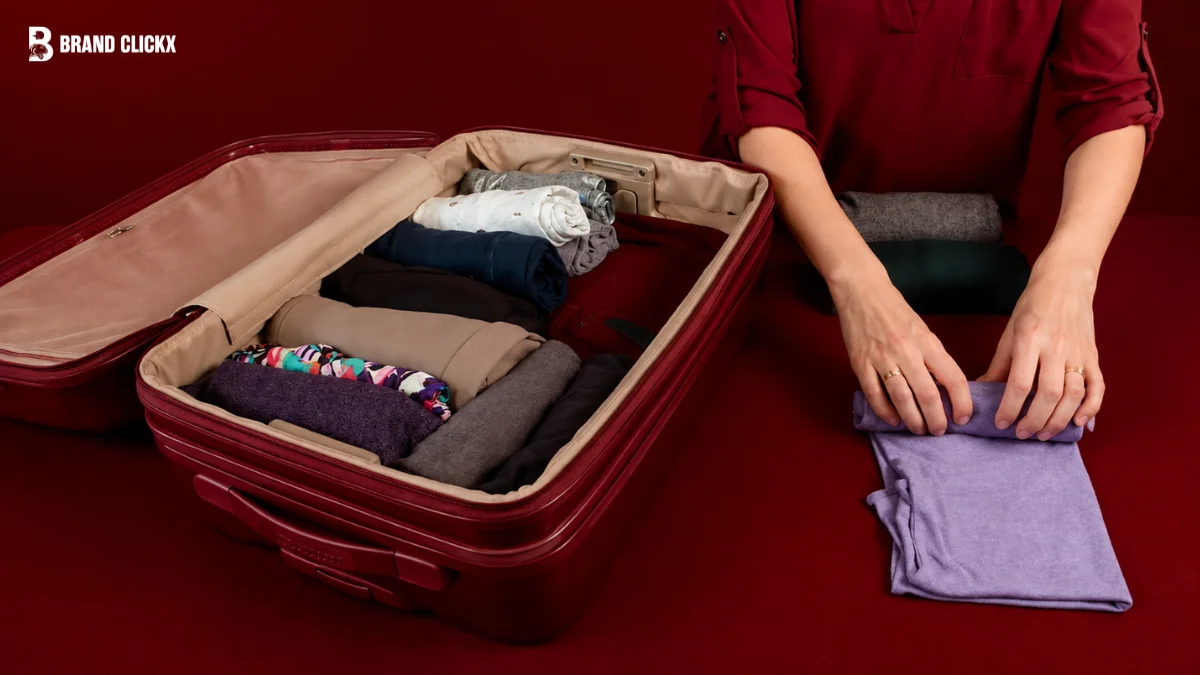
The suitcase was almost closed, but not quite. A pair of shoes had claimed an entire corner, my clothes were piled into uneven layers, and every time I pushed the zipper forward, another shirt seemed to get in the way. The frustrating part was that I wasn’t even carrying that much.
That is the problem with packing a suitcase: more space does not always come from taking fewer things. It comes from packing the right things in the right way.
If you have ever sat on a suitcase to force the zipper shut, searched through a messy bag for one shirt, or arrived with clothes covered in stubborn creases, you already know the problem.
Learning how to pack a suitcase efficiently changes that. You can roll soft clothing, fold structured pieces, use packing cubes where they actually help, place heavy items correctly, and turn awkward gaps into useful storage.
The goal is not to cram your entire wardrobe into one bag. It is to make every part of your suitcase work harder without making the bag unnecessarily heavy.
AI Overview: How to Pack a Suitcase Efficiently
The most efficient way to pack a suitcase is to plan outfits first, then combine rolling for soft casual clothing with folding or bundle wrapping for structured garments.
Put heavy items near the wheels, use packing cubes for modular organization, and fill small gaps with socks, underwear, belts, and other compact items. Leave about 15–20% of your suitcase capacity free when possible, because compressed clothing can still make your luggage too heavy.
Key Takeaways
- Roll soft T-shirts, shorts, jeans, and synthetic clothing; fold structured or delicate garments.
- Put shoes, heavy denim, and toiletry bags near the wheels to keep the suitcase balanced.
- Use compression cubes for bulky clothing, but remember that compression reduces volume, not weight.
- Fill shoe cavities and small suitcase gaps with socks, underwear, belts, adapters, or cables.
- Keep suits, blazers, linen, and other structured clothing toward the top.
- Aim to leave roughly 15–20% of your available space free for the return journey.
- Keep power banks and spare lithium batteries in your carry-on rather than checked luggage.
What Is the Most Efficient Way to Pack a Suitcase?
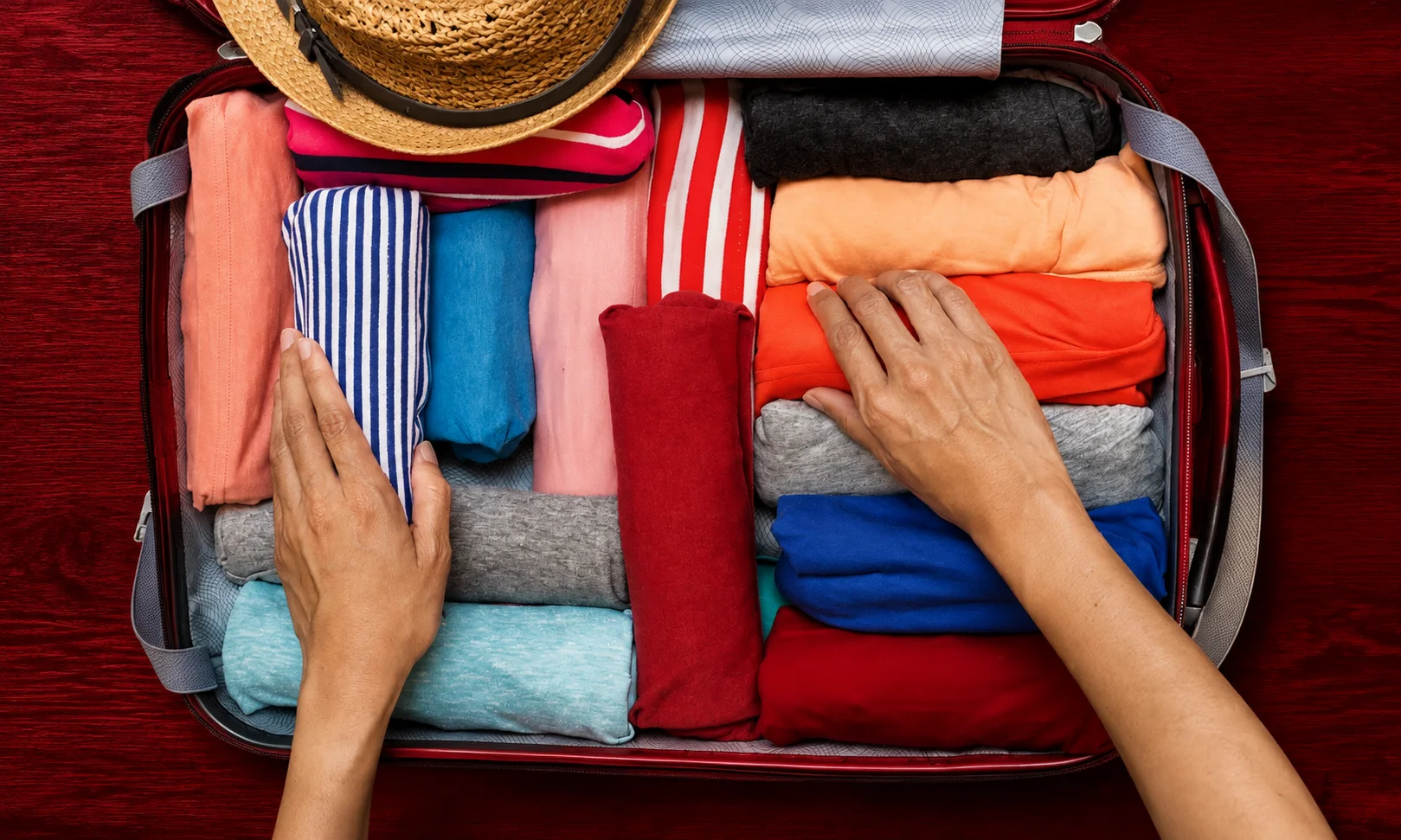
The most efficient method is a hybrid system: plan outfits first, roll soft clothing, fold or bundle-wrap structured garments, and use packing cubes for organization. Put heavy items near the wheels, fill unused spaces with small essentials, and leave some capacity available for souvenirs or last-minute items. Compression helps reduce volume, but it does not reduce luggage weight.
Start With the Trip, Not the Suitcase
The easiest way to overpack is to open your suitcase before deciding what you actually need.
Instead, build your travel packing list around the number of days, weather, activities, and outfits you will realistically use. A capsule wardrobe can help because several pieces can work together rather than requiring a separate outfit for every day.
For a week-long trip, the 5-4-3-2-1 packing rule offers a simple starting point: five sets of socks and underwear, four tops, three bottoms, two pairs of shoes, and one hat or accessory set.
It is a framework, not a law. Adjust it when your destination or activities demand something different.
Use an 80–85% Packing Target
One useful principle in the supplied travel research is to leave your suitcase around 80–85% full, keeping roughly 15–20% of its capacity available for the return journey.
Briggs & Riley and HappyFares are cited for this approach. The practical reason is simple: your suitcase may gain souvenirs, gifts, laundry, or items you did not carry outbound.
This also prevents the familiar last-minute battle with the zipper.
How to Pack a Suitcase Efficiently From Bottom to Top
Once your items are selected, the order matters.
Think about the suitcase as a structure rather than a container. Heavy items form the base, organized clothing fills the middle, small gaps are used deliberately, and delicate structured garments finish the top.
1. Put Heavy Items Near the Wheels
Start with shoes, heavy jeans, bulky toiletry bags, and other dense items.
Placing them near the wheels keeps the center of gravity lower when the suitcase is standing upright. It also prevents lighter clothing from being crushed beneath the heaviest objects.
If you are packing a roller suitcase, this is one of the simplest changes that can make the bag feel more stable.
2. Build the Middle With Clothing Modules
Next, place your main clothing groups into packing cubes or tightly organized rolls.
Compression packing cubes can reduce the volume occupied by clothing, while ordinary cubes mainly give your suitcase structure and make individual categories easier to find.
Compression cubes can reduce clothing volume by up to roughly 50%, depending on the fabric and how tightly items are packed. Treat that figure as a volume-saving claim, not a weight-saving claim.
3. Fill the Dead Space
Now look at the spaces other travelers usually ignore.
Place socks inside shoes. Put underwear into small gaps. Tuck belts, adapters, and small cables into corners or other unused cavities.
This turns dead space into useful storage without requiring another bag.
4. Finish With Structured Clothing
Your final layer should contain items that need more protection from crushing.
Blazers, tailored suits, dress shirts, linen dresses, and other structured garments should generally stay flat or use bundle wrapping rather than being tightly rolled.
This top layer also gives you easier access to clothes you may need immediately after arrival.
Roll, Fold, or Bundle? Use the Right Method
There is no single best packing technique for every fabric.
The most efficient suitcase usually combines several methods.
| Technique | Best For | Main Advantage | Main Limitation |
| Army/Ranger rolling | T-shirts, shorts, synthetic clothing, gym wear | Saves space and fills gaps | Can stress delicate collars |
| Flat folding | Linen, dress shirts, blazers, wool | Preserves structure | Can create hard creases |
| Bundle wrapping | Suits, dresses, formal outfits | Helps reduce localized wrinkles | Harder to remove one item |
| Compression bags | Puffer jackets, sweaters, winter clothing | Major volume reduction | Can add weight and create creases |
When Should You Roll Clothes?
Roll soft, flexible clothing that does not depend on a sharp structure.
T-shirts, shorts, jeans, synthetic shirts, and gym wear are good candidates. The army-roll approach compresses the garment and makes individual pieces easy to identify.
Avoid forcing delicate natural fabrics into extremely tight rolls. Fabric care guides commonly warn that 100% linen and crisp cotton develop heavy, hard-to-remove creases when rolled tightly.
When Should You Fold Clothes?
Use flat folding when preserving shape matters more than squeezing out every last pocket of air.
Dress shirts, blazers, linen pieces, and structured garments generally benefit from being folded carefully rather than tightly rolled.
This is particularly useful for business travel, where arriving with a suitcase full of compressed clothing can defeat the purpose of bringing formalwear.
When Does Bundle Wrapping Make Sense?
Bundle wrapping works especially well for multi-piece formal outfits.
Rather than sharply folding each garment separately, you wrap clothing around a soft central core. This distributes pressure across the garments instead of creating one dominant fold.
Bundle wrapping is widely recommended by travel packing guides for tailored clothes, wrapping a suit around a central accessory pouch is a commonly cited technique for arriving without needing to press it.
Are Packing Cubes Worth It?
Yes, particularly when you struggle with suitcase organization.
A packing cube creates a defined module for shirts, underwear, gym clothes, or other categories. Compression cubes take that idea further by reducing the space occupied by the contents.
Dual-zipper compression cubes have become a major recent development in luggage organization, with manufacturers like Eagle Creek and Briggs & Riley building entire product lines around compression-oriented packing.
However, there is an important limitation.
Compression does not make your belongings lighter.
You can squeeze a large amount of clothing into a smaller space and still exceed your airline’s weight allowance. That is the compression trap: an apparently spacious suitcase can become an overweight suitcase.
Who Should Use Compression Cubes?
They are especially useful if you travel with bulky casual clothing, need modular organization, or frequently move between destinations.
They can also help backpackers separate clothing categories inside a limited-size bag.
Who Should Avoid Heavy Compression?
Avoid relying heavily on compression when weight is already your main limitation.
If your airline allowance is tight, weigh the suitcase after compression rather than assuming extra empty volume means you are safely within the limit.
Shoes Are Storage, Not Just Footwear
Shoes often create some of the worst wasted space in luggage.
First, choose versatile pairs rather than packing shoes for every possible outfit. Most travel packing guides recommend limiting yourself to roughly two or three versatile pairs of shoes and wearing the bulkiest pair during travel when practical.
Then use the cavities.
Stuff socks, underwear, belts, or small accessories inside the shoes. Place footwear in a cloth bag or shoe shield so the soles do not contaminate clean clothing.
This small technique simultaneously improves shoe packing, suitcase organization, and available storage.
How to Pack Toiletries Without Creating a Mess
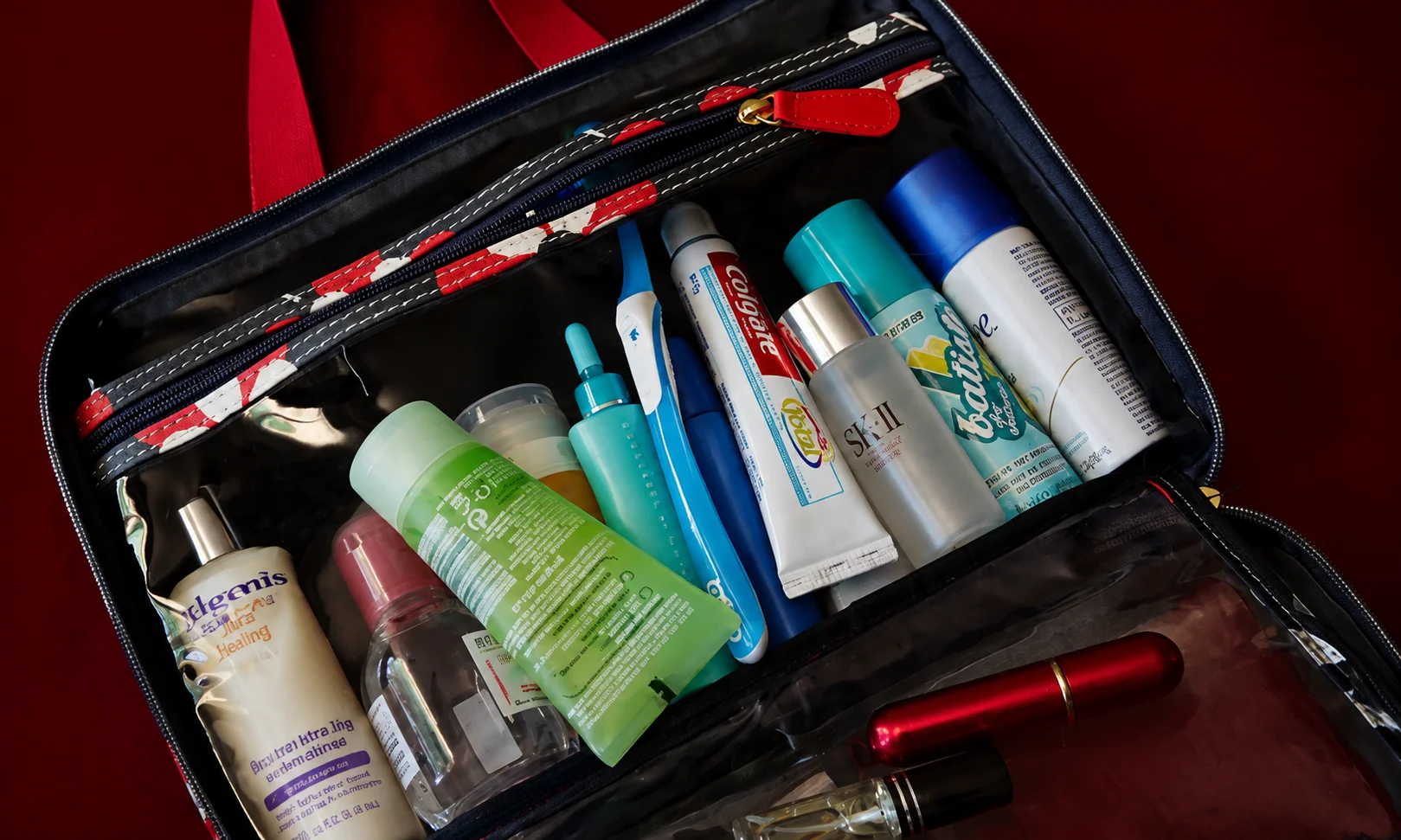
Toiletries need their own system.
Group liquids and grooming products into a dedicated toiletry bag rather than scattering bottles throughout the suitcase. Keep the bag accessible if you expect to pass through airport security.
For U.S. TSA screening, carry-on liquids, gels, and aerosols generally follow the 3-1-1 rule: containers must be 3.4 ounces (100 mL) or less, placed in a 1-quart clear bag, with one such bag per passenger.
Place that pouch somewhere easy to remove.
Solid shampoo bars and stick deodorants can also reduce the number of liquid containers you need to manage, although you should still check the requirements that apply to your specific trip.
Prevent Toiletry Leaks
Before tightening a liquid bottle, remove excess air where appropriate.
You can also place a small piece of plastic wrap over the opening before replacing the cap. Then keep toiletries contained in a separate pouch rather than trusting a bottle to remain perfectly sealed throughout the journey.
The Weight Problem Most Packing Guides Underestimate
Saving space and saving weight are two different problems.
Carry-on weight limits vary significantly by airline, many European budget carriers and Asian carriers cap carry-on weight around 7–10 kg, well below the 22–23 kg often allowed by U.S. carriers. Never assume a space-saving technique makes your bag compliant with a particular carrier’s rules.
Compression is the clearest example.
A sweater that occupies half as much volume still weighs exactly the same. If your suitcase feels unusually easy to close after compression, that is the moment to check its weight.
Airline baggage rules can also change, so verify your carrier’s current size and weight requirements before departure.
What Should Stay Out of Checked Luggage?
Efficient packing also means putting the right things in the right bag.
Spare lithium-ion batteries and power banks must remain in carry-on baggage under U.S. FAA rules. The FAA also recommends keeping portable electronic devices containing lithium batteries accessible in the cabin; airline and international requirements can be stricter.
Essential documents, necessary medication, valuable electronics, and irreplaceable valuables also make poor candidates for checked luggage.
If a carry-on is taken at the gate, remember that spare batteries and power banks may need to be removed and kept with you in the cabin.
That makes a small, accessible personal-item pouch extremely useful.
A Better Way to Handle Electronics
Cables become messy when they are simply thrown into a suitcase.
Coil each charger or cable, secure it with a twist tie or Velcro strap, and put the group into a small zipper pouch or tech organizer.
Small adapters can sometimes fit inside shoes or other unused spaces. Keep the most important electronics accessible rather than burying them beneath your clothing.
For luggage trackers, battery requirements can differ depending on the device and airline. The FAA specifically advises checking the applicable requirements for baggage tracking devices and international travel.
Three Packing Methods for Three Different Travelers
Your ideal system depends on what you are carrying.
Business Traveler
Prioritize structure over maximum compression.
Use bundle wrapping or careful folding for suits, blazers, and dress shirts. Keep formal pieces near the top and place accessories in a central pouch.
Backpacker
Prioritize volume and modular organization.
Tightly rolled quick-dry clothing inside compression cubes can make a small bag considerably easier to organize. Experienced backpackers commonly report fitting 10–14 days of travel clothing into a 35-liter backpack using compression cubes and rolling techniques.
Cold-Weather Traveler
Prioritize bulky-item compression.
Puffer jackets, sweaters, and other large winter pieces are where compression bags can have their greatest impact. A bulky down puffer jacket that normally takes up around 15 liters of space can compress to roughly 3–5 liters with a vacuum-seal bag.
Remember, though, that the weight has not disappeared.
Three Overlooked Packing Decisions
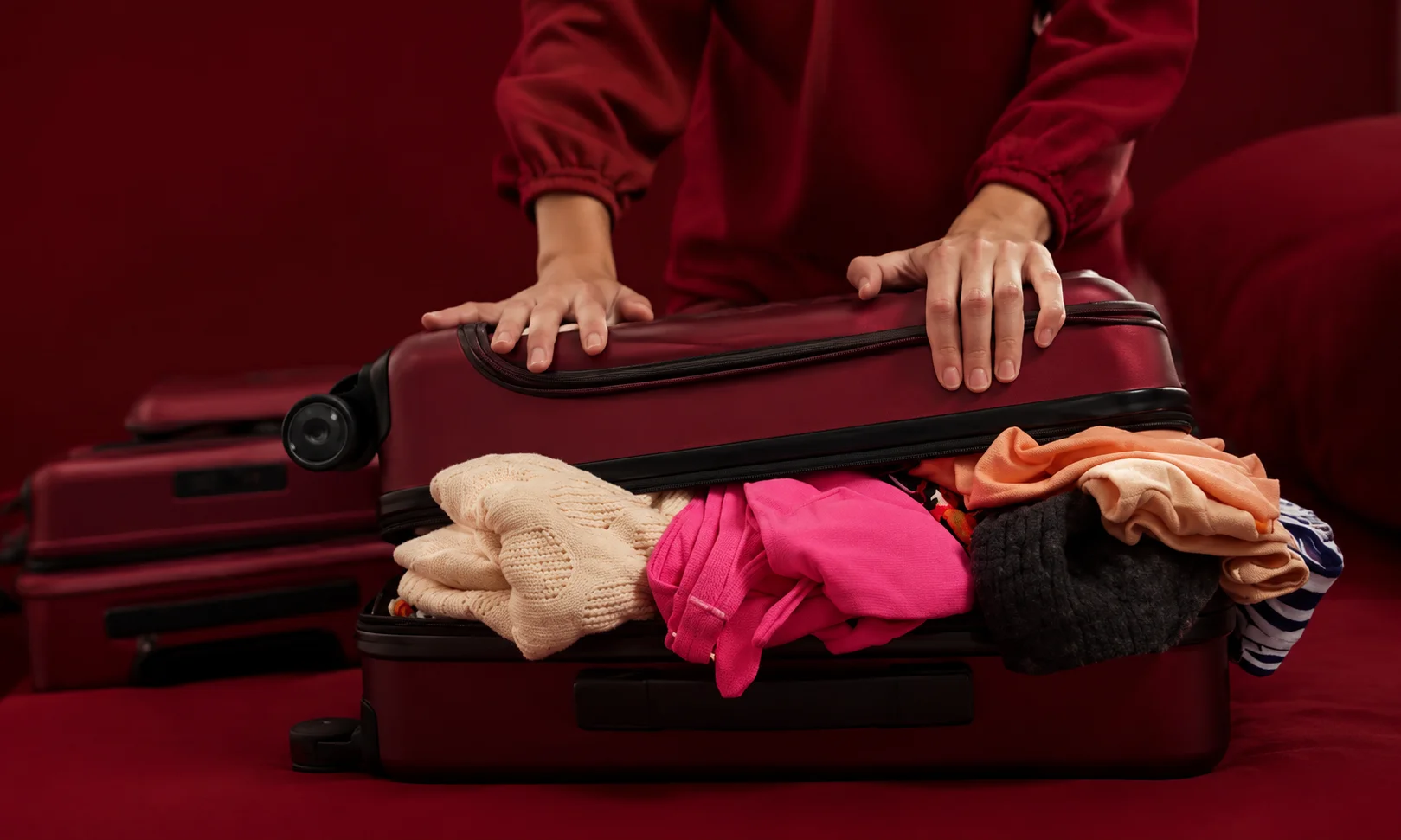
1. Your Return Trip Should Influence Your Outbound Packing
Most people pack for the departure and improvise the return.
Leaving 15–20% of capacity unused gives you a physical buffer for souvenirs and other additions. A lightweight packable tote can provide another option for carrying non-fragile extras.
2. Suitcase Space Is Not the Same as Suitcase Capacity
A bag can have plenty of visible room while already being too heavy.
This is why you should check weight after using compression. Otherwise, the technique that solved your space problem may create a baggage-fee problem.
3. The Best Packing Method Depends on Fabric
A blanket rule such as “always roll your clothes” is too simplistic.
Soft synthetic clothing benefits from rolling. Linen, crisp cotton, blazers, and other structured pieces may need folding or bundle wrapping instead.
Efficient packing is therefore a matching problem: match the technique to the item.
Common Packing Mistakes to Avoid
Avoid these habits if your goal is a lighter, better-organized suitcase:
- Packing outfits without checking whether pieces can be mixed.
- Rolling every fabric regardless of its structure.
- Using compression without checking the final weight.
- Leaving empty space inside shoes.
- Putting heavy items at the top of an upright suitcase.
- Burying toiletries where security screening becomes difficult.
- Packing too many pairs of shoes.
- Filling the suitcase completely before considering the return trip.
- Putting spare power banks in checked luggage.
- Treating airline baggage allowances as universal rather than carrier-specific.
Practical Application: Pack Your Suitcase in This Order
When you are ready to pack, use this sequence.
- Empty the suitcase completely.
Start with a genuinely empty bag so nothing gets forgotten in its pockets. - Build your outfits first.
Remove duplicate pieces before they ever reach the suitcase. - Separate clothing by technique.
Create one group for rolling, one for folding, and one for bundle wrapping. - Pack shoes near the wheels.
Fill their interiors with socks, underwear, or small accessories. - Add heavy toiletry and dense items.
Keep the weight toward the bottom of the upright suitcase. - Add your clothing modules.
Use packing cubes where they genuinely improve organization or compression. - Fill perimeter gaps.
Use belts, adapters, cables, socks, and other small objects rather than leaving corners empty. - Place formal or delicate clothing on top.
Keep blazers, dress shirts, linen, and similar garments protected from heavy compression. - Put accessible essentials where you can reach them.
Keep travel documents, necessary medication, liquids for screening, and important electronics appropriately accessible. - Stop before the suitcase is completely full.
Aim for the 80–85% capacity principle when practical, then check the actual weight against your airline’s current allowance.
That sequence gives you a repeatable suitcase organization system instead of relying on last-minute stuffing.
Conclusion: Pack Less Randomly, Not Necessarily Less
A suitcase packed efficiently does not look like a bag where everything has been squeezed into submission. Each item has a place, and each packing technique has a reason.
That is why the best system combines rolling, folding, bundle wrapping, compression, and smart suitcase organization rather than following one universal rule. Your T-shirt and your linen blazer do not have the same needs.
Remember the suitcase from the opening: the one that seemed full before it was actually organized. Once you stop treating luggage as an empty box and start treating it as a limited space that needs a system, how to pack a suitcase efficiently becomes much easier to answer.
The real trick is not fitting everything you own into one bag. It is knowing what deserves the space in the first place.
FAQ: How to Pack a Suitcase Efficiently
Is it better to roll or fold clothes?
Roll T-shirts, shorts, jeans, and other soft clothing to save space. Fold blazers, dress shirts, linen, and structured garments to reduce creasing.
How do you fit more clothes into a suitcase?
Plan outfits first, then roll suitable clothing and use packing cubes for organization. Fill empty spaces inside shoes and around the suitcase with small items.
Are packing cubes actually worth it?
Yes, especially if you want better organization or need to compress bulky clothing. Just remember that compression saves space, not weight.
How do I pack shoes without wasting suitcase space?
Place shoes near the wheels and fill them with socks, underwear, belts, or small accessories. Keep them inside a shoe bag to protect your clean clothes.
What is the 5-4-3-2-1 packing rule?
For a week-long trip, pack 5 sets of socks and underwear, 4 tops, 3 bottoms, 2 pairs of shoes, and 1 hat or accessory set. Adjust it according to your destination and activities.
How do I leave room for souvenirs?
Try to leave around 15–20% of your suitcase capacity unused when you depart. A lightweight packable tote can also give you extra flexibility on the return trip.
Can I use vacuum seal bags for carry-on luggage?
Yes, manual travel compression bags can reduce clothing volume. However, they do not reduce weight, so check your airline’s baggage limit before using them.
What should go in first when packing a suitcase?
Start with heavy items such as shoes and toiletry bags near the wheels. Add clothing next and finish with delicate or structured garments on top.
How do I prevent clothes from wrinkling?
Use rolling for soft casual clothing and folding or bundle wrapping for structured garments. Avoid tightly rolling linen and crisp cotton because they can crease easily.
How many pairs of shoes should I pack?
Two or three versatile pairs are usually enough for the packing method described here. Wear your bulkiest pair during travel when practical and pack the others.