If you are asking how to improve brand visibility in AI search engines today, you are asking the right question at the right time. The future of search is changing. People are no longer typing only keywords into a box and scrolling for results. Instead they are asking conversational questions to AI search engines and expecting clear answers fast. That means brands must adapt how they create content and interact with search technology. Businesses that want to stay competitive often work with a search engine optimization agency to adapt their strategies for AI-driven search environments.
In this article, I will walk you through what brand visibility in AI search engines really means, why it matters, the data that shows how search behavior is shifting, and most importantly, exactly what you can do to improve your visibility.
Let us start with the basics.
What Does Brand Visibility in AI Search Engines Mean?
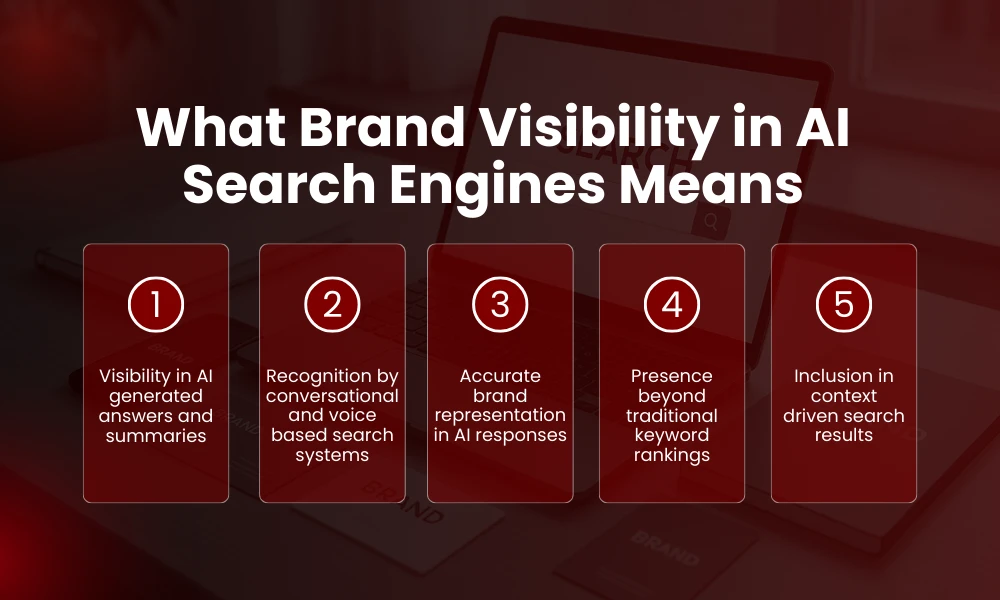
Brand visibility in AI search engines refers to how easily your brand can be found, recognized, and correctly represented by AI-powered search tools. These tools use artificial intelligence to understand language, context, intent, and relevance. They include technologies like:
- AI question-answering systems
- Generative search interfaces that summarize results
- Voice assistants powered by large language models
- Recommendation systems that integrate search with conversational responses
In short, it is not the same as traditional SEO anymore. Modern strategies increasingly rely on semantic SEO to help search engines understand the deeper meaning and relationships between topics. Because AI systems interpret queries based on meaning, they go beyond matching exact words. This means your brand must be visible in the kinds of answers and summarizations these systems provide.
Why Brand Visibility in AI Search Engines Matters Now

Change is already happening fast. Recent data from market research firms shows that over 50 percent of online searches globally involve some form of natural language interaction. According to a report from Gartner, by 2028 more than 30 percent of browsing sessions will begin with a generative AI-assisted experience rather than a traditional search bar query.
Search usage statistics support this trend. For example:
- In a survey by HubSpot, 63 percent of respondents said they prefer asking AI systems complex questions instead of typing keywords.
- Forrester research shows users trust summarized responses more than traditional first page links, especially when the snippet seems helpful.
All these trends show that brand visibility in AI search engines matters more than ever. If customers and prospects find your brand early in their AI search experience, you get broader reach, better trust, and more opportunities to convert browsers into buyers.
Core Elements to Improve Brand Visibility in AI Search Engines
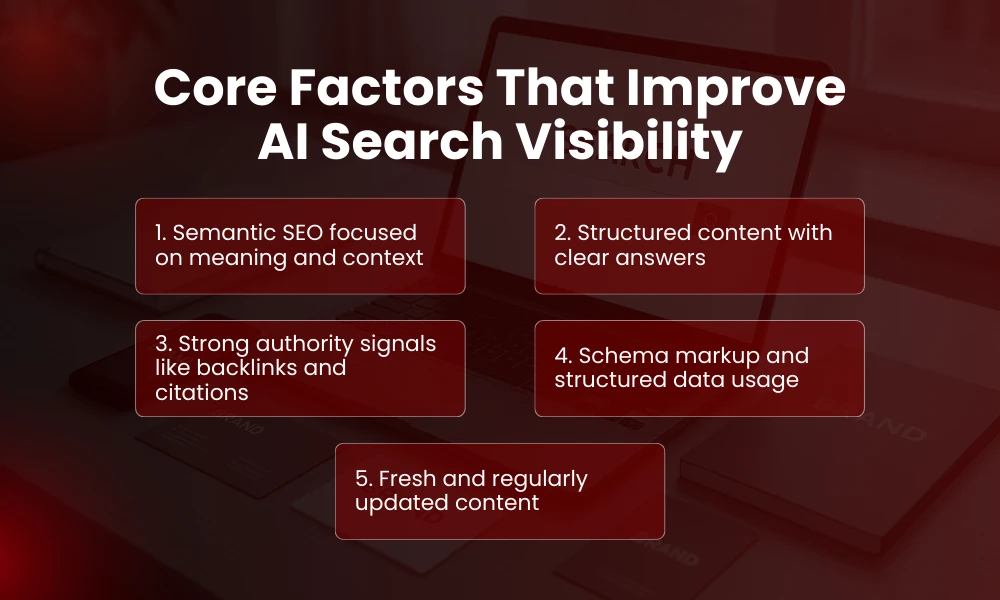
To improve brand visibility in AI search engines, you need to focus on several key areas:
1. Understand How AI Search Interprets Queries
AI search engines are trained to understand natural language. They look for meaning, context, relevance, and authority. For example when someone asks “Best running shoes for flat feet,” the AI is not just matching keywords. It is trying to understand the intent behind the question to provide a helpful answer.
2. Create Structured and Relevant Content
Studies show that structured content helps AI systems better interpret and use information. In research published by Content Marketing Institute, content organized with clear headings, bullet lists, concise answers, and strong topic relevance ranks better in AI-assisted results.
This means answering real user questions ahead of time and organizing content so AI systems can extract useful information efficiently.
3. Prioritize Semantic SEO
Semantic SEO is about covering the meaning behind keywords, not just the words themselves. When you optimize for semantic relevance and use related terms naturally, you signal to AI search engines that your content is contextually rich. This practice is essential for brand visibility in AI search engines. Many marketers now combine semantic optimization with a solid technical SEO foundation to ensure search engines can properly crawl and interpret their content.
4. Optimize for Featured Snippets and Answer Boxes
A large percentage of AI search interfaces highlight brief answers at the top of search results. According to Ahrefs, about 19 percent of all search queries lead to a featured snippet. When your content is formatted in a way that provides clear, concise answers, the chances of your brand being cited increase.
5. Build Strong Authoritative Signals
AI systems often evaluate the authority of your content by looking at things like backlinks, citations, and social proof. Research from Moz shows that sites with strong link profiles and authoritative domains tend to be favored in AI and traditional search results.
6. Leverage Schema Markup and Structured Data
Schema markup helps AI systems understand what your content is about. Use schema for articles, FAQs, products, organizations, and reviews. This metadata provides structured context that enhances brand visibility in AI search engines.
7. Monitor AI Search Performance Metrics
Analytics platforms are beginning to provide AI-specific search metrics. Tracking how your content performs in AI queries helps you understand what queries trigger your brand and where you can improve visibility.
Action Steps to Improve Brand Visibility in AI Search Engines

Here are the tactical strategies you can implement step by step:
Step 1: Research Conversational Queries
Start by identifying the kinds of questions your audience is likely to ask. Use tools that show natural language patterns and topics, such as:
- AnswerThePublic
- ChatGPT or Bard prompts
- Long-tail search query data
Understanding real questions helps you align your content with the needs of AI search behavior. To uncover these opportunities more effectively, many marketers rely on structured keyword research for SEO techniques.
Step 2: Create Meaningful Answer Content
Once you know the questions, craft detailed, accurate, and conversational answers. Write in a clear, structured format. For example:
- Use a question as a heading
- Provide a concise answer first
- Add details and examples afterward
This format makes it easier for AI systems to extract and reuse your content.
Step 3: Publish Topic Clusters Instead of Isolated Pages
A study by BrightEdge showed that content grouped into topic clusters increased organic visibility significantly more than isolated pages. These clusters connect related content so AI systems can map out context more effectively, which increases brand visibility in AI search engines. This approach is part of a broader SEO content strategy that strengthens topical authority across your website.
Step 4: Optimize Titles and Headings for Questions
AI search engines often pull answers from headings that look like direct questions. Make sure your titles and headings reflect the real questions users ask.
For example:
- Question style: “What are the best practices for remote team communication?”
- Topic style: “Remote Communication Tips”
Both might rank, but the first aligns better with conversational AI queries.
Step 5: Incorporate Multimedia Support
AI systems sometimes use images, videos, and transcripts to enrich answers. Studies show pages with optimized images and descriptive captions can perform better. Adding multimedia content like explainer videos and diagrams increases the ways AI can interpret and present your content.
Step 6: Use Internal Linking for Context
Internal links help distribute authority and help AI systems understand topic relationships within your site. Link related content naturally within your text to strengthen context and relevance.
Step 7: Emphasize Brand Mentions and Citations
The more your content is cited, referenced, or mentioned across the web and within your niche, the stronger your authority signal becomes. That improves your chances of appearing in AI-powered summaries or answer boxes.
Step 8: Use Email and Social Channels to Boost Signals
Share content through email newsletters and social media to generate early engagement signals. AI search algorithms may consider engagement metrics when evaluating relevance.
Step 9: Update Content Regularly
AI search engines prefer up-to-date information. Regular updates increase freshness scores and thus improve brand visibility in AI search engines.
Step 10: Track AI Search Results Over Time
Use analytics to track which queries AI search is associating with your brand. Understand your share of voice in AI results and identify gaps.
Common Mistakes That Hurt Brand Visibility in AI Search Engines
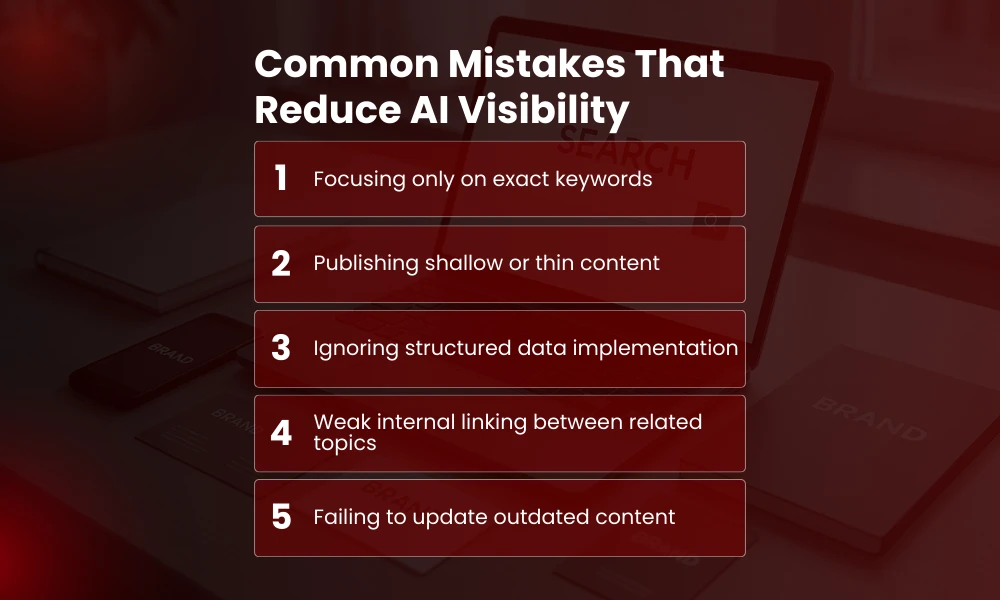
Understanding what not to do is just as important as knowing what to do. Here are frequent pitfalls:
Ignoring Conversational Queries
Many brands still optimize for exact keyword matches. This strategy will not perform well in AI search environments where context and intent matter more.
Creating Shallow Content
Thin content that lacks depth or authority will not be chosen as an AI answer source. Full, well-researched content performs better.
Failing to Use Structured Data
Without structured data, AI systems might not interpret your content correctly. Adding schema markup is a technical but necessary step.
Overlooking Internal Linking
Without internal links, AI systems cannot easily map your content topics and relevance.
Studies Showing the Shift Toward AI Search Behavior
Several recent studies support the urgency of focusing on brand visibility in AI search engines:
1. HubSpot Search Trends Report
- More than half of surveyed users preferred asking complex questions in natural language rather than typing keywords.
- Users reported higher satisfaction when search results felt contextually relevant.
2. Gartner Predicts Generative AI Uptake
Gartner projects that user interactions with generative AI search tools will grow by over 35 percent in the next three years.
3. BrightEdge Organic Search Research
Topic cluster strategy leads to twice the organic visibility compared to isolated pages.
4. Ahrefs Analysis of Featured Snippets
Nearly 20 percent of queries lead to answer boxes, highlighting the importance of concise, well-structured answers.
All these numbers confirm that search behavior is shifting and that brand visibility in AI search engines requires new optimization strategies. Many experts believe this shift is also driven by the growing role of LLMs in SEO and AI-powered search interfaces.
Tools and Technologies to Improve Brand Visibility in AI Search Engines
Here are tools that can help you research, optimize, and measure visibility effectively:
- SEO and Keyword Tools: Provide insights into conversational query structures.
- Structured Data Validators: Help implement schema properly.
- Analytics Platforms: Track AI search performance.
- Content Optimization Tools: Analyze content quality, relevance, and semantic coverage.
Using these tools in combination with the right content strategy can significantly improve your visibility.
Putting It All Together: A Roadmap
Here is a simple roadmap to improve brand visibility in AI search engines:
- Audit existing content for conversational relevance
- Identify high-impact user queries
- Create structured content around those questions
- Use schema and semantic optimization
- Add multimedia for richer context
- Build topic clusters to connect ideas
- Promote content to build authority
- Measure performance and repeat
Following this approach consistently allows you to grow your brand presence where search is headed next.
FAQs on Brand Visibility in AI Search Engines
What is the difference between traditional SEO and optimizing for AI search engines?
Traditional SEO focused on keywords and backlinks. Optimizing for AI search engines focuses on context, conversational queries, structured content, and semantic relevance.
How long does it take to see improvements in AI search visibility?
It depends on your content quality and authority signals. Some brands see early improvements within weeks, while establishing authority may take several months.
Do I need schema markup to improve AI search visibility?
Yes, structured data helps AI systems understand your content better, which improves visibility.
Does social media impact brand visibility in AI search?
Indirectly yes social engagement can contribute to authority signals and increase content engagement which AI may interpret as relevance.
What types of content work best for AI search visibility?
Detailed FAQ pages, explainers, topic clusters, video transcripts, and practical how-to guides tend to perform strongly.
Is voice search included in AI search engines?
Yes voice search uses AI interpretation and conversation context which aligns with these strategies.
Can small brands compete with large brands in AI search visibility?
Yes with focused optimized content, structured data, and audience-centric answers small brands can compete effectively.
Final Thoughts
Improving brand visibility in AI search engines is not just a technical task. It is a strategic shift in how brands think about content and relevance. By anticipating what users truly ask, structuring content for interpretation, and building authority, your brand can appear in the AI-powered search experiences that are shaping the future of discovery. Brands that want to stay ahead of these changes often invest in advanced SEO strategies designed for the next generation of AI-powered search.
If you follow the practical steps in this guide and commit to monitoring and optimizing over time you will be better positioned to rank well and maintain strong visibility in AI driven search results that matter most to your audience.