
At its core, the Viral Loop Framework is about designing growth so the product itself brings in the next user not ads, not a sales team chasing leads. The product just creates natural moments where people end up sharing it, inviting others, collaborating, or recommending it, almost without thinking about it.
The idea itself isn’t complicated: someone gets value from the product, takes an action, that action puts the product in front of someone new, and a few of those people become users themselves. Then they go through the same loop all over again.
Take a project management app, for example. Someone invites their teammates to work on a shared project. Those teammates get a feel for the product, end up creating their own projects, and invite more people from their own circles. At that point, the product’s basically doing part of the acquisition work on its own.
That’s really the whole idea behind a viral loop.
Worth noting, Google’s current guidance leans hard into content that’s actually helpful and reliable stuff written for people, not content built mainly to game the rankings. And honestly, the same logic applies here too. When startups talk about growth, the goal should be building something people genuinely want to share, not trying to force “virality” into existence.
Key Takeaways
- A Viral Loop Framework basically turns your existing users into a source of new ones through sharing, referrals, collaboration, or just natural exposure baked into the product.
- But a strong loop depends on more than referrals alone. Product value, activation, motivation, low friction, retention all of that has to be working together too.
- The viral coefficient, or what people usually call the K-factor, is how you measure roughly how many new users each existing user brings in.
- A K-factor under 1 can still support growth, but once it’s around or above 1, the loop starts compounding in a much stronger way.
- The best viral loops don’t feel like a marketing trick at all they just feel like a natural part of using the product.
- Startups should actually test the loop with real users, measure every single step of it, and fix the weakest link before even thinking about scaling.
How a Viral Loop Works
A useful viral loop usually has five connected stages:
User joins → User experiences value → User shares or invites → New person discovers the product → New person becomes a user
Then the cycle starts again.
The important part is that the loop is connected to the product experience. A user should have a real reason to introduce someone else.
There are several ways this can happen. A collaboration tool may require teammates. A communication app becomes more useful when friends join. A design platform may encourage users to share their finished work. A referral program can also provide a direct incentive for bringing someone new.
The strongest loops do not simply say, “Invite your friends.” They give users a reason to do it.
The Five Parts of a Strong Viral Loop Framework
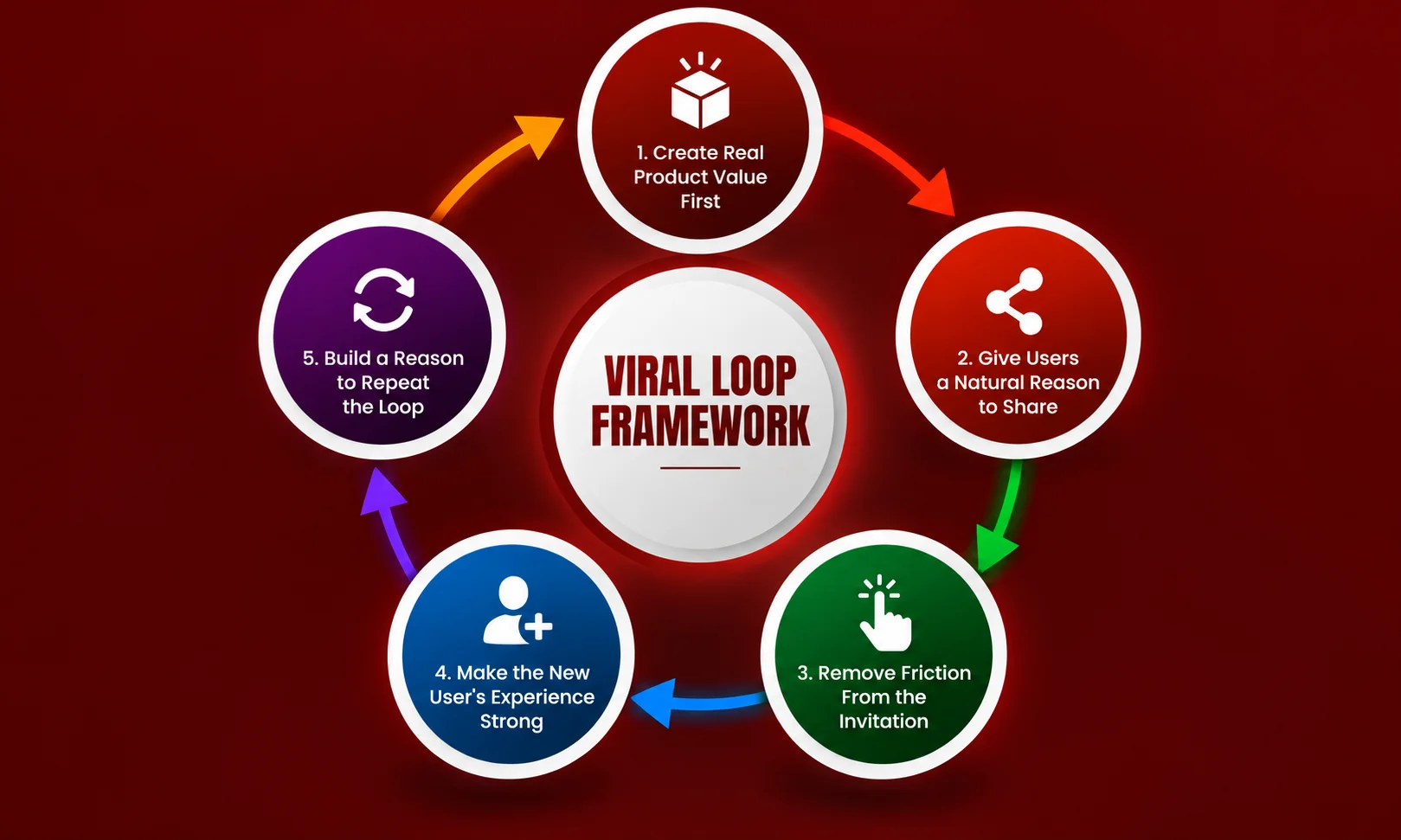
1. Create Real Product Value First
Virality can’t save a weak product. If users don’t really get why your startup’s useful, they’re not going to recommend it to anyone. So before you even start designing referral buttons, rewards, or sharing campaigns, figure out the moment when a user actually thinks, “okay, this is genuinely useful.”
That moment usually gets called the activation point. For a productivity app, it might be finishing that first task. For a design platform, maybe it’s creating that first design that actually turns out well. For a marketplace, it could be completing that first purchase. Your loop needs to start around that moment of real value not before it.
2. Give Users a Natural Reason to Share
People rarely share a product just because a company asked them nicely. They share because the product actually helped them solve something, talk to someone, show off something interesting, or get some kind of benefit out of it.
Dropbox’s a classic example here. Its referral system tied the reward directly back to the product itself, which gave users an extra reason to bring others in. A lot of referral platforms still lean on that same basic two-sided setup today.
For your own startup, ask yourself a simple question: “why would my happiest user actually want someone else to join?” If you can’t answer that clearly, the loop probably still needs some work.
3. Remove Friction From the Invitation
Even a motivated user will bail on a referral if the process feels like a hassle.
Long forms, confusing instructions, extra confirmation screens, rewards that don’t quite make sense all of that chips away at participation.
Make sharing genuinely easy. Give users a clear message to send, simple sharing options, and a straightforward sense of what happens next. The fewer steps standing between “I want to share this” and “my friend actually joined,” the better things work out.
4. Make the New User’s Experience Strong
Getting someone to click the invite is honestly only half the job. Once they land, they need to figure out fast what the product actually does and why it matters to them. If the landing page’s confusing or onboarding drags on too long, the whole loop just breaks right there.
That’s really why viral growth and onboarding are so tightly connected. A referral might get someone in the door, but activation is what decides whether they actually become part of the next cycle. So a viral loop isn’t just some acquisition tactic it’s really the whole experience, carried from one user to the next.
5. Build a Reason to Repeat the Loop
A one-time referral campaign is not necessarily a viral loop. A true loop repeats. After the new user joins, they should reach a point where sharing or inviting another person makes sense again. This creates a continuous cycle rather than a single burst of traffic. That repeatability is what gives the framework its growth potential.
How to Measure a Viral Loop

You cannot improve a viral loop by looking only at total signups. You need to understand what happens at every stage. One of the most useful measurements is the viral coefficient, or K-factor.
A simple version is:
K = Invitations per user × Invitation conversion rate
For example, if each user sends an average of 4 invitations and 20% of recipients become users:
K = 4 × 0.20 = 0.8
A K-factor of 0.8 means each user generates 0.8 additional users through the measured loop.
A value of 1 means each user is, on average, replacing themselves with one new user. Values above 1 indicate stronger self-reinforcing potential. However, K should not be treated as the only measure of success. A loop can have a respectable coefficient while still producing poor business results if the referred users do not activate, retain, or pay.
Cycle time matters too. A loop that generates new users quickly can be more powerful than one that takes months to complete. So startups should track both the number of people generated and how quickly each cycle happens.
Common Types of Viral Loops
Referral Loops
This is the most obvious model. Existing customers invite new customers and receive a reward, benefit, or product advantage.
The reward can work for both sides, such as giving the existing customer extra features while giving the new customer a discount or bonus.
Collaboration Loops
Some products naturally grow because users need other people to participate. Think about team communication, shared documents, project management, or collaborative design tools. One user creates a reason for another person to join.
This can be especially powerful because the invitation is not just promotional. The recipient is needed to complete the task.
Content Loops
Users create content that gets viewed or shared by people outside the product.
A useful template, public profile, design, video, document, or other shared asset can introduce new people to the product. If those people can easily create something similar, the loop can continue.
Incentive-Based Loops
Here, the startup deliberately rewards users for bringing others in.
Referral programs, invite-only launches, milestone rewards, and referral competitions can all fit this model. Modern referral platforms use variations of these structures for startups, newsletters, ecommerce businesses, and prelaunch campaigns.
The key is not to make the reward so attractive that people invite random users who have no interest in the product.
Viral Loop vs. Traditional Marketing Funnel

A traditional marketing funnel generally moves people from awareness toward conversion.
A viral loop works differently.
In a funnel, you keep adding people in at the top. In a loop, the output from one group actually helps create the next one.
That doesn’t mean funnels are outdated or pointless, though. Startups still need search, content, partnerships, sales, advertising, all of it. The smarter move is treating the viral loop as one piece of a bigger growth system, not the whole thing.
A startup might use content to land its first users, product experience to actually activate them, and referrals to bring in more people from there. That combination usually works out a lot better than expecting one single channel to carry everything on its own.
How to Build Your Own Viral Loop Framework
Start with the product you already have don’t just go copy someone else’s referral program and hope it works the same way.
Step 1: Find Your Sharing Moment
Look at what your successful users are already doing naturally. Are they inviting colleagues? Sharing results? Sending links around? Creating public content about it? Recommending the product to friends?
Find the behavior that’s already happening on its own.
Step 2: Identify the Trigger
Figure out what actually makes users want to share at that particular moment.
Maybe they just achieved something. Maybe they need someone else to collaborate with. Maybe there’s a reward involved, or maybe they just want another person to get the same benefit they did.
Step 3: Design the Simplest Path
Cut out anything unnecessary from the sharing process. Test how the invitation looks on both mobile and desktop, and make sure whoever receives it understands the value right away, without having to think too hard about it.
Step 4: Track the Complete Journey
Measure invitations, clicks, signups, activation, retention, revenue the whole thing. This is what tells you whether you’re actually creating real customers or just inflating your registration numbers.
Step 5: Test Before Scaling
Don’t go pouring money into promoting a loop that hasn’t actually been proven yet.
Test different messages, rewards, timing, onboarding flows, and sharing methods on a smaller group first. Then just keep whatever version brings in better-quality users.
Why Some Viral Loops Fail
Not every product is naturally viral, and forcing virality can make the user experience worse.
One common mistake is asking users to refer others before they understand the product. Another is offering a reward that attracts people who only want the reward.
A loop can also fail because the invitation reaches the wrong audience. If users repeatedly invite people who do not need the product, conversion will remain low.
There is also the problem of saturation. A user cannot invite an unlimited number of relevant people forever. As the reachable audience becomes smaller, growth can slow.
Most importantly, a viral loop does not replace product quality. If new users arrive but quickly leave, the loop may create more churn rather than sustainable growth.
What Makes a Viral Growth Guide Trustworthy?
For BrandClickX, a genuinely strong article on startup growth needs to go beyond just recycling the same popular growth stories everyone’s already read.
Experience: It should walk through the actual, practical steps founders can test themselves activation, referral friction, real user behavior, that kind of thing.
Expertise: It needs to use established growth concepts viral coefficient, cycle time, activation, retention, customer acquisition cost and actually use them correctly, not just throw the terms around.
Authoritativeness: Big claims need real sources and recognizable examples behind them, not made-up growth numbers presented like they’re facts.
Trustworthiness: It should be upfront that viral growth isn’t guaranteed. A K-factor above 1 isn’t some magic formula for rankings or revenue, and referral numbers only matter if they’re tied to actual business outcomes.
Google’s guidance leans heavily on demonstrating real experience, expertise, authoritativeness, and trust and its current search guidance also warns pretty clearly against churning out unoriginal content at scale just to try and game the rankings.
Conclusion
The Viral Loop Framework isn’t about making a product look viral. It’s about designing an experience where growth can naturally create more growth on its own.
The best loops always start with real value. A user hits a genuinely useful moment, has an obvious reason to share it, and can invite someone else without much effort at all. That new person then gets enough value out of it to become part of the next cycle themselves.
For startups, that’s really the opportunity here. Instead of constantly asking “how do we get more people?”, it’s worth asking a better question: “can our existing users naturally help bring in the next group?”
If the answer’s yes, you’ve probably got the foundation of a growth engine one that gets stronger with every cycle that actually works.
Frequently Asked Questions
What is the Viral Loop Framework?
It’s a growth model where existing users help bring in new users through referrals, sharing, collaboration, content, or invitations baked right into the product. Those new users then keep the cycle going for the next round.
What counts as a good viral coefficient?
Honestly, there’s no universal “good” number here it really depends on the product, the market, and the business model. A K-factor of 1 means each user’s bringing in roughly one new user on average, while anything below 1 means the loop isn’t quite self-sustaining yet on its own. Startups should also be looking at activation, retention, revenue, and how long each cycle takes.
Is a referral program basically the same thing as a viral loop?
Not really, no. A referral program can be part of a viral loop, but a stronger loop ties that referral behavior directly into actual product usage and gives the new user a real reason to keep the cycle going themselves.
Can any startup just build a viral loop?
Not really. Some products naturally lend themselves to sharing or collaboration, and others just don’t. If users don’t have much reason to invite anyone, forcing a referral system on top usually just adds friction instead of actual growth.
How can startups actually improve their loop?
Start with the product itself its value and how well it activates new users. From there, make sharing easier, give people a real reason to invite others, tighten up onboarding for new users, and figure out exactly where people are dropping out of the loop.
Does viral growth mean you can skip marketing altogether?
No, not at all. Viral growth can cut down how much you rely on paid acquisition, but most startups still do better with multiple channels running at once. A solid loop should work alongside content, partnerships, SEO, sales, communities, or paid campaigns not replace all of them.

Ayesha Mansha
Ayesha explores how brands capture attention and dominate the digital space. Writing across every BrandClickX section, she connects AI, advertising, commerce, and the psychology behind modern growth into one bigger picture.
@AyeshaMansha | ayesha@brandclickx.com