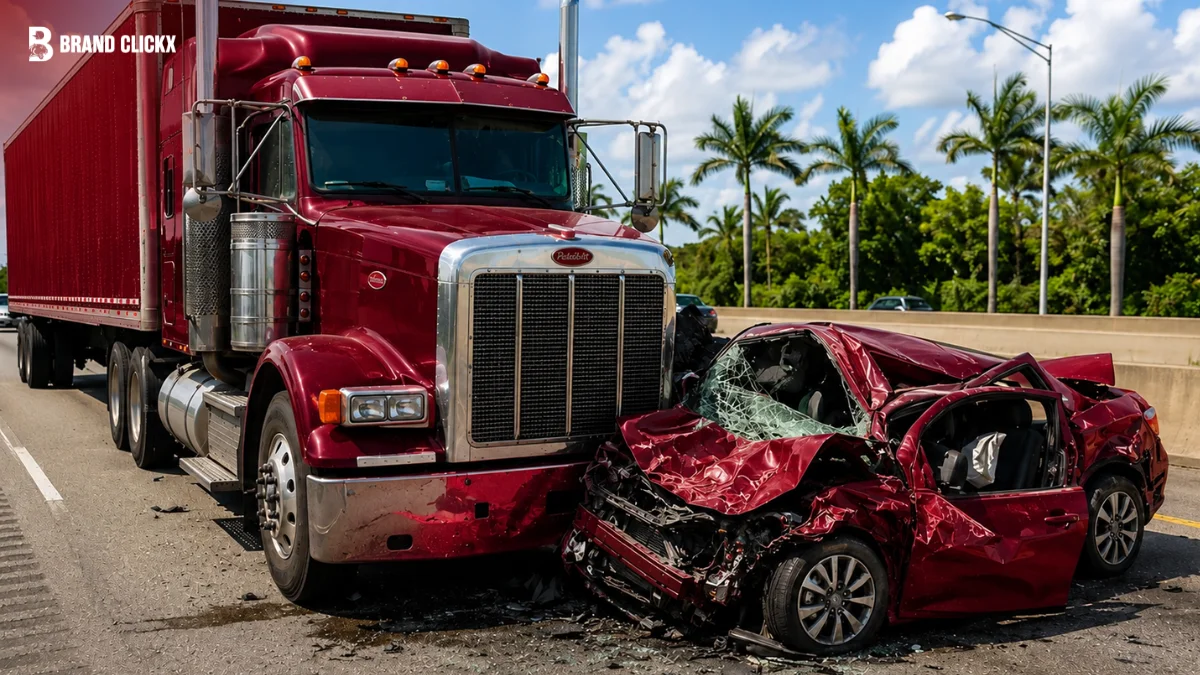
A serious truck crash can look simple from the outside: a truck, a collision, an injured person, and an insurance company. The legal reality can be much more complicated.
America’s leading truck accident law firms are not defined by an official federal ranking. There is no nationwide government, court, or bar-association list that officially names the “best” or “leading” truck accident firms.
Instead, that phrase is used by private directories, law firms, and editorial websites, each with its own criteria.
That distinction matters when you are choosing a lawyer. A commercial-truck case may involve federal safety regulations, multiple companies, electronic records, vehicle data, insurance coverage, and complicated questions about who actually caused the crash.
This article separates verifiable information from marketing claims. It explains what truck accident law firms do, how to evaluate them, which publicly identified firms appear in the supplied research, what evidence can matter, and what has recently changed in commercial-truck litigation.
AI Overview: What are America’s leading truck accident law firms?
There is no official national ranking of America’s leading truck accident law firms. The strongest way to evaluate a firm is to look at its commercial-truck litigation experience, attorney licensing, disciplinary history, evidence-preservation practices, fee agreement, conflicts, and verifiable case record.
Truck cases can also involve FMCSA regulations, electronic logging devices, maintenance records, multiple defendants, and complex causation questions.
Key Takeaways
- There is no official U.S. ranking of the country’s leading truck accident law firms.
- FMCSA regulates important areas of interstate commercial trucking, including driver qualifications, hours of service, and vehicle inspection and maintenance.
- A serious truck case can involve the driver, motor carrier, vehicle owner, maintenance company, cargo-related parties, broker, or manufacturer.
- Electronic evidence can include ELD records, telematics, GPS information, video, dispatch communications, and vehicle data.
- FMCSA’s national crash statistics recorded 4,652 fatalities and 72,840 injuries in 2024 in its large-truck-and-bus crash data.
- NHTSA reported 39,254 total U.S. traffic deaths in 2024 and estimated 36,640 in 2025.
- A firm’s past verdicts, awards, or advertising should never be treated as a guarantee of your result.
How do you choose a leading truck accident law firm?
There is no official list of America’s leading truck accident law firms. Instead, compare firms by their commercial-truck litigation experience, attorney licensing, disciplinary history, evidence-preservation practices, fee agreement, conflicts of interest, local-court capability, and publicly verifiable case history.
A ranking or award alone does not establish that a firm is right for your case.
What Does a Truck Accident Law Firm Actually Do?

A truck accident law firm generally represents people injured in crashes involving commercial motor vehicles or families pursuing wrongful-death claims.
Those cases can involve tractor-trailers, semis, 18-wheelers, delivery vehicles, tankers, dump trucks, buses, and other commercial vehicles.
The legal issues can extend beyond the actions of the truck driver. Depending on the evidence and applicable law, a claim may involve the motor carrier, vehicle owner, maintenance provider, cargo-related party, broker, or product manufacturer.
That is one reason commercial truck accident lawyers often examine both the collision itself and the business systems surrounding the vehicle.
Federal trucking rules can become relevant as well. FMCSA regulations cover subjects including driver qualifications, hours of service, controlled substances and alcohol testing, electronic logging, inspection, and maintenance.
However, a regulatory violation does not automatically establish civil liability. The lawyer still has to connect the evidence to the legal elements of the particular claim.
Why Truck Accident Litigation Became More Specialized

Federal regulation of interstate motor carriers has a long history.
The Motor Carrier Act of 1935 placed interstate motor carriers under federal regulation. Later, the Motor Carrier Safety Improvement Act of 1999 established the Federal Motor Carrier Safety Administration within the U.S. Department of Transportation.
That regulatory structure matters today because a truck collision can involve records and requirements that usually do not appear in an ordinary passenger-car accident.
The technology has changed, too. Many commercial operations now produce electronic records that can become relevant during an investigation.
Those records may include electronic logging device information, telematics, GPS data, dispatch communications, video footage, inspection records, and vehicle-system information.
The federal ELD rule reflects that technological shift. Many commercial drivers must use compliant electronic logging devices to record hours of service, although exemptions and exceptions apply.
How Do America’s Leading Truck Accident Law Firms Investigate a Case?
A serious truck case usually begins with evidence, not a settlement number.
The precise process varies by jurisdiction and facts, but several areas deserve early attention.
1. Identify the people and companies involved
The driver may be only one part of the investigation.
A lawyer may examine the motor carrier, truck or trailer owner, maintenance provider, cargo-related entities, broker, and potentially a manufacturer.
Whether any of these parties can legally be held responsible depends on the facts and the governing law.
2. Preserve potentially relevant evidence
Electronic records can become particularly important.
Potential evidence may include ELD records, dispatch information, telematics, GPS data, camera footage, inspection and maintenance records, and vehicle data.
A lawyer may send a preservation request asking relevant parties to retain potentially important evidence. Federal Rule of Civil Procedure 37(e) addresses electronically stored information that should have been preserved in litigation and is lost, but preservation duties depend on the circumstances and applicable law.
That is why the idea of a spoliation letter should not be treated as a magic document. Its practical value depends on the evidence, the parties involved, the litigation posture, and the applicable legal rules.
3. Examine trucking compliance
Investigators may review driver qualification records, hours-of-service information, inspection and maintenance records, and other materials governed by federal regulations.
For example, 49 CFR Part 395 addresses hours of service, while Part 396 addresses inspection, repair, and maintenance requirements.
Still, compliance evidence must be connected to the collision. An irregularity in an ELD record, by itself, does not prove that a driver caused the crash.
4. Reconstruct what happened
Some cases require technical analysis of the collision.
Accident reconstruction may involve photographs, vehicle damage, roadway evidence, available vehicle data, witness accounts, and other evidence.
The purpose is not simply to create an impressive presentation. The evidence must help establish what happened and whether a particular person’s or company’s conduct legally contributed to the injuries.
Which Truck Accident Law Firms Are Publicly Identifiable?
There is an important distinction between examples of firms that publicly identify themselves with truck litigation and firms that can objectively be called the nation’s “best.”
The research supplied for this article identifies several firms associated with commercial-truck litigation, including:
| Firm | Publicly identified focus in the supplied research |
| The Law Firm for Truck Safety, LLP | Multi-state catastrophic truck crashes |
| Arnold & Itkin LLP | High-damages commercial injury and defect litigation |
| Penn Kestner & McEwen | Commercial carrier collision claims |
| Metier Law Firm | Severe traumatic injury litigation |
| Beasley Allen | Plaintiff-side serious injury litigation |
These names should not be read as a national ranking.
For example, Best Law Firms lists The Law Firm for Truck Safety in its 2026 Cleveland Tier 1 Personal Injury Litigation–Plaintiffs category. That is a published local ranking, not evidence that the firm is officially America’s number-one truck litigation firm.
Likewise, private firm websites can describe their own experience and capabilities. Those descriptions can help you identify potential candidates, but they are not independent audits of quality or future results.
A Better Way to Compare Truck Accident Lawyers
If you are researching truck accident attorneys, use evidence that you can actually verify.
| What to check | Why it matters |
| Attorney license | Confirms the lawyer is authorized to practice where required |
| Disciplinary history | Gives you information beyond advertising |
| Commercial-truck experience | Shows whether the lawyer regularly handles this type of litigation |
| Trial experience | Helps you understand the firm’s litigation capability |
| Evidence preservation | Important when electronic and company records may matter |
| Fee agreement | Shows percentages, expenses, and client obligations |
| Conflicts of interest | Helps identify representation problems |
| Local-court capability | Important when jurisdiction-specific rules apply |
| Verifiable case history | Lets you distinguish documented results from marketing claims |
The American Bar Association’s Model Rule 7.1 addresses false or misleading communications about lawyers’ services. The Model Rules themselves are not automatically the professional-conduct rules of every state, because individual jurisdictions adopt and enforce their own rules.
What Makes a Truck Accident Case Different From a Car Crash?
The difference is not simply the size of the truck.
Commercial trucking can involve federal regulations, business entities, specialized records, maintenance obligations, cargo rules, and electronic systems.
A single crash can therefore raise several separate questions:
- Was the driver qualified?
- Was the driver operating within applicable hours-of-service rules?
- Was the vehicle properly inspected and maintained?
- Was the cargo properly secured?
- Who owned the truck or trailer?
- Which company employed or contracted with the driver?
- Was a broker involved?
- What electronic evidence exists?
- Did any alleged violation actually contribute to the crash?
The answers can change the direction of the case.
Six Numbers That Put the Issue in Context
The national numbers also show why commercial-truck safety remains a significant public issue.
39,254: NHTSA reported this number of people killed in all U.S. traffic crashes during 2024.
36,640: NHTSA estimated this many U.S. traffic deaths for 2025. The figure is an estimate, not the final annual count.
6.7%: NHTSA said the 2025 estimate represented a 6.7% decrease from 2024.
1.19: The 2024 U.S. traffic fatality rate was 1.19 deaths per 100 million vehicle miles traveled.
4,652: FMCSA’s crash-statistics data show 4,652 fatalities resulting from large-truck-and-bus crashes in 2024 in the displayed national dataset.
72,840: The same FMCSA dataset reports 72,840 injuries resulting from those crashes in 2024.
FMCSA also reports 152,672 fatal and non-fatal crashes in its 2024 national dataset for the displayed large-truck-and-bus category.
Those numbers should not be confused with a count of successful lawsuits. Crash statistics describe crashes and their consequences; they do not determine civil liability.
The Overlooked Role of Electronic Evidence
One of the most important differences in modern truck litigation is the amount of digital information that may exist.
An ELD can document hours-of-service information. Other systems may contain telematics, GPS information, camera footage, dispatch communications, or vehicle data.
That does not mean every truck contains the same technology or that every record will be available.
The exact data depends on the vehicle, carrier, technology provider, retention practices, applicable regulations, and circumstances of the case.
FMCSA’s recent actions show why ELD accuracy remains an active regulatory issue. On August 6, 2026, FMCSA removed five ELD devices from its registered-device list after determining that the devices failed to meet minimum requirements.
Affected carriers were directed to replace those devices by October 6, 2026.
That development does not establish that an ELD problem caused any particular collision. It simply demonstrates why lawyers may need to understand the technology behind the records they are reviewing.
Who Should Use a Truck Accident Law Firm?
A specialized truck accident law firm may be particularly relevant when your case involves:
- Severe or catastrophic injuries.
- A fatal truck collision.
- Multiple potentially responsible companies.
- Disputed liability.
- Questions about driver fatigue or hours of service.
- Significant maintenance or inspection questions.
- Cargo-loading concerns.
- Extensive electronic evidence.
- Complicated insurance or coverage issues.
These factors do not automatically mean you need a national firm.
A capable local personal-injury lawyer with genuine commercial-truck experience may be appropriate, depending on the case and jurisdiction.
Who Should Avoid Choosing a Firm Based Only on Its Marketing?
You should be cautious about selecting a lawyer solely because a website says the firm is “the best,” “number one,” or “America’s leading.”
A large settlement advertisement does not tell you whether the facts, injuries, insurance coverage, liability, or applicable law resemble your case.
The same applies to awards and badges. They may provide useful information, but you should understand who issued the recognition and what was actually measured.
A written fee agreement deserves more attention than a flashy slogan.
Common Mistakes to Avoid
Mistake 1: Assuming an ELD violation proves fault
It does not. The evidence must connect the alleged violation to the crash and satisfy the applicable legal standards.
Mistake 2: Assuming the truck driver is the only defendant
A case can involve additional companies or individuals, depending on ownership, employment, maintenance, cargo, brokerage, and product issues.
Mistake 3: Treating a national ranking as an official government judgment
There is no official nationwide ranking titled “America’s leading truck accident law firms.”
Mistake 4: Assuming every truck case follows the same deadline
Statutes of limitations and other deadlines vary by state and claim type.
Mistake 5: Choosing a lawyer based only on a settlement number
Past results do not guarantee your result.
Practical Application: How to Evaluate a Truck Accident Lawyer

If you are actually comparing firms, make the process concrete.
First, identify the jurisdiction. Find out where the crash occurred and where a potential lawsuit could be brought. Licensing and procedural rules can differ between jurisdictions.
Next, ask who will handle your case. Do not stop at the firm’s brand name. Find out which attorney will actually lead the matter.
Then, ask about commercial-truck experience. Ask whether the lawyer has handled cases involving trucking companies, ELD records, maintenance evidence, cargo issues, or multiple defendants.
Review the fee agreement carefully. The ABA’s Model Rule 1.5 addresses fees, but the actual agreement and applicable state rules control your relationship. Ask about the percentage, litigation expenses, medical liens, and what happens if there is no recovery.
Ask how evidence will be handled. A serious lawyer should be able to explain what categories of records may matter without promising that any particular record will prove your case.
Finally, verify the lawyer independently. Check the relevant state bar for licensing and disciplinary information rather than relying entirely on a firm’s own website.
This process gives you something a generic “top 10” list cannot: a way to judge whether a particular lawyer fits your particular case.
Recent Developments in Truck Litigation
Commercial-truck litigation continues to evolve alongside trucking technology and regulation.
One current development is the increasing importance of electronic records. FMCSA continues to regulate ELD compliance, and its August 2026 removal of five devices demonstrates that electronic logging systems remain subject to regulatory oversight.
Another area requiring caution is broker liability.
Whether a freight broker can be held liable for negligent selection of a carrier can involve federal preemption questions and jurisdiction-specific law. It should not be presented as a simple nationwide yes-or-no rule.
Tort reform is another area that can affect truck litigation, but its effect depends on the particular state’s legislation and the type of claim involved.
For that reason, broad claims that every truck case will become more difficult or that every jurisdiction has adopted the same damages rules are not reliable.
What May Change Next?
Some developments are reasonable forecasts rather than established facts.
As fleets continue using cameras, telematics, electronic logs, and other digital systems, lawyers will likely encounter more questions about data collection, accuracy, preservation, interpretation, and admissibility.
Autonomous commercial vehicles could eventually create new disputes involving software, product design, manufacturers, and human oversight. However, the precise legal framework for future cases cannot responsibly be stated as settled fact today.
Likewise, predictions about future federal insurance minimums should remain predictions unless Congress or the responsible federal agency actually changes the applicable rules.
Keeping those distinctions clear is essential when researching a legal topic.
Conclusion
A truck crash can begin with one moment on the highway, but the legal investigation may reach far beyond that moment. Driver records, carrier responsibilities, maintenance documents, cargo practices, electronic data, and multiple companies can all become relevant.
That is why choosing among America’s leading truck accident law firms should not be reduced to finding the firm with the biggest advertisement or largest settlement number.
The better approach is more practical: verify the lawyer’s license, commercial-truck experience, litigation capability, evidence-preservation approach, conflicts, and written fee terms. Then consider whether that experience actually fits your case and jurisdiction.
The numbers also provide important context. NHTSA recorded 39,254 traffic deaths in 2024, while FMCSA’s large-truck-and-bus data recorded 4,652 fatalities and 72,840 injuries in that same year.
The opening picture of a crash looks simple. The evidence behind it often is not. In serious truck litigation, the strongest answer usually comes not from the loudest claim of being “the best,” but from what can actually be verified.
FAQ
What are America’s leading truck accident law firms?
There is no official national ranking of America’s leading truck accident law firms. You should compare firms based on commercial-truck experience, licensing, disciplinary history, evidence handling, fee terms, conflicts, and verifiable case history.
What makes a truck accident case different from a car crash?
Truck cases can involve federal trucking regulations, electronic records, commercial carriers, maintenance companies, cargo issues, and multiple potentially responsible parties. That can make the investigation more complicated than an ordinary two-car collision.
What is a spoliation letter in a trucking lawsuit?
A spoliation or preservation letter asks a party to preserve potentially relevant evidence. Depending on the case, that evidence may include ELD records, video, maintenance records, communications, or vehicle data.
Does an ELD violation prove the truck driver caused the crash?
No. An ELD issue may be relevant evidence, but it does not automatically establish negligence or causation. Those questions depend on the facts and applicable law.
Who can be liable for a commercial truck crash?
Potentially responsible parties can include the driver, motor carrier, vehicle owner, maintenance provider, cargo-related party, broker, or manufacturer. The actual parties depend on the evidence and governing law.
How much does a truck accident lawyer cost?
Many plaintiff personal-injury lawyers use contingency-fee arrangements. The percentage, expenses, liens, and other financial terms vary, so you should review the written agreement carefully.
How long do I have to file a truck accident lawsuit?
There is no single nationwide deadline. Statutes of limitations and other notice requirements vary by state, claim type, and circumstances.
Can I sue a freight broker after a truck accident?
Possibly, but broker liability is fact-specific and can involve federal preemption questions. You need jurisdiction-specific legal analysis before assuming a broker is liable or protected from liability.