


Account-based marketing’s a B2B strategy that treats each selected company almost like its own market, rather than one big audience getting the same message. Instead of blasting a campaign out wide, marketing and sales sit down together, pick accounts that are actually a strong fit, and build experiences relevant to the specific people involved in that buying decision.
The logic’s simple enough: put your best resources against the accounts most likely to create real business value. Which is exactly why ABM works so well for businesses with longer sales cycles, multiple decision-makers, and deals big enough to actually justify the extra effort.
And it’s worth being clear here, ABM isn’t just another form of advertising. It ties together account research, content, outreach, sales activity, personalization, and measurement, all in one coordinated process, not separate teams doing their own thing off in a corner.
Key Takeaways
- Okay so the whole point of ABM is you’re not chasing every lead that comes in. You pick the accounts that are actually worth chasing and go all in on those instead.
- Before you do anything, you need an actual goal. And you need to know who you’re even going after, not a vague idea, an actual profile of the kind of company that fits. Then build a real list. Not “we’ll figure it out as we go.”
- Here’s the thing that trips people up though, sales and marketing have to be looking at the exact same account info. Same priorities. Same numbers they’re both being judged on. The second those two teams drift apart, even a little, the whole strategy stops working and usually nobody notices until deals start dying quietly.
- Also, don’t go overboard with personalization on every single account. A $500K account probably deserves a custom deck and a tailored pitch. A smaller one probably doesn’t need that same level of effort, match it to what the account’s worth.
- And stop counting leads like that’s the win. What actually matters is whether accounts are engaging, whether deals are moving through pipeline, whether they’re closing faster, whether real revenue’s showing up at the end of it.
Why Account-Based Marketing Matters
Old-school lead gen starts wide, throw the net out, see who bites, hope enough people raise their hand. ABM flips that entirely. You figure out first which accounts are actually worth chasing, then build a plan to reach the specific people inside those companies who matter.
Here’s what that actually buys you, less wasted effort. Your team’s not spending the same energy on a $2K deal as a $200K one, that math never made sense in the first place. It also gives sales and marketing one shared target to aim at, instead of two separate lists that never quite line up.
But ABM only really works when the goals behind it are realistic and something you can actually measure. Forrester’s 2026 guidance is pretty direct about this, set goals that are clear and actionable, ones sales and marketing genuinely share, instead of some vague “let’s do ABM” target that nobody can act on.
Start With Clear ABM Goals
Before choosing accounts or creating content, decide what you want ABM to achieve.
Your goal could be to:
- Create more opportunities from high-value accounts
- Increase deal size
- Shorten the sales cycle
- Improve engagement with strategic companies
- Expand existing customer accounts
- Increase customer retention or lifetime value
Keep the first goal narrow and specific. Instead of something vague like “improve ABM performance,” go with something you can actually point to, say, increasing qualified opportunities from your top 50 accounts over the next two quarters.
That kind of specificity’s what makes an ABM rollout actually manageable, and it gives everyone on the team the same clear picture of what winning even looks like.
Define Your Ideal Customer Profile
Your ideal customer profile tells you what a valuable account looks like.
Look at your existing customers and identify patterns such as:
- Industry
- Company size
- Revenue range
- Location or market
- Technology used
- Business model
- Typical challenges
- Buying behavior
- Potential contract value
- Growth signals
Do not build your ICP around assumptions alone. Use CRM data, customer interviews, sales feedback, and actual deal history where possible.
A good ICP should help your team answer one important question: “Which companies are worth our attention?”
Build and Tier Your Target Accounts
Once your ICP is clear, create a list of accounts that match it. Then divide those accounts into tiers based on business value and the amount of personalization you can realistically provide.
Tier 1: One-to-One ABM
Use this for your most important accounts. The campaign can include detailed account research, highly personalized content, executive outreach, custom landing pages, and direct sales coordination.
Tier 2: One-to-Few ABM
Group accounts with similar needs, industries, or business problems. You can personalize the campaign for the group without creating everything from scratch.
Tier 3: One-to-Many ABM
This approach works with a larger number of named accounts. Automation and scalable personalization become more important.
Demandbase describes these three approaches as one-to-one, one-to-few, and one-to-many, with different levels of investment and personalization.
The smart move is not always choosing one model. Many businesses can use a blended approach, giving their highest-value accounts more attention while handling larger groups efficiently.
Align Sales and Marketing Before Launch

This is one of the most important parts of ABM.
Marketing should not build an account list and simply hand it to sales. Both teams should agree on which accounts matter, who owns each account, what message will be used, and when sales should take action.
Create a simple shared plan that covers:
- Target accounts
- Account owners
- Key contacts
- Account priorities
- Main business problems
- Campaign messages
- Sales actions
- Shared KPIs
- Follow-up process
HubSpot’s ABM guidance also highlights organizational and sales-marketing alignment as a core part of implementation.
When both teams work from the same information, the customer gets a much smoother experience.
Research the Buying Committee
One person rarely controls a complex B2B purchase. Your research should therefore go beyond finding one contact.
Map the people who may influence the decision, such as:
- Decision-makers
- Budget owners
- Technical evaluators
- End users
- Procurement teams
- Senior executives
- Internal champions
Then understand what each person cares about.
A CFO may focus on cost and business value. A technical leader may care more about security, integration, and performance. A department manager may want a solution that saves time.
The product does not change, but the reason for buying it can be different for every person.
Create Relevant Account Content
Now turn your research into useful content.
Avoid changing only the company name in a generic email and calling it personalization. Real personalization should connect your message to a genuine business need.
You might create:
- Industry-specific guides
- Custom account landing pages
- Personalized email sequences
- Case studies
- ROI material
- Product comparisons
- Executive messages
- Account-specific presentations
For Tier 1 accounts, even a small amount of original research can make your outreach feel much more relevant.
The goal is not to impress the prospect with how much you know about them. The goal is to show that you understand their problem and have something useful to offer.
Choose the Right Channels
Your ABM campaign can use several channels, but you do not need to use every channel available.
Depending on your audience, consider:
- Paid advertising
- Organic search
- Web personalization
- Sales outreach
- Events and webinars
- Direct mail
- Executive networking
Match the channel to the account and buying stage. High-value accounts may justify more personal outreach, while larger account groups can benefit from automated campaigns.
Demandbase’s account-tiering guidance similarly recommends higher-touch tactics for priority accounts and more scalable channels for broader tiers.
Use Intent and Engagement Signals
ABM becomes more useful when you know which accounts are showing genuine interest.
Useful signals can include:
- Repeated website visits
- Visits to pricing or product pages
- Content downloads
- Webinar attendance
- Email engagement
- Multiple people from the same company visiting your site
- Sales conversations
- Product demonstrations
- Research around relevant topics
Intent data can help identify accounts that may be actively researching a solution, but it should not replace your own customer and account data. First-party engagement can provide valuable context about what an account is actually doing with your brand.
Build a Simple ABM Workflow
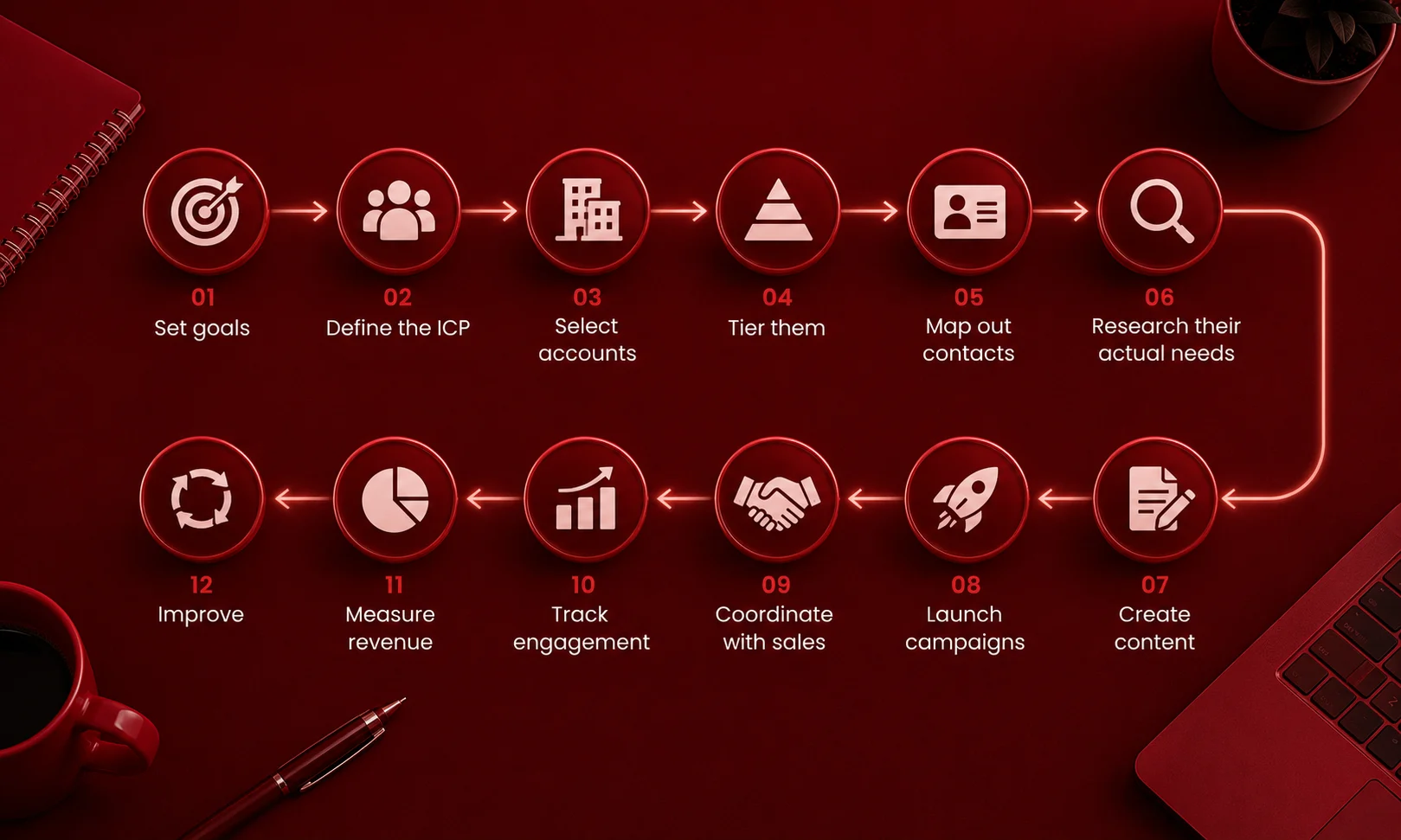
A practical rollout could look something like this:
Set goals → Define the ICP → Select accounts → Tier them → Map out contacts → Research their actual needs → Create content → Launch campaigns → Coordinate with sales → Track engagement → Measure revenue → Improve
Worth keeping all of this documented too. A living account playbook, one that covers ICP criteria, the target account list, research on each account, key contacts, messaging, campaign activity, and what sales is actually doing, keeps everyone on the same page as accounts move through the buying journey instead of scattered across ten different spreadsheets nobody’s updated in weeks.
Measure What Actually Matters
Lead volume alone can give you the wrong picture of ABM performance.
Track metrics that connect account activity with business results, such as:
Account Engagement
Look at website activity, content engagement, event participation, email interactions, and the number of engaged contacts within an account.
Pipeline and Opportunities
Track how many target accounts become opportunities, how much pipeline they create, and how quickly opportunities move through the sales process.
Revenue and Deal Value
Ultimately, ABM should connect to business outcomes. Measure closed revenue, average deal value, customer value, and expansion where relevant.
Account-Level Progress
Do not only look at campaign totals. Ask whether specific priority accounts are becoming more engaged, developing buying relationships, and moving closer to a commercial decision.
Forrester recommends combining account-level and program-level measurement while keeping measurement connected to the goals of the ABM program.
Common ABM Mistakes to Avoid
Targeting Too Many Accounts
If everything is a priority, nothing really is. Start with a manageable account list and expand when your process works.
Personalizing Only the Surface
Adding a company name to an email is not meaningful personalization. Connect your message to the account’s actual situation.
Keeping Sales Out of the Process
ABM cannot reach its full potential when marketing and sales operate separately.
Measuring Only Leads
A campaign can generate thousands of interactions and still fail to create valuable opportunities. Focus on account quality and revenue impact.
Using the Same Strategy for Every Account
A strategic enterprise account and a lower-priority prospect should not receive the same level of investment.
What Makes an ABM Guide Trustworthy?
A genuinely useful ABM resource shouldn’t just repeat marketing buzzwords back at people. It should actually explain the reasoning behind each step, and give recommendations a real marketing or sales team could pick up and use tomorrow.
For BrandClickX, that comes down to a few things really: back up the important claims with real industry sources, keep the advice practical instead of theoretical, and be upfront about what’s actual established practice versus what’s just an opinion or a made-up example.
Google’s been saying the same thing for a while now too, helpful, reliable, content built for people first. Their August 2026 site-reputation update leaned into that again, favoring content that’s genuinely useful over stuff written mainly to chase rankings.
For ABM content specifically, that means actually answering what the reader’s asking, not padding it with unnecessary keyword repetition, and giving real, usable implementation detail instead of just defining “what is ABM” over and over across a dozen articles.
Conclusion
More messages to more companies was never the win here. That’s the trap a lot of teams fall into early on. The real work is narrowing down to the right accounts, actually learning something real about the people making decisions there, and giving them an actual reason to pick up the phone or reply to an email.
So don’t try to boil the ocean. Nail down who the ideal customer even is. Build a list that’s actually focused, not bloated. Get sales and marketing on the same page, genuinely, not just in a kickoff meeting that everyone forgets about. Personalize the stuff that’s worth personalizing, and skip it where it isn’t. Then measure against things that matter to the business, not vanity numbers.
Once that whole loop’s repeatable, that’s when it can actually grow, without turning into the same generic blast campaign it was trying to avoid in the first place. And that’s really the moment ABM stops being a marketing tactic on a slide and starts actually driving revenue.
Frequently Asked Questions
What is ABM implementation, in plain terms?
It’s just putting the strategy into motion. Set a goal, know who you’re targeting, pick the accounts, build the campaigns, get sales actually involved, and check if any of it’s working.
How long does this take?
Really depends on how big you’re starting. A small test can be up and running in a few weeks. A full rollout takes longer, you’re prepping data, researching accounts, sorting out tools, writing content, getting sales and marketing to actually agree on things. Small first, always.
Only for big companies?
Not at all. Even a small company can run this if they’ve got a defined set of accounts worth going after. Just size the effort to match what you can realistically do.
How’s it different from normal marketing?
Normal marketing goes wide first and narrows down later. This does the opposite, pick the accounts first, then build toward them specifically.
What should actually get tracked?
Engagement, how many people at the account are actually responding, opportunities, pipeline, deal speed, win rate, revenue, expansion. Track what ties back to the goal, skip the rest.
Does it work with inbound?
Yeah, pretty well actually. Inbound brings people in and teaches them. ABM just takes the accounts worth the extra attention and gives them something more tailored on top of that.