

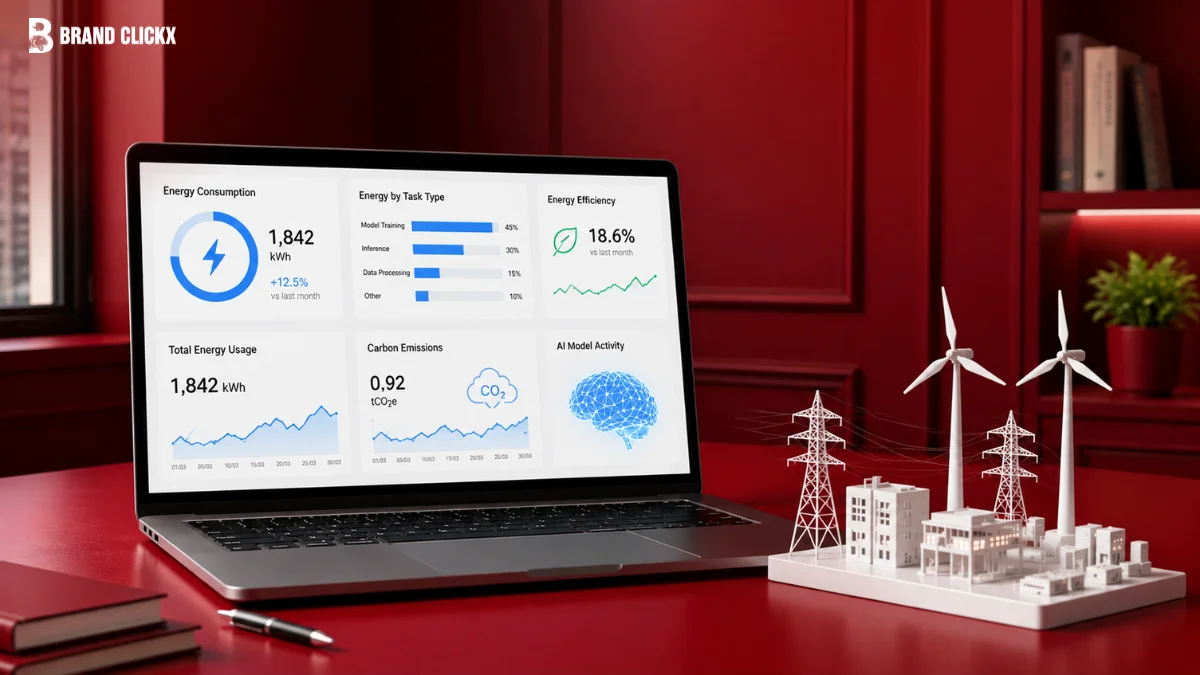
0.3 watt-hours for a typical text AI query does not sound like much. That was my first reaction too. But the number starts to look very different when you stop thinking about one prompt and look at millions of prompts, huge model-training runs, and data centers that operate day and night.
That is where the real story of an AI energy consumption report begins.
There is also a problem with many articles on this topic. One says an AI query uses a tiny amount of electricity. Another makes it sound like every prompt is draining the power of a house. Both can be misleading if you don’t know what they are actually measuring.
So, rather than throwing one scary number at you, this report separates the pieces: model training, AI inference, data-center electricity, cooling, regional grid pressure, and what could happen by 2030.
The goal is simple. You should finish this article knowing which numbers are useful, which ones need context, and where the hidden energy cost of artificial intelligence really sits.
AI Energy Consumption Report: What the Latest Data Shows
The latest International Energy Agency (IEA) analysis shows that global data-center electricity consumption reached about 485 TWh in 2025, up from 415 TWh in 2024. Data-center electricity use is projected to reach around 950 TWh by 2030, roughly doubling over five years.
AI is a major reason for that growth. The IEA says electricity consumption from AI-focused data centers increased by 50% in 2025, while total data-center electricity demand grew by 17%.
At the same time, energy use per individual AI task is falling quickly. Simple text queries can be relatively cheap, while reasoning, video generation and agentic AI tasks can require hundreds or even thousands of times more energy than simple text generation.
That is the part many simple AI energy stories miss: efficiency is improving, but AI use is expanding and becoming more energy-intensive.
Key Takeaways
- Global data centers used about 485 TWh of electricity in 2025, according to the IEA.
- The IEA expects data-center electricity use to reach about 950 TWh by 2030.
- AI-focused data-center electricity consumption grew 50% in 2025.
- A typical text-based ChatGPT query has been estimated at roughly 0.3 Wh, but this is an estimate, not a universal number for every AI model or task.
- Long inputs, reasoning, image generation, video generation and agentic tasks can consume substantially more energy than a simple text request.
- Training is only one part of AI’s energy footprint. Running models for users, known as inference, can become the bigger issue when usage reaches very large scale.
- Data centers may represent only around 3% of global electricity demand by 2030, but their local impact can be much larger because facilities are concentrated in particular regions.
How Much Energy Does AI Consume?
There is no single number that represents all AI energy consumption.
A small machine-learning model running occasionally on a laptop is obviously very different from a large language model running across thousands of accelerators inside a hyperscale data center.
A useful way to think about AI energy use is in three layers:
| Layer | What consumes electricity? | Why it matters |
| Training | GPUs/AI accelerators, memory, networking and cooling | Large models can require enormous computing resources during development |
| Inference | Running the trained model for users | Repeated millions or billions of times |
| Infrastructure | Cooling, power delivery, networking, storage and other equipment | Supports the AI workload but is not itself the model |
There is another important distinction.
Power describes how quickly electricity is being used, usually in watts or megawatts. Energy describes the amount used over time, such as watt-hours, kilowatt-hours or terawatt-hours.
So when you see that an AI data center needs hundreds of megawatts, that is a power figure. When you see that data centers consumed hundreds of TWh during a year, that is an energy figure.
Mixing these two is one reason AI energy discussions can become confusing very quickly.
Where Does the Energy Go When Training Large AI Models?
Training is the part that gets most of the attention because large models require huge amounts of computation before they are ready for users.
During training, AI accelerators repeatedly process enormous amounts of data. The system has to move data between processors and memory, communicate between machines, store information and keep everything cool.
The electricity does not go only into the GPU.
A modern AI data center also needs networking equipment, storage, power systems and cooling. The IEA’s analysis separates accelerated servers from other IT equipment and infrastructure such as cooling, showing that the total electricity footprint of a data center is broader than the electricity used directly by AI chips.
This is also why claims such as “training one large model uses X GWh” should be treated carefully.
The result depends on the model, hardware, number of training runs, utilization, training duration, software efficiency and what parts of the data-center overhead are included.
There is no universal training-energy number that applies to every large AI model.
Training Is Only Half the Story: AI Inference
Here is something I think is easy to overlook. After a model has been trained, the work does not stop. Every time someone sends a prompt to an AI system, the model has to perform inference. That means the data center is doing computation again to generate the response.
One request is small. Billions of requests are not.
Epoch AI estimated that a typical GPT-4o text query consumes around 0.3 Wh under its assumptions. The same analysis found that very long inputs could raise the estimated energy substantially, with a 10,000-token input estimated around 2.5 Wh and a 100,000-token input approaching 40 Wh. These figures are estimates rather than measurements of every real-world query.
This is why you should not compare “energy per prompt” with “total AI energy” as if they were the same metric.
They answer different questions. The first asks, “What might one task cost?”
The second asks, “How much electricity does the entire system consume?”
How Much Energy Does One AI Query Use?
For a normal text request, a commonly cited estimate is around 0.3 Wh for a GPT-4o query. Epoch AI describes this as a reasonable, somewhat pessimistic estimate and also notes that actual consumption varies with token counts, hardware utilization and other assumptions.
That does not mean every AI query uses 0.3 Wh.
A short question and a long reasoning task are not equivalent. Neither is a text response equivalent to generating a high-resolution video.
The IEA makes this difference even clearer. Its 2026 analysis says energy consumption per AI task has fallen by at least an order of magnitude annually in recent years, but newer uses such as video generation, reasoning and agentic tasks can consume hundreds or thousands of times more energy per query than simple text generation.
So if you see a headline saying “one AI prompt uses X electricity,” ask one question before trusting it:
What kind of prompt?
That single question can completely change the answer.
AI Data Centers Are the Real Energy Story
This is probably the most important part of the whole subject.
People often imagine AI energy consumption as electricity going directly into a chatbot. In reality, AI depends on physical infrastructure.
Data centers contain servers, networking equipment, storage, power systems and cooling systems. AI workloads are pushing these facilities toward much higher power densities than many traditional computing environments.
The IEA reports that the power density of AI servers increased 11 times between 2020 and 2025 and could increase another fourfold by 2027. An individual advanced server rack could have peak power demand comparable to the electricity use of about 65 households by 2027.
That creates a very different problem from simply asking whether one prompt is expensive.
A region might have plenty of electricity overall but still struggle to connect a huge new data center quickly.
The IEA estimates that around 20% of planned data-center projects could face delays if grid-related risks are not addressed.
This is why AI energy consumption has become an electricity-grid issue, not just a technology issue.
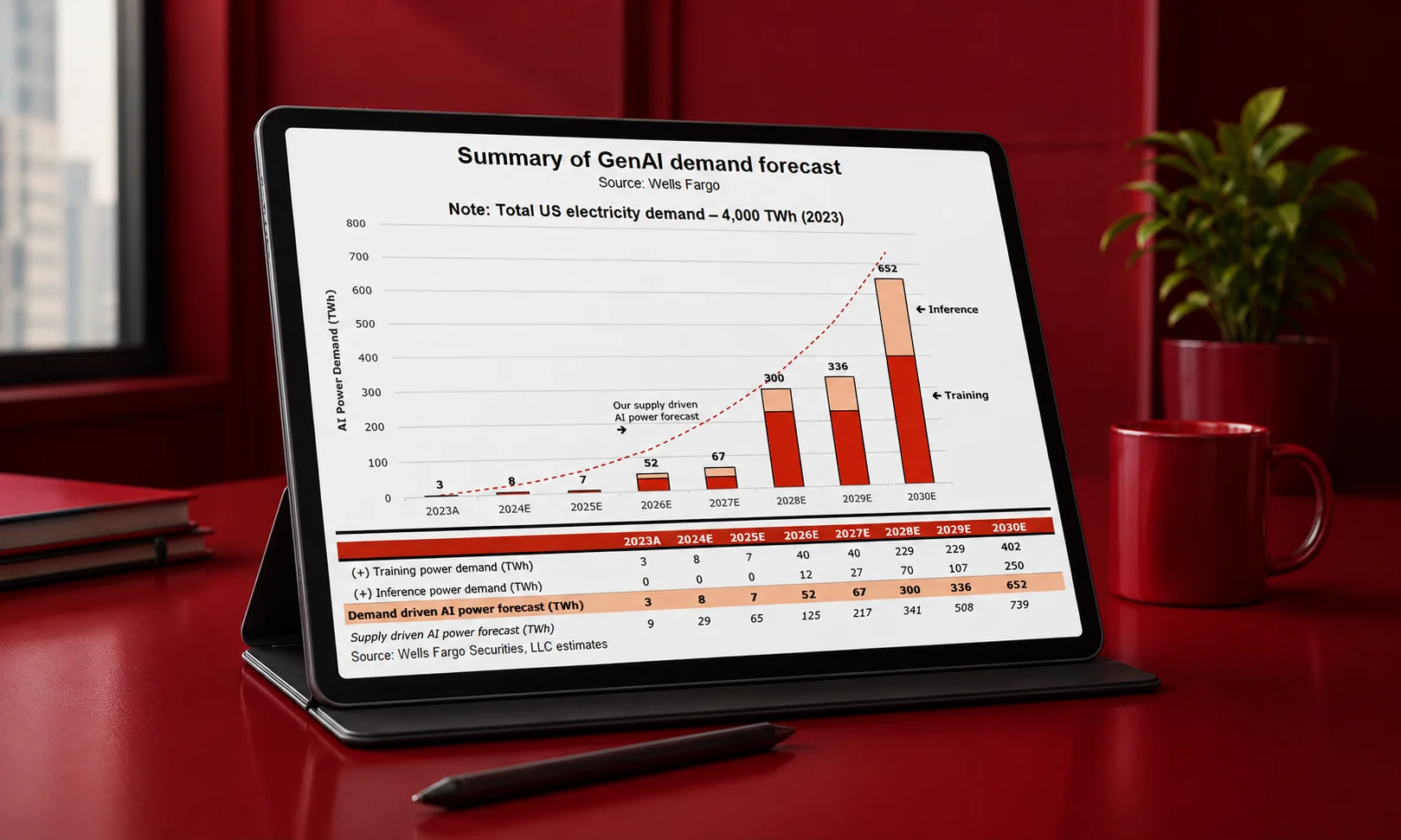
AI Energy Consumption by 2030: What the Forecasts Say
The IEA’s 2026 base case puts global data-center electricity consumption at about 950 TWh in 2030, compared with 485 TWh in 2025. That would make data centers responsible for around 3% of global electricity demand.
The number sounds enormous, and it is.
But there is an important piece of context: 3% of global electricity is still a relatively small share of total worldwide demand.
The problem is that the impact is not evenly distributed.
The IEA says data centers could account for almost half of electricity-demand growth in the United States through 2030. In Japan, they could account for more than half of demand growth, while Malaysia could see data centers account for as much as one-fifth of electricity-demand growth.
So the better question is not simply:
“Will AI use a lot of electricity?”
It clearly will.
The better question is:
Where will that electricity come from, and can the local grid deliver it reliably?
Why AI Energy Consumption Reports Give Different Numbers
If you have read several AI energy reports, you have probably noticed something strange.
The numbers don’t always agree.
That does not automatically mean one source is lying.
Often, researchers are measuring different things.
Different definitions
One study may measure electricity used by AI servers only. Another may include cooling and other data-center infrastructure. A third may estimate the entire data-center electricity demand and then calculate how much is associated with AI. Those are not interchangeable figures.
Different workloads
A simple text question is not the same as a reasoning task. Image generation is different again. Video generation can be more demanding still. Long-context applications also change the calculation because processing a large amount of input requires additional computation.
Different hardware
An older accelerator and a newer accelerator can perform similar AI tasks with very different efficiency.
Software optimization matters too.
Better batching, model architectures, memory management and inference techniques can reduce the electricity needed for a task.
Different electricity systems
The environmental impact also depends on where the data center operates.
Using electricity from a relatively low-carbon grid is different from using electricity from a grid with a high share of fossil fuels. That means “AI used X kWh” does not automatically tell you “AI produced X amount of carbon.”
A Better Way to Read an AI Energy Statistic
When you see a number in an AI energy consumption report, check four things.
First: What is being measured?
Is it training, inference, one query, one model, one data center or all data centers?
Second: What period does it cover?
A 2023 estimate may not represent 2026 hardware and models.
Third: What assumptions were used?
Look for assumptions about GPU power, utilization, token counts, cooling and electricity sources.
Fourth: Is it measured or estimated?
This is a big one.
Some AI energy numbers come from direct operational data. Others are engineering estimates based on assumptions because companies do not publicly disclose everything needed to calculate the figure.
A good report should tell you which is which.
The Environmental Cost: Carbon, Water and More
Electricity is only part of the environmental story.
The carbon footprint of AI depends heavily on how that electricity is generated. A data center powered by a grid with a large share of low-carbon electricity will have a different emissions profile from one operating on a more carbon-intensive grid.
Water is another issue.
Data centers may use water for cooling, depending on their cooling technology and local conditions. The amount can vary widely between facilities, climates and cooling systems.
There is also a broader infrastructure footprint: land, transmission equipment, transformers, construction materials and the manufacturing of servers and AI accelerators.
This does not mean every AI request has a huge environmental footprint.
That would be an oversimplification. The more realistic concern is scale. A small environmental cost per task can become significant when the number of tasks, servers and facilities grows rapidly.
Is AI Energy Consumption Actually a Crisis?
I would be careful with that word.
The global electricity system is much bigger than AI, and the IEA’s base case still puts total data-center electricity consumption at around 3% of global electricity demand in 2030.
But that does not mean the problem is insignificant.
The local effects can be much stronger than the global percentage suggests. A new data center can place a major load on a particular grid, especially where several projects are being developed at the same time.
There is also a second issue.
AI is getting more efficient, but people are using it more. And new AI applications are doing more complicated work.
So efficiency alone does not guarantee that total electricity consumption will fall. That tension between efficiency and growing demand is one of the most important things to watch over the next few years.
What Could Make AI More Energy Efficient?
There are several ways to reduce the energy required to run AI systems.
Better AI hardware
Newer accelerators can perform more computation with less electricity per task. That does not make the data center energy-free, but it can lower energy intensity.
Smaller models
Not every task needs the largest available model.
A smaller model can often handle classification, summarization, extraction or simple generation tasks without the same computational cost as a much larger model.
For companies running AI at scale, choosing the smallest model that does the job can make a meaningful difference.
Inference optimization
Techniques such as quantization, pruning, better batching, and efficient model serving can reduce computation or memory requirements.
But there is no universal “80% energy saving” number.
The result depends on the model, hardware, software, and workload. A technique that works very well for one system may deliver a much smaller improvement somewhere else.
More efficient cooling
Cooling is an important part of data-center infrastructure.
As AI racks become more power-dense, data-center operators are increasingly using advanced cooling approaches to handle the heat produced by high-performance computing.
Better cooling can reduce overhead, but it still requires infrastructure and energy.
Cleaner electricity
Even when electricity demand cannot be eliminated, its environmental impact can be reduced by using lower-carbon electricity sources.
The IEA expects renewables to meet nearly half of the additional electricity demand from data centers through 2030, with natural gas and nuclear also playing important roles in different regions and scenarios.
How to Measure and Reduce AI Energy Use in Practice
If you operate an AI system, the first step is not buying new hardware.
It is measuring what you already use.
Start by recording the workload:
- Which model are you running?
- How many requests do you process?
- How many input and output tokens are involved?
- What hardware runs the model?
- How long does inference take?
- What is the electricity source?
- Are cooling and infrastructure included in your calculation?
Then compare the result before and after optimization.
You can also test smaller models for simple workloads, use quantization where it makes sense, reduce unnecessarily long prompts and outputs, and avoid running expensive models for tasks that do not need them.
For larger organizations, energy-monitoring tools can help estimate emissions and hardware-level energy consumption.
The key is consistency.
If you change the measurement method every month, your numbers may look better or worse simply because the calculation changed.
Who Should Use Energy-Monitoring Tools?
They are most useful for companies, AI developers, researchers and teams running repeated workloads where energy efficiency can be measured over time.
Who Should Avoid Overinterpreting Them?
Individual users should not assume that a tool’s estimate is an exact measurement of every cloud AI service.
Cloud providers may use different hardware, scheduling systems, cooling infrastructure and electricity sources. Estimates are useful for comparison, but they should not be presented as perfect measurements.
The Difference Between AI Energy Efficiency and Total AI Energy
This distinction deserves its own section because it is easy to miss. Imagine an AI system becomes 10 times more efficient per task.
That sounds fantastic. But if the number of tasks grows 20 times, total energy consumption can still increase.
The IEA is already seeing this tension. Its 2026 analysis says energy consumption per AI task has fallen rapidly, while AI-focused data-center electricity consumption still grew 50% in 2025.
This is why both numbers matter.
Energy per task tells us about efficiency. Total electricity consumption tells us about scale. You need both to understand the actual energy impact of artificial intelligence.
What This AI Energy Consumption Report Actually Tells Us
After looking at the numbers together, the picture is less dramatic than some headlines suggest and more serious than others imply.
At the individual-query level, simple text AI can use a relatively small amount of electricity. Estimates such as 0.3 Wh are useful for understanding the scale, but they are not universal measurements for every model or workload.
At the infrastructure level, things become much bigger. AI is pushing data centers toward higher power densities, larger facilities and greater demand for electricity and grid connections.
At the global level, the IEA expects data-center electricity consumption to reach around 950 TWh by 2030. That is a substantial increase, even though it remains around 3% of global electricity demand.
So the hidden cost of large AI models is not really one chatbot prompt.
It is the combination of scale, infrastructure, increasingly powerful workloads and the electricity needed to keep everything running.
Final Thought
At the beginning, 0.3 Wh for a text AI query looked almost too small to care about. And honestly, for one simple prompt, it is small.
The picture changes when that prompt becomes millions or billions of requests, when models become larger and more capable, and when companies build enormous data centers to keep those systems available around the clock.
That is why I would not describe AI energy consumption as simply “good” or “bad.” The more useful question is whether AI can become efficient quickly enough to keep up with the speed at which people are adopting it.
The latest AI energy consumption report data suggests we are getting better at making individual AI tasks more efficient while simultaneously building much more AI infrastructure.
That tension is probably the real story. Efficiency is improving. Demand is growing even faster in some parts of the system. And for the next few years, both things can be true at the same time.
Frequently Asked Questions
How much energy does AI consume?
AI does not have one fixed energy consumption number. A simple text query may use a fraction of a watt-hour, while large training runs and advanced AI tasks can require vastly more energy. At the infrastructure level, the IEA estimates global data centers consumed about 485 TWh of electricity in 2025, with AI-focused facilities growing especially quickly.
How much electricity does AI use?
The answer depends on whether you mean one AI task or the entire AI infrastructure. For a typical GPT-4o text query, Epoch AI estimated around 0.3 Wh under its assumptions, while global data-center electricity consumption reached about 485 TWh in 2025. These figures should not be compared directly because they measure completely different scales.
How much energy does AI training consume?
There is no reliable single number for all AI training because energy use varies with model size, hardware, training duration, utilization and other factors. Training can require very large computing resources, but the total footprint also depends on whether researchers include cooling, networking and other data-center overhead. That is why specific training-energy estimates should always be read together with their assumptions.
Does AI use more energy for training or inference?
Training can be extremely energy-intensive because a large model may require enormous amounts of computation before deployment. However, inference happens every time users interact with the model, so at very large usage volumes it can become a major part of the total energy footprint. The balance depends on the model, number of users, workload and how often the model is retrained.
How much energy does one AI query use?
A commonly cited estimate is about 0.3 Wh for a typical GPT-4o text query. Epoch AI also found that longer inputs can increase the estimated energy considerably, while the IEA notes that reasoning, video and agentic tasks can consume hundreds or thousands of times more energy than simple text generation.
How much electricity will AI use by 2030?
The IEA expects global data-center electricity consumption to reach around 950 TWh by 2030, roughly double the 485 TWh estimated for 2025. AI-focused data centers are expected to grow faster than data centers overall, but the exact AI-only share remains uncertain because companies and researchers do not have a single standardized global measurement system.
Why does AI consume so much electricity?
Large AI systems perform enormous amounts of computation using high-performance accelerators. They also need memory, networking, storage, power delivery and cooling, so the electricity footprint is larger than the processor’s power draw alone. As AI systems become more capable and are used at larger scale, the total infrastructure required to support them also grows.
Does generative AI use a lot of electricity?
It can, but the amount depends heavily on the task. Simple text generation can be relatively efficient, while image generation, video generation, long-context processing, reasoning and agentic workloads can require much more computation. The IEA specifically identifies these newer workloads as an important source of uncertainty in future AI electricity demand.
What is the carbon footprint of AI?
The carbon footprint of AI depends on the electricity used to power the workload and the carbon intensity of that electricity. Two identical AI systems can therefore have different emissions if they operate on different electricity grids. A proper carbon estimate should also clearly state what parts of the AI infrastructure are included.