
In January 2009, Tropicana replaced the familiar orange-with-a-straw image on its Pure Premium packaging with a new design centered on a glass of orange juice. Within two months, sales had fallen 20% and the company returned to its previous packaging. A later academic study estimated the economic cost of the change at about $27 million.
The old package carried a queue of people already connected with Tropicana. Research on the redesign also found that consumers had difficulty finding the product after the change.
That is the problem distinctive brand assets are meant to solve. They are colours, shapes, characters, sounds and phrases that let someone recognize a brand before reading its name. The useful question is whether your brand actually owns those cues in memory. The audit below gives you a way to find out.
Key takeaways
- Distinctive brand assets can be a colour, shape, sound, character, package or phrase that cues your brand.
- Fame tells you how widely an asset is linked to your brand, while uniqueness tells you how strongly that link belongs to you.
- The strongest assets score high on both measures.
- New assets need repeated use before they become useful memory cues.
- Changing an established asset should require consumer evidence rather than internal preference.
What counts as a distinctive brand assets?
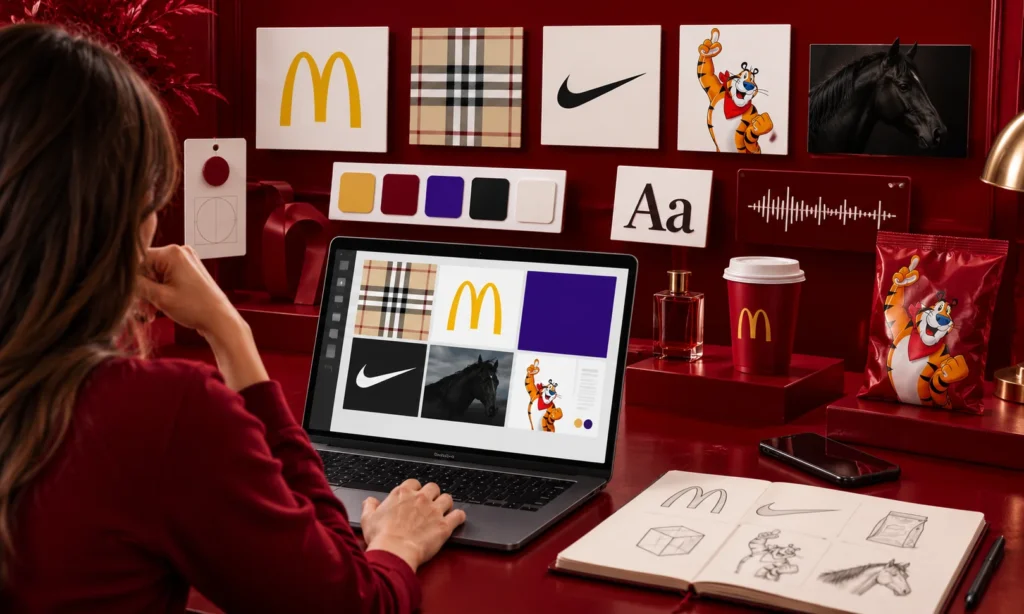
Distinctive brand assets are any recognizable element that can bring a brand to mind without relying on the brand name itself. The obvious example is a logo. But the category is much wider.
Brand codes go beyond logos
Brand codes can include colours, shapes and symbols, characters and mascots, typography, packaging, sounds and music, taglines and recurring phrases, fixed layouts, and photographic styles.
Some assets are easy to notice. Others work quietly. A particular package shape can help someone spot a product on a crowded shelf. A short sound can identify an ad before the brand name appears. A recurring character can create the same connection across years of campaigns.
The test is simple: remove the brand name and ask whether people would still know who it belongs to. If the answer is no, then you may have a design element. You do not necessarily have a distinctive brand assets.
Positioning and assets do different jobs
Positioning is what you want the market to understand about the brand. Distinctive brand assets are one of the ways people recognize the brand. That distinction matters because a brand can have strong positioning without owning many recognizable cues. It can also have familiar assets without having a clear reason for people to choose it.
A brand book may list 20 approved colours, fonts and graphic elements. That does not mean consumers have learned all 20 as brand cues. The real asset list is the smaller group that has entered memory.
Why do distinctive brand assets work?
People do not give every buying situation their full attention. A recognizable cue can make the brand easier to identify when attention is limited. That is where mental availability comes in.
Assets act as retrieval cues
Mental availability describes how easily a brand comes to mind across buying situations. Distinctive brand assets can help because they connect a visual, verbal or sensory cue with an existing memory structure. When the cue appears again, the brand association has something to work from.
The effect depends on the strength of the association. A colour that people simply like is different from a colour that reliably makes them think of one particular brand. This is why consistent use matters. Repetition gives people more chances to connect the cue with the brand.
Recognition can support brand equity
Brand equity is partly built through the associations people hold with a brand. Distinctive brand assets give those associations another route into memory. A person may see the name and recognize the brand. They may also see the package shape, character or colour and arrive at the same brand without reading the name.
That gives the brand more ways to be recognized. Current research covering 1,162 distinctive brand assets across 21 categories found that shape-based assets such as logos and packaging had the strongest average performance.
The study reported an average Fame of 40% and average Uniqueness of 71% for shape-based assets. Colour assets were weaker in that dataset at 12% Fame and 39% Uniqueness. Those figures are benchmarks from that study. They are not universal targets for every brand.
How do you measure a distinctive brand assets?
The cleanest audit uses two measures: Fame and Uniqueness. Fame asks how many people connect the asset to your brand. Uniqueness asks how much of that association belongs to your brand rather than competitors.
Measure Fame first
Show the asset without the brand name. Then ask: “Which brand does this make you think of?” Fame is the percentage of the total sample that links the asset to your brand. For example, if 40 out of 100 people connect a particular shape with your brand, then its Fame score is 40%.
The question needs to stay open enough for people to give the brand that genuinely comes to mind. Showing the brand name first would tell people what answer you want.
Then measure Uniqueness
Uniqueness looks at the brand responses that an asset receives compared with all brand responses to that asset. If people connect an asset with several brands, then it has less ownership in memory. A simple way to think about it is:
Fame = people linking the asset to your brand ÷ total people surveyed
Uniqueness = links to your brand ÷ links to all brands for that asset
The two numbers tell different stories. A cue can be famous but shared. Another can be highly unique but known by very few people. You need both measures before deciding what to do next.
Use the four-quadrant audit
Plot every asset on a Fame × Uniqueness grid.
| Fame | Uniqueness | What it means | Action |
| High | High | Strongly linked to the brand and hard to confuse | Use and protect |
| High | Low | Well known but shared with competitors | Avoid relying on it alone |
| Low | High | Ownable but not widely known | Build through repetition |
| Low | Low | Weak brand link and weak ownership | Ignore or test |
The grid gives you a better answer than a simple list of “good” and “bad” assets. An asset with low Fame and high Uniqueness may deserve investment because the association belongs to you even though few buyers know it yet.
An asset with high Fame and low Uniqueness needs more care. People recognize the cue, but it may also bring competitors to mind.
What can you do if you have a small research budget?

You do not need to begin with a huge brand study to find obvious problems. Build a practical audit around the same two questions. Test the assets with people who actually buy or consider the category, then record which brand comes to mind.
Keep the test consistent
- Show the asset without the brand name.
- Ask which brand it brings to mind.
- Record every brand people mention.
- Then calculate Fame and Uniqueness using the same method for every asset.
A small directional test will not give you the precision of a large market study. It also cannot tell you everything about non-customers or small movements over time. But it can expose an obvious problem.
If your supposedly famous colour is barely linked to your brand or your supposedly ownable symbol brings three competitors to mind, then you have something worth investigating.
Keep the questions and scoring consistent when you repeat the exercise. That gives brand tracking more value because you can see whether associations are moving rather than relying on internal opinions.
How do you build new distinctive brand assets?
A new asset needs three things: a cue people can recognize, consistent use and enough exposure for the association to form. That takes time.
Pick something you can actually own
The asset needs to give people a reason to connect it with your brand rather than the category in general. A generic colour may be easy to use but difficult to own. A particular shape, character, sound or combination of elements may give you a stronger starting point.
The choice should also work across the places where people encounter the brand. An asset that works only in one television ad has limited value. An asset that works on packaging, digital ads, retail displays and other communications has more chances to build memory.
Repetition does the heavy lifting
Once you choose an asset, keep using it. Changing the colour every campaign or replacing a character whenever a new creative team arrives makes the memory structure harder to build. This is where share of voice matters. People need repeated exposure to connect the cue with the brand.
There is no reliable universal rule saying distinctive brand assets take exactly three years or five years to build. The time depends on the brand, category, reach, asset and consistency of use. So the practical rule is simple: give the asset enough repeated exposure before judging whether it works.
How do distinctive brand assets get destroyed?
Most established assets do not disappear because one person makes a bad decision. They usually weaken through a series of reasonable-looking changes.
The internal team gets tired first
- The same colour has been used for years.
- The same character has appeared in campaign after campaign.
- The same package has been on the shelf for a long time.
Inside the company, this can feel repetitive. Consumers do not experience the brand at anything close to the same frequency. That gap matters.
The marketing team may see an asset hundreds of times during planning and production. A buyer may see it only when shopping or when an ad reaches them. Internal boredom is therefore a poor reason to remove an established asset.
Rebrands can remove memory cues
Leadership changes can bring new priorities. Agencies change. Campaign platforms change. Packaging gets refreshed. Each decision can look small by itself. The risk appears when several established cues disappear at the same time.
Tropicana provides a clear example. Its redesign removed the familiar straw-in-orange image from the front of the package. The new design lasted about two months before the company returned to the previous packaging. The lesson is not that every redesign fails. The lesson is that established recognition cues have accumulated value.
Current research on packaging redesign also points to the need to protect recognizable brand cues and test identification and findability when major packaging changes are made. That is why a refresh should separate temporary campaign execution from assets the brand has spent years teaching people to recognize.
What rule should protect your assets?
Put the decision process into the brand guidelines before the next redesign arrives. Use this five-step asset protection rule
1. List the assets you actually own
Record the assets that have evidence behind them. Include their Fame and Uniqueness scores when available.
2. Give someone authority over changes
Distinctive brand assets should not change simply because a new campaign team prefers another colour or typeface. Give a senior brand owner clear authority over permanent asset changes.
3. Require evidence before removal
Before an established asset is changed, ask what the consumer data show.
- If Fame or Uniqueness is falling, then investigate why.
- If the only argument is that the team is tired of seeing it, then that is a different problem.
4. Check whether the asset is actually failing
Brand tracking can show whether an association is weakening. Use that evidence alongside market and creative information before making a permanent change.
5. Set a review process
Review assets often enough to catch problems, but do not treat every review as an invitation to redesign them. The purpose of the review is to protect memory structures and identify assets that need attention.
This also gives the CMO and brand team a clear answer when someone asks who approved a change. The person with authority should be able to point to the evidence rather than personal taste.
A broader rebrand should follow the same discipline. If the asset is part of what people recognize, then its Fame and Uniqueness need to be considered before it is removed. That matters beyond recognition. Strong brand associations can also support pricing power because consumers have more than one route back to the brand.
The read
I think distinctive brand assets are one of the easiest parts of brand strategy to damage because the warning signs are easy to miss. A weak campaign gets discussed quickly. A familiar colour that slowly loses its connection with the brand can sit unnoticed for years.
The practical answer is to audit what people actually recognize before changing what the company has grown tired of seeing. Start with one asset this week. Remove the brand name. Ask people what brand comes to mind. Then check Fame and Uniqueness.
That small exercise can tell you whether you have a brand asset worth protecting or simply an element your internal team has been calling one. For marketing effectiveness, the cheapest mistake to avoid may be throwing away recognition you already paid to build. Protect the cues that have earned their place in memory.