A function can spend years inside a brand and still end up back with an agency. Keurig Dr Pepper showed how quickly that can happen in 2025 when it shut its Liquid Sunshine in-house creative agency and moved creative work to external partners.
That makes brand in housing marketing a more useful question than simply asking how many brands have built internal teams. The real question is what they kept after the move and what they later decided needed outside capacity, specialist depth or a different perspective.
The pattern is starting to look clearer: recurring work tied closely to the brand has a stronger case for staying inside, while work that needs unusual scale, specialist capability or an outside view has a stronger case for staying external.
Key takeaways
- In-house adoption remains widespread, but external agencies remain part of most large marketing models.
- Social, digital creative and some media work have moved inward more than many other functions.
- Recent reversals show that creative scale and specialist capacity can pull work back outside.
- The hybrid model gives brands internal control while keeping external capacity for work that changes in volume or skill requirements.
- The right decision depends on the function rather than an in-house or agency label.
What actually moved in house
The broad move is real. In a 2023 industry survey, 65% of respondents said they had moved some established business from external agencies to their in-house agencies during the previous three years. The most common areas included digital creative for social, search and email, plus traditional creative and some media services.
Social and digital creative moved first

Social content fits the in-house model because the work repeats constantly. Brands can keep people close to product launches, customer questions and daily conversations while avoiding a new agency brief for every small asset.
Content production followed a similar path. Internal teams can build repeatable processes for resizing, editing, copy and routine campaign assets. That does not mean every production job belongs inside. It means the recurring layer is easier to keep busy.
Media moved inward too
Media has been a more complicated move. The 2023 survey found that 54% of in-house agencies handled some media planning or buying, while respondents who had considered bringing media in house but had not done so described media as too complex.
That distinction matters for insourcing media. A brand in housing marketing can bring parts of planning or buying inside without replacing every specialist, platform relationship or external media capability.
Creative, data and strategy are more mixed
Many brands have creative work inside them, but how much they do changes a lot. Some teams do everyday production, while agencies handle big campaigns or special tasks.
Data and analytics are also part of in‑house agencies, but what they do depends on the company’s overall data and technology setup. Strategy is even harder to define. A company’s own team might run brand in housing marketing strategy, while an outside partner runs campaign strategy or special planning.
So an in‑house agency is a way of organizing work, not a fixed list of jobs. The same role can be inside one company and outside another.
What stayed, and why
The work most likely to stay inside has three traits: it happens frequently, depends heavily on internal context and benefits from fast decisions. Those traits reduce the value of sending every request through an external partner.
High-frequency work
Daily social publishing is the clearest example. The team needs to understand what the brand in housing marketing is doing today and what customers are asking right now. That context has value when the work involves dozens of small decisions rather than a few large campaigns.
The same logic can apply to routine content production, email creative, site updates and other recurring jobs. Once the workflow is busy enough, the coordination required to brief and review an outside team can become its own cost.
Work close to the customer
Internal teams also have direct access to product, sales, customer service and other parts of the business. That can make them useful when the marketing work changes alongside the business itself.
The advantage is less about being physically closer to the brand in housing marketing and more about reducing the distance between the person doing the work and the people who know the business problem.
Where speed matters
Speed is another reason work stays inside. The 2023 research identified speed and institutional knowledge among the benefits marketers associate with in-house agencies.
But speed alone does not prove that a function belongs inside. A specialist agency may still be faster when the work requires skills the brand in housing marketing does not use often enough to maintain internally.
What quietly went back out
The return is easier to miss because an in-house launch has a clear announcement, while a reversal may appear as a new agency appointment or a restructuring story.
Creative scale can change the calculation
Keurig Dr Pepper provides the clearest recent example. The company shut Liquid Sunshine in May 2025 after building the in-house agency in 2020. It said external agency infrastructure and efficiencies were better suited to its need for personalized creative at scale.
The case is useful because the team had not simply failed to produce work. It had won industry recognition shortly before the closure. The decision shows that quality alone does not settle the operating question when the company changes how it wants to produce and scale creative.
Some work can move outside without killing the internal team
PepsiCo shows a different version. In 2025 its U.S. beverages business brought VaynerMedia into an integrated model with the internal team. The external partner was given a role in fast-moving social content while PepsiCo retained brand-building and strategy capabilities internally.
That is not a full reversal. It is more useful evidence for the hybrid model because specific work moved outward while the internal capability remained.
Full reversals are not the whole story
Suntory Global Spirits also shut its internal agency in 2024, according to reporting at the time. The public record around these changes does not give us enough detail to claim that every marketing function moved outside.
That limitation matters. We can document that some in-house structures were closed or reduced. We cannot turn three cases into proof that every brand in housing marketing is reversing in housing.
The common thread is narrower: functions can return outside when the required scale, specialist capability or operating economics change.
The costs that never made the business case

The original business case for in housing often starts with agency fees. That is only one side of the comparison.
The team costs more than payroll
Recruitment, retention, management and training all sit inside the internal model. The brand in housing marketing also carries the risk that a specialist becomes difficult to replace or that demand changes faster than the team can be resized.
That does not make agencies cheaper by default. It means the comparison has to use the full scope of work rather than a salary line against an agency fee.
Technology and specialist capacity matter
An internal team may need production tools, media platforms, measurement systems and other technology that an external partner already has. Some of those costs are obvious. Others appear gradually as the team expands its remit.
The same issue applies to senior specialists. A brand in housing marketing may need a capability only a few times a year while an agency can spread that expertise across several clients.
Compare the whole scope
This is where scope of work and agency remuneration need to be read together. If an agency fee covers specialist people, technology, production capacity and variable demand, then comparing that fee with the salary of one internal role gives the wrong answer.
The reverse is also true. If the brand in housing marketing has steady volume and already owns the required systems, then an external fee may include work the internal team could handle efficiently.
What the hybrid actually looks like now
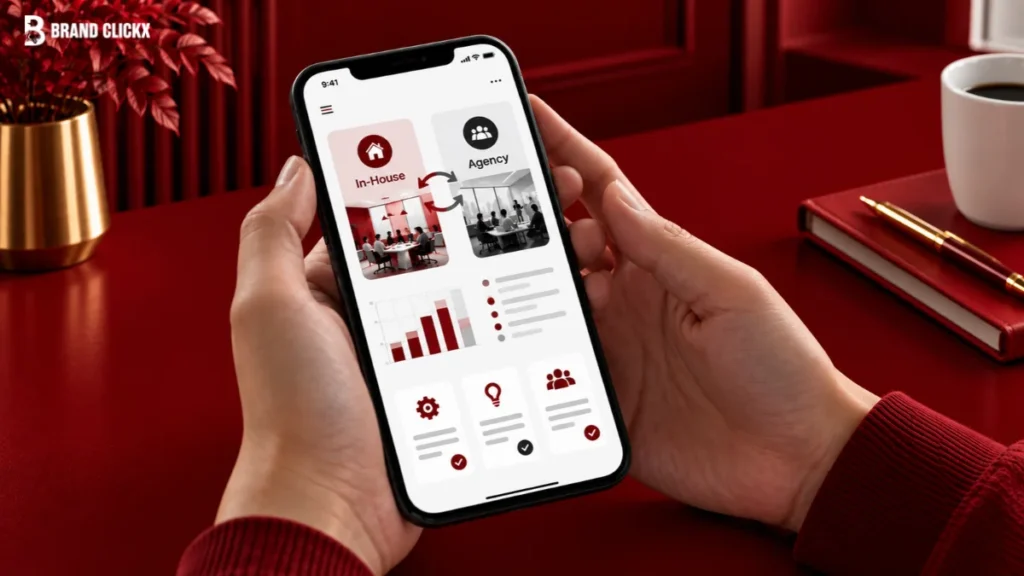
The evidence points toward a mixed model rather than a clean split between brands that insource and brands that outsource.
What stays inside
Internal teams tend to make the most sense for work that is frequent, brand-specific and closely tied to day-to-day decisions. That can include social, recurring content, routine creative and parts of media or analytics.
The 2023 survey found that 92% of respondents with in-house agencies also worked with external agencies. External work was mainly used when internal teams lacked bandwidth or capabilities.
What goes outside
External partners become more useful when the work needs specialist depth, unusual capacity or a fresh perspective. Major campaigns can also create temporary demand that does not justify keeping equivalent capacity inside all year.
The relationship changes too. The agency is no longer necessarily the brand’s default production department. It can become a specialist layer that plugs into an internal team when the job requires it.
That is why the hybrid model is more than a compromise. It is a way to assign different types of work to the operating model that fits them.
How to decide for a specific function
Use the In-Housing Fit Test before moving another function inside.
- Frequency: How often will this work happen? Daily or weekly demand creates a stronger case for internal capacity than a few projects each year.
- Judgment: How much specialist judgment does the function require? Rare expertise can be harder to maintain internally.
- Scale: Does demand stay steady or spike around campaigns? Variable demand creates a stronger reason to keep external capacity available.
- Outside view: Would an external team bring useful category experience or a perspective the internal team is unlikely to get from working on one business?
- Hiring: Can the brand in housing marketing recruit and retain the people required to do the work well?
The test is not a scoring system. A function can pass four questions and still belong outside if the fifth one exposes a serious capability gap. The useful output is a clearer scope decision: what the internal team owns, what the agency owns and what can move between them when demand changes.
The Read
The sorting does not look finished. A 2026 industry benchmark still found substantially stronger sentiment for continued in-housing than for a broad pullback even after several high-profile closures and reductions in 2025.
AI could restart the sorting because it changes the cost and speed of production. But it does not erase the basic question of where specialist capability, scale and judgment should live.
The function worth reassessing this year is media. It has moved inward more slowly because of its complexity, while technology and automation keep changing what an internal team can realistically handle. The useful question is not whether media should be in house. It is which part of media the brand in housing marketing can support well enough to keep there.