
Key Takeaways
- A value proposition explains the main value that a business offers to customers.
- Your value proposition exposes the main value that you offer to audiences.
- Keep it precise, clear, and easy to understand.
- The aim of the Value Proposition Canvas is to make it easy to find a perfect match.
- Always use feedback to improve your performance.
Your competitors may offer similar products, but customers need an appropriate reason to choose you. A clear value proposition shows your product’s benefits and what makes your business different from others. It helps customers in understanding why the product is useful and is the right option.
What Is a Value Proposition?

Value proposition explains your business that
- What is unique in your business?
- What makes your business different?
- Why should customers choose your business?
- What advantage does it provide to customers?
- Why is it best for customers?
The purpose of a value proposition is to make customers well aware of your business. So, in short, a value proposition gives the main information about your business. Businesses use a value proposition in their advertisement to show customers their main advantages. The value proposition of companies mainly appears on website homepages, product pages, advertisements, and marketing materials.
Key Elements of a Strong Value Proposition
The key elements of a strong value proposition are as follows:
Target Customer
You should know the target customers for whom the product is made, such as students, businessmen, teachers, or any other specific group. It can also depend on age. Knowing the target customer will result in a stronger value proposition.
Customer Needs and Pain Points
Customers may have some issues or problems to solve. A stronger value proposition shows that it knows those issues and challenges and has a proper plan to solve them.
Product Benefits and Customer Outcomes
This explains the way of service to help customers. This also eplain that what benefits customers will get if they choose your business. This can include time-saving, lower costs, and good work.
Competitive Differentiation
Customers can also find the same product you contain on another business. Competitive differentiation involves showing the uniqueness in your business.
Value Proposition vs. Unique Selling Proposition
| Value Proposition | Unique Selling Proposition (USP) |
| Explains the overall value a business provides. | Explains what makes a business or product different. |
| Focuses on customer needs and benefits. | Focuses on the unique advantage over competitors. |
| Answers: “Why should customers choose us?” | Answers: “What makes us different?” |
| Can include several benefits and outcomes. | Usually focuses on one clear and specific difference. |
| Example: “Affordable meals delivered quickly to your door.” | Example: “Fresh meals delivered in 20 minutes.” |
Types of Value Propositions
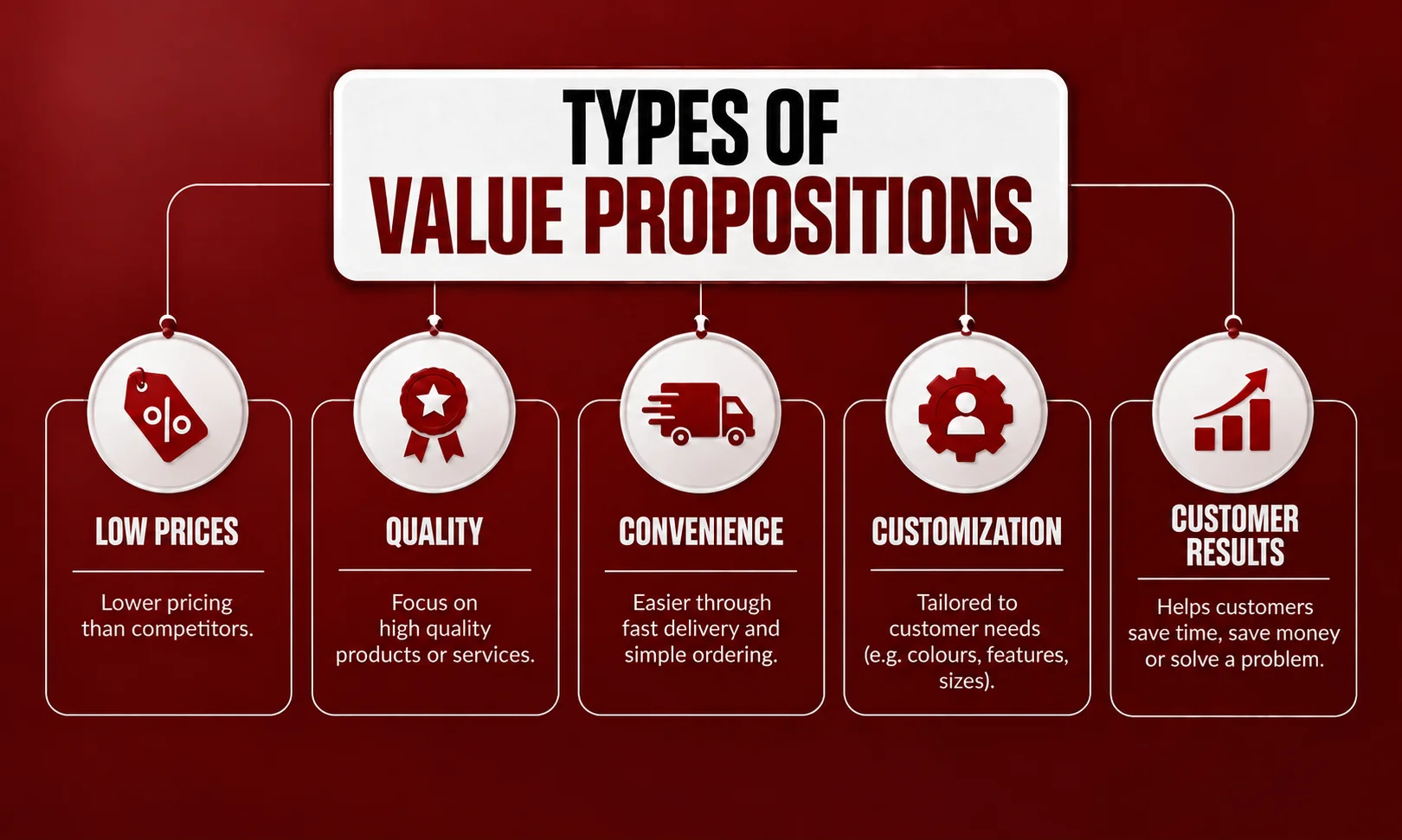
Important types of value propositions are described as follows:
Low Prices
Some businesses use lower pricing than competitors to make it unique. Some customers want low pricing, and if you are using a low-pricing value proposition, they will probably choose you.
Quality
Some businesses focus on quality to make them unique because some customers only want good quality; they don’t care about pricing.
Convenience
This type of value proposition involves making things easier through fast delivery, easy ordering services and simple returns if any problem comes.
Customization
This involves giving customers things according to their needs. For example, customers also choose products based on colours, features, and sizes.
Customer Results
This involves results that customers get from using a product or service. For example, a product may help customers save money, save time, work faster, or solve a specific problem.
Value Proposition Canvas
A Value Proposition Canvas is a simple business tool that helps you understand the customers’ needs and how your product can fulfill those needs. It has two main parts:
- It looks at what customers want, problems they face, and the benefits they want.
- It shows what your product offers, how it solves customer problems, and how it gives benefits to them.
In simple words, the Value Proposition Canvas helps a business match its product with customers’ needs.
How to Create a Value Proposition
- Decide who will buy your product..
- Find out customers’ needs and problems they want to solve.
- Explain your product benefit to customers and their gain.
- Show how your product makes things easier or solves specific customer problems.
- Explain why customers should choose your business instead of other competing businesses.
- Write the main benefit, customer need, and difference into a short and easy statement.
How to Test and Improve Your Value Proposition
Test with customers: Show your value proposition to real customers and see if they understand it.
Collect feedback: Ask customers what they like or dislike, and whether the message fulfill their needs.
Compare different versions: Try different versions of your value proposition to see which one communicates the benefits more clearly.
Refine the message over time: Use customer feedback and results to improve your value proposition and keep it relevant.
Conclusion
A clear value proposition helps customers in quickly understanding the value of your product. It explains the main benefits, customer needs, and shows the uniqueness of your business. You can create a value proposition that is simple, clear, and relevant to your audience by understanding your target customers and getting customer feedback.
Frequently Asked Questions
What Is the Purpose of a Value Proposition?
A value proposition explains a business offer, its customer benefits, and the reasons customers may choose it. It gives customers a quick idea of the value.
What Is the Difference Between a Value Proposition and a USP?
A value proposition explains the overall value that a business provides to customers, while USP focuses on the specific thing that makes a business or product different from competitors.
How Do You Write a Good Value Proposition?
To write a good value proposition, identify your target customers, understand their needs, explain your product’s benefits, and show what makes your business different. Keep the statement short, clear, and easy to understand.
Can a business have more than one value proposition?
Yes, a business can have more than one value proposition, especially when it serves different customer groups or offers different products. Each value proposition can focus on the specific needs and benefits that matter to a particular group of customers.