Any business requires a proper set of instructions for the completion of tasks. This set of instructions is called a standard operating procedure. SOP stands for standard operating procedure. The main purpose of SOP is to make sure that all the processes are carried out accurately in the correct sequence.
SOPs reduce errors and risks, and increase efficiency. There are greater chances of doing work and tasks successfully by following SOPs. They also make work easier to do and help beginners by giving them the step by step guide of whole process.
Key Takeaways
- SOP stands for standard operating procedure. Main purpose of SOP is to make sure that all the processes are carried out accurately in the correct sequence.
- SOPs help businesses to reduce mistakes, improve efficiency, and maintain regular quality.
- A good SOP should include the purpose, required resources, safety measures, and approval.
- Creating an SOP involves identifying the process, writing clear steps, testing the procedure, training employees, and updating it regularly.
- SOPs can be used for different processes, including hiring, customer service, and hotel check-in.
- SOPs explain the overall process, while work instructions provide detailed steps for a specific task.
- Regular reviews and employee training help to make sure that SOPs remain useful and easy to follow.
Why Are SOPs Important for Businesses?
SOPs are important for businesses because, with SOPs, all the workers in a particular business follow the same procedure and thus a common workflow, and doing a particular work consistently with the same procedure improves product quality and efficiency, and work is also completed on time. Following the common guidelines daily also results in fewer mistakes, better training, and increased capability.
What Are the Key Components of an SOP?
The key components of an SOP are described below.
- SOPs should clearly explain their purpose and the processes they will cover.
- They should clearly describe the role of workers in different tasks and should give them responsibility for each task.
- They should clearly explain the resources required to carry out a particular task.
- They should clearly give the step-by-step guidelines for performing tasks accurately.
- They should also include safety measures and clearly tell what to do if something goes wrong.
- They must be reviewed by experts before approval.
How to Create an SOP
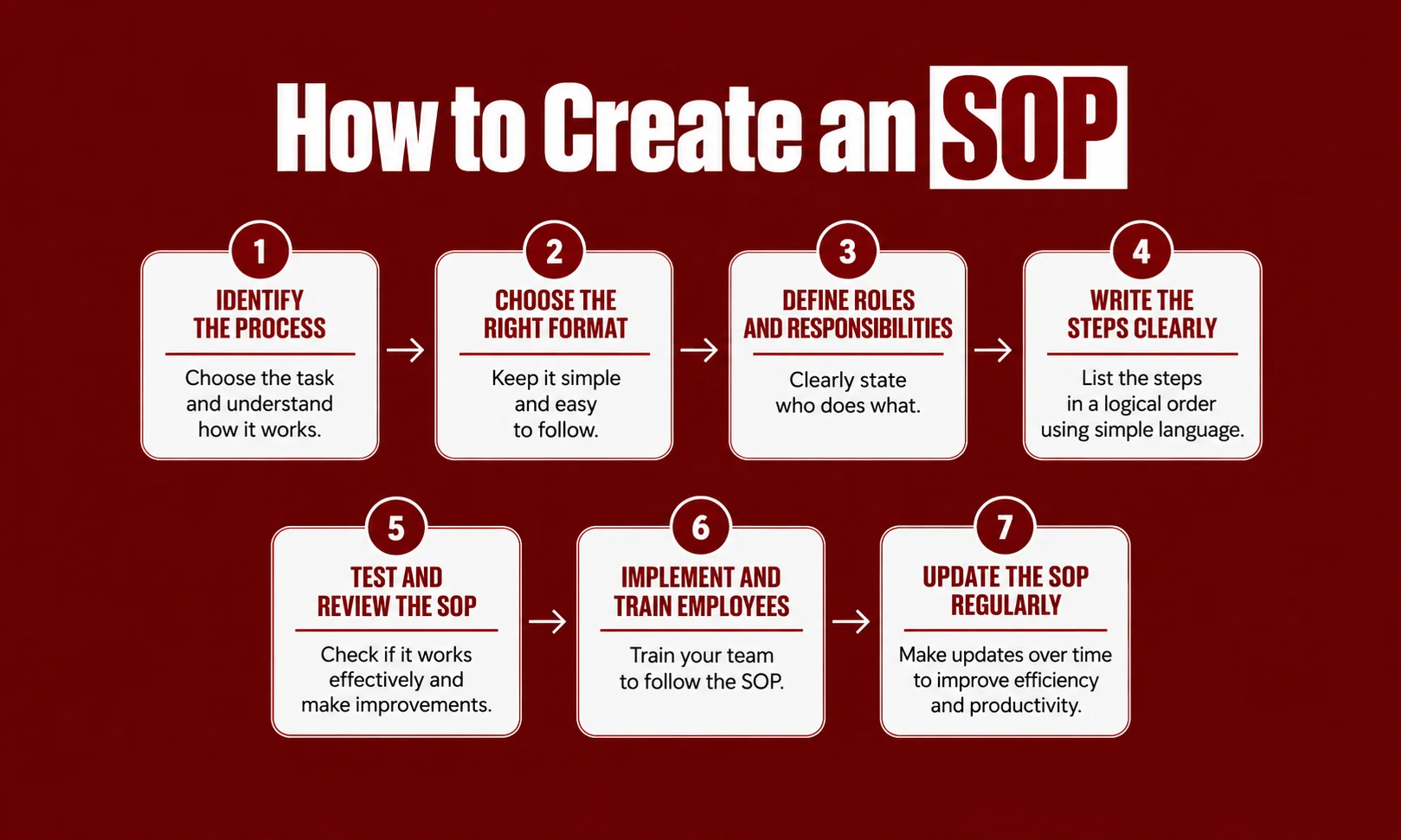
If you don’t have SOPs for your business, you can create them by following these steps:
Identify the Process
Choose the task or process for which you are making instructions. Make sure that you know the working of the process.
Choose the Right Format
Make instructions that are written in an easy format and are also easy to follow. Explain the instructions simply by giving the information in the correct order.
Define Roles and Responsibilities
Explain the role of each employee in a specific task, such that everyone knows his work and tries to do it well.
Write the Steps Clearly
Write the steps in a simple order. Use simple language to explain the instructions. Don’t include unnecessary complicated language.
Test and Review the SOP
After making SOPs, first check whether it works well and complete the task effectively and efficiently.
Implement and Train Employees
Train the employees to work according to the SOPs so that every employee can complete tasks easily.
Update the SOP Regularly
Update the SOPs regularly over time so that, by using new tools and new steps, productivity increases.
SOP Examples
Employee Hiring SOP
Employee hiring SOP includes:
- What should a company check before hiring employees?
- Which types of people does the company require?
- Are any specifications required in person?
- And sometimes also age
Customer Service SOP
Customer Service SOP includes:
- How to handle customers’ questions and complaints?
- How to deal with customers?
- How to inform them about the issue?
- How to solve their problem?
Hotel Check-In SOP
Hotel check-in SOP guides staff on dealing with guests. It includes:
- How to check identification?
- How to collect payments?
- How to provide room details?
- When to give them the key?
- What to do in response to any complaint?
SOP Best Practices
Best SOP practices include:
- Using simple language
- Keeping instructions clear and specific
- Making the SOP easy to find
- Testing it with employees
- Reviewing it regularly
SOP vs. Work Instruction
| SOP | Work Instruction | |
| Main difference | Explains what needs to be done, who does it, and the overall process. | Explains exactly how to perform a specific task step by step. |
| When it is used | It is used for managing and standardizing an entire process. | It is used when employees need detailed instructions for one specific task. |
| Example | An SOP for hiring employees explains the overall hiring process. | A work instruction explains exactly how to enter a new employee’s information into the HR system. |
So,
SOP = the overall process.
Work instruction = the detailed steps for a specific task.
Challenges of Using SOPs
The challenges of SOPs are as follows:
- SOPs may become wrong when tools or processes change.
- Employees may not follow the SOP accordingly, which can lead to mistakes.
- Following an SOP strictly will make it difficult to handle any uncommon situation.
- Confusing or incomplete instructions can make the SOP difficult to understand and follow.
- Employees need proper training to understand and apply complex SOPs correctly.
Final Thoughts on Standard Operating Procedures
Standard Operating Procedures help businesses keep their work organized and easy to follow. A well-written SOP gives employees clear instructions, reduces mistakes, and makes training new employees easier. However, an SOP should not be treated as a fixed document. Businesses should review and update it when processes, tools, or responsibilities change. SOPs can help employees complete tasks more efficiently and maintain consistent quality when written clearly and used properly.
Frequently Asked Questions
What Does SOP Mean in Business?
SOP in business means telling employees how to deal with customers, listen to their problems, and solve their problems.
What Is the Purpose of an SOP?
The purpose of an SOP is to make step by step instructions to do a particular task effectively and easily. It guides workers on how to perform a particular task.
Who Is Responsible for Creating an SOP?
People such as Managers, team leaders, or subject-matter experts are responsible for creating SOPs because they understand the process well.
Can a Small Business Use SOPs?
Yes, SOPs must be used by large as well as small businesses because they also face most of the same challenges that a big business faces.