
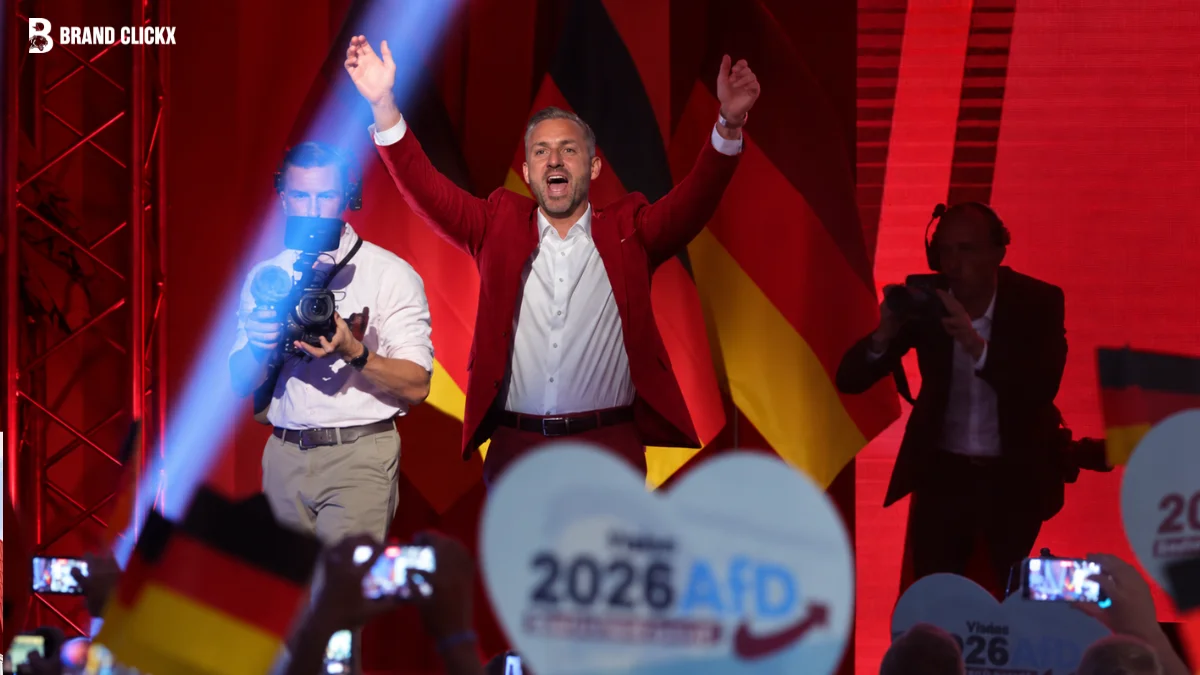
On Sunday, September 6, 2026, Germany’s far-right Alternative for Germany (AfD) party won a historic election. They won in the eastern state of Saxony-Anhalt. This changes Germany’s political landscape.
The anti-immigration party got 44.4 percent of the vote. This makes them the first far-right group to win a German state election since World War II.
The AfD more than doubled its past election results. However, they are expected to fall just short of a full majority in parliament.
Mainstream parties refuse to work with the far-right. Because of this, the state faces a long and hard process to form a new government.
A Political Earthquake in the East
Record Turnout and Huge Losses
A record 76.5 percent of voters cast their ballots. The election results were a big blow to Chancellor Friedrich Merz’s federal government.
The Christian Democratic Union (CDU) has led Saxony-Anhalt since 2002. However, they dropped to a historic low of 18.4 percent. This is less than half of what they won in 2021.
How the Smaller Parties Did
Several smaller parties passed the 5 percent mark needed to enter the state parliament. The socialist Left Party (Die Linke) got 9.3 percent. The Green party got 8.7 percent, and the Social Democrats (SPD) got 8.4 percent.
| Political Party | Projected Vote Share (2026) | Projected Seats | 2021 Vote Share |
| Alternative for Germany (AfD) | 44.4% | 39 | 20.8% |
| Christian Democratic Union (CDU) | 18.4% | 15 – 16 | 37.1% |
| Die Linke (Left Party) | 9.3% | 8 | 11.0% |
| The Greens | 8.7% | 8 | 5.9% |
| Social Democratic Party (SPD) | 8.4% | 8 | 8.4% |
| Sahra Wagenknecht Alliance (BSW) | 5.2% | 4 – 5 | N/A |
Data reflects early exit polls and public broadcasting projections as of Sunday evening.
The Free Democrats (FDP) got only 2.5 percent. They were voted out of the parliament completely.
The Campaign and Candidate
A Social Media Star Leads the Charge
Ulrich Siegmund led the AfD campaign. He is 35 years old and used to sell fragrances. He is now a social media star with a large TikTok following.
Siegmund rode a blue, old-style East German moped to vote. His supporters cheered for him. He said his party has a mandate to govern.
“We have achieved exactly what we wanted; we have made history,” Siegmund told a happy crowd in Magdeburg. He said the result would “shake all of Germany”.
Nostalgia and Hardline Policies
During the campaign, Siegmund used nostalgia for the old communist East Germany. He focused on nationalism. This connected with voters angry about a slow economy, high prices, and the war in Ukraine.
If he forms a government, Siegmund promises a major deportation push. He wants to cut social help for asylum seekers.
The party also wants to ban rainbow flags in schools. They want students to sing the national anthem. They plan to stop building new wind farms and leave the public broadcasting network.
The AfD also opposes the integration of Islamic communities. Their state program says, “Islam belongs neither to Germany nor to Saxony-Anhalt”.
Germany’s domestic intelligence agency calls the state’s AfD branch “right-wing extremist“. A famous magazine, Der Spiegel, recently called Siegmund “the most dangerous man in Germany”.
Election Deadlock and the Rules
Falling Short of a Majority
The state parliament needs 42 seats for a clear majority. It has a total of 83 seats.
Projections show the AfD winning 39 seats. This means they are three seats short of ruling alone.
Mainstream parties have a strict rule called a “firewall.” They refuse to work with the AfD.
Sven Schulze is the current state leader from the CDU. He admitted his party lost, but he still refuses to work with the far-right. CDU leader Franziska Hoppermann called the loss a “bitter defeat”.
BSW as the Kingmaker
Because of this standoff, a new left-wing party might decide who wins. This party is called the Sahra Wagenknecht Alliance (BSW).
BSW mixes left-wing money policies with conservative social ideas. They also support Russia. They got about 5.2 percent of the vote and will likely get 5 seats.
This makes the parliament split. The AfD has 39 seats. The mainstream parties have 39 seats. BSW has 5 seats.
Constitutional Wildcards
The state constitution rules are now very important. The new parliament must meet within 30 days.
To elect a state leader, a candidate needs an absolute majority in the first two rounds of secret voting. If that fails, a third round only needs a simple majority of votes cast.
BSW leader Claudia Wittig said her party will decide issue by issue. They might work with the AfD on energy policies.
If BSW members do not vote in the third round, the AfD’s 39 votes could be enough to win. This would let Siegmund form a minority government.
BSW also suggested a neutral leader, but Siegmund rejected this idea as a “mess”.
Economic Warnings and Global Reactions
Threats to the Economy
An AfD government has caused serious economic worries. Chancellor Merz warned that a far-right win would cause “considerable damage.” He said foreign companies would think three times before investing in the state.
The German Economic Institute agreed. They said the AfD’s anti-immigrant plans would hurt the region, which desperately needs foreign workers.
Global Reactions
In France, Europe Minister Benjamin Haddad called the AfD’s win a “serious moment.” He told people to remember the dark history of nationalism.
Former U.S. President Donald Trump shared the election results online. A Russian official also praised the “historic win”.
Billionaire Elon Musk posted “Well done!” in German to AfD leader Alice Weidel on X (formerly Twitter). Siegmund thanked Musk for his support and hoped to work together.
Protests and Future Impact
Inside Germany, people protested the results. In Magdeburg, thousands gathered to support democracy. Gerhard Feige, a local Bishop, warned that “not everyone who is elected democratically is a democrat”.
Saxony-Anhalt is small, with 2.1 million people. However, state governments in Germany have a lot of power over schools, police, and culture.
The AfD’s big win in the east puts a lot of pressure on Chancellor Merz. It shows a major change in German politics before the 2029 national elections.
Frequently Asked Questions
Did the AfD win an absolute majority in Saxony-Anhalt?
No. Even though the AfD won about 44.4 percent of the vote, they are projected to get 39 seats. They need 42 seats for an absolute majority in the 83-seat state parliament.
What is the “firewall” in German politics?
The “firewall” is a strict rule kept by Germany’s mainstream political parties. It means they refuse to form coalitions or work with far-right extremist parties like the AfD.
Who is the AfD’s lead candidate in Saxony-Anhalt?
The AfD campaign was led by Ulrich Siegmund. He is a 35-year-old former salesman who became very popular on the social media app TikTok.
How can the AfD govern without a majority?
If the AfD cannot find a partner, they could try to form a minority government. Under state rules, a third round of voting for the state leader only requires a simple majority. If other parties abstain from voting, the AfD’s 39 seats could be enough to win.
What are the AfD’s main policy plans for the state?
The AfD wants to start a major deportation program. They also want to ban rainbow flags in schools, stop building wind farms, and limit the role of Islam in public life.