
Last updated : September 2026
The 102nd IFA Berlin trade show has opened at the Berlin ExpoCenter City. More than 1,900 tech companies from 49 countries are taking part, attracting about 220,000 visitors from around the world. In recent years, major tech shows focused heavily on cloud software and online AI chatbots.
However, IFA 2026 brings a clear shift toward AI that takes physical action in the real world. Under the show’s theme, “The Future Is Now,” makers of computers, home appliances, and smart vehicles are showing products that use artificial intelligence directly on physical hardware.
Speaking to reporters at the opening press conference, IFA Management Chief Executive Leif Lindner called this a fundamental turning point for consumer tech. Lindner explained that AI is no longer just an extra marketing feature, but the underlying system running everyday devices. Instead of sending requests to distant web servers to create text, new home appliances, robots, and personal gadgets use built-in chips and sensors to work directly in real life.
Global Trade Rules Reshape the Show Floor: Europe Becomes the Main Test Market
The setup of IFA 2026 clearly shows how trade rules affect where tech companies sell their goods. Chinese tech firms make up 932 of the exhibitors, filling almost half of the show floor. This strong presence comes after the United States Federal Communications Commission (FCC) placed new restrictions on foreign-made smart robots that weigh over 4.4 pounds and can move or navigate on their own.
Because the US market is now restricted for certain robot vacuums and smart home devices, manufacturers have shifted their main focus to the European Union. As a result, Berlin is no longer just another tour stop; it has become the main launchpad for these products.
Showing this shift, Chinese tech giant Xiaomi set up its first official booth in IFA’s 102-year history. Located in Hall 6.2, Xiaomi brought about 400 products, including its MIJIA smart home lineup, its own 3-nanometer XRING O3 chip, and its SU7 electric cars.
Meanwhile, longtime exhibitor Samsung moved its main showcase away from the exhibition grounds to Humboldt Carré in downtown Berlin, leaving open floor space for other brands.
On-Device Computing: Powerful Chips Run AI Without the Cloud
New computer announcements focused on running smart AI software directly on laptops and desktops without internet delays or paid cloud subscriptions.
Nvidia made a major splash across the computing halls with its new RTX Spark platform, which will arrive in October 2026 inside computers from eight major makers.
The chip setup pairs a 20-core Grace CPU with a 6,144-core Blackwell GPU, giving computers up to 1 petaflop of local AI power. Nvidia also launched Personal AI Router (PAIR), a free tool that shares heavy AI tasks across idle computers on the same home or office network so jobs finish faster without using cloud servers.
Computer makers showed off creative laptop designs, focusing on repairability, very light weights, and flexible shapes:
| Manufacturer | Device Model | Key Hardware Details | Design Highlights |
| Samsung | Galaxy Book6 14-inch | Intel Core 3 or Core 5; 25-hour video battery life | Keeps classic ports (HDMI 1.4, USB-A, headphone jack) with a $799 starting price |
| Acer | Swift Blade 14 | Intel Core Series 3 (“Wildcat Lake”); 3K OLED screen | Ultra-thin frame measuring 14mm thick and weighing only 799g |
| Acer | Project DualPlay Mini | 8-inch display; dual cooling fans | Rotating screen that flips from a handheld gaming device into a mini laptop |
| Acer | Vero 16 | Modular, easy-to-fix parts | Removable motherboard so users can upgrade chips later |
| Lenovo | IdeaPad Vibe | AMD Ryzen or Qualcomm Snapdragon; OLED screen | Seven Pantone colors, extra storage slot, and swappable keys |
| Lenovo | AeroBlade Concept | Solid-state cooling system | Ultra-thin body under 10mm thick, weighing less than 830g |
Detachable Cameras and New Phone Shapes
Phone and camera makers moved away from standard, plain designs by testing new screen shapes and detachable parts.
Xiaomi gave the public an early look at the Xiaomi 18 Fold, a folding phone with a shorter, wider “passport” shape meant to compete with Samsung’s Galaxy Z Fold 8. When open, this wider shape gives users a better screen for watching widescreen videos. Instead of using chips from Qualcomm or MediaTek, Xiaomi built the phone with its own XRING O3 processor and fast LPDDR6 memory.
Detachable camera parts were also a major trend. RugOne, a brand from tough-phone maker Ulefone, revealed the Xsnap 7 Pro. The phone includes a small, 39-gram cube camera that attaches to the back with magnets.
You can pop the small camera off and use it on its own as a waterproof action camera. It records 2.7K video for up to 40 minutes and sends a live video feed to the phone from up to 50 meters away. The phone itself comes with a 50MP main camera, a 64MP night-vision lens, and heavy-duty dust and water protection.
Similarly, Hohem showed off the Eyepic, a two-in-one vlogging gadget that pairs a handheld motorized stabilizer with a removable 4K camera. The small camera cube unclips from the handle to serve as an action camera that is waterproof down to 32.8 feet without any extra case. When taken off, the handle turns into a wireless remote control with a 2.51-inch screen showing a live video preview from up to 32 feet away.
Real-World Robots: Humanoid Helpers and Smart Cleaners
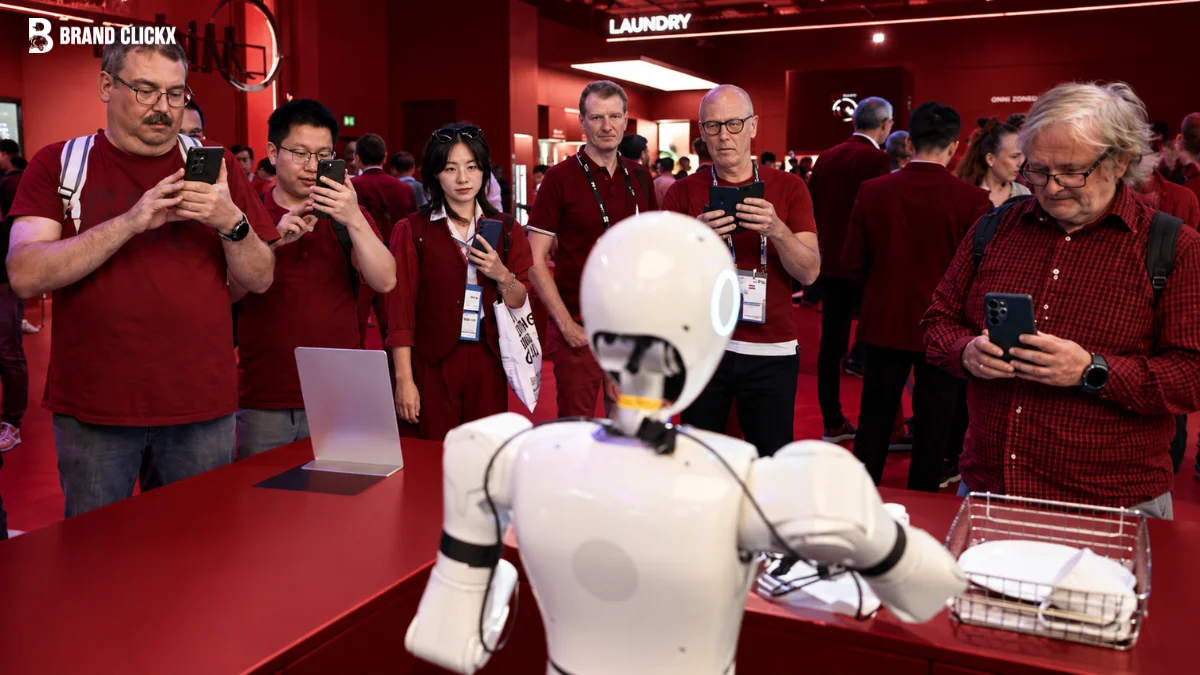
Robots stole the show at IFA 2026, starring in live obstacle runs and a dedicated “Robots on the Runway” fashion show. Instead of simple lab tests, companies demonstrated working machines built for real jobs and home cleaning.
A major highlight was the European debut of Mornine, a two-legged humanoid robot made by AiMOGA, a branch of automaker Chery. Mornine earned full European safety certification (CE mark) from Germany’s TÜV Rheinland, covering motor safety, wireless signals, and cybersecurity. This approval makes Mornine the first humanoid robot officially certified for business use in the European Union, where it currently works inside car showrooms.
| Robot Model | Best Used For | Physical Build | Smart Features |
| Agibot A3 | Stores, events, and group shows | Weighs 55kg; 12kW quick power output | Can do somersaults; coordinates groups of up to 100 robots using wireless signals |
| Hypershell X Ultra S | Hiking, running, and physical recovery | Lightweight wearable frame under 2kg | Uses AI to turn leg movements into motor power; offers 12 walking and sports modes |
| Roborock Saros Rover | Cleaning multi-level homes | Movable wheel-and-leg system | Climbs over raised doorsills and walks up home stairs to clean |
| Anker Robot Lawn Mower S2 Max | Large yards and lawns | All-wheel drive climbing hills up to 38 degrees | Fast built-in AI brain; cuts up to 3.7 acres with no border wires needed |
Smart Home Tech: Appliances That Think and Act for You
Appliance brands moved past basic phone apps, introducing smart tools that manage daily chores on their own.
LG showed off its ThinQ Claw system, a home assistant powered by conversational AI. Instead of setting timers by hand, users can talk to it normally. For example, telling the system “I have guests coming tonight” prompts it to warm up the oven, dim the lights, and cool down the living room automatically.
Miele introduced the Diamond G8, known as the first dishwasher to combine an inside door camera, hot-air drying, and automatic soap dispensing. The camera takes pictures of dishes, pots, and glasses to pick the right water temperature and amount of soap. It can also connect to local power grids to run its cleaning cycle when electricity is cheapest during the night.
Midea showed a voice-controlled air conditioner that uses radar sensors to see where people are sitting in a room. It blows cold air directly toward people instead of cooling empty corners, cutting power waste.
Dyson held its own side event called “Dyson Unveiled,” launching 10 new products. The biggest surprise was the $499 CameraJet electric toothbrush. It has a tiny camera taking 28 photos every second; built-in AI finds the spaces between your teeth and sprays water jets to floss them automatically.
For pet owners, Neakasa introduced Rico, a $200 automatic pet feeder. It holds a week’s supply of freeze-dried food and water, mixing fresh wet meals on schedule without needing a refrigerator.
Better Privacy: Storing Data at Home Instead of the Cloud
With more cameras and microphones entering living rooms, buyers worry about online privacy. In response, brands are designing devices that store and analyze data right at home.
Security company Blurams unveiled wire-free cameras that process alerts on the device without forcing users to pay for monthly cloud storage. The lineup features solar-powered outdoor cameras, indoor 4K cameras, and Baamy, a screen-free toy for children that answers questions locally without uploading kids’ voices to public internet servers.
At the same time, Anker Innovations announced that it is bringing its separate brand names
such as Eufy smart-home gadgets and Soundcore headphones under the single Anker name. Founder and CEO Steven Yang explained that products will now be grouped into “Anker for You” and “Anker for Home”.
To connect these devices, Anker introduced MindBase, a central home hub that supports the open Matter smart home standard. It holds up to 48 terabytes of local hard drive storage, letting users save security video feeds and run smart AI routines entirely inside their own house without sending data online.
A More Practical Era for Tech Gadgets
IFA 2026 marks a clear shift from flashy software ideas to useful, working machines. Across the event halls, companies proved that AI is no longer just a concept; it is now built directly into tools that handle chores, lower energy bills, and keep personal data private.
With faster on-device chips and smarter sensors, consumer gadgets no longer need to depend completely on cloud servers. Driven by new trade rules in North America and rapid manufacturing in Asia, Europe’s biggest tech show has become the primary stage to prove what modern robots, computers, and smart homes can do in daily life.
Frequently Asked Questions
What is IFA 2026 and when does it take place?
IFA Berlin is Europe’s largest trade exhibition for consumer electronics and home appliances. The 2026 show runs from September 4 to September 8 at the Berlin ExpoCenter City (Messe Berlin) in Germany. More than 1,900 brands from 49 countries are exhibiting for roughly 220,000 visitors.
Why are so many Chinese tech brands exhibiting at IFA this year?
Nearly half of the exhibitors at IFA 2026m 932 companies in total are from China. Many shifted their primary product launches to Europe after new US regulations restricted imports of foreign smart robots weighing over 4.4 pounds. As a result, Berlin has become their primary market for releasing new hardware.
What is Nvidia RTX Spark and how does it work?
RTX Spark is Nvidia’s new computing architecture built to run artificial intelligence directly on personal computers. It combines a 20-core Grace processor with a 6,144-core Blackwell graphics chip to provide up to 1 petaflop of computing speed right on the desk. Major PC makers will begin releasing systems running RTX Spark in October 2026.
What are some of the most unusual gadgets introduced at IFA 2026?
Several brands introduced surprising and quirky smart devices, including:
- Dyson CameraJet: A $499 electric toothbrush featuring a camera and computer vision that detects tooth gaps to automatically shoot pressurized water jets.
- Neakasa Rico: A $200 automatic feeder that rehydrates freeze-dried food with water to serve fresh wet meals for pets without refrigeration.
- Miele Diamond G8: A dishwasher with an internal door camera that scans dishes to pick the best wash cycle and runs when electricity rates are lowest.
- Acer Project DualPlay Mini: A concept handheld gaming device whose screen flips and swivels to reveal a mini laptop keyboard.
Are any humanoid robots ready for commercial work in Europe?
Yes. AiMOGA’s Mornine bipedal humanoid robot received full European CE certification from Germany’s TÜV Rheinland for mechanical safety, radio communications, and cybersecurity. This certification makes Mornine the first humanoid robot officially approved for business work in the European Union, where it currently works in automotive retail centers.