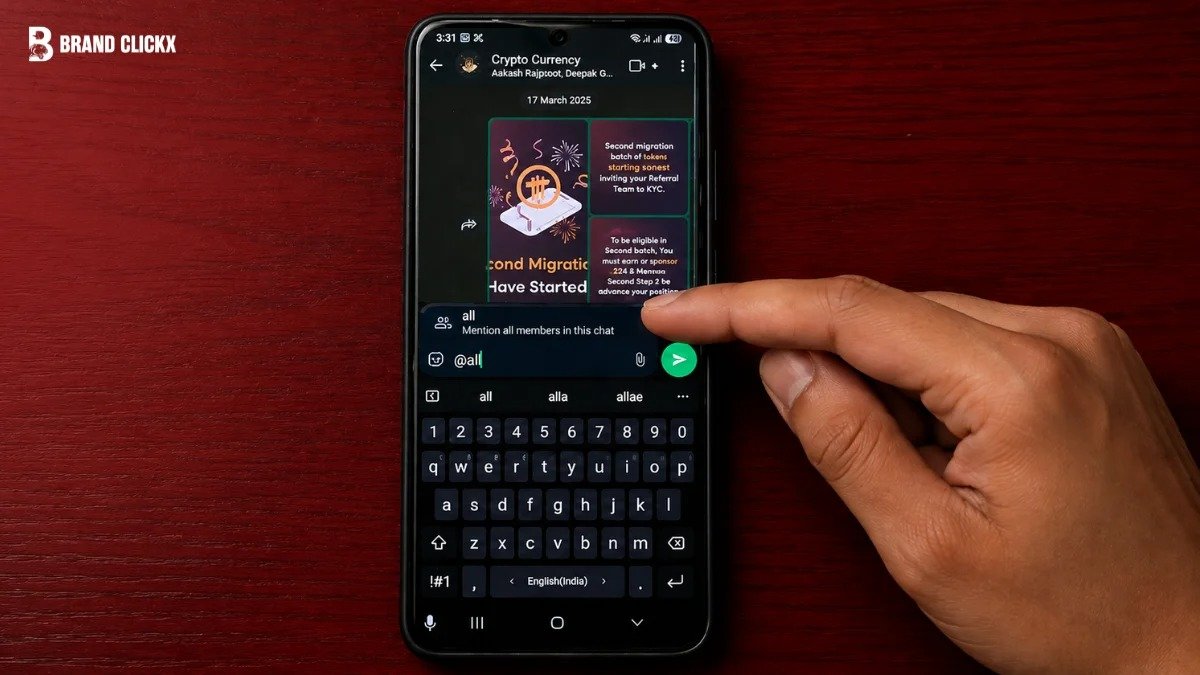
Three group chat updates shipped on 4 August: poll deadlines, hidden voters and one-tap side chats. The @all tag is the significant one, because it pierces the mute button and WhatsApp has built two limits around that.
Published: Thursday, 6 August 2026 | BrandClickX News Desk
Summary
WhatsApp announced three group chat updates on 4 August 2026: improved polls with end times, hidden voter names and a 15-minute edit window; @all mentions that notify every member; and the ability to create a new group from an existing one. The @all tag reaches muted members, but is restricted to admins in groups of more than 32 people.
Key Takeaways
- WhatsApp announced three group chat updates on 4 August 2026
- Polls gain end times, hidden voter names and a 15-minute edit window
- @all mentions notify every group member, including those who have muted the chat
- In groups over 32 people, @all is restricted to admins
- Users can disable @all notifications separately in Settings
- A “Create a similar group” button starts a new chat from an existing group’s members
- Comparable features have existed in Slack and Discord for years
- Rollout is staged, so availability will vary
What Shipped
Three feature areas, announced through Meta’s newsroom and rolling out now.
| Feature | What it does |
| Poll end time | Locks voting at a set deadline |
| Hidden voter names | Votes recorded without showing who chose what |
| Poll editing | Fix a question within 15 minutes of posting |
| @all mentions | Notifies every member of the group |
| Create a similar group | Starts a new chat using an existing group’s members |
The @all Tag Is the Consequential One
It notifies everyone — including people who have muted the chat.
WhatsApp’s stated use cases are school or office closures, event deadlines and last-minute changes. Its framing: alert everyone about important, time-sensitive messages without tagging each person individually.
Two limits are built around it, and they matter more than the feature itself.
Limit one: group size. In groups with more than 32 people, @all is available to admins only. Below that threshold, any member can use it.
That is a deliberate anti-abuse measure. A tag that overrides mute in a 200-person community group, available to everyone, would be unusable within a day.
Limit two: user control. Members can disable @all notifications separately in Settings. So the mute override is not absolute — it is opt-out rather than mandatory.
The trade-off is real, though. For most people the mute button is the only defence against a busy group chat. A tag that pierces it is genuinely useful for a school closure and genuinely irritating for a fantasy football league. The 32-person threshold is where WhatsApp has drawn that line.
Polls Got the Most Attention
Three changes, and one of them alters group behaviour rather than convenience.
End times lock voting at a deadline, which stops the familiar problem of a poll drifting for days while two people still have not voted.
Poll editing within 15 minutes fixes typos and unclear wording without deleting and reposting.
Hidden voter names is the interesting one. WhatsApp’s stated reasoning is that people feel more comfortable sharing their input when their choice is not attributed.
That is a genuine behavioural change. Visible voting in a group chat produces herding — people see what others picked and follow. Anonymous voting produces different answers, particularly on anything mildly sensitive: who wants to cancel, who cannot afford the restaurant, who does not want to go.
Side Chats Without the Awkwardness
A “Create a similar group” button now appears on the group details screen.
It starts a new chat using the existing group’s members as a starting point, rather than requiring you to add everyone manually.
WhatsApp’s own framing is unusually candid about what people actually use this for: “splitting off into a side conversation to plan a surprise party, coordinate event logistics, or dive deeper into a topic without cluttering the main chat.”
The surprise party example is the honest one. Most side chats exist to exclude someone, usually harmlessly. WhatsApp has removed the friction from doing that.
Being Fair About What This Is
These are quality-of-life fixes, not innovations. Slack and Discord have had equivalents for years.
@channel and @everyone are long-established in workplace and community messaging. Anonymous polling exists across most survey and collaboration tools. Creating a channel from an existing membership list is standard.
What makes it notable is scale rather than novelty. WhatsApp is the default group messaging platform across much of the world — for families, schools, workplaces, building committees and community organisations that will never touch Slack. Features that have been normal in professional software for a decade arriving there affects a very large number of everyday coordination problems.
The honest summary: WhatsApp has closed an obvious gap, competently, and the guardrails around @all suggest they thought about the abuse case before shipping.
Timeline
| Date | Development |
| 3–4 August 2026 | Meta publishes the announcement |
| 4 August 2026 | Features begin rolling out |
| Ongoing | Staged rollout continues across regions and platforms |
As with most WhatsApp updates, availability arrives in stages. If you do not see the features yet, they are likely still rolling out.
Expert Analysis
The design decisions here are more considered than the feature list suggests.
On @all: the 32-member threshold is a sensible dividing line. Below it, a group is small enough that social pressure regulates misuse — you know everyone, and tagging them all pointlessly has consequences. Above it, anonymity sets in and admin control becomes necessary. Choosing 32 rather than a round number suggests it was derived from data rather than intuition.
On hidden voters: this is the change most likely to alter how groups actually behave. Attributed voting in a chat where everyone knows everyone suppresses honest preferences. Removing attribution should produce more accurate group decisions — which is, presumably, the point of a poll.
On side chats: reducing friction here is useful and slightly uncomfortable. It makes legitimate sub-coordination easier and exclusion easier by exactly the same mechanism. That is not a criticism so much as an observation about what group messaging is.
What is not addressed: the persistent group chat problems remain untouched. There is still no reliable way to leave a group without everyone being told, no way to reduce a group’s priority without muting it entirely, and no threading. @all is a way to demand attention, not a way to organise it.
Frequently Asked Questions
What are WhatsApp’s new group chat features?
Three updates announced on 4 August 2026: poll improvements including end times, hidden voter names and a 15-minute edit window; @all mentions; and the ability to create a new group from an existing one.
Does @all work if I have muted the chat?
Yes. WhatsApp states @all alerts reach members even when the group is muted. However, you can disable @all notifications separately in your Settings if you do not want them.
Can anyone use @all?
In groups of 32 people or fewer, any member can. In groups with more than 32 people, @all is available to admins only a restriction designed to prevent misuse in large groups.
Can I hide who voted in a WhatsApp poll?
Yes. Hidden voter names is one of the new poll options, which WhatsApp says helps people feel more comfortable sharing their input without their individual choice being visible to the group.
Can I edit a poll after posting it?
Yes, for up to 15 minutes after posting. This allows corrections to typos or unclear wording without needing to delete the poll and start again.
How do I create a new group from an existing one?
Open the group details screen and select “Create a similar group.” This starts a new chat using the existing group’s members as a starting point rather than adding each person manually.
Why would I set a poll end time?
It locks voting at a chosen deadline, which prevents polls remaining open indefinitely while a few members have not responded. WhatsApp positions it as helping groups reach decisions faster.
When will I get these features?
Rollout began on 4 August 2026 and is staged, so availability varies by region and platform. If the features are not yet visible, they are likely still being distributed.
Conclusion
The headline feature is @all, and the interesting part is the constraints around it. A tag that overrides mute could easily have been a disaster in large groups. Restricting it to admins above 32 members, and letting individuals switch the notifications off entirely, suggests the abuse case was considered before launch.
Hidden voter names may end up mattering more. Anonymous voting changes what people are willing to say in a group where everyone knows everyone.
None of this is new to anyone who has used Slack. It is new to the several billion people who coordinate their lives on WhatsApp instead.