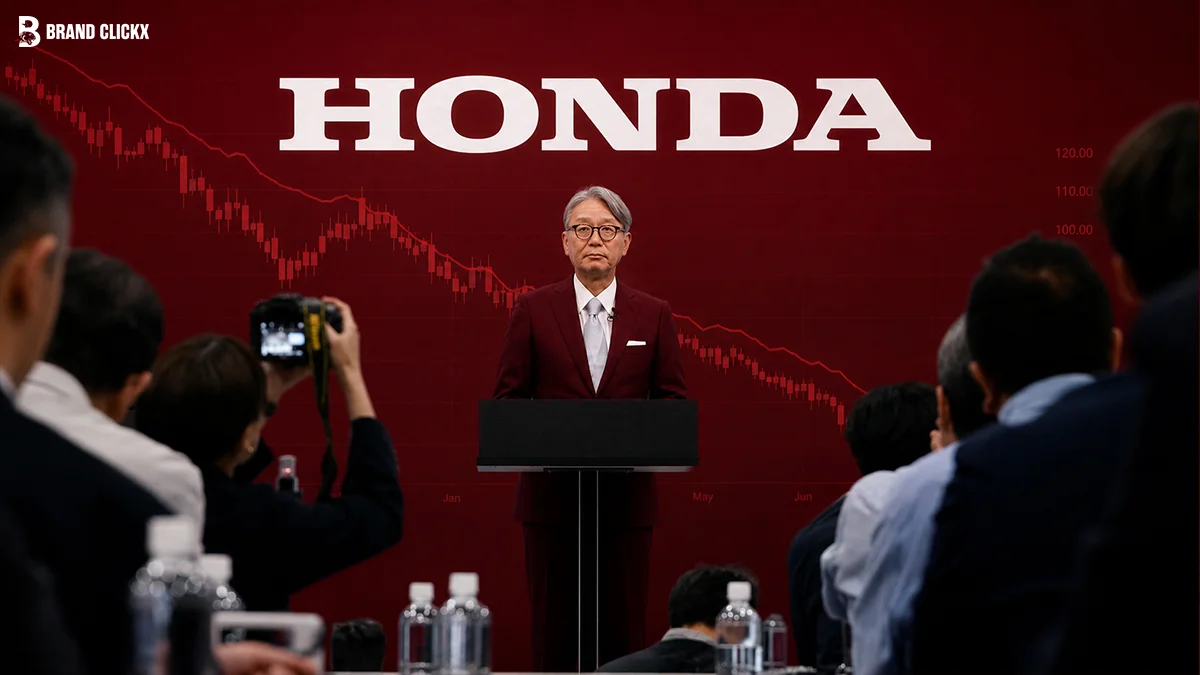
Honda cancelled three North American EVs, suspended an $11 billion Canadian battery project and posted its first annual loss since 1957. Six weeks of July announcements show what it is building instead.
Published: Thursday, 30 July 2026 | BrandClickX News Desk
Summary
Honda Motor reported a net loss of ¥423.9 billion for the fiscal year ended 31 March 2026 its first annual loss since listing in 1957. The cause was a write-down of its electrification strategy, including the cancellation of three North American EV models. Since then Honda has confirmed a new US-built Ridgeline pickup, paused Civic Si production, and is reportedly weighing an eighth North American plant.
What Happened to Honda?
On 12 March 2026, Honda cancelled three electric vehicles it had been building its North American future around.
The models were the Honda 0 SUV, the Honda 0 Saloon and the Acura RSX all three slated for production at Honda’s retooled Marysville, Ohio facility.
The 0 Series had been unveiled with considerable confidence at CES in Las Vegas in January 2025. It was cancelled fourteen months later.
In its own statement, Honda attributed the decision to changes in the business environment, including a major US policy shift and slowing EV market growth. The company said it would “reassess its resource allocations and further strengthen its hybrid models.”
It also warned that additional expenses or losses could follow in later fiscal years.
The Scale of the Write-Down
Honda posted a net loss of ¥423.9 billion, roughly $2.7 billion, for the year ended 31 March 2026.
That was the actual result, reported in May. The figures moved considerably along the way, and it is worth being precise about which is which:
| Figure | What it is |
| ¥835.8bn profit | Prior year (FY ended March 2025) |
| ¥550bn operating profit | Original FY2026 forecast |
| ¥270bn–¥570bn operating loss | Revised FY2026 forecast, March 2026 |
| ~¥690bn net loss | Forecast net loss announced 12 March |
| ¥423.9bn net loss | Actual reported result |
| ¥521.4bn | Impairment losses on plant, equipment and intangibles for discontinued EV models |
| Up to ¥2.5 trillion (~$15.7bn) | Total losses tied to the strategy reassessment, across two fiscal years |
Honda’s total EV-related investment before the reversal had exceeded ¥3 trillion.
The swing in a single fiscal year from a forecast profit of ¥550 billion to a possible operating loss of ¥570 billion is among the most dramatic reversals in modern automotive history.
Notably, Honda did not cut its dividend. It uses dividend on equity as its shareholder return metric and left the per-share forecast unchanged.
What Else Was Abandoned
The cancellations went well beyond three models.
- An $11 billion EV and battery project in Canada was suspended
- A target of EVs reaching 20% of global sales by 2030 was scrapped
- A commitment to sell only electric or fuel-cell vehicles by 2040 was dropped
- Sony Honda Mobility, the joint venture with Sony, announced on 25 March 2026 that it would halt development and sales of EVs entirely
That last one mattered symbolically. The Sony partnership was Honda’s answer to the software-defined car the idea that vehicles were becoming smartphones on wheels, and that Sony’s expertise in semiconductors and entertainment would be the differentiator.
How Honda Got Here
The investment trail is documented and it was aggressive.
| Year | Commitment |
| 2021 | Announces it will phase out petrol-powered cars |
| 2022 | $700 million to convert its Ohio plant into an EV hub |
| 2023 | $4.4 billion with LG Energy Solution for an Ohio battery plant |
| Jan 2025 | Unveils the 0 Series at CES |
| Mar 2026 | Cancels the entire North American EV programme |
The reasons for the reversal are the same ones affecting the whole industry: US EV demand growing more slowly than forecast, a shift in American policy support, pricing pressure, and intensifying competition from Chinese manufacturers.
There is a pointed comparison in the Japanese business press. Toyota tracked actual customer behaviour in the US market where hybrids were selling better rather than planning primarily around regulatory targets. Honda planned around the regulations. The regulations changed.
What Honda Is Building Instead
July 2026 produced a run of announcements that read as a single coherent strategy: hybrids, trucks, and North American manufacturing.
23 July A new Ridgeline is confirmed. Honda announced development of the third-generation Ridgeline midsize pickup, to be produced in the United States and reach market within two years. A teaser image was released. Production of the current model stops later this year, creating a temporary gap in the lineup.
23 July Civic Si production pauses. Honda said production of the current Civic Si will pause at the end of the 2026 model year, citing “evolving business conditions.”
20 July An eighth North American plant is under consideration. Automotive News reported Honda is weighing additional US manufacturing capacity, on the basis that its seven existing North American plants are not enough.
The CR-V led US auto sales through the first half of 2026 the first time it has topped the American market.
Honda led the Cars.com 2026 American-Made Index, with five Honda and Acura vehicles in the top ten, including the Passport, Ridgeline, Odyssey and Acura MDX.
The Prelude returned after 25 years and it is a hybrid. A 2.0-litre Atkinson-cycle four-cylinder paired with two electric motors produces 200 horsepower and 232 lb-ft, reaching 60 mph in around six seconds, with an EPA-estimated 44 mpg combined.
Read together, the direction is unambiguous. Honda is rebuilding around what it can already sell profitably in the market that generates most of its automotive earnings.
Timeline
| Date | Development |
| Jan 2025 | Honda 0 Series unveiled at CES |
| 12 Mar 2026 | Three North American EVs cancelled; forecast revised to a loss |
| 25 Mar 2026 | Sony Honda Mobility halts EV development |
| May 2026 | Mid-to-long-term strategy press conference held |
| 14 May 2026 | FY2026 results confirm a ¥423.9bn net loss |
| 20 Jul 2026 | Reports of an eighth North American plant under study |
| 22 Jul 2026 | US auto sales leadership changes announced, effective 3 August |
| 23 Jul 2026 | Third-generation Ridgeline confirmed; Civic Si production paused |
| H1 2026 | CR-V leads US auto sales for the first time |
Expert Analysis
There are two ways to read a ¥423.9 billion loss, and the distinction matters.
The alarming reading is that Honda burned more than ¥3 trillion on a strategy it abandoned inside five years, and that a company which listed in 1957 needed until 2026 to post its first annual loss.
The more accurate reading is that this was an accounting event, not a demand collapse. The loss came from impairments and restructuring charges ¥521.4 billion of write-downs on plant and capitalised development costs for models that will never be built. Honda’s core products kept selling. The CR-V just topped the US market for the first time.
That is why the dividend survived. Honda explicitly leaned on two things to protect shareholder returns: improving automobile profitability through next-generation hybrids, and the cash generation of its motorcycle and financial services businesses. The motorcycle division, easy to overlook, remains one of the most consistently profitable operations in the group.
The unresolved question is timing. Honda has not exited electrification it says future EV introductions will proceed “flexibly,” monitoring profitability against market trends. That is a reasonable position if US EV adoption stays slow. It becomes an expensive one if adoption accelerates and Honda has dismantled the capability to respond.
The Ohio facility was retooled for cars that no longer exist. Whatever gets built there next is the real test of this strategy.
Frequently Asked Questions
Did Honda really post a loss?
Yes. Honda reported a net loss of ¥423.9 billion, around $2.7 billion, for the fiscal year ended 31 March 2026. It was the company’s first annual loss since it listed on the Tokyo Stock Exchange in 1957.
Why did Honda cancel its electric vehicles?
Honda cited slowing US EV market growth, a major change in American policy, pricing pressure and rising competition. It cancelled the Honda 0 SUV, Honda 0 Saloon and Acura RSX, all planned for production in Ohio.
Is Honda giving up on EVs entirely?
No. Honda says future EV launches will proceed flexibly, judged against profitability and market trends. But it has scrapped its 2030 and 2040 electrification targets and shifted resources toward next-generation hybrids.
What happened to the Acura RSX?
The electric coupe SUV was cancelled in March 2026 as part of Honda’s electrification reassessment. It was to have been the first vehicle off Honda’s global EV platform, built at the retooled Marysville, Ohio plant.
Is Honda making a new Ridgeline?
Yes. Honda confirmed on 23 July 2026 that a third-generation Ridgeline will be produced in the United States and reach market within two years. Production of the current model stops later this year.
Why is Civic Si production pausing?
Honda announced on 23 July 2026 that production of the current Civic Si will pause at the end of the 2026 model year, citing evolving business conditions. Honda did not specify when or whether it returns.
Is Honda building another US factory?
Automotive News reported in July 2026 that Honda is considering an eighth North American plant, on the basis that existing capacity is insufficient. Honda has not confirmed a decision.
Did Honda cut its dividend?
No. Despite revising its forecast to a loss, Honda left its dividend per share forecast unchanged, citing its use of dividend on equity as a shareholder return metric and the cash generation of its motorcycle and finance businesses.
Conclusion
Honda spent five years and more than ¥3 trillion preparing for a market that did not arrive on schedule, then took the write-down in a single quarter.
What it has announced since is almost the opposite bet. A pickup truck built in America. A revived sports coupe with a hybrid drivetrain. A CR-V outselling everything else in the United States. Possibly an eighth factory.
Neither strategy is obviously wrong. The first was too early; the second risks being too late. The company that got this right Toyota did so by watching what people bought rather than what policy required.