Ranking on Google no longer guarantees people will find your brand. A buyer can type the same question into ChatGPT, Google AI Overviews, or Perplexity and receive a synthesized answer that never references your page even if you hold the top organic position.
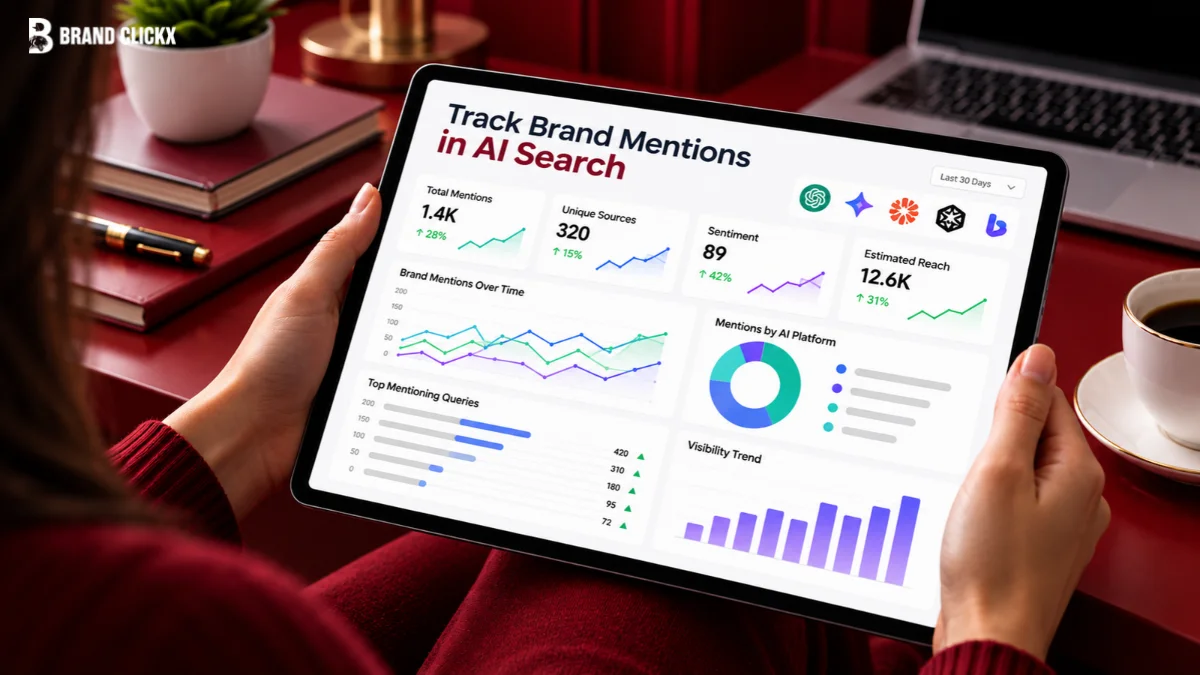
That shift has created an entirely new category of software: AI visibility tools, designed to track how often your brand appears in AI-generated answers, which URLs are being cited, how you compare to competitors, and where the gaps are.
The agency team at Dynamic Global Marketing which offers AI Search Optimization as part of its service portfolio spent time working through nine of these platforms, verifying pricing and engine coverage directly against vendor documentation. The five tools below are the strongest of those 9 Best AI Visibility Tools to Track Brand Mentions, each matched to a distinct buyer profile.
What AI Visibility Tools Do and Why They Are Not the Same as Rank Trackers
Before comparing tools, it helps to understand what this category actually measures. Every AI visibility platform does a version of the same thing: it runs a defined set of prompts questions your buyers might realistically ask across major AI engines, reads the generated answers, and reports on the outcome. Four measurements typically emerge:
- Mentions — how often an engine names your brand at all.
- Citations — the specific URLs the engine pulled from when constructing its answer.
- Sentiment — whether the engine’s description of your brand is favorable, neutral, or unflattering.
- Share of voice — how much of the AI conversation you own relative to named competitors.
The distinction between mentions and citations matters more than most buyers expect. Knowing that ChatGPT mentioned your brand is useful context. Knowing it cited your pricing page, not your product comparison guide, is something a content team can act on. Tools that only count mentions deliver a dashboard. Tools that trace citations produce a work queue.
This category is also described with overlapping terms: GEO (generative engine optimization), AEO (answer engine optimization), and LLMO (large language model optimization) all refer to improving how brands appear in AI-generated answers. AI visibility tools are the measurement layer that supports that practice.
Here is how this category compares to traditional SEO tooling:
| Traditional SEO Tools | AI Visibility Tools |
|---|---|
| Track position on a results page | Track mentions inside a generated answer |
| Measure keyword rankings | Measure share of voice against competitors |
| Report on organic traffic | Report on citations and referenced URLs |
| Watch competitor rankings | Watch which brands answer engines name |
One important limit applies to every tool reviewed here: none of them control what an AI engine says. They measure. Any vendor promising placement in AI results is overselling what the technology can deliver. Answers also vary by session, so every number in every dashboard is a sample of a moving target, not a count of a fixed position.
How These Five Tools Were Selected
Dynamic Global Marketing’s editorial team evaluated nine AI visibility platforms against a consistent set of weighted criteria: engine coverage, citation and source tracking, share-of-voice analysis, pricing transparency, prompt depth and refresh frequency, and setup and reporting quality. Engine coverage and citation tracking carried the highest weight, because they determine whether the data produces work or only produces charts.
From that nine-tool comparison, the five tools profiled below rank highest, each suited to a distinct buyer profile. The full nine-tool analysis including Ahrefs Brand Radar, Semrush AI Visibility Toolkit, ZipTie, and Rankscale is available at: dynamicglobalmarketing.com/blog/best-ai-visibility-tools/
Quick Comparison: The Top 5 AI Visibility Tools
Prices verified against vendor documentation in July 2026 and subject to change. AthenaHQ pricing was not confirmed directly on the vendor pricing page at the time of the original review.
| Tool | Best For | Engines Tracked | Entry Price | Unlimited Seats | Claude Coverage |
|---|---|---|---|---|---|
| Profound | Enterprise teams needing full engine coverage | Up to 9 (tier-dependent) | $99/mo (ChatGPT only) | No (1 seat at entry) | Enterprise tier only |
| Peec AI | Agencies and multi-client management | 3 of 6 (all 6 at Enterprise) | $95/mo | Yes | Enterprise tier only |
| Scrunch AI | Technical teams focused on AI crawler analytics | 7+ engines | $250/mo | Not publicly stated | Yes |
| AthenaHQ | Single-market teams wanting broad self-serve coverage | 7 engines including Claude | ~$295/mo (credit-based; unconfirmed) | Yes | Yes |
| Otterly.ai | Small teams and budget-conscious first-time buyers | 4 core + 2 add-ons | $29/mo | Yes | Not available |
Tool Profiles
1. Profound
Best for: Enterprise brands and agencies that need visibility tracking across every major AI answer engine, with analytics connecting crawler behavior to real traffic.
Profound sits at the top of most category rankings for one reason: its ceiling is higher than anything else in the field. At the Enterprise tier, the platform tracks up to nine answer engines ChatGPT, Perplexity, Google AI Overviews, Google AI Mode, Gemini, Claude, Copilot, Grok, and DeepSeek and connects AI crawler activity to your own analytics stack through integrations with Cloudflare, Akamai, AWS, Fastly, Vercel, Netlify, and Google Analytics.
That combination of engine breadth and crawler attribution sets Profound apart at the top of the market.
The platform operates on a read/write model. The read side tracks visibility, competitive benchmarking, citation analysis, and prompt volumes. The write side includes credit-based content Agents that generate AI-optimized content and optimization recommendations based on what the tracking data reveals.
Key capabilities:
- Answer Engine Insights and Prompt Volume data
- ChatGPT Shopping visibility tracking
- All-time historical data
- Credit-based content Agents for optimization
- Per-client workspaces on agency plans
- CSV and JSON exports from Growth tier
Pricing: Starter at $99 per month billed annually covers ChatGPT alone with 50 prompts and a single seat. Growth at $399 per month adds Perplexity and Google AI Overviews, bringing the total to three engines. Everything beyond three engines Gemini, Claude, Copilot, Grok, Google AI Mode, and DeepSeek requires a custom Enterprise contract. Independent estimates place Enterprise pricing between $2,000 and $ 5,000+ per month.
The key caveat: The $99 price point is a limited entry product, not the platform Profound is known for. The full capability lives at the Enterprise tier. For mid-market teams that need Gemini and Claude coverage without a sales cycle, the tools at slots 2 and 5 below are more realistic starting points.
Limitations: Steep tier gating; single seat at Starter; credit-based Agent pricing makes monthly costs harder to forecast; Claude and Gemini require an Enterprise contract.
2. Peec AI
Best for: Agencies managing multiple clients, and in-house teams that want more than one engine tracked without paying per seat or per client.
Peec AI’s strongest differentiator on this list is the combination of unlimited seats on every plan and published agency-specific pricing. The agency track starts at $245 per month and includes centralized billing, per-client project workspaces, and flexible prompt allocation across accounts.
The platform tracks brand presence across six mainstream AI engines: ChatGPT, Perplexity, Gemini, Microsoft Copilot, Google AI Overviews, and Google AI Mode. Every plan below Enterprise caps you at three engines of your choice, with additional engines available as paid add-ons at $35 to $165 per month depending on tier.
Key capabilities:
- Visibility Score, Share of Voice, Sentiment, and Position tracked per engine
- Query Fanout analysis the background searches a model runs while composing an answer
- Robots.txt crawlability checks against more than 40 AI bots
- Server-log crawl insights
- Citation analysis with URL classification by type (editorial, corporate, community, reference, or your own domain)
- Citation gap analysis identifying where competitors are cited, and you are not
- Standalone crawlability checker available without a subscription
- MCP server and REST API for BI integration
Pricing: Brand plans from $95 per month (Starter, three engines, unlimited seats) to $495 per month (Advanced), with custom Enterprise pricing. Agency plans range from $245 to $795 per month. Annual billing saves approximately 15 percent.
Comparison to Profound at entry tier: Peec’s $95 Starter plan includes three engines and unlimited team members. Profound’s $99 Starter includes one engine and a single seat. That gap matters most in agency contexts where multiple people need access and client separation is a daily operational requirement.
Limitations: Three-engine cap below Enterprise; Claude, Grok, DeepSeek, and Mistral are Enterprise-only; SOC 2 certification was in progress, not complete, at the time of review.
3. Scrunch AI
Best for: Technical SEO leads and performance teams that want to understand what AI crawlers do on their site, not only what AI answers say about the brand.
Scrunch AI approaches the category from a fundamentally different angle than most tools here. Where the majority of platforms focus on the output side what AI engines say about your brand Scrunch emphasizes the input side: which AI bots are crawling your pages, how often, what they read, and whether the pages they access match the pages that end up cited. The platform integrates with Google Analytics GA4, giving teams a view of AI-driven referral traffic alongside traditional sessions data.
Following a June 2026 acquisition by Sitecore, Scrunch AI now operates within a broader enterprise digital experience ecosystem, which may affect roadmap priorities but has not changed its pricing or feature set for existing customers as of this review.
Key capabilities:
- Brand mention monitoring, sentiment analysis, competitor benchmarking, and share of voice
- Engine coverage: ChatGPT, Claude, Perplexity, Meta AI, Google AI Mode, Google AI Overviews, and Gemini
- AI crawler identification and attribution named tracking of ClaudeBot, GPTBot, and PerplexityBot
- GA4-connected view of AI referral traffic
- Shopping visibility analysis and AI search trend tracking
- Agent Experience Platform (AXP) machine-readable site versions for AI crawlers, currently in limited testing with no public launch date
Pricing: Core at $250 per month for brands; Agency Core at $500 per month with published pricing; Enterprise custom on both tracks.
What sets it apart: Most tools watch one side of a citation the answer an AI gives. Scrunch watches both sides, recording where your brand appears and which bots crawled the pages that were subsequently cited. For a team already working with server logs and crawl budgets, that bilateral view is materially different from a mention-only tracker.
Limitations: Entry price is roughly 2.5 times Peec’s Starter plan. Which engines are included at each tier is not publicly documented, so confirmation requires a sales conversation. The Agent Experience Platform is not yet publicly launched.
4. AthenaHQ
Best for: Single-market teams wanting broad engine coverage including Claude on a self-serve plan, paired with a structured workflow layer.
AthenaHQ offers the widest self-serve engine list of any tool in this comparison. The platform tracks brand visibility across ChatGPT, Google AI Overviews, Google AI Mode, Perplexity, Gemini, Claude, and Microsoft Copilot seven engines on a single plan, without requiring an Enterprise contract for Claude coverage.
The platform’s Action Center is the feature that most distinguishes it from dashboard-only trackers. Rather than presenting visibility data for a team to interpret, the Action Center converts citation gaps and mention deficits into structured, trackable tasks a workflow layer designed to answer what to do next, not only what the current state is.
Key capabilities:
- Prompt tracking across seven AI engines, including Claude
- Share of Voice and Mention Rate over time
- Citation Analysis identifying which URLs appear in AI answers
- Competitor Benchmarking
- Unlimited Topics and Unlimited Seats
- Revenue Attribution through GA4 and Shopify integrations
- Action Center for converting insights into structured implementation tasks
Pricing: Credit-based. Self-Serve pricing has been independently reported at approximately $295 per month; Enterprise pricing is custom. Note: This price was not confirmed directly on the vendor’s pricing page at the time of Dynamic Global Marketing’s review and should be verified before budgeting.
The credit model arithmetic: Tracking a prompt across eight engines burns eight credits per run. A 100-prompt tracking set run across eight engines twice monthly consumes 1,600 credits a meaningful fraction of a Self-Serve allowance before any ad-hoc queries are added. Budget by expected credit burn, not by the monthly price, and get the credit-per-engine rate in writing before committing.
Limitations: No free trial; Self-Serve plan limited to a single country; the credit model can be difficult to forecast; some independent sources report inconsistent documentation about what the entry plan includes.
5. Otterly.ai
Best for: Solo marketers, small teams, and anyone testing AI visibility tracking for the first time before committing to a higher-cost platform.
Otterly.ai holds the lowest real entry price of any tool in this category $29 per month for the Lite plan and is the only platform in this comparison that publishes its tier prices, add-on costs, and plan limits on a single pricing page without a quote form. That transparency extends to a prompt calculator that helps prospective buyers estimate how many prompts they actually need before purchasing.
Otterly also stands out for including unlimited team members on every tier, including Lite. Most platforms in this category either charge per seat or cap entry plans at one user. The platform earned a Gartner Cool Vendor recognition in 2025.
Key capabilities:
- Daily tracking across four core AI engines: Google AI Overviews, ChatGPT, Perplexity, and Microsoft Copilot
- Brand Visibility Index and GEO URL Audits
- Multi-country tracking across more than 50 countries
- Looker Studio reporting
- AI keyword research
- Live MCP server and public API from Standard tier
- Agency partner program with per-client workspaces from Standard tier
Pricing: Lite at $29 per month (15 prompts, 4 core engines, unlimited seats); Standard at $189 per month (100 prompts, API and MCP access); Premium at $489 per month (400 prompts). Annual billing saves approximately 15 percent. Google AI Mode and Gemini are paid add-ons on every plan. Adding all available add-ons to Lite brings the effective monthly total to approximately $76.
Limitations: 15 prompts on Lite cover one brand in one market trial-sized, not production-sized. Claude is not available at any tier. Gemini and Google AI Mode cost extra on every plan. Lite has no API or MCP access.
Comparing the Five Tools Side by Side
Engine Coverage
Entry-tier coverage matters most for most buyers. Profound and Peec AI both require higher tiers or add-ons to reach Gemini, Claude, and Copilot. Scrunch AI, AthenaHQ, and Otterly.ai offer broader initial coverage, each with different trade-offs on price and model breadth.
| Engine | Profound (Entry) | Peec AI (Entry) | Scrunch AI | AthenaHQ | Otterly.ai |
|---|---|---|---|---|---|
| ChatGPT | Yes | 1 of 3 choices | Yes | Yes | Yes (core) |
| Google AI Overviews | Growth+ only | 1 of 3 choices | Yes | Yes | Yes (core) |
| Google AI Mode | Enterprise only | Enterprise only | Yes | Yes | Add-on |
| Perplexity | Growth+ only | 1 of 3 choices | Yes | Yes | Yes (core) |
| Gemini | Enterprise only | Add-on | Yes | Yes | Add-on |
| Claude | Enterprise only | Enterprise only | Yes | Yes | Not available |
| Copilot | Enterprise only | Add-on | Not confirmed | Yes | Yes (core) |
Citation and Source Tracking
Citation-level data the specific URLs referenced in an AI answer is available across all five tools, but implementation depth varies. Peec AI’s citation source classification (editorial, corporate, community, reference, or your own domain) and gap analysis is among the most structured approaches here. Scrunch AI’s dual-sided view (which URLs were cited, and whether AI bots crawled those URLs before citing them) is the most technically detailed. Profound’s citation tracking at the Growth tier and above includes historical trend data.
Seat and Client Handling
Seat pricing is one of the biggest hidden cost factors in this category. A platform with a low sticker price and per-seat billing can become more expensive than a higher-priced competitor for any team larger than two or three people.
| Tool | Seats | Agency Workspaces |
|---|---|---|
| Profound | 1 at Starter; additional on higher tiers | Yes, on agency plans |
| Peec AI | Unlimited on all brand tiers | Yes, published agency plans |
| Scrunch AI | Not publicly stated | Yes, Agency Core plan |
| AthenaHQ | Unlimited | Not clearly documented |
| Otterly.ai | Unlimited on all tiers | Yes, from Standard plan |
Pricing Models
Three distinct pricing structures appear across these five tools. Flat-tier pricing (Peec AI, Otterly.ai, Scrunch AI) is the most predictable: you pay a fixed amount for a defined feature set. Credit-based pricing (AthenaHQ, and partially Profound for its content Agents) means your actual cost depends on how many prompts you run, across how many engines, at what cadence.
Add-on pricing (Otterly.ai for specific engines, Peec AI for engines above three) means the headline tier price and the total program cost differ substantially.
The practical implication: always price the complete program your prompt volume, your required engines, your team size, and your refresh frequency not just the tier entry point.
Choosing the Right Tool for Your Situation
Enterprise budget, full engine coverage needed: Profound is the appropriate choice. Its crawler-to-analytics attribution and nine-engine ceiling are unmatched. Budget by Enterprise tier pricing, not by the $99 Starter, and expect a sales conversation before you can access Claude, Gemini, and Google AI Mode.
Agency with multiple clients, published pricing required: Peec AI’s agency track is designed for exactly this use case. Unlimited seats, per-client project separation, and centralized billing are available at the $245 Agency Starter tier without a custom contract. Price the engine add-ons you need before finalizing the comparison.
Technical team, crawler behavior as important as brand mentions: Scrunch AI’s combination of bot-level attribution and GA4-connected referral traffic is the most technically grounded approach in this comparison. The Sitecore acquisition may eventually embed these capabilities into a broader enterprise content platform.
Claude coverage required on a self-serve plan: AthenaHQ is the strongest option. It tracks seven engines including Claude without an enterprise contract, and its Action Center bridges measurement and implementation. Verify current credit rates before budgeting.
Testing AI visibility for the first time or working with limited budget: Otterly.ai’s $29 Lite plan provides the lowest genuine entry point in the category. It covers four engines and includes unlimited seats. Note that Claude is not available at any tier, and Gemini and Google AI Mode cost extra.
Questions to Ask Before Purchasing Any AI Visibility Tool
- Which specific AI engines does this tool cover at the tier I am considering?
- Are any engines or features sold as add-ons that are not included in the plan price?
- How does the pricing model work flat tier, per credit, per domain, or per seat?
- How many seats are included, and what does an additional seat cost?
- Does the tool offer per-client workspaces, and what does a multi-client setup cost?
- What is the prompt limit, and how does it translate to my expected tracking volume?
- How often does the tool refresh its prompt tracking data?
- Does the tool track citation URLs, or only brand mentions?
- Can I export raw data, and in what formats?
- What integrations does the tool support GA4, Search Console, Looker Studio, API?
- Is there a free trial, and what features are available during the trial?
- How are credits defined, and what does tracking one prompt across five engines cost?
Buyer Checklist
Before signing up for any tool in this category, verify the following:
- Confirm which engines are included in your intended plan, not which engines the platform supports in total
- Calculate the full program cost: tier price plus engine add-ons plus additional seats plus credit consumption at your expected volume
- Confirm whether the pricing model is flat-tier, credit-based, or per-domain, and model your costs at 2x your current expected usage
- Ask whether Claude, Google AI Mode, and Gemini are included or require add-ons
- Determine whether per-client workspaces are available at your tier if you are managing multiple brands
- Verify whether citation-level URL tracking is included, or whether the tool only reports brand mentions
- Ask about data freshness: how often prompts run and how quickly new data appears in the dashboard
- Confirm whether API or export access is available at your tier if you plan to integrate the data elsewhere
Important Concepts for Evaluating AI Visibility
Share of voice in this context means the proportion of AI-generated answers that name your brand, measured against a set of defined competitors. It is a relative number, and it changes when you add or remove competitors from the comparison set.
Prompt sets are the lists of questions a tool runs on your behalf. Their composition determines what you learn. A set built around category-level queries produces different data than one built around problem-aware queries. Most tools let you define custom prompts; a few generate them algorithmically from your keyword data.
AI crawlers GPTBot for ChatGPT, ClaudeBot for Claude, PerplexityBot for Perplexity are the bots that read your site on behalf of AI engines before incorporating that content into generated answers. Ensuring your robots.txt doesn’t block these crawlers, and that your pages are structured in a way they can parse, is a prerequisite for being cited.
Query fan-out describes the background searches an AI model runs while composing a single response. A question that looks like a single query may trigger a dozen background lookups. Understanding which sub-queries lead to a citation of your content is a more granular level of analysis than surface-level mention tracking.
Generative engine optimization (GEO) is the practice of improving how brands appear in AI-generated answers. It draws on many of the same inputs as traditional SEO structured content, credible citations, technical accessibility but the output is a brand mention in a synthesized answer rather than a link on a results page. AI visibility tools are the measurement infrastructure for GEO.
General Red Flags When Evaluating AI Visibility Vendors
Guaranteed placement in AI answers is not technically possible with current architecture. Any vendor making explicit placement promises rather than measurement and optimization promises should be treated with skepticism.
Undisclosed engine gating: If a vendor’s pricing page doesn’t list which engines are covered at which price, confirm that information before purchase. Several platforms use the total engine count as marketing language while gating most engines behind Enterprise contracts.
Credit-based pricing without published rates: Credit-based pricing without published per-engine credit rates makes it impossible to accurately model your program cost before subscribing. Ask for the rate card in writing.
Overstated benchmark claims: Controlled head-to-head benchmarks require a single, shared, stable prompt set running simultaneously across every platform being compared. Most published comparisons in this category do not meet that standard.
Frequently Asked Questions
What is the difference between AI visibility tools and traditional SEO rank trackers?
A rank tracker measures where your pages appear on a traditional search results page. An AI visibility tool measures whether your brand appears inside a generated answer, which follows different retrieval and citation logic. A page can rank first on Google and never be named by ChatGPT for the same query. The two tools measure different surfaces and are not substitutes for each other.
Which AI visibility tool is best overall?
Based on Dynamic Global Marketing’s editorial analysis, Profound is the strongest platform overall for organizations with an Enterprise budget. For most teams, Peec AI at $95 per month offers better practical value, and Otterly.ai at $29 is the most accessible starting point. The right answer depends more on required engine coverage, team size, and budget than on any single capability.
Do AI visibility tools cover Google AI Overviews and Google AI Mode?
Google AI Overviews and Google AI Mode are different surfaces, and coverage of one does not imply coverage of the other. Profound includes both at Enterprise. Peec AI includes both, with Google AI Mode costing extra below Enterprise. AthenaHQ and Scrunch AI include both. Otterly.ai covers Google AI Overviews in the core plan and Google AI Mode as a paid add-on.
Which tools cover Claude?
Of the five tools reviewed here, AthenaHQ and Scrunch AI include Claude on self-serve plans. Peec AI and Profound include Claude only at the Enterprise tier. Otterly.ai does not cover Claude at any tier. For brands whose buyers actively use Claude, this single requirement removes Profound’s Starter, Peec’s lower tiers, and Otterly.ai from the shortlist.
How much does AI visibility tracking cost?
Entry pricing across the five tools reviewed here runs from $29 per month (Otterly.ai Lite) to approximately $295 per month (AthenaHQ Self-Serve, unconfirmed). Full enterprise coverage across all major engines typically requires a custom contract and costs substantially more. The full program cost including engine add-ons, seats, and credit consumption consistently exceeds the headline tier price.
Is there a free AI visibility tool?
None of the five tools reviewed here offers a free-forever plan, though several offer trials. Partial no-cost checks are available: Peec AI’s robots.txt crawlability checker tests your site against more than 40 AI bots without a signup, and Ahrefs subscribers can check whether tracked keywords trigger Google AI Overviews inside Rank Tracker. The simplest free check is to ask the AI engines your buyers use what they recommend in your product category, then note which brands appear.
How often do AI visibility tools refresh their data?
Most platforms in this category run prompt tracking at least weekly on paid plans, with daily options available at higher tiers. AthenaHQ and Otterly.ai include daily monitoring at their core paid plans. Because AI answers vary by session, trend lines over multiple refresh cycles are more meaningful than single data points.
Should I replace my SEO tools with an AI visibility tool?
No. AI visibility tools and traditional SEO platforms measure different surfaces and complement rather than replace each other. Traditional rank tracking, backlink analysis, and technical SEO tooling remain necessary for managing traditional organic search. AI visibility tools address the additional layer of brand presence in generated answers. Most organizations operating in competitive categories need both.
How do I improve my AI visibility once I have measurement in place?
Measurement identifies gaps; closing them is a separate practice. AI visibility improvements typically involve publishing content on topics where competitors are named but you are not, structuring content so AI models can parse and cite it clearly, ensuring AI crawlers aren’t blocked by your robots.txt configuration, and earning mentions on the third-party sources AI engines tend to reference.
Which tool is best for a small agency managing multiple clients?
Peec AI’s agency track, starting at $245 per month, is the most purpose-built option for multi-client management, with published pricing, unlimited seats, and per-client project workspaces. Otterly.ai’s Standard plan at $189 per month also includes an agency partner program with client workspaces, at a lower entry cost but with fewer engines included in the base plan.
Does AI visibility tracking require technical setup?
Setup complexity varies. Otterly.ai is designed to reach first data quickly without technical integration. Profound’s Agent Analytics requires integration with a CDN or analytics platform. Scrunch AI’s AI referral traffic attribution requires a GA4 connection. For pure mention and citation monitoring without crawler-level data, most tools in this category can be configured without technical resources.
Conclusion
AI search has become a meaningful discovery channel for buyers across most B2B and B2C categories, and traditional rank tracking does not capture what happens on that surface. The five tools reviewed here Profound, Peec AI, Scrunch AI, AthenaHQ, and Otterly.ai represent the current leading options for teams that want to understand where their brand stands in AI-generated answers.
The right starting point is not necessarily the most capable platform. It is the platform that covers the engines your buyers actually use, at a price that reflects the program cost rather than the entry tier, with seat and client handling that fits your team structure. For most organizations that have not yet begun tracking AI visibility, an entry-level plan on Otterly.ai or Peec AI will reveal enough to build an initial work queue and the data it produces will clarify what level of investment is justified next.