

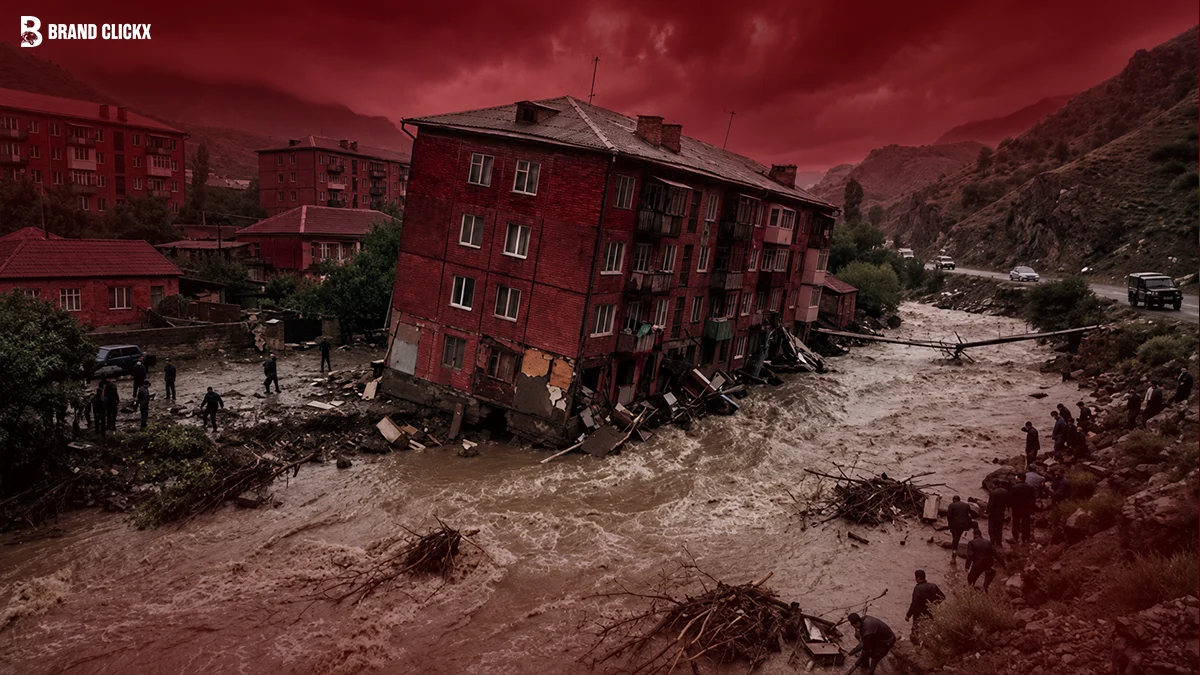
A once-in-a-century flood killed at least seven people in March. Six weeks later Putin removed the man in charge. Now the republic votes with its infrastructure still broken.
Published: Wednesday, 29 July 2026 | BrandClickX News Desk
Summary
Dagestan, a Russian republic of more than three million people in the North Caucasus, was hit by its worst flooding in around a century between 28 and 31 March 2026. At least seven people died, more than 6,000 homes were damaged and 564 settlements lost power. On 4 May, President Vladimir Putin removed regional head Sergei Melikov and installed Fyodor Shchukin. Elections follow in September and October.
Key Takeaways
- Dagestan suffered its worst flooding in about a century from 28–31 March 2026
- At least seven people died; more than 6,200 were affected and 564 settlements lost power
- More than 6,000 homes were damaged, 3,755 of them in Makhachkala
- Officials in Makhachkala were arrested over 40 million roubles meant for storm sewer repairs
- Putin removed Sergei Melikov on 4 May after a widely criticised response
- Fyodor Shchukin, a former Supreme Court judge, is acting head
- Elections follow on 20 September and in October 2026
- Infrastructure repairs are estimated to take around a decade
Where Is Dagestan?
Dagestan is Russia’s southernmost republic, on the western shore of the Caspian Sea in the North Caucasus.
It borders Azerbaijan and Georgia, with a population above three million. The capital is Makhachkala. Derbent, its second city, is one of the oldest continuously inhabited cities in Russia.
It is the most ethnically diverse republic in the Russian Federation, with more than a dozen major ethnic groups and no single majority. That complexity shapes everything about how it is governed.
What Happened in March?
Anomalous rainfall between 27 and 29 March produced flooding described as one of the largest in the region in a hundred years.
The water came fast and the infrastructure did not hold.
| Impact | Figure |
| Deaths | At least 7 |
| People affected or evacuated | More than 6,200, including 1,300 children |
| Homes damaged | More than 6,000, with 3,755 in Makhachkala |
| Social facilities affected | 842, including schools and hospitals |
| Healthcare facilities flooded | More than 40 |
| Settlements without stable power | 564 |
| Rescuers deployed | More than 3,000 |
A note on the death toll. Figures moved as the story developed. The Moscow Times reported at least five in early April. Russia’s Emergency Situations Ministry gave six. Melikov and independent outlet Meduza put it at seven, including four children. Seven is the figure now generally cited.
Three electrical distribution substations were destroyed and two railway bridge spans collapsed. Around 320,000 people lost electricity. Seventy-six people sought medical help with symptoms of intestinal infection.
The hardest-hit areas were Makhachkala, Kaspiysk, and the Khasavyurtovsky and Derbentsky districts. Chechnya was also affected.
On 5 April, a three-storey extension to a residential building in Makhachkala collapsed. Officials said it had been built in a river floodplain in breach of construction rules.
Why Was the Damage So Severe?
Because the water met decades of unregulated building and unmaintained drainage.
Officials initially framed it as an act of nature. Melikov called the flood “unprecedented in its severity.”
That explanation did not survive contact with the evidence.
Makhachkala’s public utilities admitted the city’s storm drain system was never designed for that volume of rainfall. Mikhail Bolgov of the Russian Academy of Sciences pointed to two factors coinciding: drainage built for ordinary conditions, and deviations from standards during urban development.
Forbes Russia reported that many newer neighbourhoods have no drainage systems, storm sewers or runoff channels at all. Some areas have gone decades without sewage infrastructure.
The scale of illegal construction is documented. In 2023 authorities moved to classify 457 apartment buildings as illegal. In February 2026 — weeks before the flood — more than 1,300 unauthorised structures were demolished. Residents say demolitions often just clear space for new building.
Then came an arrest that crystallised the argument. In Makhachkala, the former head of the housing and communal services department and a chief specialist were detained, accused of stealing 40 million roubles allocated for major repairs to the storm sewers.
The Response That Ended a Career
Melikov’s handling of the aftermath, more than the flood itself, appears to have finished him.
Federal ministers arrived: Alexander Kurenkov for Emergency Situations, Irek Faizullin for Construction, Alexander Kozlov for Natural Resources.
Melikov kept a low profile. When he did appear publicly, he visited a collapsed building in Makhachkala flanked by masked, heavily armed security — imagery better suited to a conflict zone than a relief operation.
He then blamed reckless property development, saying: “Several houses have been built right in the riverbed itself!” He also attributed the deaths of motorists swept off a federal motorway to local carelessness.
That last remark drew widespread condemnation. Novaya Gazeta Europa quoted a resident of Mamedkala saying the death toll had stayed low only because locals pulled each other out of the water themselves.
Residents pointed back at the state, noting that key flood-protection structures had been in disrepair for years.
Putin Removed Him Six Weeks Later
On 30 April, Putin announced Melikov would leave. On 4 May, the decree was signed.
Officially, Melikov resigned at his own request for personal reasons, and Putin framed the move as a transfer to another, unspecified position — a face-saving formula analysts linked to Melikov’s standing among the security services. He is a former army general.
His replacement is Fyodor Shchukin, 49, who had chaired Dagestan’s Supreme Court since February 2024. He resigned from the bench the same day he was appointed.
Two things make the choice notable.
Shchukin is a judge, not a general. Both of his immediate predecessors came from military or security backgrounds and, analysts note, tended to answer problems with repression.
He is reported to be the first ethnic Russian to lead the republic. Melikov was of mixed Russian and Lezgin descent. Shchukin is from the Nizhny Novgorod region.
On 6 May, Shchukin dissolved the regional government and named Magomed Ramazanov, deputy presidential envoy to the North Caucasus Federal District, as acting prime minister. Ramazanov belongs to ethnic groups native to Dagestan, and analysts read the pairing as a deliberate tandem preserving the republic’s ethnic balance.
Why Melikov Was Already Vulnerable
The flood was the final item on a long list.
- October 2023 — a mob stormed Makhachkala airport searching for Israeli passengers
- June 2024 — coordinated attacks on churches, synagogues and a police post in Derbent and Makhachkala killed 27 people, including 17 law enforcement officers
- September 2022 — the largest anti-mobilisation protests in the North Caucasus took place in Makhachkala and Endirei
- Ongoing — chronic power outages, poor roads, and repeated corruption arrests of local officials
Dagestan has also been disproportionately mobilised for the war in Ukraine while remaining chronically underfunded for infrastructure. Analysts describe a persistent local perception that the federal centre extracts more than it returns.
What Happens Next?
Two votes, both this autumn.
| Date | Event |
| 20 September 2026 | People’s Assembly election all 90 seats, on Russia’s common election day |
| October 2026 | The new Assembly elects the Head of the Republic |
The head of Dagestan is not chosen by popular vote. The president submits a list of three candidates to the regional parliament, which then votes. Shchukin is eligible to run for a full term and serves as acting head until an elected head takes office.
The practical question is whether anything material changes before then. Estimates for repairing the damaged infrastructure run to roughly a decade. Storm drains that failed in March have not been rebuilt.
Reports in late July indicated further heavy rain, strong winds and a risk of rising rivers and mudflows in the republic. Anyone in the region should check current warnings with Russia’s Emergency Situations Ministry rather than relying on news summaries.
Expert Analysis
The removal of Melikov reads as a Kremlin correction rather than a local one, and that is the tension.
Putin has again appointed an outsider to run an ethnically complex Muslim republic. Analysis published by the Jamestown Foundation argues that this continued reliance on outsiders risks worsening the underlying problem, however capable the individual.
The counter-reading is more optimistic. Installing a judge rather than a general, paired with a locally rooted prime minister, suggests an attempt at administration rather than pure control. Shchukin’s record includes setting up expedited court processes for flood victims’ compensation claims and publicly warning against fraud in that process.
András Tóth-Czifra, an analyst of Russian domestic politics, has noted that Dagestan’s strategic position and fragmented elite landscape mean any leadership change requires careful orchestration.
The deeper problem is not personnel. It is that the drainage was stolen, the buildings were approved illegally, and neither of those facts is fixed by replacing a governor.
Frequently Asked Questions
Where is Dagestan?
Dagestan is Russia’s southernmost republic, on the Caspian Sea in the North Caucasus, bordering Azerbaijan and Georgia. Its capital is Makhachkala and it has a population of more than three million people.
What happened in the 2026 Dagestan flood?
Heavy rainfall between 27 and 29 March caused flooding described as the worst in around a century. At least seven people died, more than 6,000 homes were damaged, and 564 settlements lost stable power supply.
Who is the head of Dagestan now?
Fyodor Shchukin, appointed acting head on 4 May 2026. He previously chaired Dagestan’s Supreme Court and is reported to be the first ethnic Russian to lead the republic. He serves until an elected head takes office.
Why was Sergei Melikov removed?
Officially he resigned for personal reasons. Analysts attribute it to a sluggish and poorly received flood response, following earlier crises including the 2023 airport unrest and the 2024 attacks in Derbent and Makhachkala.
When are the Dagestan elections?
The People’s Assembly election is on 20 September 2026, with all 90 seats contested. The newly elected assembly then elects the Head of the Republic in October 2026. The head is not chosen by popular vote.
Why was the flooding so destructive?
Beyond record rainfall, investigators point to unregulated construction in river floodplains, missing drainage in newer neighbourhoods, and storm sewers that were never repaired despite funds being allocated for the work.
Is Dagestan safe to visit?
Many governments advise against travel to the North Caucasus because of security risks. Check your own government’s current travel advice, and note that flood-damaged infrastructure remains a live issue.
What is Dagestan known for internationally?
Beyond politics, it is best known as a centre of wrestling and mixed martial arts, producing a number of world champions. Derbent’s ancient fortress is a UNESCO World Heritage site.
Conclusion
The flood was not really about the rain. Dagestan gets storms. What it does not have is drainage that works, buildings placed where they should be, or officials who spent the repair money on repairs.
Removing Melikov answered the political question. It did not answer the engineering one, and the calendar is unforgiving elections in September and October, a rebuild measured in years, and a rainy season that keeps arriving.