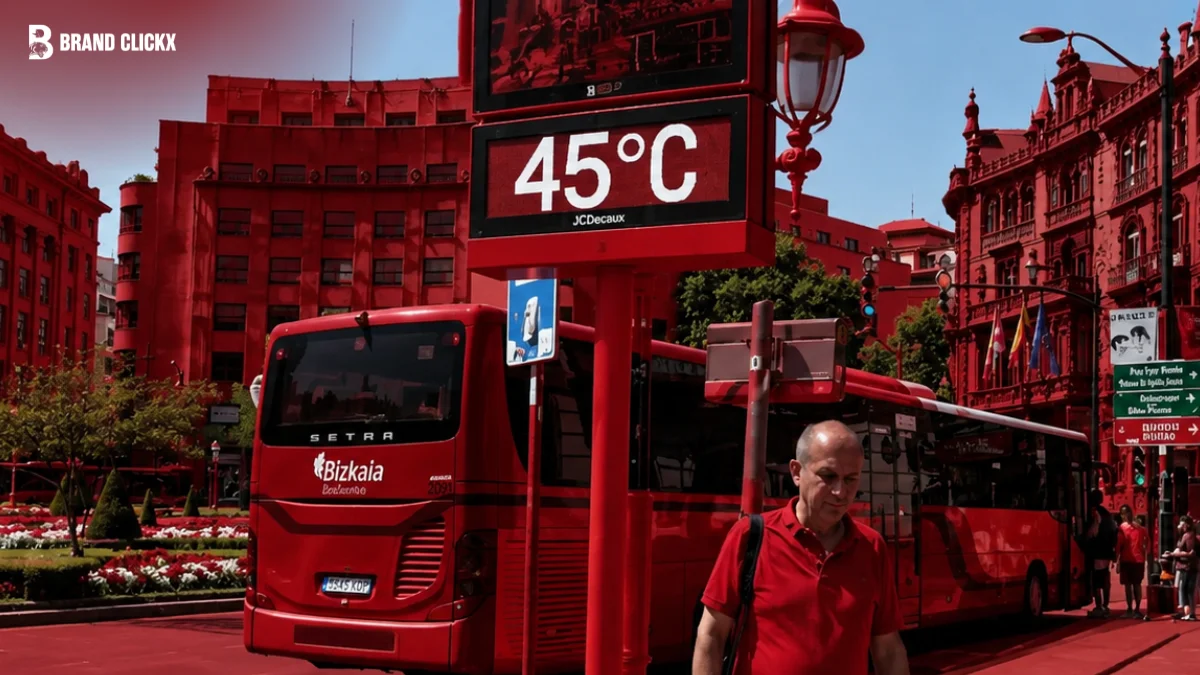
AEMET warns of a fresh rise after the summer’s third heatwave with more than 110,000 hectares already burned and heat deaths running at their highest since records began
Published: Monday, 27 July 2026 | BrandClickX News Desk
This is a fast-moving situation. Heat and wildfire warnings change several times a day. Check AEMET (aemet.es) for alerts covering your exact location before travelling or planning outdoor activity.
Summary
Spain faces another surge of extreme heat as July closes, with temperatures approaching 40C across much of the country on Monday, 27 July 2026. The State Meteorological Agency, AEMET, warns of dangerous overnight temperatures and extreme wildfire risk. It follows the summer’s third official heatwave, which peaked on 23 July. More than 1,600 deaths have been attributed to heat since 21 June, and over 110,000 hectares have burned.
What Is Happening Today?
AEMET forecasts clear skies across almost all of Spain on Monday, pushing thermometers toward 40C. The southwest and the interior of the peninsula will see the most punishing readings.
Andalusia and Extremadura concentrate the worst of it. Only the Cantabrian strip in the north escapes, with low cloud, morning mist and light scattered rain.
The overnight figures matter as much as the daytime peaks. Minimum temperatures above 20C are spreading along the Mediterranean coast and through the south, making sleep difficult and removing the recovery period the body needs after a hot day.
Strong Levante winds through the Strait of Gibraltar are driving fire risk higher still.
Where Is the Heat Worst?
The southwest and inland river valleys are bearing the brunt. In Seville, temperatures were already around 30C before dawn.
Galicia is the surprise. AEMET flagged the rise there as notable and in places extraordinary unusual for Spain’s rainy northwest.
According to forecasts published by Tutiempo.net, parts of the Miño valley in Ourense reach around 37C. The Rías Baixas sit near 34C, the Pontevedra Miño around 35C, and southwestern A Coruña close to 34C.
Forecasters advise avoiding sun exposure between 1pm and 9pm across affected areas.
Castilla y León, Aragón, La Rioja and Navarra face mostly clear skies. Catalonia and the Balearics may see early showers. Valencia stays more moderate near the coast. In the Canary Islands, conditions remain broadly stable.
Why Is Spain So Hot This Summer?
A stubborn atmospheric blocking pattern has parked hot Saharan air over Iberia and refused to move.
AEMET explained the mechanism in Special Adverse Weather Bulletin No. 23/2026. A cut-off low known in Spain as a DANA sat to the west of the peninsula while high pressure built at mid-levels over North Africa.
That combination funnelled a mass of warm, dry air carrying suspended dust across mainland Spain and the Balearics. Blocking patterns are self-sustaining: once established, they steer cooler Atlantic systems away for days at a time.
The result has been repetition rather than a single extreme event. Spain has recorded three official heatwaves this summer.
What Counts as a Heatwave?
AEMET declares a heatwave when at least 10% of its weather stations record maximum temperatures above the 95th percentile for July and August, for three consecutive days or more. It is a statistical threshold, not a fixed temperature.
How Hot Has This Summer Been?
The numbers are stark, and they come from AEMET’s own historical series.
- June 2026 was the second warmest June on record, averaging 3.2C above normal. Only June 2025 was hotter
- The 13 warmest Junes since 1961 have all occurred this century
- 23 June 2026 was Spain’s warmest June day since at least 1950
- Early June to mid-July ran roughly 3.3C above the long-term norm
- June 2026 was also the third driest in the series
The third heatwave, running from 21 July, pushed readings locally past 45C in the southeastern third of the mainland, with the Guadalquivir and Ebro valleys, northeastern depressions, Pyrenean valleys and inland Mallorca worst affected.
The Human Cost
Spain’s daily mortality monitoring system has attributed more than 1,600 deaths to heat since the summer began.
The MoMo system, run by the National Epidemiology Centre at the Carlos III Health Institute, estimated 1,646 heat-attributable deaths between 21 June and 11 July. Of those, 990 were women and 656 men.
The single worst day was 10 July, with 138 deaths, followed by 9 July with 130.
By region, Catalonia led with 164 deaths, ahead of Andalusia on 120, Madrid on 113, the Basque Country on 109 and Castilla y León on 95.
June alone was the deadliest heat month of June since MoMo began operating in 2015, with estimates exceeding 1,000 deaths.
An Important Caveat
MoMo does not count heatstroke cases. It is a statistical model that compares observed daily deaths against expected figures, incorporating AEMET temperature data.
Most heat-related deaths are not sunstroke. Extreme temperatures destabilise existing cardiovascular and respiratory conditions, which is why the elderly and chronically ill dominate the figures. MoMo estimates are also revised as data comes in.
Wildfires: One of the Worst Seasons in a Decade
Spain has passed 110,000 hectares burned in 2026, the largest area of any southern European country this year, according to the European Forest Fire Information System.
Two fires account for much of that total:
| Fire | Province | Approx. area |
| La Mierla | Guadalajara | 26,000+ ha |
| Cinco Villas | Zaragoza | 15,000+ ha |
| Los Gallardos | Almería | 5,400 ha |
| San Bartolomé de la Torre | Huelva | 4,600 ha |
| Paüls | Tarragona | 3,321 ha |
| La Bisbal d’Empordà | Girona | 2,000+ ha |
The Los Gallardos fire in Almería killed several people in early July, making it one of the deadliest the region has seen in years. The Paüls fire in Tarragona forced more than 18,000 people into confinement before being extinguished on 16 July.
Fires have concentrated in the northwest of the peninsula alongside Guadalajara, Huesca, Zaragoza, Almería and Huelva. New blazes were reported in recent days in Castellón and near Madrid.
Analysts at eldiario.es rank 2026 among the worst fire seasons of the past decade.
Timeline
| Date | Development |
| June 2026 | Second warmest June on record; third driest |
| 20–25 June | First heatwave; 278 deaths attributed |
| 23 June | Warmest June day in Spain since at least 1950 |
| 7 July | AEMET issues red heat alerts for Aragón, Catalonia, Valencia |
| Early July | Los Gallardos fire in Almería turns deadly |
| 16 July | Paüls fire in Tarragona extinguished |
| 21 July | Third heatwave begins; Bulletin 23/2026 issued |
| 23 July | Heatwave peaks; local readings above 45C |
| 27 July | Temperatures climb again toward 40C |
What Experts Say
Hugo Morán, president of AEMET and Spain’s secretary of state for the environment, described the country as caught in a chain of successive heatwaves a pattern that complicates any attempt to get ahead of fire risk.
Ferran Dalmau, a forestry engineer at the Pau Costa Foundation, made the point more sharply. Vegetation is not getting the gap it needs to reabsorb moisture between heat episodes, he warned, meaning fires may not yet have shown their full potential this season.
That combination desiccated fuel, sustained heat and dry thunderstorms producing lightning without rain is what fire scientists mean by extreme fire behaviour. AEMET has specifically flagged the risk of dry afternoon storms over mountainous areas igniting new fires.
Spain sits in the fastest-warming continent on Earth. Europe has heated at roughly twice the global average since the 1980s, which is why records here fall more often than the global average would suggest.
How to Stay Safe
Spanish health authorities and AEMET give consistent guidance:
- Stay indoors between 1pm and 9pm during peak heat episodes
- Drink water regularly, before you feel thirsty
- Check on elderly neighbours and relatives — they are the highest-risk group
- Never leave children or animals in parked vehicles
- Cool your home overnight by ventilating when temperatures drop
- Know heatstroke signs: confusion, hot dry skin, rapid pulse, stopping sweating. Call 112 immediately
For travellers, red alerts signal exceptional risk to health, not merely uncomfortable weather. Check AEMET warnings by province rather than relying on national summaries.
What Happens Next?
AEMET’s monthly outlook, issued 23 July, points to continued above-average temperatures as August begins. The end of July consolidates a picture of progressive heat and atmospheric stability, with the highest readings in the major river valleys.
Two risks carry forward. Fire danger stays extreme while vegetation remains dry, and cumulative heat exposure keeps pressure on a health system already stretched by summer staffing gaps.
Spain still has the whole of August ahead. In 2025, the country’s most intense heatwave on record ran for 16 days that month.
Key Takeaways
- Temperatures approach 40C across much of Spain on 27 July 2026
- Andalusia and Extremadura are hottest; Galicia is seeing an unusual spike
- Nights above 20C are the main health danger
- Three official heatwaves have hit Spain this summer
- MoMo attributed 1,646 deaths to heat between 21 June and 11 July
- More than 110,000 hectares have burned, the most in southern Europe
- June 2026 was the second warmest on record and third driest
- Check AEMET by province — national summaries miss local alerts
Frequently Asked Questions
How hot is Spain right now?
Temperatures approach 40C across much of Spain on 27 July 2026, with Andalusia and Extremadura hottest. Parts of inland Galicia reach 37C. Overnight lows stay above 20C along Mediterranean coasts.
How many heatwaves has Spain had in 2026?
Three official heatwaves so far. The most recent began on 21 July and peaked on 23 July, with local readings above 45C in the southeastern third of the mainland.
How many people have died from heat in Spain?
Spain’s MoMo system attributed 1,646 deaths to heat between 21 June and 11 July 2026. June alone exceeded 1,000, the deadliest June since the monitoring system began in 2015.
Is it safe to travel to Spain right now?
Travel continues normally, but red alerts indicate exceptional health risk. Check AEMET warnings for your specific province, avoid midday sun, and monitor wildfire news for rural or coastal destinations.
Why is Spain having so many heatwaves?
A persistent atmospheric blocking pattern, reinforced by a cut-off low west of Iberia and high pressure over North Africa, has funnelled hot Saharan air over Spain and kept Atlantic systems away.
How bad are Spain’s wildfires this year?
More than 110,000 hectares have burned in 2026, the largest area in southern Europe. Major fires at La Mierla in Guadalajara and Cinco Villas in Zaragoza account for over 41,000 hectares combined.
What does a red heat alert mean in Spain?
Red is AEMET’s highest warning level. It signals exceptional risk with potentially very serious consequences for health and property, not simply uncomfortable weather. Follow official instructions immediately.
What does AEMET stand for?
Agencia Estatal de Meteorología, Spain’s State Meteorological Agency. It is the official government body issuing forecasts and weather warnings, operating under the Ministry for Ecological Transition.
Conclusion
The individual numbers in Spain this summer are not unprecedented. Spain has hit 45C before, and it has lost more hectares in worse years.
What is different is the absence of gaps. Heatwave follows heatwave, vegetation never rehydrates, and the human body never gets a cool night to recover.
That relentlessness is the story and August has not started.