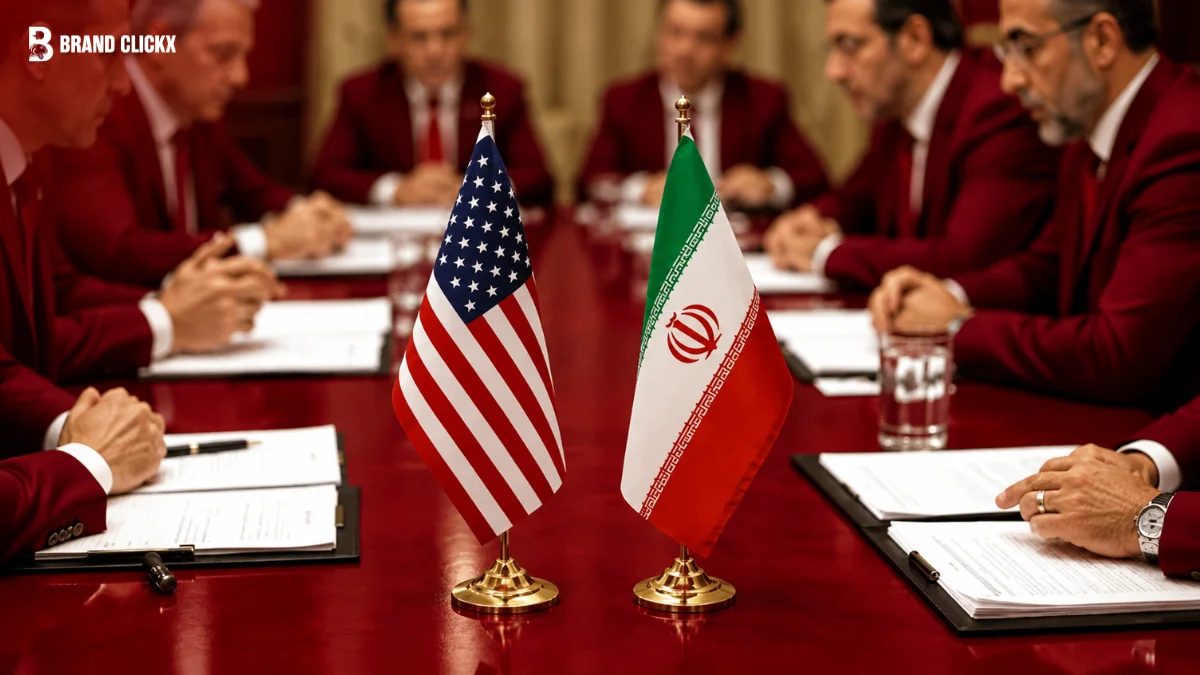
Oman’s delegation lands in Tehran, the guns fall silent and the clock runs down to a mid-August deadline
Published: Monday, 27 July 2026 | BrandClickX News Desk
Summary
The United States and Iran have halted air and missile strikes for a third straight day as of Monday, 27 July 2026, the longest quiet stretch since their June ceasefire collapsed earlier this month. Mediators from Oman, Pakistan and Qatar are pressing both sides back to the table. The Strait of Hormuz remains the central dispute. With a 60-day deadline expiring in mid-August, the pause decides whether the Middle East returns to war or to a deal.
What Happened?
Neither the US nor Iran launched strikes over the weekend of 25–26 July, and the quiet held into Monday. It follows roughly two weeks of nightly US bombing and Iranian retaliation against Gulf states hosting American forces.
US Central Command paused operations. Iran’s army then stopped its own attacks, army spokesman Mohammad Akraminia said, describing Tehran’s posture as purely retaliatory.
Two reasons have surfaced. CBS News, citing two regional sources, reported the pause followed the arrival of an Omani delegation in Tehran. The New York Times reported that President Donald Trump held back a planned escalation over concerns about shrinking US stocks of missile interceptors and air-defence munitions in the region.
Neither government has called this a new ceasefire. Both describe it as a pause.
Why Does It Matter?
The clock is the story. The Islamabad Memorandum of Understanding signed on 17 June set a maximum 60-day window to negotiate a final peace deal. That window closes around 16 August 2026.
More than half of it has already been consumed by fighting rather than talks. The nuclear question the war was ostensibly fought over remains untouched at the negotiating table.
For readers following Iran news from outside the region, the practical stakes are energy and shipping. The Strait of Hormuz normally carries roughly a fifth of the world’s seaborne oil. It has been effectively closed or restricted since March, and US pump prices remain above $4 a gallon.
Background: How the War Reached This Point
On 28 February 2026, the United States and Israel launched joint airstrikes on Iran. Supreme Leader Ayatollah Ali Khamenei was killed. Iran struck back at Israel, US bases and Gulf states, and moved to close the Strait of Hormuz.
Khamenei’s son, Mojtaba Khamenei, was named Supreme Leader. President Masoud Pezeshkian remained in office as the government’s negotiating face.
Pakistan brokered a conditional two-week pause on 8 April. Talks in Islamabad on 11 April produced no agreement Trump said the nuclear issue alone remained unresolved, while Foreign Minister Abbas Araghchi said a deal was close but criticised US demands.
A separate Lebanon ceasefire, mediated by the US State Department, began on 16 April.
What the June Memorandum Actually Said
The 14-point Islamabad Memorandum, signed by Trump at Versailles and by Pezeshkian in Tehran on 17 June, committed both sides to:
- An immediate and permanent end to the war on all fronts, including Lebanon
- Full removal of the US naval blockade within 30 days
- Toll-free passage for commercial vessels through Hormuz for 60 days only
- A reconstruction plan for Iran worth at least $300 billion, developed with regional partners
- Down-blending of Iran’s near-weapons-grade uranium under IAEA supervision
- A final deal within 60 days, extendable by mutual consent
It deferred the hardest questions: the full scope of sanctions relief, long-term nuclear limits, and who controls the strait.
Timeline of the Iran–US Ceasefire
| Date | Development |
| 28 Feb 2026 | US and Israel strike Iran; Khamenei killed; war begins |
| 8 Apr 2026 | Pakistan brokers conditional two-week ceasefire |
| 11 Apr 2026 | Islamabad talks end without agreement |
| 16 Apr 2026 | Separate Lebanon ceasefire begins |
| 21 Apr 2026 | Trump extends the pause pending an Iranian proposal |
| 12 Jun 2026 | Both sides agree final MoU text |
| 17 Jun 2026 | Islamabad Memorandum signed; 60-day clock starts |
| ~7 Jul 2026 | Iran fires on vessels in Hormuz; US strikes resume |
| 8 Jul 2026 | Trump declares the deal over at the NATO summit in Ankara |
| 14 Jul 2026 | US reimposes naval blockade; drops proposed transit fee |
| 23 Jul 2026 | 13th consecutive night of US strikes |
| 25–27 Jul 2026 | Both sides pause; Omani delegation in Tehran |
| ~16 Aug 2026 | MoU negotiating deadline expires |
Latest Updates
Diplomacy has intensified. US Ambassador to the United Nations Mike Waltz said on Sunday that Trump is giving negotiations room, while stressing the US military remains, in his phrasing, “locked and loaded”. Waltz said contacts are running at every level, from technical to the most senior.
Mediators are multiplying. Anadolu Agency reported that Pakistani and Qatari mediators stepped up contacts after both sides responded to a de-escalation formula. Oman is separately handling the maritime file.
The blockade has not lifted. CENTCOM said Sunday its naval blockade remains in full effect, reporting 12 commercial vessels redirected, two disabled and two boarded as of Saturday.
Incidents continue at sea. Iranian media said the Revolutionary Guard Corps turned back six vessels with warning shots in 24 hours. Tasnim News Agency reported an oil tanker exploded after striking a mine, saying it had left the Iranian-approved route.
Netanyahu heads to Washington. Israeli Prime Minister Benjamin Netanyahu meets Trump on Tuesday, 28 July their first Washington meeting since February. He told Fox News he fully backs Trump’s approach and would defer to the president’s judgement.
The Strait of Hormuz: The Core Dispute
What is the Strait of Hormuz? It is a 21-mile-wide waterway between Iran and Oman connecting the Persian Gulf to the Gulf of Oman. Roughly a fifth of globally traded oil and much of the world’s LNG passes through it.
The disagreement is about authority, not geography. Tehran argues the June memorandum lets it manage transit for now. Washington rejects any Iranian control and has promoted an alternative route hugging the Omani side.
Iran’s Foreign Ministry spokesman Esmaeil Baghaei said the Omani talks produced progress, but confirmed the strait’s status is unchanged.
A regional official involved in mediation told the Associated Press that a compromise under discussion would let Iran manage transit with fewer restrictions on ships — a formula that gives Tehran a role without conceding sovereignty.
Traffic tells the story. Before the war, about 110 ships crossed daily. During the worst of July’s fighting, that fell to roughly 13 in a 24-hour period, according to MarineTraffic data cited by CNN.
Who Is Affected?
Iran. Ports, bridges, rail junctions and coastal infrastructure have been struck. One Iranian official put direct and indirect damage at around $270 billion.
Gulf states. The UAE has absorbed the most Iranian attacks, followed by Bahrain, Saudi Arabia and Kuwait. Qatar lost significant LNG capacity to a March strike, according to QatarEnergy.
Lebanon. The Health Ministry reported 4,328 killed and 12,229 wounded since 2 March.
Shipping and energy consumers worldwide. Higher freight costs, war-risk insurance premiums and fuel prices are being felt well beyond the Gulf.
Yemen and the Red Sea. Houthi attacks on Saudi tankers have compromised the main alternative export route, prompting Saudi strikes in response.
Market Impact
Oil dipped back below $100 a barrel late last week after touching that mark for the first time in two months. Brent still finished the week up around 10%, according to market data compiled by Trading Economics.
Average US petrol prices remain well above $4 a gallon.
To keep tankers moving, the US International Development Finance Corporation created a government-backed maritime reinsurance facility, initially about $20 billion and roughly doubled in April. Shipping volumes stayed low regardless insurance does not solve a safety problem.
One overlooked detail: the memorandum’s toll-free clause runs for 60 days only. Analysts at law firm Gibson Dunn note this signals Iran may impose a transit charge afterwards, reportedly near $1 per barrel about $2 million for a very large crude carrier.
Official Responses
White House. Communications director Steven Cheung said Trump has consistently preferred diplomacy but retains all options, adding: “It would be wise for Iran to work toward a negotiated deal.”
Iran. The army says it halted retaliatory operations but warned the conflict would widen if US attacks resume. Pezeshkian has said reparations and firm guarantees against future attack are essential.
United Nations. Secretary-General António Guterres said he is deeply alarmed by Houthi attacks on commercial shipping and urged de-escalation. He appointed veteran diplomat Jean Arnault as his personal envoy in March.
IAEA. Director General Rafael Grossi has warned that a deal without restored inspections would amount to an “illusion of an agreement”. The agency has not verified conditions inside Iran’s nuclear sites since 2025.
What Experts Say
Carl Schuster, former director of the US Pacific Command’s Joint Intelligence Center, argued the April ceasefire had “little chance of survival” because the civilian Iranian government that signed it does not command the Islamic Revolutionary Guard Corps. That gap between signature and enforcement has defined every collapse since.
Vice President JD Vance has said the US holds a strong position regardless of outcome, arguing Iran’s nuclear programme and military have been degraded.
Analysts point to a structural problem in the memorandum itself. By sequencing maritime and sanctions steps ahead of nuclear talks, it made the whole framework hostage to whichever side felt shortchanged first. Herbert Smith Freehills Kramer described the agreement as functioning as much as a sequencing mechanism as a ceasefire.
The EU’s Kaja Kallas has warned that without nuclear specialists at the table, any settlement risks being weaker than the 2015 JCPOA.
The Human Cost
Casualty estimates vary widely and independent verification remains difficult, partly because of Iran’s prolonged internet blackout and restricted access for journalists.
Iran’s Ministry of Health recorded 3,468 people killed between 28 February and 8 April. Norway-based Hengaw put the toll far higher for the war’s first 40 days. US-based HRANA documented 3,636 deaths as of 7 April, including at least 254 children.
UN OCHA reported that 115,193 civilian units were damaged as of 3 April, including 763 schools. The WHO verified 23 attacks on health care in Iran during March, resulting in nine deaths.
The Pentagon confirmed to CBS News that nearly 100 US troops were injured in Iranian strikes on regional bases after 7 July, with most returning to duty.
What Happens Next?
Three paths are realistic.
A restored interim ceasefire. Mediators are converging on a Hormuz formula acceptable to both. This is the outcome the Omani, Pakistani and Qatari channels are built for.
An extension. The memorandum allows the 60-day window to be extended by mutual consent. The Wall Street Journal has reported Trump was willing to extend if needed.
Renewed escalation. Trump met Cabinet officials on 24 July to review options if talks fail. Munitions constraints may slow, but would not prevent, a return to bombing.
Watch three signals this week: the Netanyahu meeting on Tuesday, whether the naval blockade eases, and whether nuclear talks resume at all before mid-August.
Key Takeaways
- Strikes have paused for a third day — the calmest stretch since the June deal collapsed
- The Islamabad Memorandum’s 60-day deadline expires around 16 August 2026
- Control of the Strait of Hormuz, not the nuclear file, triggered July’s fighting
- The US naval blockade remains fully in force despite the pause
- Oman, Pakistan and Qatar are all mediating simultaneously
- Oil slipped below $100 a barrel but remains sharply elevated
- Nuclear negotiations — the war’s stated cause — have not meaningfully begun
Frequently Asked Questions
Is there currently a ceasefire between Iran and the US?
No formal ceasefire is in force. Both sides paused strikes on 25 July and the quiet has held into 27 July, but neither government has declared a new agreement. The June memorandum remains technically alive, though Trump declared it over on 8 July. Officials describe the current situation as a pause supporting negotiations.
Why did the Iran–US ceasefire collapse in July 2026?
Iran fired on commercial vessels transiting the Strait of Hormuz in early July. The US responded with sustained airstrikes and reimposed sanctions on Iranian oil and a naval blockade. Each side accuses the other of breaching the June memorandum. The unresolved question of who controls the strait was the immediate trigger.
What is the Islamabad Memorandum of Understanding?
It is a 14-point framework signed on 17 June 2026 by Presidents Trump and Pezeshkian, mediated by Pakistan. It declared an end to hostilities, required removal of the US naval blockade within 30 days, guaranteed toll-free Hormuz transit for 60 days, and set a 60-day deadline to negotiate a final agreement.
Is the Strait of Hormuz open right now?
Partially. Commercial traffic is running far below pre-war levels of roughly 110 vessels per day. Iran’s Revolutionary Guard is stopping ships that leave its designated route, and the US enforces a separate blockade of Iranian ports. Both restrictions remain in place despite the pause in strikes.
Who is mediating between the US and Iran?
Pakistan brokered both the April ceasefire and the June memorandum. Qatar has since joined the effort, and Oman is handling the specific question of managing shipping through the Strait of Hormuz. China has also encouraged de-escalation, publishing a joint five-point plan with Pakistan in March.
How have oil prices reacted?
Brent crude briefly reached $100 a barrel in late July for the first time in two months before easing back. It finished the week up roughly 10%. US average petrol prices remain above $4 a gallon. Prices have swung sharply on every diplomatic signal since February.
Who leads Iran now?
Mojtaba Khamenei became Supreme Leader after his father, Ayatollah Ali Khamenei, was killed in the 28 February strikes. Masoud Pezeshkian remains President and signed the June memorandum. Abbas Araghchi continues as Foreign Minister and lead negotiator.
When is the deadline for a final deal?
The 60-day negotiating window opened when the memorandum was signed on 17 June 2026, placing expiry around 16 August. The text allows extension by mutual consent. Most of the period has been consumed by fighting rather than substantive negotiation.
Conclusion
A pause is not peace. Three quiet days after two weeks of nightly bombing is meaningful, but the structures that broke this deal twice — the strait, the blockade, and an untouched nuclear file are all still standing.
The next three weeks will settle it. Either mediators convert this quiet into a restored ceasefire and an extended deadline, or the August expiry arrives with nothing agreed and both militaries positioned to resume.
BrandClickX will update this report as developments occur.