
The Rule of 40 is a financial indicator mainly used to evaluate the performance of SaaS companies. It contains two main factors: revenue growth and profit ratio. The main idea is that sales growth rate and profit ratio of company should total make 40% or more. For example, a company has 30% sales growth and a 10% profit ratio so its Rule of 40 score is 40%.
It shows a balance of growth and profitability for a company. However, it is a simple guideline, not a rule, and should not be looked at alone.
Key Takeaways
- The Rule of 40 combines revenue growth and profit ratio to check the performance of company.
- A company follows the Rule of 40 when its revenue growth and profit margin make 40% or more.
- The Rule of 40 helps in balancing growth and profitability. It is mainly used for SaaS companies.
- Different combinations of growth and profit can produce the same Rule of 40 score.
- The Rule of 40 is more useful for growing and established companies than very early-stage startups.
- The 40% benchmark is not a strict rule and can vary depending on the company, industry, and market conditions.
- The Rule of 40 should be used with other business measures rather than on its own.
How to Calculate the Rule of 40

To calculate the Rule of 40, add company’s sales growth and profit margin. The formula is given below:
Rule of 40 = Sales Growth% + Profit Margin%
If result is 40% or more then it means the company achieves the Rule of 40.
Revenue Growth Rate
Revenue growth rate shows an increase in company’s sales as compared to previous year. For example, if sales of company increase from $1 million to $1.3 million then its growth rate is 30%.
Profit Margin
Profit margin shows the profit of a company after paying its prices. For example, if a company achieves $1 million in sales and earns $10,000 profit then its profit margin is 1%. Different profit measures can be used for SaaS companies. The important thing is to use the same method while comparing companies.
Why Does the Rule of 40 Matter?
The Rule of 40 gives a simple view of growth and profitability of a company. It helps investors and business leaders to take look at both factors instead of focusing on only one factor.
Balancing Growth and Profitability
A company may grow quickly but spend heavily for growth. Another company makes big profits but grow slowly. The Rule of 40 keeps the balance between growth and profitability.
Evaluating SaaS Business Performance
The Rule of 40 is mainly used for SaaS companies, where growth and profitability are important. A company can reach the 40% benchmark by growing fast, making big profits or by combination of both.
Making Growth and Profitability Decisions
Companies can use the Rule of 40 to find areas that need more attention. Strong growth with low profits may require better cost control. Strong profits with slow growth may require more investment in growth.
How to Interpret a Rule of 40 Score
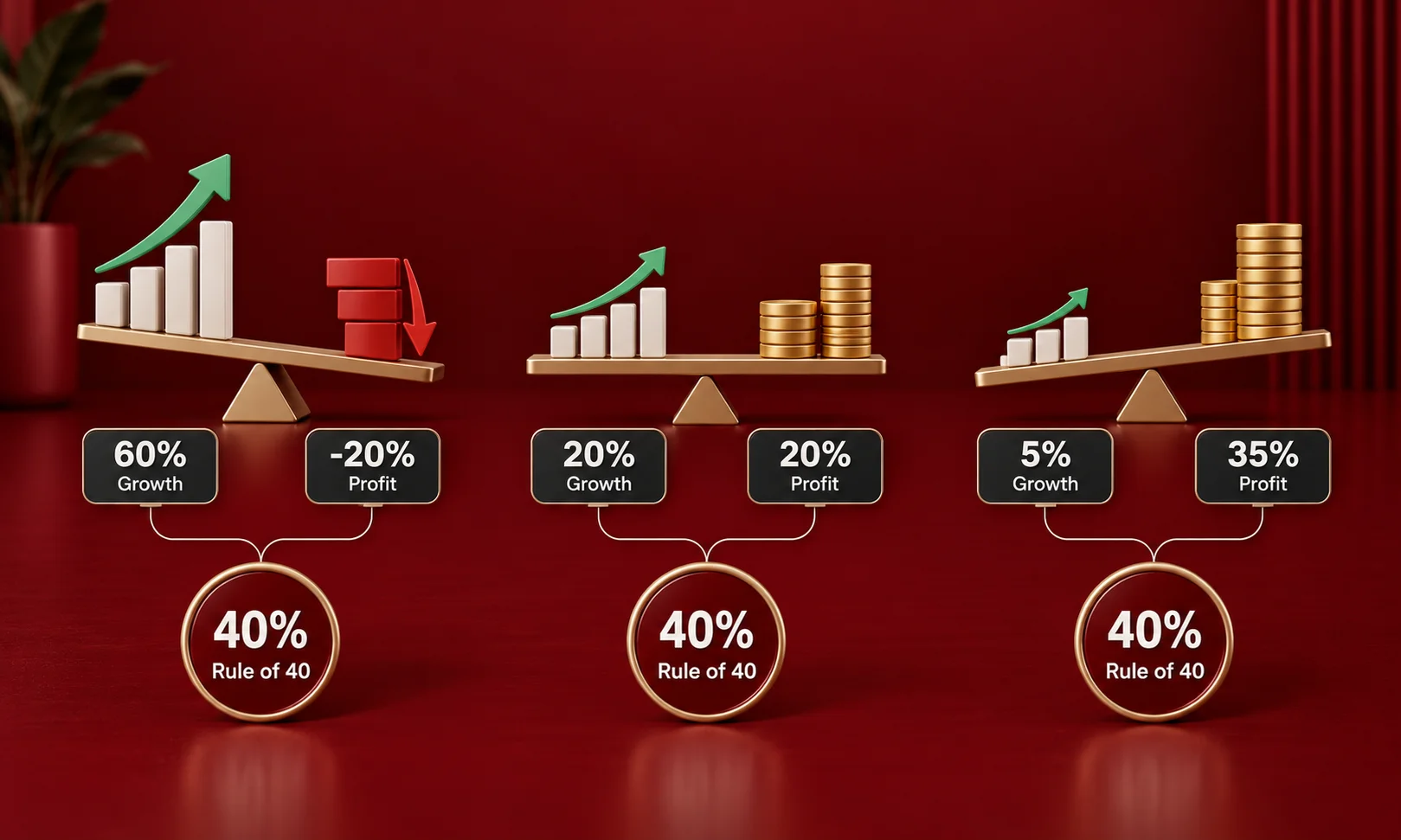
A Rule of 40 score shows the way a company balances growth and profit. Different combinations of growth and profit can produce the same score.
High Growth and Low Profitability
A company may have very fast growth but low or negative profit. This can happen when a company spends large amount on sales, marketing, or new products. For example, 60% growth and a -20% profit ratio gives a Rule of 40 score of 40%.
Moderate Growth and Moderate Profitability
A company can have a stable position, with good growth and a decent profit. For example, 20% growth and a 20% profit margin give a score of 40%.
Low Growth and High Profitability
A stable company may grow slowly but make strong profits. For example, 5% growth and a 35% profit ratio also give a score of 40%.
When Should You Use the Rule of 40?
- The Rule of 40 is useful for checking the performance of a growing SaaS company.
- Investors and business leaders can use it to look at growth and profit and see if the company has a good balance.
- It is more useful for growing and established companies than very early-stage startups, which may focus heavily on growth and have little or no profit.
- It can also help compare similar SaaS companies when the same growth and profit numbers are used.
Limitations of the Rule of 40
- The Rule of 40 is useful, but it does not give a complete overview of performance of company.
- First, the 40% benchmark is not rule. A good score can change depending on the company, industry, and market conditions.
- Second, there is no single way to measure profit ratio. Using EBITDA or free cash flow can produce different results.
- The Rule of 40 also does not consider many important factors, such as customer loyalty, the quality product or future market opportunities.
- Finally, it may not be very useful for very early-stage companies, which often focus on fast growth before making profits.
For these reasons, the Rule of 40 should be used with other business measures instead of on its own.
Final Thoughts
The Rule of 40 is a simple way to check company’s growth and ability to make profit. It is helpful for SaaS companies because they usually need to keep a balance between growing quickly and making profit. A score of 40% or more can be useful for comparison, but it does not describe the whole story. Companies should also think about other factors before making business or investment decisions.
FAQs
Is the Rule of 40 only for SaaS companies?
No, Rule of 40 is not only for SaaS companies. It can also be used to check the growth and profitability in technology businesses.
Can a company have a Rule of 40 score above 40%?
Yes, a company can have a score above 40%. For example, 30% revenue growth and a 20% profit margin makes the Rule of 40 score 50%.
After how much time should a company calculate its Rule of 40 score?
Companies should calculate the Rule of 40 regularly after some months. Using the same time period and calculation method can make it easier to notice changes.
Can the Rule of 40 score change from year to year?
Yes. The score can change as the company’s revenue growth and profit margin change. A company may have a higher score during a period of strong growth and a lower score when growth slows or costs increase.