

Key Takeaways
- Comcast Corporation is a publicly traded company, so it is owned by its shareholders rather than one individual or family.
- Brian L. Roberts beneficially owns 100% of Comcast’s outstanding Class B common stock.
- Comcast’s Class B stock represents 33⅓% of the company’s combined voting power.
- Holders of Class A common stock collectively hold the remaining 66⅔% of the combined voting power.
- Major disclosed Class A shareholders include The Vanguard Group, BlackRock, and State Street Corporation.
- Brian Roberts is Comcast’s Chairman and Co-CEO, while Michael J. Cavanagh serves as Co-CEO.
- Comcast completed the separation of Versant on January 2, 2026. Comcast no longer owns an equity interest in Versant.
- In June 2026, Comcast announced plans to separate NBCUniversal and Sky into a new publicly traded company. That transaction has not yet been completed as of August 19, 2026.
Quick Answer
So, who owns Comcast?
The simplest answer is Comcast’s shareholders. Comcast is publicly traded on Nasdaq under the ticker CMCSA, which means ownership is spread across individual investors, institutional investors, and other shareholders.
There is, however, an important exception to the usual public-company structure. Brian L. Roberts beneficially owns all of Comcast’s outstanding Class B common stock. Comcast’s corporate structure gives the Class B shares 33⅓% of the combined voting power, while Class A shareholders collectively hold the other 66⅔%.
That makes Roberts an unusually influential shareholder, but it would still be inaccurate to say that he owns all of Comcast or that the Roberts family owns the entire company.
The distinction matters: ownership of shares, voting power, and day-to-day management are three different things.
Comcast Is a Publicly Owned Company
Comcast is not a privately held business controlled entirely by one person.
Its Class A common stock is publicly traded, and thousands of investors can own Comcast shares directly or indirectly through investment funds, retirement accounts, mutual funds, and other financial vehicles.
The company’s 2026 proxy statement identified several shareholders with more than 5% of a voting class as of December 31, 2025. The disclosed Class A holdings included:
| Shareholder | Comcast Class A ownership reported |
|---|---|
| The Vanguard Group | 10.0% |
| BlackRock, Inc. | 7.4% |
| State Street Corporation | 5.1% |
| Brian L. Roberts | 100% of Class B |
These percentages come from Comcast’s 2026 proxy statement. Importantly, the proxy also explains that some of the institutional ownership figures were based on earlier SEC filings submitted by those investors. They should therefore be treated as reported ownership figures tied to the relevant filing dates, rather than as a live, minute-by-minute ownership tracker.
This is why no single institutional investor can accurately be described as the owner of Comcast.
Brian Roberts’ Special Position
Brian L. Roberts is the most important individual shareholder when it comes to Comcast’s voting structure.
Comcast has two voting classes of common stock. Class A is the widely held public class, while all outstanding Class B common stock is beneficially owned by Roberts.
As reported in Comcast’s 2026 SEC filings, there were 9,444,375 outstanding Class B shares, and Roberts beneficially owned 100% of them. The Class B shares collectively carry 33⅓% of Comcast’s combined voting power.
That arrangement gives Roberts substantially more voting influence than simply looking at the number of Class B shares would suggest.
It is also important not to describe this as majority control. 33⅓% is a significant voting position, but it is not more than 50% of Comcast’s total voting power.
How Comcast’s Two-Class Stock Structure Works
The key to understanding Comcast’s ownership is its dual-class voting system.
| Stock class | Who generally holds it | Combined voting power |
|---|---|---|
| Class A common stock | Public and institutional investors | 66⅔% |
| Class B common stock | Brian L. Roberts | 33⅓% |
Each Class B share carries 15 votes per share. Comcast’s corporate documents also provide that the Class B shares’ 33⅓% aggregate voting position is generally non-dilutable by additional issuances of other classes of common stock.
Class A voting power works differently. The number of votes attached to each Class A share is determined under Comcast’s corporate structure based on the outstanding Class A and Class B shares.
This means the raw number of shares does not tell the whole story.
Someone researching Comcast’s largest shareholders therefore needs to look at both how much stock an investor owns and what voting rights come with that stock.
Does Brian Roberts Own Comcast?
No, not in the sense of owning the entire company.
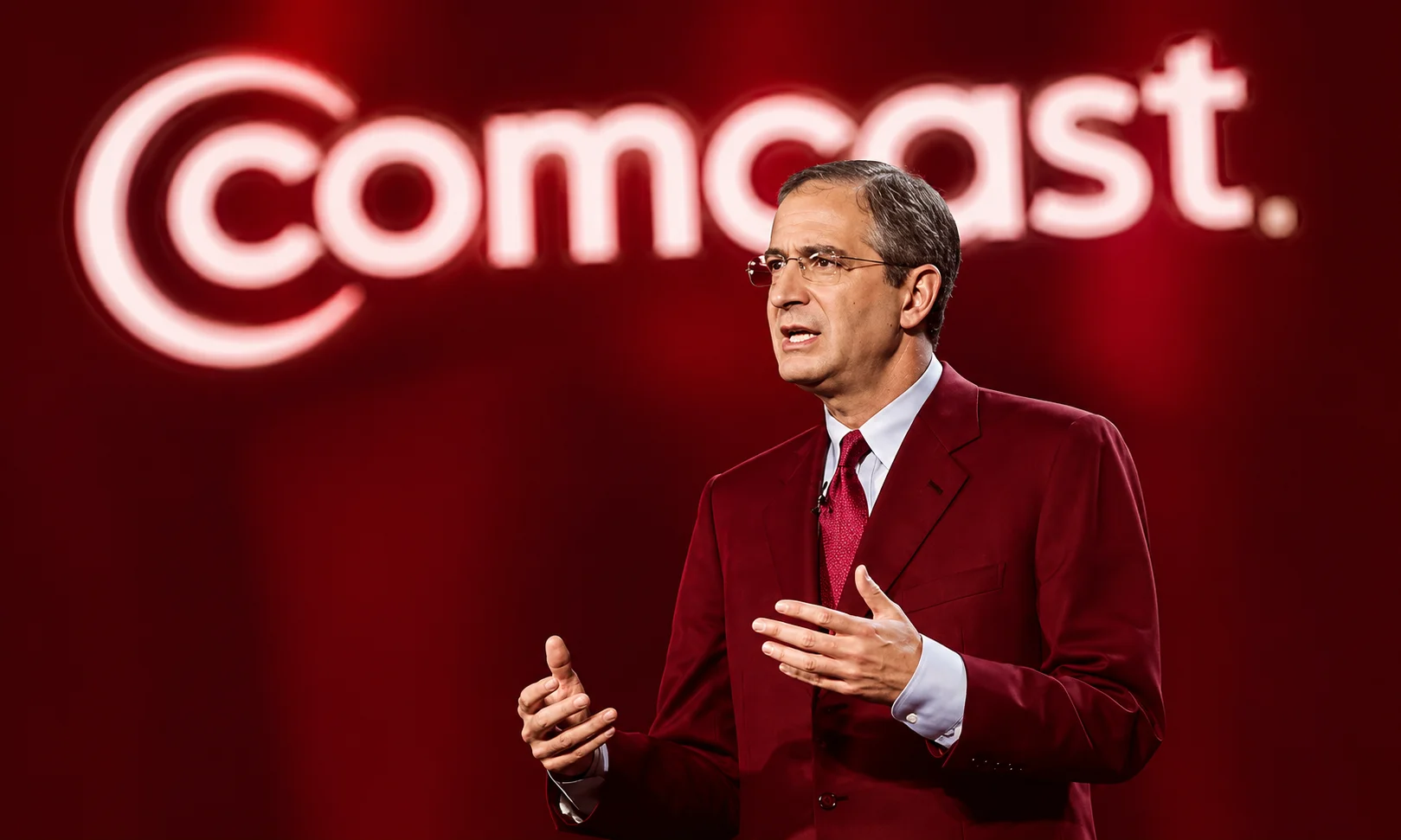
Brian Roberts owns all outstanding Class B common stock, but Comcast also has a large publicly traded Class A shareholder base.
His Class B shares give him 33⅓% of Comcast’s combined voting power, while Class A shareholders collectively hold the remaining 66⅔%.
Roberts also has other interests in Comcast, but the Class B shares are the most significant part of his voting position.
So saying “Brian Roberts owns Comcast” is an oversimplification. A more accurate description is that Brian Roberts is Comcast’s largest individual voting shareholder through the company’s Class B stock structure.
Does the Roberts Family Own Comcast?
The Roberts family has a deep historical connection to Comcast, but the company is not privately owned by the family.
Comcast was founded by Ralph J. Roberts, Brian Roberts’ father, in 1963. Brian Roberts later became one of the company’s central executives and eventually took over as its chief executive.
Today, the specific Class B ownership disclosed by Comcast belongs to Brian L. Roberts, not to the Roberts family collectively. Comcast’s 2026 proxy identifies Roberts as the beneficial owner of all outstanding Class B shares.
That distinction is worth making because phrases such as “the Roberts family owns Comcast” can make the company’s public ownership structure sound much simpler than it actually is.
Who Are Comcast’s Biggest Institutional Shareholders?
Institutional investors are an important part of Comcast’s shareholder base.
According to Comcast’s 2026 proxy statement, the largest disclosed Class A beneficial owners above the 5% threshold included:
The Vanguard Group
Vanguard was reported as beneficially owning 373,581,278 Class A shares, equal to 10.0% of the Class A common stock in the proxy’s ownership table.
BlackRock
BlackRock was reported as beneficially owning 298,215,422 Class A shares, representing 7.4% of the Class A stock.
State Street Corporation
State Street was reported as beneficially owning 186,826,370 Class A shares, or 5.1% of the Class A stock.
These companies are major institutional shareholders, but their presence should not be interpreted as meaning that Vanguard, BlackRock, or State Street individually owns or controls Comcast.
Their reported holdings are in Class A common stock, while Roberts’ special voting position comes from the separate Class B class.
Do Vanguard, BlackRock, or State Street Control Comcast?
No single one of these institutional investors holds the special Class B position that belongs to Brian Roberts.
Vanguard, BlackRock, and State Street are substantial Class A shareholders. Their investments can give them meaningful influence as institutional investors, but that is different from owning Comcast outright.
The Class B shares held by Roberts represent 33⅓% of the combined voting power, and that percentage is generally protected from dilution under Comcast’s corporate structure.
So there are two separate questions:
- Who owns large amounts of Comcast stock? Several institutional investors and other public shareholders.
- Who has the special Class B voting position? Brian L. Roberts.
Keeping those questions separate makes Comcast’s ownership structure much easier to understand.
Who Runs Comcast?
Ownership and management are not the same thing.
As of 2026, Comcast is led by Brian L. Roberts and Michael J. Cavanagh as Co-CEOs. Roberts also serves as chairman. Cavanagh became Co-CEO in January 2026 after previously serving as Comcast’s president and chief financial officer.
Roberts therefore has two important roles at Comcast: he is both a major voting shareholder through his Class B stock and one of the company’s top executives.
Cavanagh, meanwhile, does not own Comcast in the sense of being its corporate owner. His role is executive leadership.
This is another reason why “who owns Comcast” and “who runs Comcast” should not be treated as the same question.
What Does Comcast Own?
Comcast has evolved considerably from the cable business that established the company.
Its businesses include connectivity, broadband, wireless services, business connectivity, entertainment distribution, technology platforms, and other media-related operations.
The company’s portfolio has also included major entertainment businesses associated with NBCUniversal and Sky.
However, Comcast’s corporate structure changed significantly in 2026, so older articles can now be misleading.
Two developments are particularly important: the completed Versant separation and the planned separation of NBCUniversal and Sky.
What Happened to Versant?

Comcast completed the separation of Versant Media Group on January 2, 2026.
Versant became an independent publicly traded company, with its Class A shares trading on Nasdaq under the ticker VSNT. Comcast distributed 100% of Versant’s shares to Comcast shareholders based on their Comcast holdings.
Following the transaction, Comcast no longer beneficially owns an equity interest in Versant.
The distribution was made at a ratio of one Versant share for every 25 Comcast Class A or Class B shares held as of the December 16, 2025 record date.
This is important because some older descriptions of Comcast’s business portfolio still list Versant’s former networks and digital properties as Comcast assets.
That information is no longer accurate after the January 2026 separation.
What Is Happening With NBCUniversal and Sky?
Comcast announced another major corporate change on June 29, 2026.
The company said it intends to separate NBCUniversal and Sky from Comcast through a tax-free spin-off, creating a separate publicly traded company focused on media and entertainment. Comcast described the transaction as expected to take approximately one year to complete.
There is an important distinction here:
The separation has been announced, but it has not been completed as of August 19, 2026.
Until the transaction closes, NBCUniversal and Sky remain within Comcast’s corporate structure.
Once the planned transaction is completed, Comcast shareholders are expected to own shares in both the remaining Comcast business and the newly separated media company.
That means future articles about Comcast’s ownership and business portfolio will need to account for another major structural change.
Comcast Ownership vs. Voting Power
The easiest way to understand the situation is to separate economic ownership from voting rights.
| Question | Answer |
|---|---|
| Is Comcast publicly owned? | Yes |
| Who owns Comcast’s publicly traded Class A stock? | A broad group of institutional and individual shareholders |
| Who owns all outstanding Class B shares? | Brian L. Roberts |
| What voting power does Class B represent? | 33⅓% of Comcast’s combined voting power |
| What voting power does Class A represent collectively? | 66⅔% |
| Does Brian Roberts own 100% of Comcast? | No |
| Does Vanguard own Comcast? | No |
| Does BlackRock own Comcast? | No |
| Who are Comcast’s Co-CEOs in 2026? | Brian L. Roberts and Michael J. Cavanagh |
| Is Versant still owned by Comcast? | No |
| Is the NBCUniversal and Sky separation complete? | No, it is still planned as of August 19, 2026 |
This distinction is the key to answering the question accurately.
Why Comcast’s Ownership Structure Stands Out
Comcast is unusual because one individual holds all of its Class B common stock while the company remains publicly traded.
The Class B shares have special voting rights and collectively account for 33⅓% of Comcast’s voting power. At the same time, the much larger Class A shareholder base collectively holds 66⅔% of the voting power.
This structure gives Brian Roberts an important voice in corporate matters without making him the sole owner of Comcast.
It also explains why simply looking at a list of the largest shareholders can give an incomplete picture. The type of shares an investor owns matters just as much as the number of shares.
Who Has the Most Influence at Comcast?

Brian Roberts is arguably the most influential individual shareholder because of his ownership of all Class B common stock and the voting rights attached to it.
But that does not mean he owns a majority of Comcast’s voting power.
The Class A shareholder base collectively holds the larger 66⅔% portion of the combined voting power. Comcast’s board and executive leadership also play important roles in the company’s governance and operations.
So the better description is that Comcast has a dispersed public shareholder base combined with a significant individual voting position held by Brian Roberts.
The Bottom Line
So, who owns Comcast?
Comcast is owned by its shareholders as a publicly traded corporation. Its Class A stock is held by a broad range of public and institutional investors, including major firms such as Vanguard, BlackRock, and State Street.
Brian L. Roberts has a special position because he beneficially owns 100% of Comcast’s outstanding Class B common stock. Those Class B shares represent 33⅓% of Comcast’s combined voting power, while Class A shareholders collectively hold the remaining 66⅔%.
That makes Roberts a major voting shareholder, but it would be incorrect to say that he personally owns all of Comcast or that the Roberts family owns the company.
The company’s structure is also changing. Comcast completed the Versant spin-off in January 2026, and it announced plans in June 2026 to separate NBCUniversal and Sky into another publicly traded company. That second transaction remains a future plan as of August 19, 2026.
For the most reliable picture of Comcast’s ownership, the company’s latest SEC filings and official announcements are more useful than older ownership articles, particularly because institutional holdings and Comcast’s corporate structure can change over time.
Frequently Asked Questions
Who owns Comcast right now?
Comcast is owned by its public shareholders. Its Class A stock is widely held, with major disclosed institutional shareholders including Vanguard, BlackRock, and State Street. Brian L. Roberts separately owns all outstanding Class B shares.
Does Brian Roberts own Comcast?
No. Brian Roberts does not own 100% of Comcast. He owns all outstanding Class B common stock, which represents 33⅓% of the company’s combined voting power. The rest of the voting power belongs collectively to Class A shareholders.
Does Brian Roberts control Comcast?
Roberts has substantial voting influence through the Class B shares, but those shares represent 33⅓% of Comcast’s combined voting power, not a majority. It is therefore more accurate to describe him as Comcast’s most influential individual shareholder rather than saying he has majority voting control.
Is Comcast owned by Vanguard?
No. Vanguard is a major Class A shareholder, but it does not own Comcast outright. Comcast’s 2026 proxy reported Vanguard as beneficially owning 10.0% of the Class A common stock based on the information disclosed in the filing.
Is Comcast owned by BlackRock?
No. BlackRock is another major Class A shareholder. Comcast’s 2026 proxy reported BlackRock as beneficially owning 7.4% of the Class A common stock based on the cited SEC filing information.
Who founded Comcast?
Ralph J. Roberts founded Comcast in 1963. His son, Brian L. Roberts, later became the company’s long-term chief executive and remains chairman and Co-CEO in 2026.
Who is Comcast’s CEO in 2026?
Comcast has two Co-CEOs: Brian L. Roberts and Michael J. Cavanagh. Roberts also serves as chairman. Cavanagh became Co-CEO in January 2026.
Is NBCUniversal still owned by Comcast?
Yes, as of August 19, 2026. Comcast has announced plans to separate NBCUniversal and Sky into a new publicly traded company, but that transaction has not yet been completed.
What happened to Versant?
Comcast completed the Versant separation on January 2, 2026. Versant became an independent publicly traded company, and Comcast no longer owns an equity interest in it.
Is Versant still part of Comcast?
No. Versant became independent in January 2026. Its Class A shares trade on Nasdaq under the ticker VSNT, and Comcast retained no ownership interest after the separation.
Will Comcast still own NBCUniversal in the future?
Comcast has announced a planned spin-off of NBCUniversal and Sky. If completed as announced, Comcast shareholders will own shares in both the remaining Comcast company and the newly separated media company. The transaction was expected to take approximately one year from the June 29, 2026 announcement.