Somewhere between 1,404 and 1,850 private companies on Earth are worth a billion dollars or more, and the reason we cannot give you one number is the first honest thing in this article: the three trackers that count unicorns disagree by hundreds, mostly about China.
What they all agree on is the acceleration. Crunchbase counted 245 new unicorns minted in 2026, more than all of 2025 (193) and more than 2023 and 2024 combined, and July alone produced 40, the highest monthly count in four years. The machine is speeding up, it is overwhelmingly an AI machine, and it is redrawing the map of where billion dollar companies are born.
This is that map: every country’s unicorn count, the ten cities that produce most of them, the class of 2026, the seed stage phenomenon that broke the old rules, and the zombie unicorns still on the lists even after the founder went to prison.
Methodology. We publish the three authoritative counts side by side rather than blending them: CB Insights (1,404 unicorns as of September 10, 2026), the Hurun Global Unicorn Index (1,603 across 52 countries, valuations as of January 1, 2026, companies founded in the 2000s or later), and the Crunchbase Private Unicorn Board (1,850 current, plus 644 exited). City data comes from StartupBlink’s October 2026 ecosystem dashboards.
A unicorn is a private company valued at $1 billion or more in a priced round. Where trackers disagree, we show both numbers. Data as of November 2026.
The Country Table: Who Has How Many
| Rank | Country | CB Insights | Hurun 2026 | The Story |
| 1 | United States | 806 | 806 | 57% of the world’s total; Crunchbase counts 953 |
| 2 | China | 166 | 381 | The great counting gap, explained below |
| 3 | India | 67 | 61 | Consumer led: OYO (9B),Dream11(9B), Dream11 (8B), Lenskart ($7.9B) |
| 4 | United Kingdom | 65 | 80 | 81% of them in London; fintech heavy |
| 5 | Germany | 37 | 32 | Industrial AI and now fusion (Proxima, Munich) |
| 6 | France | 31 | 29 | 93% in Paris; Mistral AI and LeCun’s new lab |
| 7 | Israel | 26 | 17 | Security and AI agents, 88% in Tel Aviv |
| 8 | Canada | 22 | 24 | Waabi ($3.8B) leads the autonomous wave |
| 9 | Brazil | 20 | 16 | Latin America’s anchor, fintech first |
| 10 | Singapore | 16 | 20 | Southeast Asia’s HQ city |
| 11 | South Korea | 15 | 16 | Toss ($7B) leads; 14 in Seoul alone |
| 12 | Japan | 5 | 9 | The rich world’s unicorn underperformer |
| 13 | Hong Kong | 5 | n/a | Klook, WeLab, and Even Realities’ 2026 arrival |
Southeast Asia as a region shows the methodology problem in miniature: CB Insights carries 28 unicorns, Hurun counts 35 worth a combined $80 billion, and Tracxn counts 67 created all time with 52 still holding the status. Same region, three truths.
The City Table: Where They Actually Are
Unicorns are not national. They are municipal. Ten metro areas produce the overwhelming majority:
| Rank | City | Unicorns | Share of Country | Anchor Companies |
| 1 | San Francisco Bay Area | 282 | 45% of US | OpenAI, xAI, Stripe, Databricks |
| 2 | New York | 121 | 19% of US | Chainalysis, Fireblocks, VAST Data |
| 3 | Beijing | 64 | 42% of China | ByteDance, Yuanfudao, Bitmain |
| 4 | London | 42 | 81% of UK | Revolut, Checkout.com, Snyk |
| 5 | Los Angeles | 39 | 6% of US | SpaceX, Anduril, Skims |
| 6 | Shanghai | 34 | 22% of China | Xiaohongshu (RedNote) |
| 7 | Boston | 33 | 5% of US | Devoted Health, WHOOP, Lightmatter |
| 8 | Bangalore | 32 | 47% of India | Razorpay, Ola, ShareChat |
| 9 | Paris | 28 | 93% of France | Mistral AI, Doctolib, Qonto |
| 10 | Tel Aviv | 23 | 88% of Israel | Moon Active, Cato Networks, HiBob |
Read the concentration column twice. Paris holds 93% of France’s unicorns. London holds 81% of Britain’s. The Bay Area alone has more unicorns than every country on Earth except the United States, and Los Angeles by itself outproduces Germany or France. The map is not flattening. It is spiking.
The movement inside the table matters too. Beijing has slipped from third to sixth in StartupBlink’s ecosystem index, with its score down 21% in 2026, and Shanghai fell 20%. Bangalore slid from eighth to twelfth, overtaken inside India by New Delhi.
The climbers are London (up to third globally), Paris (from eleventh to ninth since 2021), and Tel Aviv, which just posted its best ranking in six years. Capital is concentrating in fewer, safer, deeper hubs.
The Class of 2026: What 245 New Unicorns Tell Us
The new arrivals are not a cross section of the economy. They are a bet on one theme. In June, 20 of 23 new unicorns were technology companies, and AI dominated every month of the year. The class of 2026 breaks into five waves:
The AI labs. DeepSeek raised its first ever outside round in June, a $7.4 billion Series A, and by November carried a reported valuation around $90 billion, the fastest ascent from zero to deca-centaur ever recorded. In London, David Silver’s Ineffable Intelligence raised a $1.1 billion seed round at a $5.1 billion valuation. In Paris, Yann LeCun’s AMI Labs raised $1.03 billion, also at seed, at $4.5 billion. Redwood City’s humans& hit $4.48 billion on a $480 million seed.
The picks and shovels. Etched, building transformer only inference chips, reached $21 billion. Lumilens hit $5.5 billion moving data between chips with light. Nexthop AI reached $4.2 billion building Ethernet for AI data centers. Neysa, Yotta, and CtrlS gave India three new GPU cloud unicorns.
The robots. Figure carries a 39billionvaluation.The2026classaddedHadrian(39 billion valuation. The 2026 class added Hadrian (7.9 billion, automated defense factories), Mind Robotics (3.4billion,aRivianspinout),BedrockRobotics(3.4 billion, a Rivian spinout), Bedrock Robotics (4.1 billion, autonomous construction), and a Chinese humanoid wave led by XPeng Robotics (6.3billion)andLimXDynamics(6.3 billion) and LimX Dynamics (2.2 billion).
The energy play. Valar Atomics reached $6 billion building small nuclear reactors for AI data centers, and Munich’s Proxima Fusion raised at about $2.7 billion for stellarator fusion. When the constraint is power, power companies become tech unicorns.
The defense wave. Anduril sits at 31billion,and2026mintedNerosTechnologies(31 billion, and 2026 minted Neros Technologies (2.5 billion, drones), Cathedral (1.4billion,AIcybertoolsfortheUSmilitary,inWashingtonDC),andHarmattanAI(1.4 billion, AI cyber tools for the US military, in Washington DC), and Harmattan AI (1.4 billion, Paris, backed by Dassault Aviation).
We track the public market’s version of this repricing in our AI stock crash analysis, and the private leaders in depth in our top AI startups ranking and the BrandClickX World Top 500 Startups.
The Seed Stage Phenomenon That Broke the Rules
The strangest sentence in the 2026 data is this: multiple companies became unicorns at seed. Ineffable Intelligence raised $1.1 billion before it had a product in market. AMI Labs raised $1.03 billion. humans& raised $480 million. A seed round used to buy a team eighteen months of runway; in 2026 it buys a billion dollar label on day one.
The mechanism is simple and dangerous: frontier AI researchers are so scarce that investors are pricing the team, not the company. When the team is the asset, the valuation is a wage negotiation wearing a term sheet. History says most seed stage unicorns of past eras eventually justified or died quietly; the class of 2026 will be no different, just faster.
The Zombie Unicorns Nobody Removed
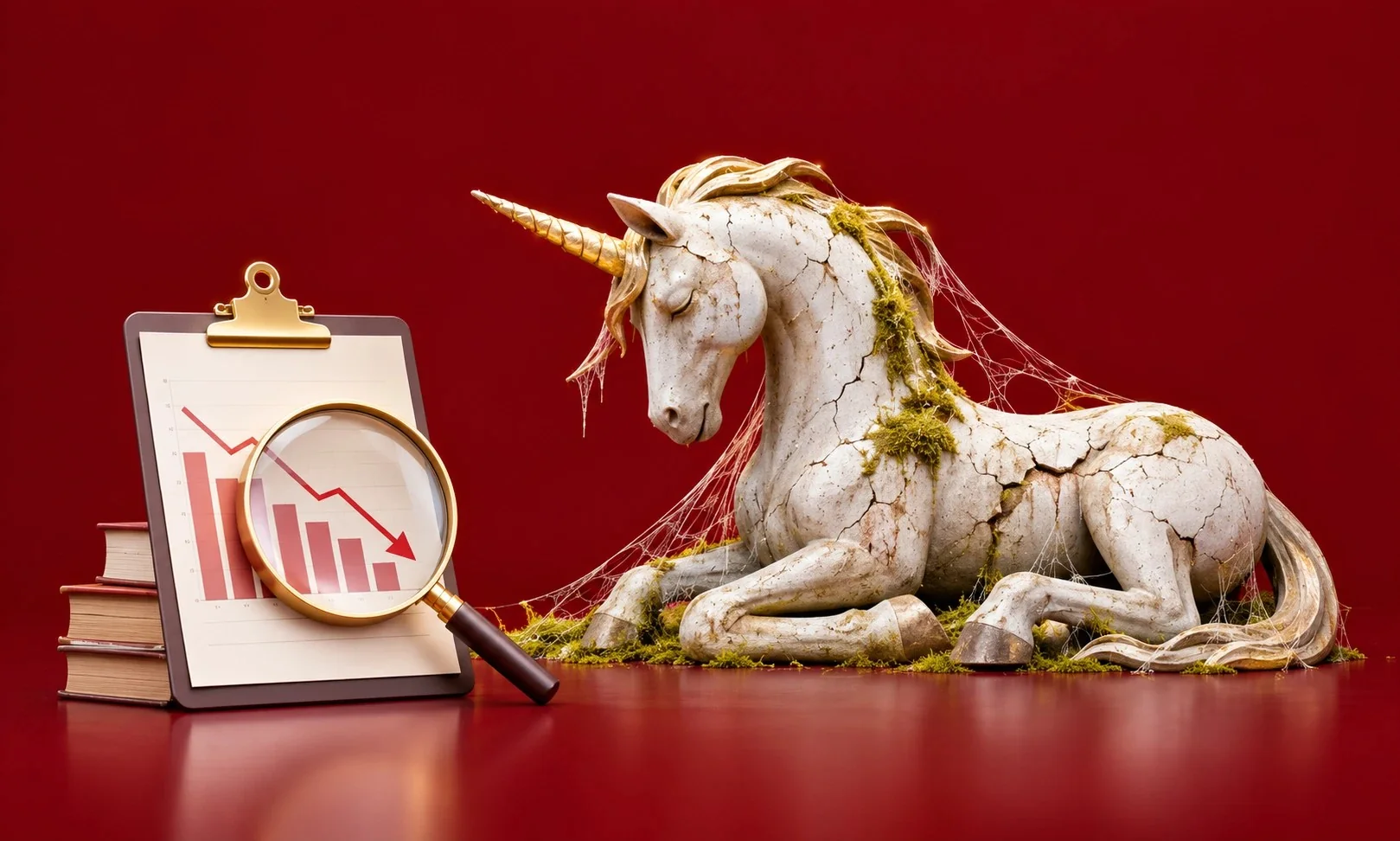
The trackers count valuations, not health, which produces the map’s darkest corner. CB Insights still listed Indonesian aquaculture startup eFishery at $1.3 billion months after its founder was sentenced to nine years in prison for embezzlement and money laundering in April 2026. The Philippines’ Revolution Precrafted remains listed at $1 billion years after settling obligations to angry suppliers.
Crunchbase’s board counts 644 unicorns that have exited, but the ones that quietly rot in place stay on the map, inflating national totals. When you read that a country has 20 unicorns, the honest reading is 20 companies last priced at a billion dollars, some of them years ago. Our startup failure analysis covers what the map looks like after the repricing.
The Founder Migration Map
The most striking statistic in the Hurun data is not a country count. It is a diaspora: 217 unicorns worldwide were co-founded by Indians, but 156 of them are headquartered outside India, and more than 90% of those are in the United States. India ranks third or fourth as a country; as a founder factory, it ranks second globally.
The same pattern, smaller, applies to Israel and France. The map of unicorns is really a map of where talent meets capital willing to price it, and for two decades that meeting place has been a forty mile strip of California, a story we cover from the funding side in our reporting on Sarvam AI’s unicorn round and the broader fastest growing tech startups.
The Layer Above: The Hectocorns
Above the unicorns sits a private tier that now rivals public markets. SpaceX and ByteDance anchor it, and OpenAI’s valuation, which we tracked to $852 billion in our OpenAI valuation analysis, would make it one of the most valuable companies on Earth, public or private. Anthropic, valued at $183 billion in its last round, is on an IPO path we follow in OpenAI vs Anthropic.
When three private companies are worth more than most stock exchanges’ entire mid cap tiers, the unicorn map stops being a startup story and becomes a capital markets story.
FAQ
How many unicorn startups are there in the world in 2027?
Between 1,404 (CB Insights, September 2026) and 1,850 (Crunchbase’s unicorn board), with Hurun counting 1,603 across 52 countries. The gap is mostly methodology: what counts as a startup, how stale valuations are handled, and how deeply each tracker covers China.
Which country has the most unicorns?
The United States, with 806 on both CB Insights and Hurun, and 953 on Crunchbase’s broader board. That is roughly 57% of the world total.
Why do China unicorn counts differ so much?
CB Insights counts 166; Hurun counts 381. CB Insights applies stricter verification and disclosure standards and covers fewer Chinese rounds; Hurun counts more aggressively but with a January 1, 2026 valuation cutoff and a founding date filter. Neither is wrong; they are measuring different definitions.
Which city has the most unicorns?
The San Francisco Bay Area, with 282, more than every country except the United States. New York is second at 121, Beijing third at 64.
How many new unicorns were created in 2026?
245 through late 2026, per Crunchbase, already past 2025’s full year total of 193. July 2026 alone minted 40, the highest monthly count in four years, and AI companies dominated every month.