

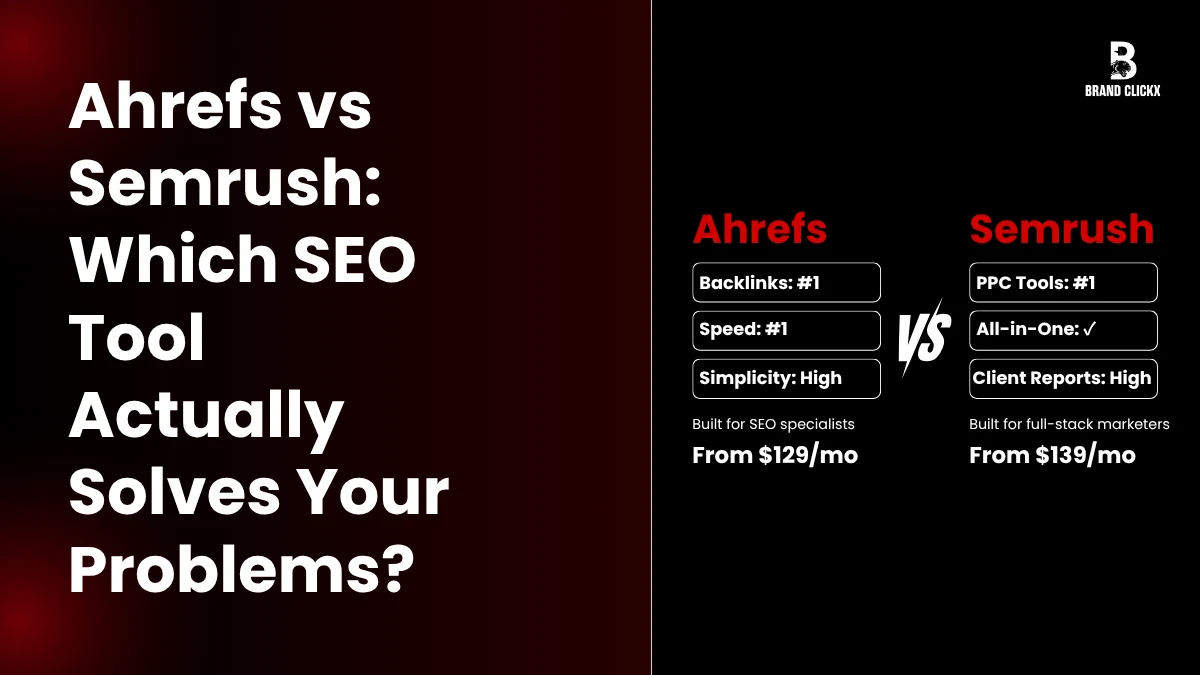
You will know you picked the wrong tool within about two days. Not because anything breaks. Just because you stop opening it.That is the real test nobody talks about Ahrefs vs Semrush.
Not the feature comparison tables, not the YouTube reviews from people who got free access, not the blog posts written by affiliates who get paid either way. Just: are you actually using the thing or are you avoiding it?
I have paid for both. Sometimes at the same time, which felt ridiculous. And after doing this for long enough, the Ahrefs vs Semrush question stopped feeling complicated. It got simpler actually. But not in the way most comparison articles frame it.
Something Has Shifted in 2026 and It Matters Here: Ahrefs vs Semrush
Three years ago the main argument was database size. Who had more backlinks indexed, who updated faster, whose keyword volume numbers were more trustworthy. That was the whole fight.
That fight has changed for Ahrefs vs Semrush.
AI overviews are eating clicks that used to belong to articles. Google updates are coming faster and the recovery windows are shorter. Content that ranked fine eighteen months ago is sitting on page four now and nobody can fully explain why. In that kind of environment, having a tool with the biggest database is less useful than having a tool that helps you actually think through what to do next.
Semrush has leaned into that. More AI-assisted suggestions, more content workflow tools, more ways to connect what you are doing in organic search to what you are doing in paid. Ahrefs has stayed more focused. Better at the core SEO work, less interested in being everything.
Neither is wrong among Ahrefs vs Semrush. They just made different bets.
The Stuff That Actually Annoys People
Look, most review articles skip this part or soften it so much it becomes useless. Affiliate commissions do funny things to honest opinions.
So here is what real users complain about Ahrefs vs Semrush.
With Ahrefs it is almost always the credits. Every export eats into your monthly allowance. Extra rows on a report cost credits. Run a few site audits, export some keyword lists, do some competitor analysis and suddenly you are two thirds through your credits by day twelve. That stings when you are already paying $129 a month minimum. Some users describe it as being charged twice — once for the subscription and then again every time you actually use the tool seriously. That frustration shows up constantly in SEO communities and it is not exaggerated.
Semrush complaints are different. The interface is genuinely dense. Not impossible but dense. Someone new to the platform will spend their first week accidentally clicking into the wrong section, opening reports they did not want, and trying to figure out how to get back to where they were. It gets better over time but there is a real adjustment period and it is longer than Semrush’s own onboarding materials suggest.
Also during busy algorithm update periods some users have noticed the backlink data lagging behind Ahrefs by nearly a week. If you are tracking competitor link building in real time that gap is not nothing.
Both tools among Ahrefs vs Semrush have people who love them. Both have people who switched away and never looked back. The divide almost always comes down to workflow, not raw capability.
Keyword Research, Real Talk: Ahrefs vs Semrush
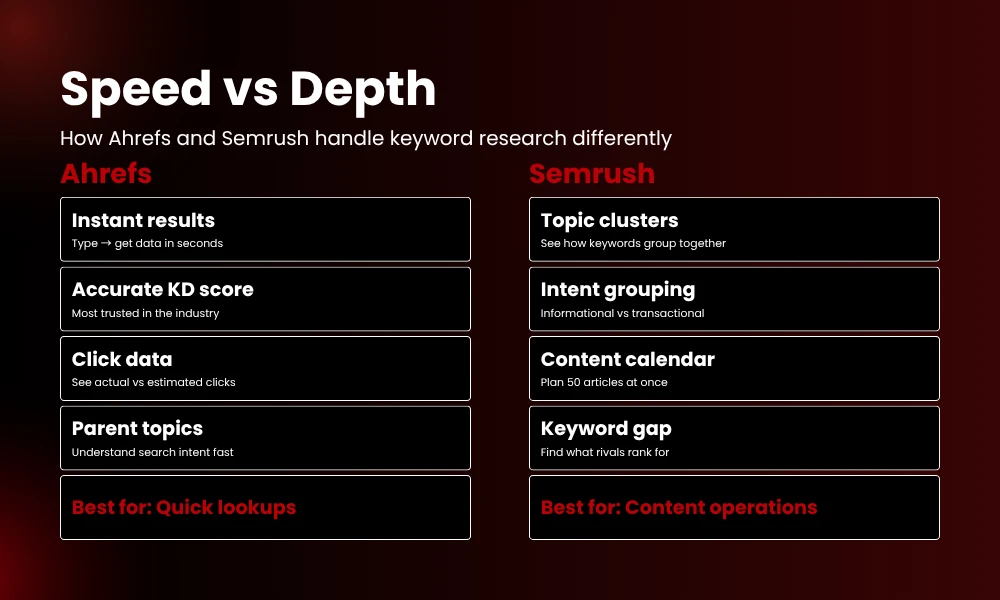
Ahrefs is faster here. That is not a controversial opinion among people who use both regularly.
You type in a keyword and within a few seconds you have difficulty, volume, click data, parent topic. The difficulty score has been around long enough that most working SEOs have calibrated their expectations around it. It is not gospel but it is trusted.
Semrush does more with keywords. The Magic Tool organizes everything into clusters and intent groups and subcategories. For someone building out a full content calendar across a large site, that structure is actually valuable. You are not just looking at individual keywords, you are seeing how they relate to each other and which clusters make sense to target together.
For a quick check before a call though, it is too many steps. You want one answer and instead you get a whole system that requires you to engage with it seriously before it gives you what you need.
Pick based on how you actually work. Quick lookups and individual decisions, Ahrefs. Planning large content operations from scratch, Semrush does more of the organizational work for you.
Backlinks
This is where Ahrefs built its reputation and honestly that reputation still holds.
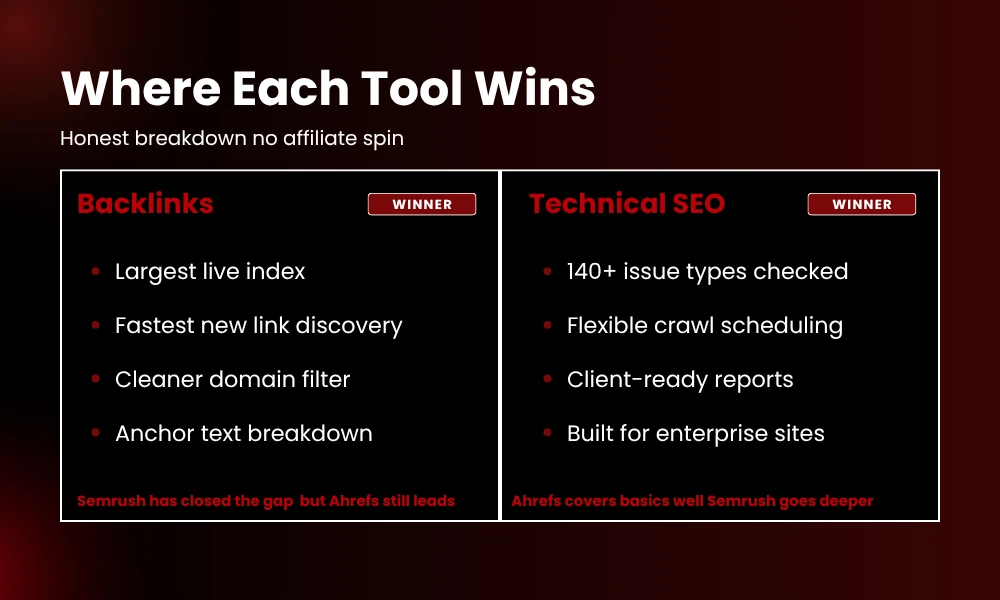
The index is large, the data is fresh, and the workflow for link prospecting is clean. Referring domains filter is straightforward. Anchor text breakdown makes sense. When you are doing outreach research or trying to understand why a competitor is ranking, you can get in, get what you need, and get out without a lot of extra friction.
Semrush has genuinely gotten better here over the last couple years. Their Authority Score is useful and the toxic link flagging has helped people during manual action recovery. But ask someone who does link building professionally every day which tool they pull up first for prospecting and most of them still say Ahrefs. The gap has closed. It has not flipped.
Technical SEO: Ahrefs vs Semrush
Semrush crawler is more thorough, full stop.
Over 140 issue types, flexible crawl scheduling, reports that look polished enough to hand to clients without spending an hour reformatting. If you manage technical SEO for multiple clients and need to show your work clearly, Semrush handles that better.
Ahrefs is simpler. Broken links, redirect chains, duplicate content, basic Core Web Vitals context. For most sites that is actually enough. A ten page local business site does not need 140 issue types checked. An enterprise ecommerce platform with 800,000 URLs probably does, and Semrush gives you more to work with in that scenario.
Who Each Tool Actually Fits: Ahrefs vs Semrush
There is no universal winner. Anyone who tells you there is has an affiliate link in their article.
Ahrefs makes more sense if:
- Your main focus is organic SEO, specifically link analysis and keyword research
- You want something fast and focused that does not require wading through a content marketing suite every time you need a backlink report
- You hate clicking through nested menus to find information that should be two clicks away
- You mostly work on a smaller set of sites and do not need paid search data woven into everything
Semrush makes more sense if:
- You are handling more than just organic search and the same person or team is doing SEO, PPC, content planning, and client reporting
- You want one login instead of four separate subscriptions
- You need those client reports to look professional without extra design work
- White-label reporting matters for your business
The overlap between Ahrefs vs Semrush descriptions is real. Some people genuinely need both and pay for both. It is expensive. The combination is comprehensive though.
What You Will Actually Pay
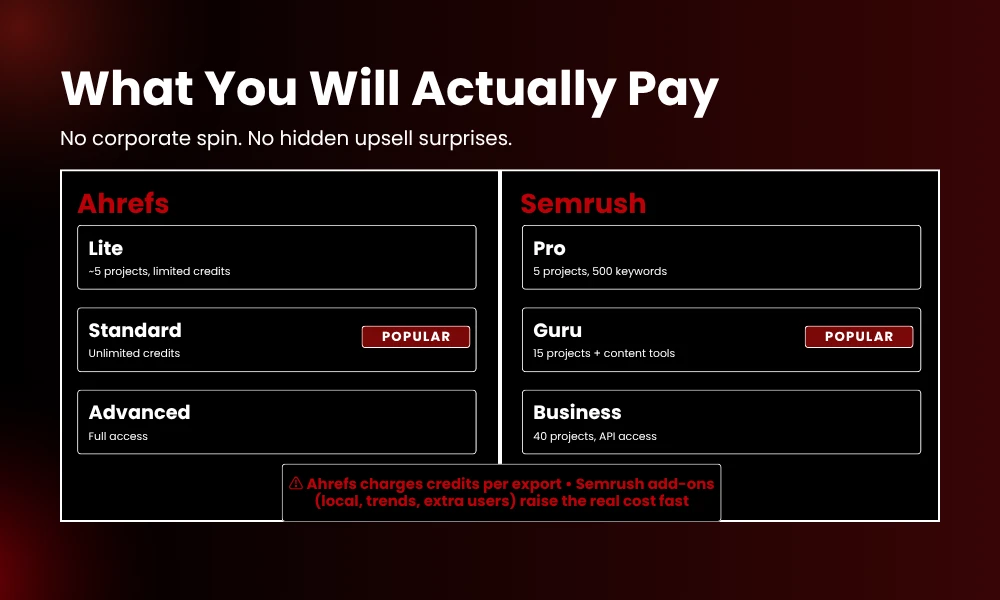
Ahrefs Lite is $129 a month. Standard is $249. Advanced is $449. The credit limits on Lite will start bothering you if you are researching multiple sites and exporting data regularly. Budget upward if that is your situation because running out of credits mid-month on a client project is its own kind of stressful.
Semrush Pro is $139. Guru is $249. Business is $499. The base plans include more projects than comparable Ahrefs plans. But the local SEO add-on costs extra. Trends data costs extra. More than two users costs extra. A team that actually uses the full platform can watch $139 become $280 or more before realizing what happened.
Solo operators on one or two personal sites can often stretch Ahrefs Lite if they are disciplined about credits. Agencies or teams covering multiple clients across SEO, content, and paid usually find Semrush Guru makes more financial sense once they add up what separate tools would cost.
The Short Version: Ahrefs vs Semrush
Ahrefs if SEO is your primary focus and you want the fastest cleanest tool for links and keywords without extra stuff weighing it down. It does not try to be a content calendar or a social monitoring platform. It tries to be excellent at SEO. For the most part it succeeds.
Semrush if you are running a full marketing operation and need one platform that connects everything. It is heavier. The learning curve is real. For teams that genuinely need all of what it offers, those are acceptable costs.
The Ahrefs vs Semrush argument will not end because both tools are legitimately good at different things. The right answer for you is whichever one you will open tomorrow without dreading it.
Questions That Come Up Constantly
Which one is easier for someone just starting out?
Ahrefs. Less to learn up front, cleaner layout, less chance of spending twenty minutes lost in the wrong section. Semrush is not impossible for beginners but most people need a few days before it starts feeling natural.
Which one has more accurate data?
Depends what you are measuring. Ahrefs backlink data and keyword difficulty are widely trusted by professionals. Semrush traffic estimates and paid search data are solid and often more detailed. Neither is accurate at everything.
Is running both at the same time worth it?
Some agencies do. Ahrefs for link work and quick keyword research, Semrush for content strategy and reporting. It is expensive and only makes sense if you are genuinely using both heavily enough to justify the cost.
Why does Ahrefs cost that much?
Maintaining a live backlink index that large is expensive infrastructure. The credit system also helps them manage server load. Some users feel the price is justified by data quality. Others feel the credit limits make it hard to use freely at that price point. Both reactions are fair.
Free trial options?
Semrush typically offers a trial or a limited free version. Ahrefs generally does not, though short promotions show up occasionally. Check both sites directly because the offers change.
Local SEO specifically?
Semrush. Their dedicated local toolkit with listing management and local rank tracking was built specifically for that use case. Ahrefs can track local keywords but does not have a purpose-built local solution the way Semrush does.
Last Thing for Ahrefs vs Semrush
The Ahrefs vs Semrush decision is not complicated once you stop trying to find the objectively better tool and start asking which one fits your actual day.
Watch tutorials from real practitioners, not brand content. Run the trials with real projects, not fake test accounts. And pick based on what you will genuinely use, because the most sophisticated tool in the world does nothing sitting unclicked in a browser tab.