Let me be upfront: I’ve used both of these tools extensively, and I have opinions. Ahrefs vs SE Ranking isn’t a clear-cut contest, it depends almost entirely on what you’re trying to do and what you’re willing to spend. This breakdown covers everything from backlink data to pricing to the features most comparison articles quietly skip over.
If you’re expecting me to declare one tool “the best SEO software”, that’s not happening here. What I will do is give you enough real information to make the right call for your situation.
What Each Tool Is Actually Built For
Ahrefs
Ahrefs has been around since 2010 and built its name on one thing: backlinks. Over time it turned into a proper full-suite platform, but the link intelligence piece is still where it genuinely outperforms almost everything else on the market. Big brands use it — Shopify, HubSpot, LinkedIn. That’s not coincidental. When you’re managing SEO at scale, across hundreds of thousands of pages, Ahrefs earns its keep.
The tool is built for people who are already comfortable with SEO concepts. You won’t find much hand-holding, and honestly that’s fine — the depth is the point.
SE Ranking
SE Ranking launched in 2013 as a rank tracking tool and has since grown into something considerably more capable than most people realize. The pricing is the obvious differentiator — you can get a genuinely solid SEO stack for what you’d spend on a few client lunches — but what keeps people around is that the data quality has improved dramatically in recent years.
In the Ahrefs vs SE Ranking debate, SE Ranking tends to win on approachability. Faster to learn, easier to navigate, and the reporting layer is built with client delivery in mind from the start.
Backlink Data: Not Even Close
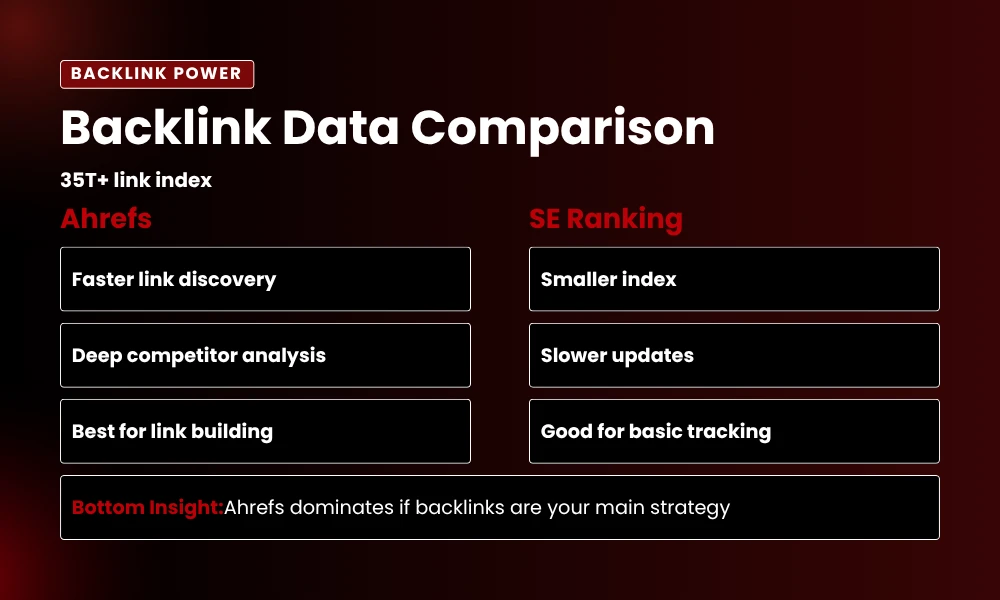
There’s no version of the Ahrefs vs SE Ranking conversation where SE Ranking wins on backlinks. Ahrefs crawls the web at a scale most competitors can’t match — more than 35 trillion links in its index, updated constantly. When a new link goes live pointing to one of your pages, Ahrefs typically picks it up within days rather than weeks.
The Site Explorer tool is genuinely excellent. Anchor text distribution, referring domain trends, broken link discovery, historical link data — it’s all there, and it’s fast. For competitive link analysis, it’s the tool I’d reach for first every time.
SE Ranking’s backlink module has gotten better. For tracking your own link profile or doing a basic competitor audit, it does the job. But if you’re doing serious prospecting work — finding DR 70+ opportunities in a competitive niche, analyzing link velocity patterns, building disavow files — SE Ranking will leave you wanting more. That’s just the reality.
Keyword Research: Better Than You’d Expect From Both
What Ahrefs Does Well Here
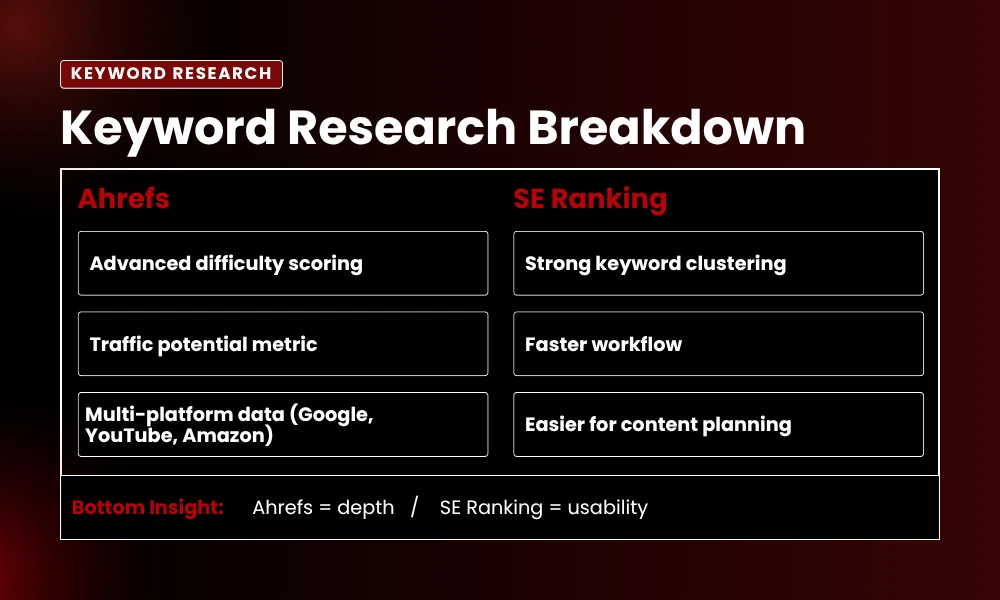
The Keyword Explorer in Ahrefs pulls data across Google, Bing, YouTube, and Amazon, which matters more than people give it credit for. The Keyword Difficulty score is calculated from actual backlink profiles of ranking pages — not a simplified formula — so it’s more reliable for making actual decisions about what to target. Traffic Potential is a genuinely useful metric that most tools don’t offer: instead of just showing volume for the target keyword, it shows the total traffic a ranking page typically gets across all the terms it ranks for.
For large content operations doing topical mapping, the parent topic feature and keyword clustering save a significant amount of time.
Where SE Ranking Holds Its Own
SE Ranking’s keyword tool is not a watered-down alternative. The data is solid, the interface is faster for quick research sessions, and the Keyword Grouper is one of the better semantic clustering tools available at any price point. If you’re planning a pillar page strategy or mapping content clusters across a site, that feature specifically is worth paying attention to.
The competitive gap analysis is also strong — comparing two domains side-by-side to find keyword opportunities your competitor is capturing that you’re not is intuitive and actionable. In this part of the Ahrefs vs SE Ranking comparison, the gap is much narrower than most people assume.
Quick Feature Comparison
| Feature | Ahrefs | SE Ranking |
| Backlink Index | 35T+ links — industry benchmark | Solid; smaller but reliable |
| Keyword Research | Deep global data, Traffic Potential metric | Strong with semantic grouping |
| Rank Tracking | Daily updates on paid plans | Daily + hourly; granular location |
| Site Audit | 100+ checks, JS rendering supported | Thorough; beginner-friendly UI |
| Content Tools | Content Explorer + AI writing | Content Editor with real-time scoring |
| White-Label Reports | Not available | Yes — higher tier plans |
| Local SEO | Basic SERP location data | Dedicated local rank tracking |
| Starting Price | ~$129/month | ~$52/month |
| Best Fit | Advanced SEOs, large agencies | SMBs, freelancers, growing teams |
Rank Tracking: SE Ranking Was Built For This
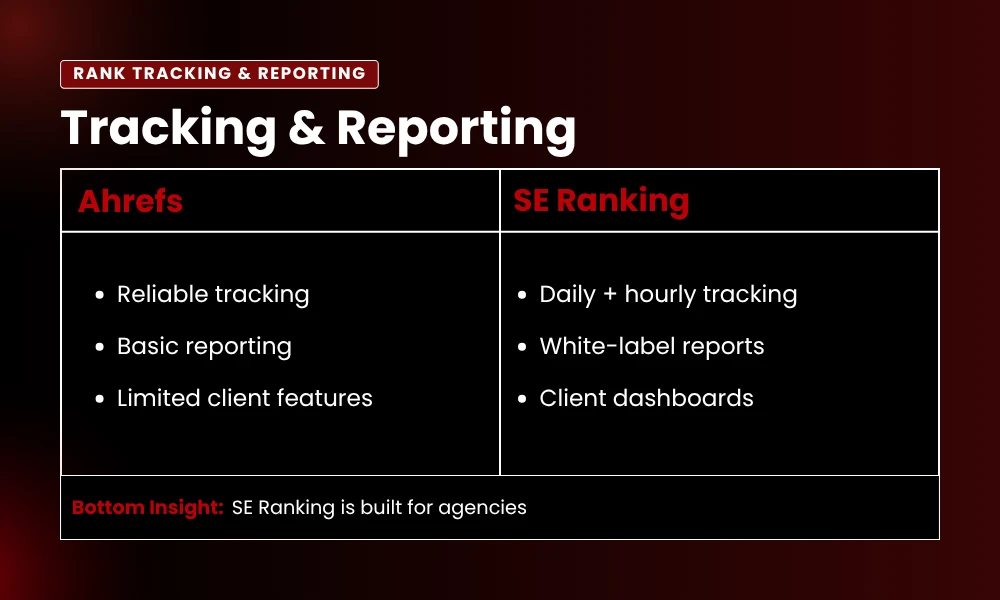
Rank tracking is where SE Ranking started, and it still shows. Daily updates are standard. Hourly tracking is available on higher plans, which matters if you’re monitoring volatile SERPs or running tests. You can segment by device, location, and search engine without needing to jump through hoops.
What really separates SE Ranking in this category is the reporting. The rank tracking reports are clean, exportable, white-labelable, and genuinely something you can send to a client without embarrassment. That’s a specific, practical thing that agencies care about.
Ahrefs does offer rank tracking and the data is reliable. It’s just not where the product’s development attention has gone. If daily rank monitoring and structured client reporting are your primary workflow, SE Ranking wins this one clearly. In the broader Ahrefs vs SE Ranking picture, this is one of the few categories where SE Ranking isn’t just “close” — it’s better.
Site Auditing: Both Are Solid, Different Audiences
Ahrefs Site Audit
More than 100 checks, JavaScript rendering support, historical crawl comparisons — it’s a serious audit tool. The issue prioritization is well-designed, and the crawl data you get access to is genuinely deep. For technical SEOs who know what they’re looking at, this is a powerful environment to work in.
SE Ranking Website Audit
SE Ranking’s audit surfaces the same categories of issues but explains them in plain language. That might sound like a minor thing, but for agencies where a client or junior team member needs to understand a report, it makes a real difference. Issue tracking over time is also well-implemented — you can see whether things are improving or regressing between crawl cycles, which is how auditing actually works in practice.
Content Tools: Two Different Philosophies
Ahrefs Content Explorer is a research machine. Search across billions of published pages, filter by traffic, referring domains, publication date, social traction — it’s the tool I’d use to understand what content is winning in a niche and why. For content strategists and link builders who need to understand the existing landscape before creating anything, it’s hard to replace.
SE Ranking’s Content Editor takes a different angle. It scores your content in real time against top-ranking pages, suggesting related terms, flagging gaps in topical coverage, and indicating target word counts based on what’s actually ranking. For writers and content managers who want in-platform guidance while they work, it’s a more practical day-to-day tool than what Ahrefs offers at the content creation stage.
Neither approach is wrong — they serve different parts of the content workflow. In the Ahrefs vs SE Ranking matchup on content tooling, it depends entirely on whether your priority is research or production.
Pricing: The Elephant in the Room
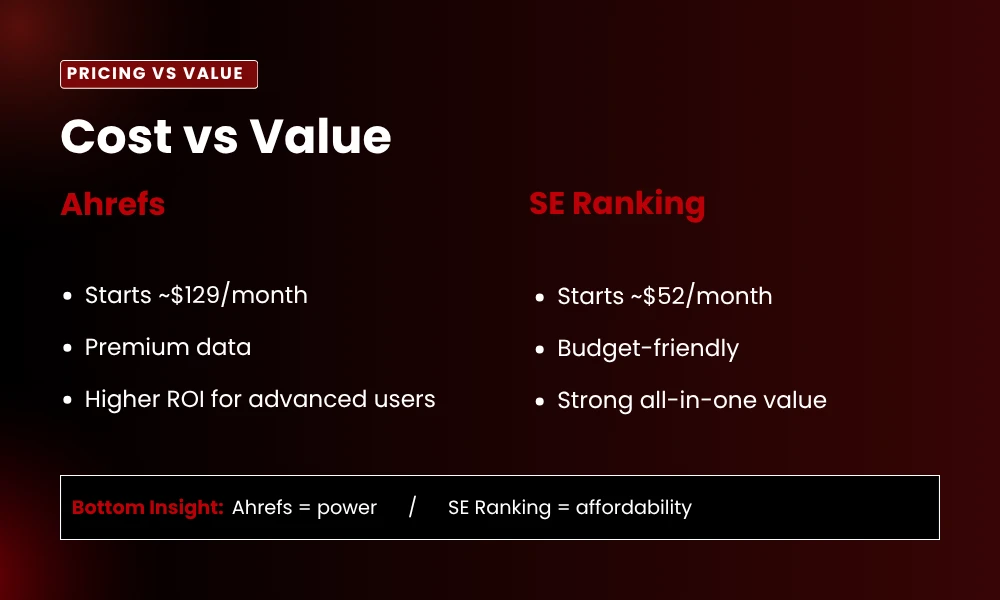
Ahrefs starts at around $129 a month. SE Ranking starts at around $52. That’s a meaningful difference in absolute terms, and for a solo practitioner or small agency still figuring out margins, it’s not an abstract distinction.
Before you just go with the cheaper option, though — consider usage. An agency running Ahrefs hard across fifteen client accounts, running Content Explorer daily, and doing deep competitor research is probably getting more value per dollar than a solo freelancer tracking twenty keywords a week. Pricing and value aren’t the same calculation.
That said, the Ahrefs vs SE Ranking pricing gap is real, and for buyers where budget is a genuine constraint, SE Ranking at its price point is one of the strongest value propositions in SEO software. You’re not settling — you’re making a smart allocation decision.
Learning Curve and Day-to-Day Usability
Ahrefs has improved its UI significantly over the years. It’s cleaner than it used to be. But the depth of the tool means there’s still a real learning curve for anyone new to it. Understanding how to interpret all the data correctly — when Keyword Difficulty is vs. isn’t a reliable signal, how to read a link velocity chart, how to set up Content Explorer searches that actually surface useful results — takes time.
SE Ranking onboards people faster. The interface is more forgiving, the tooltips are better, the help documentation is written for a wider audience. A new hire can be producing useful work in SE Ranking within a few days. With Ahrefs, expect a few weeks before someone is genuinely productive across all the features.
For teams with high turnover or multiple people sharing access, that onboarding gap matters operationally.
Agency Features: SE Ranking Is Built For This, Ahrefs Isn’t
White-label PDF reports. Client-specific dashboards with custom branding. A Lead Generator widget you can embed on your own website so prospects can run a site audit and immediately see the value you’re offering. These are SE Ranking features. Ahrefs doesn’t have them.
If you’re running a client-facing SEO business, this is a significant practical difference. Ahrefs is excellent as an internal research tool inside an agency — many shops use it exactly that way. But if you’re asking which platform is built around agency delivery workflows, SE Ranking wins that comparison without much of a contest.
Local SEO: An Underrated Difference
Local SEO is increasingly a major slice of the market, and the two platforms have invested in it very differently.
SE Ranking’s local rank tracking goes granular — city level, neighborhood level if needed — and the Google Business Profile integration is a genuine workflow feature, not an afterthought. For agencies with a roster of local business clients, that specificity matters.
Ahrefs captures local SERP data within its rank tracker but doesn’t have dedicated local SEO tooling. It’s not where their development roadmap has focused. For local-heavy work, SE Ranking is the more purpose-built platform in this Ahrefs vs SE Ranking comparison.
Data Accuracy: Different Strengths
Both tools estimate keyword volumes using clickstream data and search engine sampling — so neither gives you exact numbers, and neither should claim to. Ahrefs is generally considered to have more reliable volume estimates in competitive, high-traffic niches. It’s been the benchmark long enough that most experienced SEOs calibrate their expectations against it.
SE Ranking’s trump card here is the direct Google Search Console and Analytics integration. When you connect your own properties, you get first-party data layered into the platform — something no third-party crawler can replicate. For performance reporting on your own sites, that hybrid view is more accurate than anything Ahrefs can produce from its crawl data alone.
The Actual Verdict
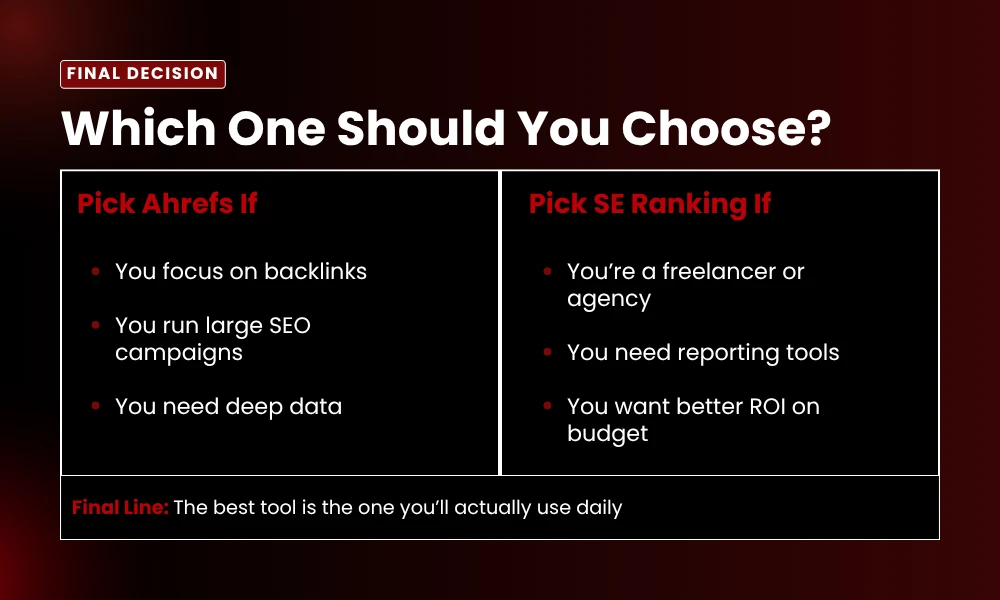
Pick Ahrefs if: you’re an experienced SEO working on large, complex, competitive sites and your work lives inside backlink analysis, keyword research at scale, and Content Explorer. The investment is real, but so is the ROI when you’re extracting full value from it.
Pick SE Ranking if: you’re a freelancer, small agency, or growing team that needs a complete, reliable SEO platform that doesn’t require a finance conversation to justify. The rank tracking is better. The agency reporting is better. The onboarding is faster. And for most practical use cases — including keyword research, auditing, and rank monitoring — the data holds up.
Both offer trial periods. The honest recommendation is to spend a week with each doing your actual work, not demo tasks, and see which one you want to open every morning.
Frequently Asked Questions
Is Ahrefs worth the higher price compared to SE Ranking?
For high-volume agencies and experienced SEOs who use the backlink data and Content Explorer daily — yes, absolutely. For freelancers and smaller teams, SE Ranking covers most of the same ground at a third of the cost. The right answer depends on how intensively you’ll actually use the power features.
Which has more accurate keyword data?
Ahrefs has a slight edge on keyword volume accuracy in competitive niches based on most practitioner consensus. SE Ranking’s advantage is the Google Search Console integration, which layers in first-party data for your own verified properties — something no third-party tool can fully replicate.
Can SE Ranking fully replace Ahrefs for backlink work?
For general link monitoring, basic competitor checks, and keeping an eye on your own profile — yes, SE Ranking handles that fine. For serious link prospecting, deep competitive analysis, and disavow file management in highly competitive niches, Ahrefs’ significantly larger and fresher index is hard to swap out.
Which is better for agencies?
SE Ranking, without much debate. White-label reporting, branded client dashboards, the Lead Generator widget, and flexible client-based pricing are all agency-specific features. Ahrefs is excellent as an internal research tool inside an agency, but it’s not built around client delivery workflows the way SE Ranking is.
Does SE Ranking offer a free trial?
Yes — 14 days, no credit card required. Ahrefs has a free tier called Ahrefs Webmaster Tools that gives you access to some features for verified websites, but a full platform trial requires a paid subscription.
Bottom Line
The Ahrefs vs SE Ranking debate has gotten more interesting as SE Ranking has matured. A few years ago this would have been a shorter article. Today, SE Ranking is a legitimate platform that serious SEOs use as their primary tool — not a budget compromise. And Ahrefs remains the benchmark for data depth that most tools measure themselves against.
Use this guide as a starting point. Then test them yourself. The right tool is the one that fits the way you actually work, not the one with the most impressive feature list on paper.