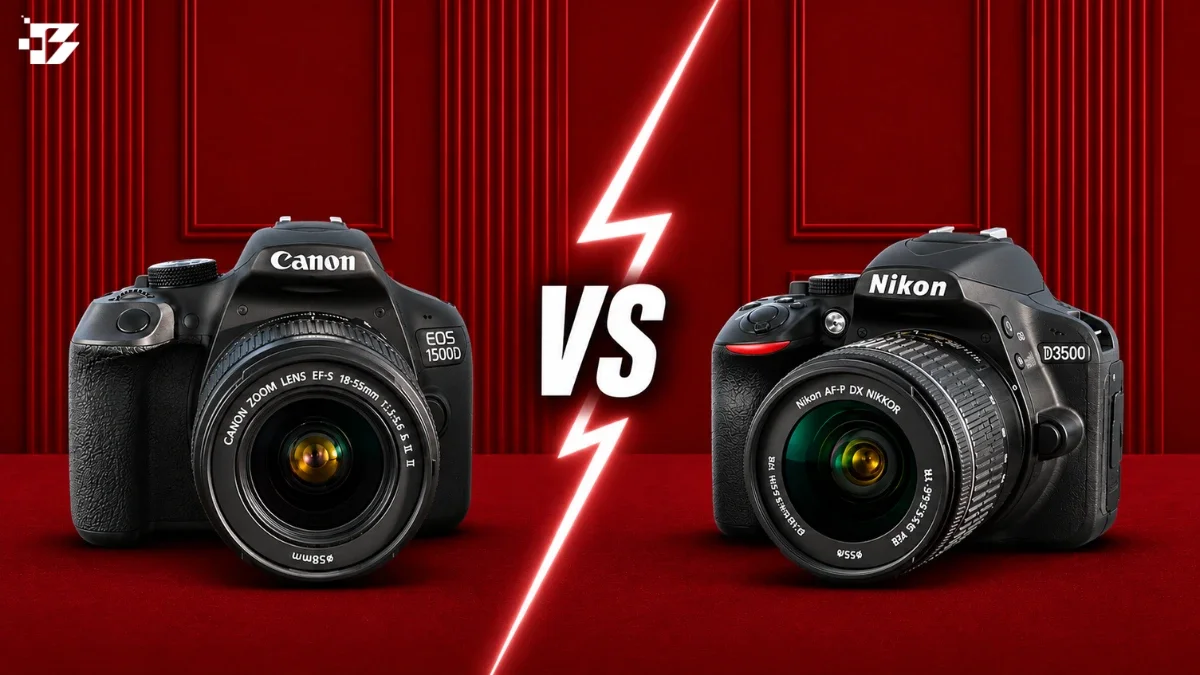
Canon Vs Nikon: Here is the fact that breaks every camera argument on the internet: Canon and Nikon were not born rivals. They were partners. The first Canon cameras of the 1930s shipped with Nikon lenses on the front, because Canon could not make its own glass.
The two companies then spent the better part of a century trying to bury each other, and every camera you have ever touched carries the scars. Autofocus motors inside lenses, affordable full frame sensors, clean high ISO files: all of it exists because one of these companies humiliated the other and forced a response.
This is the full story of photography’s greatest rivalry, and where it stands in 2026.
Key Takeaways
- Nikon was founded in 1917 as an optics maker. Canon arrived in 1933 as a camera maker that could not make lenses, so it bought them from Nikon until the late 1940s.
- The Nikon F, launched in 1959, made Nikon the undisputed choice of professional photographers for two decades.
- Canon answered by ignoring the pros and winning everyone else: the 1976 AE-1, the first microprocessor camera, sold in the millions.
- Canon’s all-or-nothing EF mount bet in 1987 pulled professionals away from Nikon through the 1990s. Nikon’s D3 answered in 2007 with low light performance that embarrassed the entire industry.
- In 2025, Canon shipped roughly 41% of the world’s interchangeable-lens cameras, more than every other manufacturer combined. Nikon holds about 11% and turns a profit on every camera it sells.
- The war’s latest chapter is survival itself: DSLRs fell to 691,000 units in 2025 against 6.3 million mirrorless cameras, and both companies are fighting for a market that smartphones already shrank.
Canon Vs Nikon: 1917 And 1933: An Optics Company And A Camera Company
Nikon came first, and it did not start with cameras. On July 25, 1917, backed by Mitsubishi president Koyata Iwasaki, three Japanese optical companies merged into Nippon Kogaku, the Japan Optical Industries Corporation. It made lenses, binoculars, microscopes and rifle scopes. Precision glass for a nation that did not want to import it.
Canon started sixteen years later in a Tokyo laboratory, and it started scrappy. In 1933, Goro Yoshida, his brother-in-law Saburo Uchida and Takeo Maeda set out to reverse-engineer the expensive German Leica cameras of the day and build something ordinary people could afford. Yoshida was a devout Buddhist, so he named his 1934 prototype Kwanon, after Kannon, the thousand-armed goddess of mercy. The original logo was literally the deity. For export, the name softened to Canon in 1935, and the company incorporated as Precision Optical Industry Co. in 1937.
Now the detail that makes this rivalry delicious. Canon could design a camera body, but it could not make a lens worth mounting on it. So Nippon Kogaku supplied the optics. Nikkor lenses sat on Canon’s earliest cameras, including the 1936 Hansa Canon, and the arrangement ran into the late 1940s. The two giants of Japanese photography spent their formative years leaning on each other, which makes everything that followed feel like a family feud. Because it is one.
The Nikon F: Twenty Years Of Owning The Professionals
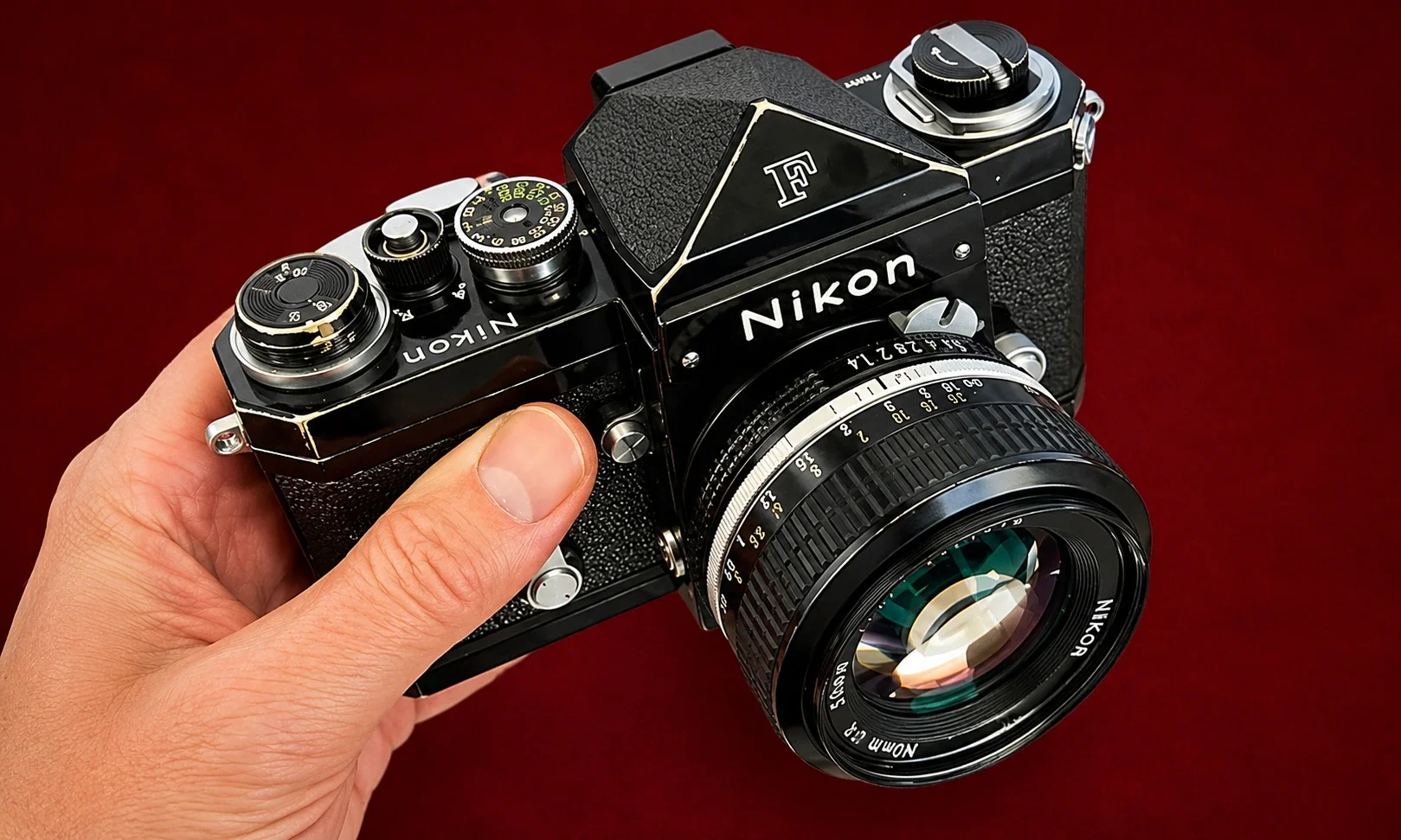
In 1959, Nikon released the Nikon F, and for the next two decades the argument was over.
The F was not the first single-lens reflex camera, but it was the first one that survived professional use. It was modular, brutal in its reliability, and backed by a lens system that covered everything a working photographer could need. When you look at photographs from Vietnam, from the moon landings’ press pools, from any 1960s or 70s news event, you are mostly looking at pictures made with Nikon F cameras. A Nikon rangefinder from the company’s earliest camera years sold at auction in 2016 for $406,000, which tells you what that legacy is worth to collectors.
Nikon owned the professional market so completely that Canon faced a choice: fight Nikon for the same small pool of press photographers, or go around them. Canon went around.
Canon’s Flank Attack: The AE-1 And The Microprocessor
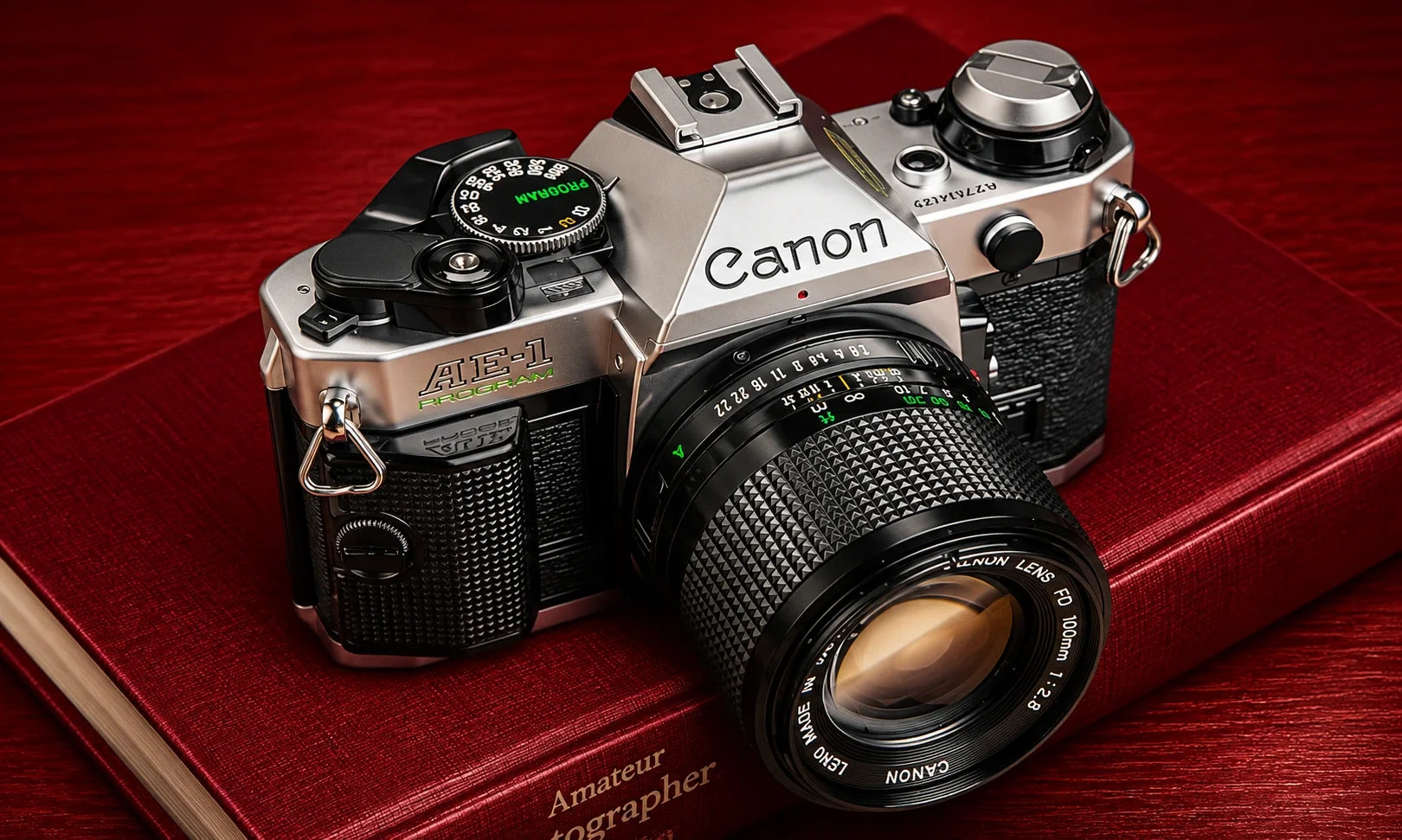
In 1976, Canon launched the AE-1, and it was a declaration of a completely different strategy.
The AE-1 was the first 35mm SLR built around a microprocessor. That chip let Canon strip roughly 300 parts out of the camera, automate the factory, and sell a genuinely capable automatic-exposure SLR at a price ordinary families could pay. Then Canon did something the camera industry had never seen: it advertised on television, at scale, treating a serious camera like a consumer product instead of a specialist’s instrument.
The AE-1 and its A-series siblings sold in the millions and became some of the best-selling SLRs ever made. Nikon kept the professionals. Canon quietly took everyone else, and everyone else turned out to be the bigger pile of money. That philosophy, chase the many rather than the few, has defined Canon for fifty years. It is why Canon’s lineup has always stretched from cheap Rebels to flagship bodies, while Nikon’s identity stayed welded to the working photographer.
1987: Canon Bets The Company
The boldest move of the entire war came in 1987. Canon abandoned its FD lens mount entirely and launched the EF mount: fully electronic, no mechanical linkages, with the autofocus motor moved inside the lens itself.
It was a genuine bet-the-company decision. Canon told its entire customer base that their existing lenses were now legacy, and asked them to trust the new system. Nikon made the opposite call, preserving its F-mount compatibility back to 1959, which photographers praised and engineers quietly suffered under, because a mount designed in 1959 constrained every autofocus design after it.
Canon was right. In-lens motors focused faster and quieter, the EF system scaled beautifully, and through the early 1990s professional photographers, the ones Nikon had owned for three decades, began switching to Canon in numbers that still sting in Tokyo. The white Canon telephoto lenses on sports sidelines became the visible proof that the crown had moved.
2007: Nikon’s Revenge, Served In The Dark
Nikon spent the 1990s and early 2000s absorbing body blows: Canon’s autofocus advantage, Canon’s full frame 5D in 2005 at a price that undercut everyone, Canon’s 5D Mark II in 2008 accidentally inventing the DSLR filmmaking revolution.
Then in 2007, Nikon shipped the D3, and the industry flinched.
The D3’s high ISO performance was not incrementally better. It was a different category of better. Photographers were shooting weddings by candlelight and indoor sports under terrible arena lighting, and getting files that looked clean. Overnight, “Nikon is better in the dark” became the conventional wisdom, Canon shooters quietly checked resale values, and Nikon proved it could still land punches that changed the conversation.
This is the pattern that matters: every era of this war produced a humiliation, and every humiliation produced a leap. The motor inside your lens, the affordable full frame sensor, the clean high ISO file. None of it happens without the other company existing.
Canon Vs Nikon: The Mirrorless Reckoning both Giants Late to Their Own Party
The cruelest chapter is that neither company won the next era on merit. Sony did.
While Canon and Nikon defended their DSLR duopoly, Sony’s mirrorless cameras ate the future, and by the time both giants launched their mirrorless systems in 2018, Sony owned the category. The duopoly’s response was real but reactive: Canon’s R system and Nikon’s Z system both arrived with excellent hardware and a decade of catch-up to run on lenses.
The 2025 numbers show how it settled. Canon shipped about 2.88 million interchangeable-lens cameras, roughly 41% of the global market, more than Sony, Nikon, Fujifilm, Panasonic and every smaller brand combined, according to manufacturer filings reconciled against CIPA industry data. It was Canon’s 23rd consecutive year at number one. Sony holds around 28%. Nikon sits near 11%, but here is the part the share-obsessed miss: Nikon restructured itself to turn a profit on every camera and a fat margin on every lens, and it is financially healthier at 11% than it was at twice that. The Z6 III, Z8 and the Z5II, which grabbed a third of Japanese full frame sales the month it launched, are the products of that discipline.
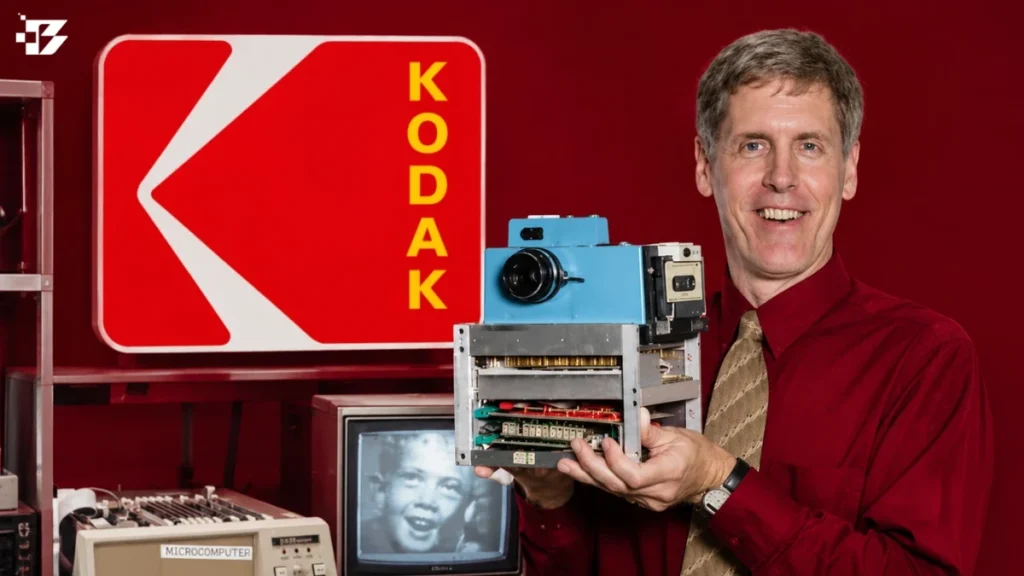
Meanwhile the format they fought over for eighty years is gone. DSLRs fell to 691,000 units worldwide in 2025, down 31% in a single year, against 6.3 million mirrorless bodies. Nikon has effectively exited DSLRs. The F-mount era, the one that started with the Nikon F in 1959, is functionally over. We documented what this kind of transition does to companies that miss it in our file on the biggest tech brand failures: Kodak invented the digital camera and still lost. Canon and Nikon did something rarer. They were late, they were humbled, and they survived anyway.
The War In One Table
| Year | Shot Fired | Winner of the Era |
|---|---|---|
| 1917 | Nikon is founded as Nippon Kogaku in Japan. | Nikon (only player) |
| 1933–37 | Canon is founded and initially ships cameras with Nikkor lenses. | Partnership |
| 1959 | Nikon F launches and establishes Nikon as a professional photography leader. | Nikon (for nearly 20 years) |
| 1976 | Canon AE-1 brings microprocessor-controlled photography to the masses. | Canon wins the masses |
| 1987 | Canon’s EF mount makes a bold autofocus bet. | Canon takes the professionals |
| 2005 | Canon EOS 5D makes full-frame digital photography more accessible. | Canon |
| 2007 | Nikon D3 delivers exceptional low-light performance. | Nikon |
| 2018 | Canon and Nikon enter the full-frame mirrorless market, years after Sony. | Sony leads the era |
| 2025 | Canon holds approximately 41% market share, while Nikon holds around 11%. | Canon on volume; both remain competitive |
So Which Brand Should You Buy In 2026?
The honest professional answer: the war no longer decides this, because both companies make superb cameras and the differences are now about systems, not quality.
Canon leads in stabilization, autofocus stickiness, and the deepest full frame lineup from $500 to $7,000, with the trade-off that RF lenses run expensive and third party options are limited. Nikon counters with the best viewfinders in the business, aggressive value at every tier, and the Z8, which might be the best camera-per-dollar in the professional class. If you shoot their color science, you will never leave. For everyone starting fresh, the deciding factor is the same one we stress in every camera guide: price the lenses, not the body, because you will own the glass long after the body is obsolete.
And keep one eye on the actual disruptor. The device killing the entry-level market for both companies is in your pocket, which our best camera phones of 2026 guide covers in detail. Canon and Nikon survived each other for eighty years. Surviving the smartphone is the war that counts now. Brand wars this durable are rare; the only one we have covered at this depth is Coca-Cola vs Pepsi, and the pattern is identical: the rivalry itself became the marketing.
Frequently Asked Questions
Is Canon or Nikon older?
Nikon. It was founded in 1917 as Nippon Kogaku, an optics company. Canon began in 1933 as a camera laboratory and incorporated in 1937. Canon’s earliest cameras actually used Nikon’s Nikkor lenses because Canon could not yet make its own glass.
Which sells more cameras, Canon or Nikon?
Canon, decisively. In 2025 Canon shipped roughly 2.88 million interchangeable-lens cameras, about 41% of the global market, more than all other brands combined. Nikon holds approximately 11% but is profitable on every camera it sells.
Why did professionals switch from Nikon to Canon in the 1990s?
Canon’s 1987 EF mount put the autofocus motor inside the lens, making focusing faster and quieter. Nikon’s choice to keep its 1959 F-mount preserved compatibility but constrained autofocus design. Sports and press photographers switched for the speed, and the white Canon lenses on sidelines became the symbol of the shift.
Are Canon and Nikon still making DSLRs?
Effectively no. Global DSLR shipments fell to 691,000 units in 2025, down 31% year over year, against 6.3 million mirrorless cameras. Nikon has exited the format and both companies now develop only mirrorless systems.
Which is better for beginners, Canon or Nikon?
Both are excellent. Canon’s R50 is the easiest entry point and topped Japanese mirrorless sales charts, while Nikon’s Z50 II and Z5II offer more camera for the money. Choose whichever system’s lens prices fit your budget.
The Bottom Line
Canon and Nikon spent eighty years proving that a great rival is worth more than a great plan. Nikon’s professional perfectionism forced Canon to democratize the camera. Canon’s mass-market machines forced Nikon to rediscover its soul. Sony’s ambush forced them both to evolve or join Kodak.
They started as partners in a Tokyo workshop, spent a century at war, and end up in the same place: two of the last companies standing in an industry the smartphone tried to delete. The war goes on. Your camera bag is the winner.