

Running a retail business in New York means competing in one of the most demanding and fast-moving markets in the world. Customers expect speed, clarity, security, and convenience all from the moment they land on your site. That’s exactly why having a properly built ecommerce website NY retailers can rely on is no longer optional. It’s a core business asset.
This guide breaks down a complete, practical, and conversion-focused eCommerce website checklist specifically tailored for New York retailers. Whether you’re launching a new store or improving an existing one, this checklist ensures your website is built to attract traffic, convert visitors, and scale profitably.
Why Retailers Need a Structured E-commerce Website NY Checklist
New York shoppers are digitally savvy, impatient with poor experiences, and quick to abandon websites that feel confusing or slow. At the same time, search engines are more selective than ever, rewarding websites that deliver clarity, usability, and technical excellence.
A ecommerce website NY checklist helps you avoid common mistakes such as:
- Overcomplicated navigation
- Weak product pages
- Slow site performance
- Confusing checkout flows
- Poor SEO foundations
More importantly, it ensures your ecommerce website is designed to sell, not just exist.
Website Foundations Every NY eCommerce Store Must Get Right
Before thinking about traffic or conversions, the technical and strategic foundation of your website must be solid.
Define Clear Business Goals
Every successful eCommerce website NY starts with clarity. You should know exactly what your website is meant to achieve. Are you focused on local NY customers, statewide shipping, or nationwide reach? Are you selling high-volume products or premium items?
These decisions influence everything from site structure to messaging and checkout design.
For many retailers, working with a specialized New York web design agency helps translate these business goals into a website structure that supports conversions, scalability, and long-term growth in a competitive local market.
Choose the Right eCommerce Platform
Your platform should match your current needs and future growth plans. Shopify works well for retailers who want speed and simplicity. WooCommerce offers flexibility for content-driven stores. Magento suits larger catalogs with complex operations.
The goal isn’t choosing the “best” platform, it’s choosing the right one for your business model.
Understanding the differences when choosing the right eCommerce platform helps NY retailers avoid technical limitations, performance issues, and costly migrations as the business grows.
Establish Strong Branding
Consistency builds trust. Your logo, typography, colors, and tone should remain uniform across every page. A strong brand presence instantly signals professionalism and credibility, which is critical in a competitive NY market.
SEO Essentials for eCommerce Website NY Businesses
Search visibility is what fuels long-term growth. Without SEO, even the best website struggles to attract consistent traffic.
Keyword Strategy and On-Page SEO
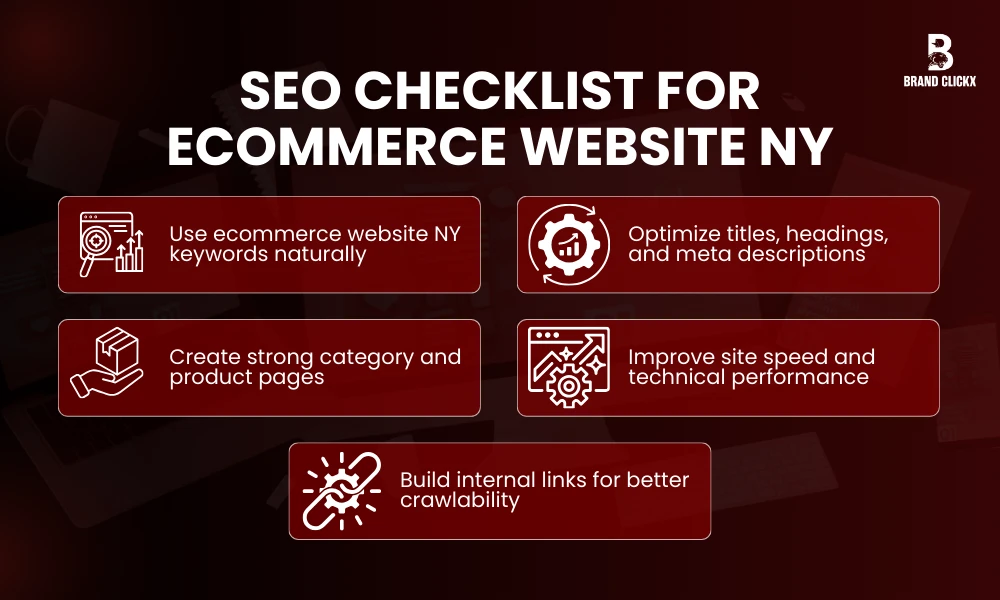
Your primary keyword, on the ecommerce website NY, should be used naturally across:
- Page titles
- Meta descriptions
- H1 and H2 headings
- Category and service pages
Beyond that, supporting keywords should reflect buyer intent, local relevance, and product-specific searches.
Applying proven on-page SEO best practices ensures search engines clearly understand your content while improving clarity and usability for real shoppers.
Technical SEO Setup
Your site should be technically easy for search engines to crawl and index. This includes clean URLs, proper internal linking, optimized images, and fast load times. XML sitemaps and structured data help search engines understand your content more effectively.
Ignoring technical SEO often leads to ranking issues, even when content quality is high.
For competitive regions, investing in technical SEO in New York helps ecommerce websites maintain crawl efficiency, fast performance, and strong search visibility.
User Experience Design That Converts NY Shoppers
Design isn’t about aesthetics alone. It’s about guiding users toward a purchase with minimal friction.
Strategic UX design for higher conversions focuses on reducing friction, guiding user behavior, and turning visits into completed purchases.
Homepage Structure That Makes an Immediate Impact
Your homepage should answer three questions instantly:
- Who are you?
- What do you sell?
- Why should customers trust you?
Clear headlines, featured categories, trust badges, and visible calls-to-action help users decide within seconds whether to stay or leave.
Intuitive Navigation and Menu Structure
If users can’t find what they want quickly, they leave. Simple category labels, logical product grouping, and breadcrumb navigation all reduce friction. For stores with large inventories, mega menus and clear subcategories work especially well.
Search and Filtering Features
Many users prefer searching over browsing. A powerful site search with auto-suggest, filters, and sorting options significantly improves usability and conversion rates, particularly for mobile users.
Product Pages That Actually Sell
Your product pages are the most important revenue-driving assets on your ecommerce website NY.
High-Quality Product Visuals
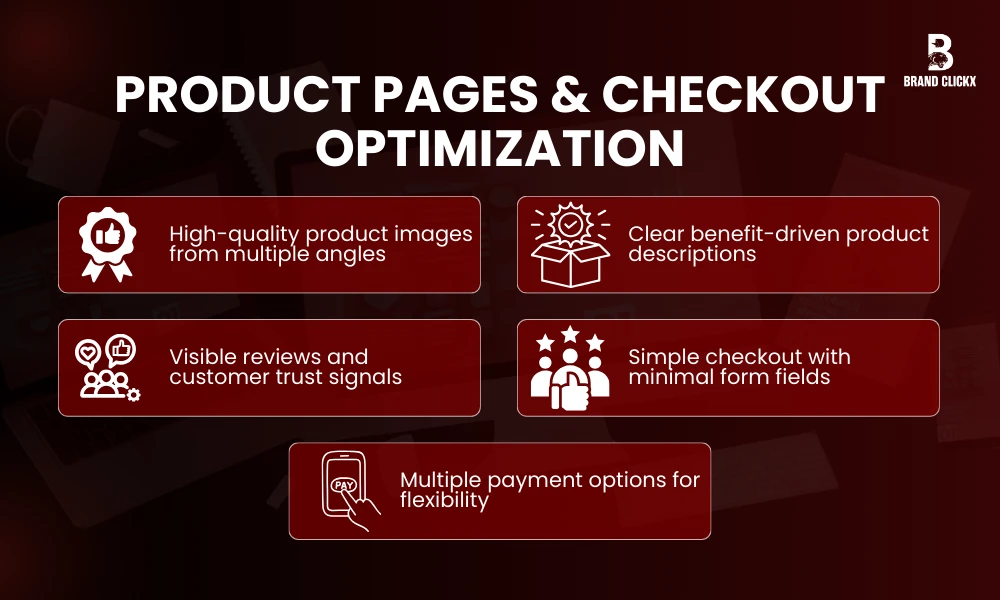
Clear, professional images build confidence. Multiple angles, zoom functionality, and lifestyle shots help customers visualize ownership. When possible, short product videos further increase engagement.
Benefit-Focused Product Descriptions
Instead of listing features, focus on outcomes. Explain how the product solves a problem, improves daily life, or offers value. Well-written descriptions reduce hesitation and increase purchase intent.
Reviews, Ratings, and Social Proof
Customer feedback builds trust faster than any sales copy. Display reviews prominently and encourage post-purchase feedback. For NY retailers, local testimonials can be especially powerful.
Checkout Optimization: Where Revenue Is Won or Lost
Cart abandonment is one of the biggest challenges in eCommerce, and checkout design plays a major role.
Simple, Transparent Checkout Flow
Your checkout process should be short, clear, and predictable. Avoid forcing account creation. Show shipping costs early. Reduce form fields wherever possible. The goal is to eliminate anything that slows the buyer down.
Optimized checkout page design prioritizes clarity, trust signals, and speed to reduce abandonment and increase completed orders.
Multiple Payment Options
Different customers prefer different payment methods. Offering credit cards, digital wallets, and buy-now-pay-later options increases completed purchases and reduces friction.
Clear Shipping and Return Policies
Customers want certainty. Shipping timelines, costs, and return policies should be easy to find and easy to understand. Confusion here leads directly to abandoned carts.
Security and Trust Signals for eCommerce Websites
Trust is non-negotiable in online retail.
SSL and Secure Transactions
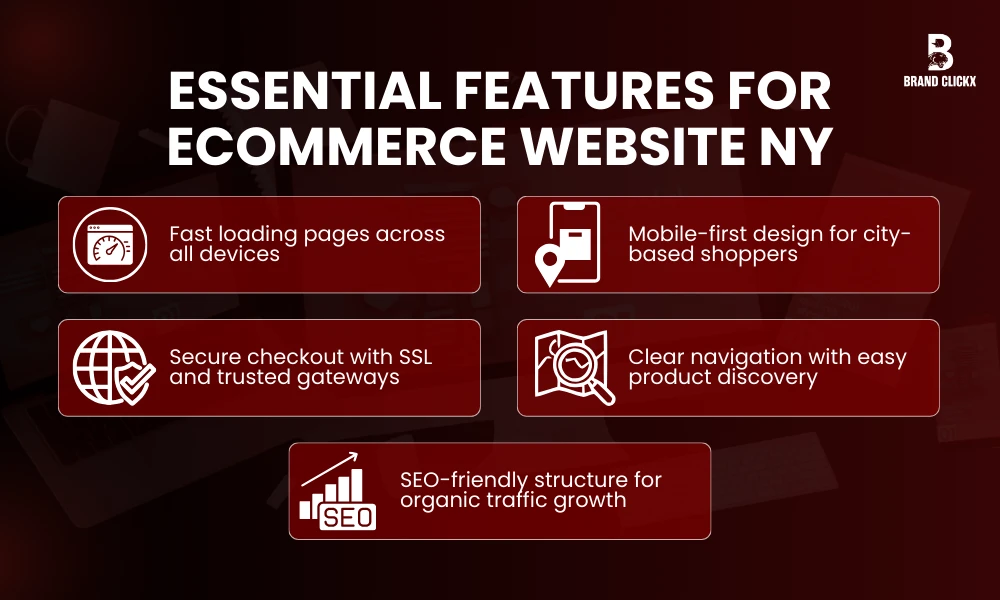
An SSL certificate protects customer data and signals credibility. Every page, not just checkout, should run on HTTPS. Search engines also consider security a ranking factor.
Privacy Policies and Compliance
Your website should clearly explain how customer data is collected, stored, and used. Transparency builds confidence, especially among privacy-conscious consumers.
Performance and Mobile Optimization
Most eCommerce traffic now comes from mobile devices, particularly in urban markets like New York.
Mobile-First Design
Your site must function flawlessly on smartphones and tablets. Buttons should be easy to tap, text readable without zooming, and navigation simple even on smaller screens.
Strong Core Web Vitals scores improve both search rankings and real user experience, especially for mobile-first NY shoppers.
Page Speed Optimization
Slow websites lose sales. Compress images, reduce unnecessary scripts, and use caching where possible. Faster load times improve both rankings and conversions.
Analytics, Tracking, and Continuous Improvement

An ecommerce website NY retailers rely on should never stay static.
Analytics Setup
Tracking tools allow you to understand how users interact with your site. You should monitor traffic sources, product performance, conversion rates, and drop-off points.
Ongoing Testing and Optimization
Small improvements add up. Testing headlines, layouts, product images, and calls-to-action helps you refine performance over time. Data-driven decisions consistently outperform guesswork.
Marketing Integrations That Drive Growth
Your website should integrate seamlessly with your marketing efforts.
Email Marketing Automation
Email remains one of the highest-ROI channels in eCommerce. Automated sequences for welcome emails, abandoned carts, and post-purchase follow-ups increase lifetime value without additional ad spend.
Social and Local Visibility
Connecting your store with social platforms and local listings increases reach and credibility. For NY retailers, local relevance often influences purchasing decisions more than price alone.
In addition to direct sales, strategic eCommerce lead generation helps retailers capture long-term value through email marketing, retargeting, and loyalty-building efforts.
Final Thoughts
Building a high-performing ecommerce website NY businesses can compete with requires more than a good design. It requires strategy, structure, optimization, and continuous refinement.
By following this checklist, you ensure your website:
- Attracts the right traffic
- Delivers a smooth user experience
- Builds trust and credibility
- Converts visitors into loyal customers
A strong eCommerce foundation doesn’t just support growth, it accelerates it.
Frequently Asked Questions
What makes an ecommerce website effective for NY retailers?
An effective ecommerce website for NY retailers focuses on speed, mobile usability, secure payments, and clear navigation. New York customers expect fast load times, transparent pricing, and a smooth checkout experience. Strong local SEO and trust signals also play a major role in driving conversions.
How much does it cost to build an ecommerce website in New York?
The cost of building an ecommerce website in NY varies based on complexity, platform, and features. Basic stores may start at a few thousand dollars, while fully customized ecommerce websites with advanced integrations, UX design, and SEO optimization can cost significantly more.
Why is local SEO important for ecommerce websites in NY?
Local SEO helps ecommerce websites in NY reach customers who are searching for products within their area. Optimizing for location-based keywords, Google Business profiles, and local content increases visibility, builds trust, and improves conversion rates among nearby shoppers.
What features should every ecommerce website NY businesses use have?
Every ecommerce website NY businesses rely on should include mobile responsiveness, fast loading speeds, secure checkout, clear product pages, multiple payment options, and customer reviews. These features directly impact usability, trust, and sales performance.
How can NY retailers reduce cart abandonment on their ecommerce website?
NY retailers can reduce cart abandonment by simplifying checkout, showing shipping costs early, offering guest checkout, and providing multiple payment options. Clear return policies and trust badges also help reassure buyers before completing a purchase.