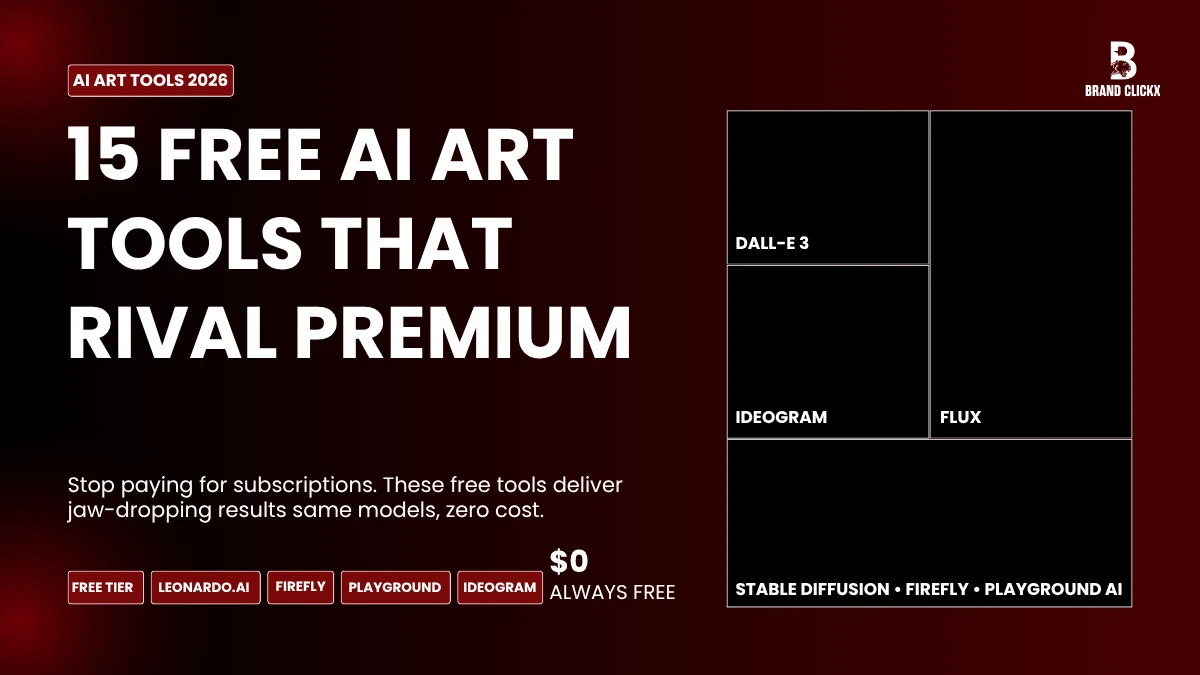
You open Instagram and see these jaw dropping digital portraits. Everyone in the comments is losing it asking what software the artist used. You already know. Midjourney, probably. Or Photoshop. Or something else that wants your credit card before you even figure out where the export button is.Here is what nobody really talks about free AI art tools.
You do not need a subscription to make art people stop scrolling for. I spent the last few months running through everything I could get my hands on, and the free options right now are genuinely ridiculous. Not “good for free.” Just good. Good enough that you might forget you are not paying.
You have probably run into the fake free stuff already. Trials that were actually demos with watermarks slapped on everything. Tools that gave you three images and then hit you with a paywall. Maybe you are just sick of having seven subscriptions bleeding your account every month for free AI art tools you use twice a week.
That is exactly why this list exists.
Why Free AI Art Tools Deserve Your Time
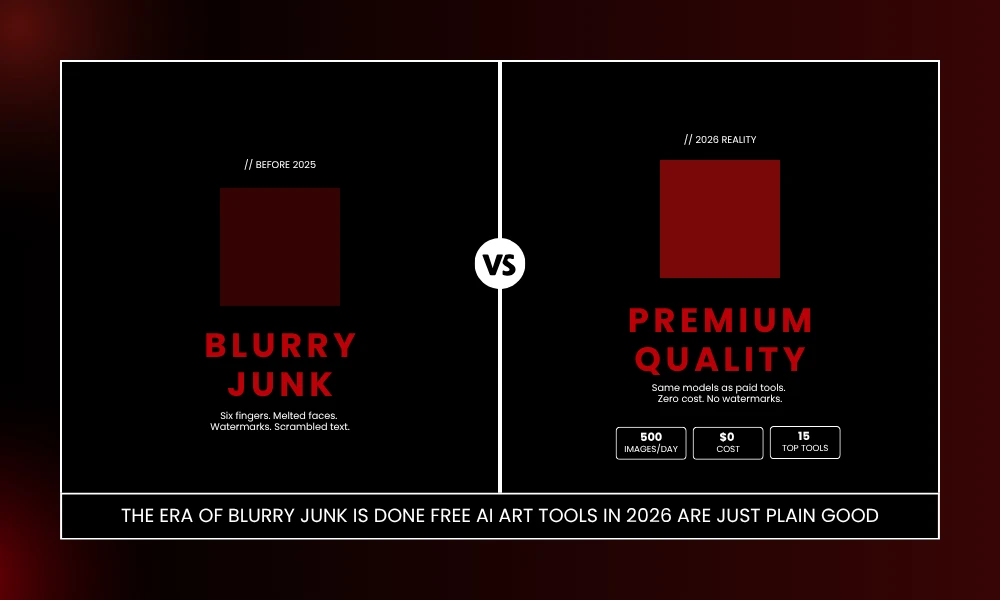
For a long time, free meant blurry junk. The text looked like scrambled alphabet soup. Hands had six fingers. Faces had that weird melted look. You know exactly what I mean.
That era is done. In 2026, a lot of these free tools are running on the same underlying models as the expensive ones. DALL-E 3. Flux. Custom models that go head to head with the big names. What you are usually giving up is speed and daily limits, not quality.
There is another thing worth mentioning. Free tiers are actually perfect for learning. You can burn through bad prompts, figure out what style you actually want, build out a portfolio, all before spending anything. Most people I know who do this professionally did not start by paying. They messed around first. Figured out what worked. Then upgraded once they knew what they were doing.
The real constraint now is not how good the output is. It is just how many images you can make per day.
The 15 Free Tools Actually Worth Using
I am going to be straight with you on each one. What it does well. Where it falls apart. How many free images you actually get without jumping through these free AI art tools.
1. Microsoft Designer (Bing Image Creator)
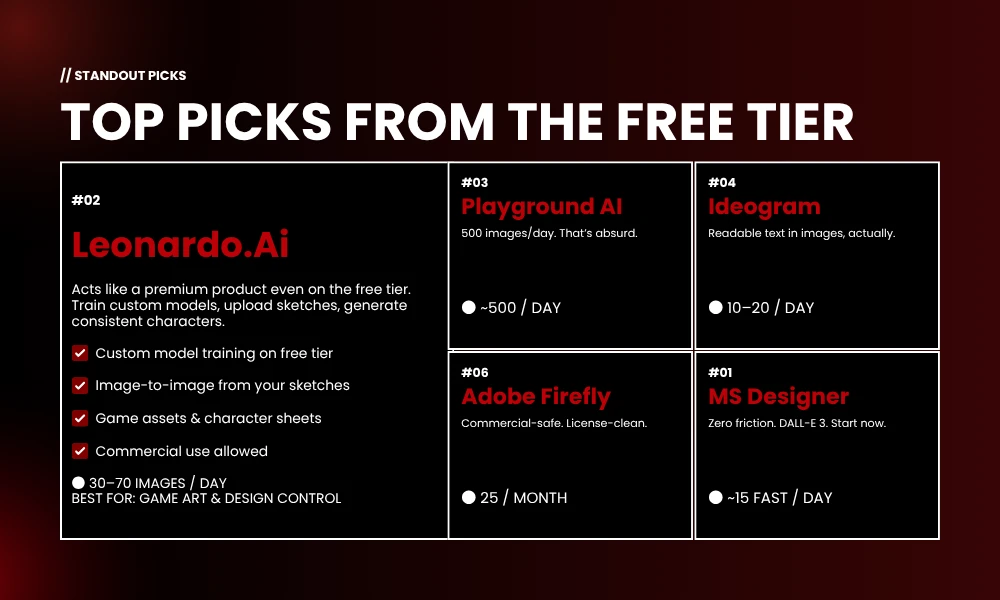
Easiest starting point on the list, by a wide margin. You log in with a Microsoft account, type what you want, DALL-E 3 does its thing. No downloads. No weird Discord server you have to join. No credit card.
Around 15 fast generations per day. After that it slows down but keeps working. The output is solid for general stuff — social posts, blog headers, rough concept work. It handles text better than most free tools, though not perfectly.
Best for: Anyone who wants something working in under five minutes with zero friction for free AI art tools.
2. Leonardo.Ai
This one acts like a premium product even on the free tier. You get 150 tokens daily, which shakes out to somewhere between 30 and 70 images depending on what settings you run. That is a lot.
The real appeal is control for free AI art tools. You can upload a sketch and direct the output from there. You can train your own models. Game assets, character sheets, concept work that actually stays consistent across generations. The catch is that free images are public by default. Do not sketch out your secret startup logo here unless you plan to upgrade later.
Best for: Artists and game developers who need actual control before they commit to paying.
3. Playground AI
If you need volume, this is your tool. The free plan gives you around 500 images per day. Which is absurd. That is a full mood board, fifty character variations, and still credits left over to make something stupid just for fun.
Clean interface. Image to image editing. Background removal. The photorealism dips a little on complex scenes but for illustration work and stylized output, the volume alone makes it worth using.
Best for: Rapid prototyping. Anyone who wants to iterate through ideas fast without hitting a wall every hour.
4. Ideogram
Getting readable text into an image is genuinely one of the hardest things for these tools. Most of them just spell things wrong or turn your carefully written sign into random characters. Ideogram actually tries to solve this, and it gets it right more often than not.
You get around 10 to 20 prompts per day free. There is a Magic Prompt feature that takes your rough idea and builds it into something more detailed automatically. Free images are public and downloads are JPG only. But for anything with words — posters, social graphics, signage — this is the one.
Best for: Typography, poster design, anything where the text actually has to be legible.
5. Canva
Canva is already where most non-designers live. Their image generator sits right inside the editor, so you make the image and drop it straight into your design. No exporting, no importing, no switching between four windows.
Free users get about 50 generations per month. The output is not going to compete with the dedicated generators. But the workflow is the whole point. You are not using Canva because the images are the best. You are using it because everything happens in one place.
Best for: Content creators and marketers who are already designing in Canva anyway.
6. Adobe Firefly
This is the safe choice, specifically because Adobe trained it on licensed content. You can actually use what you make for commercial work without spending an hour reading copyright forums afterward. That matters more than people realize.
Only about 25 generative credits per month though, so you cannot be reckless with it. The quality is professional. The integration with Photoshop and Illustrator is genuinely seamless if you already use those. The vector recoloring free AI art tools are a nice bonus.
Best for: Anyone who needs commercially clean output and already works inside Adobe products.
7. ChatGPT with GPT Image
Free users get maybe 2 to 3 images per day. That sounds almost insulting, and yeah, it is stingy. But the quality and the editing experience make those credits worth something.
The conversational editing is the real thing here. You tell it “make the jacket red” and it does. It does not regenerate the entire image. It edits the specific part you mentioned. That kind of targeted control is hard to find anywhere, free or paid.
Best for: Precision edits. Images where the text rendering actually needs to be correct.
8. Gemini with Imagen
Google folded Imagen into Gemini and the photorealism is strong. Prompt adherence is tight. There is even a feature that can translate text inside an image while preserving the original font style, which is a surprisingly useful thing to be able to do.
Free users get a generous daily allowance, but images come out with a small Gemini watermark. For drafts, internal work, or personal projects, that watermark is basically irrelevant. Easy to crop or edit out if it bothers you.
Best for: Photorealistic output and any project that involves multilingual text.
9. Recraft
Recraft is the only one on this list that actually outputs vector art. Real SVG files. Scalable icons. Logos that stay sharp when you blow them up to billboard size. That is a completely different category from everything else here.
Around 30 credits daily, roughly 25 standard images. Free tier is non commercial though, so you cannot sell the output without upgrading. For portfolio work, mockups, and personal projects, it is a designer’s best free option for free AI art tools.
Best for: Icons, logos, anything that needs to scale without turning into mush.
10. Flux (Open Source)
Flux from Black Forest Labs is open source. If you have a halfway decent GPU you can run it locally, forever, with no limits and no watermarks and no company logging what you generate.
The quality goes up against Midjourney and does not embarrass itself. Text handling is solid. The catch is that you need a GPU with at least 12GB of VRAM and you need to be comfortable with Python. If that sounds like a foreign language, skip this one. If it sounds like a normal Tuesday, this is unlimited free power with no strings.
Best for: Technical free AI art tools users who want complete control and no restrictions whatsoever.
11. NightCafe
NightCafe is more of a community than a tool. You earn credits by voting on other people’s work, joining daily challenges, and showing up consistently. It gamifies the whole process.
You start with about 5 credits per day plus whatever you earn from participating. Runs on Stable Diffusion and DALL-E variants. The social side is genuinely fun in a way I did not expect. You stumble into styles you never would have tried on your own.
Best for: Hobbyists who like the community angle and do not mind working for credits a little.
12. Grok Imagine
xAI put image generation directly inside Grok. Free users get around 10 images every two hours, which is actually a reasonable amount when you do the math. The interface is basically just chat.
Quality holds up across different free AI art tools styles. Creative prompts get coherent results. Fine control is limited compared to something like Leonardo, but for quick experiments and “what would this look like” moments, it works well.
Best for: Casual use and anyone already spending time on Grok or X.
13. Stable Diffusion via DreamStudio
Stable Diffusion is where a lot of this technology came from originally. You can run it locally through Automatic1111 or ComfyUI for completely free, unlimited generations. Stability AI also runs DreamStudio with a small web based free tier if you want something easier to set up.
The local route gives you infinite output and full privacy. Custom models, LoRAs, ControlNet, the whole ecosystem. But the learning curve is steep. Like, genuinely steep. Not for people who just want to make a quick image.
Best for: Tinkerers who want to build their own pipeline from the ground up.
14. Dream by WOMBO
Simplest free AI art tools on this list. You open the app, write a prompt, pick a style, done. No sliders to adjust. No settings to overthink. You get an image in seconds.
Free version caps your resolution and style options, but for quick creative bursts or mobile use it is hard to beat for pure simplicity. Art styles cover everything from photorealistic to surreal to whatever you would call “retro fever dream.”
Best for: Complete beginners. Anyone who wants to make something on their phone without reading a tutorial first.
15. Artbreeder
Works completely differently from everything else here. Instead of prompts, you blend images. You slide controls around — age, color, expression, style — and watch something new emerge. Upload a photo, cross it with another image, adjust the mix.
Less precise than prompt based tools. The results can go weird fast. But they can also go somewhere genuinely unexpected and interesting, which is the whole appeal. Some of the most unique portraits I have seen people make came out of Artbreeder.
Best for: Character design, portrait work, anyone who likes exploring without a destination in mind.
Quick Comparison Table
| Tool | Free Allowance | Best For | Commercial Use? |
| Microsoft Designer | ~15 fast/day + unlimited slow | Zero friction beginners | Yes |
| Leonardo.Ai | ~30 to 70 images/day | Game art, control | Yes |
| Playground AI | ~500 images/day | Volume, prototyping | Check terms |
| Ideogram | ~10 to 20 prompts/day | Text in images | No |
| Adobe Firefly | ~25 credits/month | Commercial safety | Yes |
| ChatGPT Image | ~2 to 3/day | Precision editing | Yes |
| Gemini/Imagen | Generous | Photorealism | Check terms |
| Recraft | ~25 images/day | Vector art, logos | No |
| Flux (local) | Unlimited | Total control | Yes |
| NightCafe | ~5/day + earned | Community | Check terms |
How to Actually Pick One
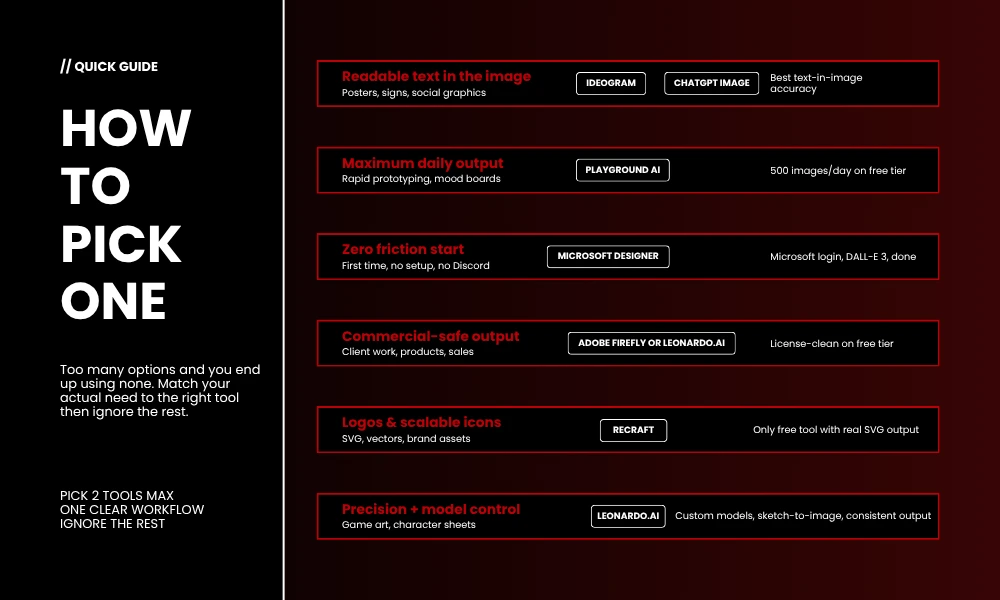
Too many options and you end up using none of them. Here is the short version for free AI art tools.
Need readable text in the image? Ideogram or ChatGPT. Need commercial rights on free tier? Firefly or Leonardo. Need to make a hundred images today? Playground.
If you are new to all of this, just pick two tools from this list and ignore the rest. You do not need fifteen accounts. You need one workflow that fits how you actually think and work.
Free vs Paid: When to Actually Upgrade
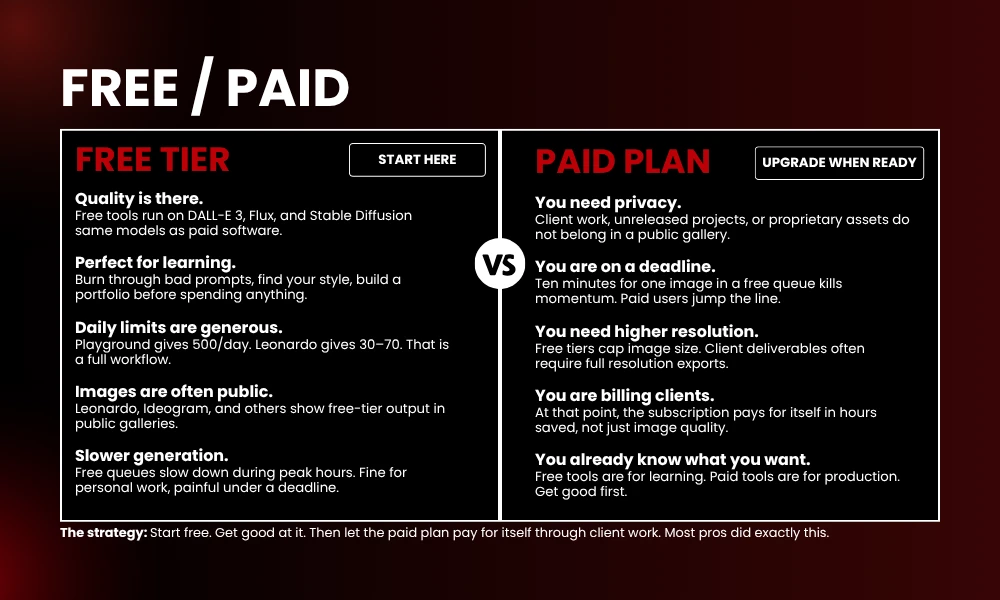
Free stuff is great. But there is a point where it stops making sense.
If you are making images for clients, you will eventually hit the friction. Queues. Resolution caps. Watermarks. Slower generations when you are under a deadline. When you are waiting ten minutes for a single image because the free queue is backed up, that is the moment you know it is time.
The other reason is privacy. Most free tiers make your images public. If you are working on something unreleased, confidential, or proprietary, a public gallery is a problem. Paid plans lock that down.
Start free. Get good at it. Then let the paid plan pay for itself.
Frequently Asked Questions
Can I sell art made with these free tools?
Depends on the tool. Leonardo and Adobe Firefly allow commercial use on free plans. Recraft and Canva restrict it. Always read the actual terms of service before you put anything up for sale.
Are free tools safe to use?
Generally, yes. With caveats. Your images usually live on company servers and may be visible publicly. Do not put confidential work or personal information through a free tier. Stick to established companies for anything sensitive.
Why do these tools have daily limits?
Running image generation is expensive on the computer side. The daily caps exist because companies cannot give away unlimited GPU time without going broke. The limits are basically the cost of keeping the free tier alive.
Do free tools put watermarks on images?
Some do. Gemini adds a small one. Canva does on certain exports. Most dedicated generators — Playground, Leonardo, Ideogram — do not watermark free output, though they often make images public instead.
Can I use these for client work?
You can, carefully. Check the license first. Think about whether your client work should be sitting in a public gallery. Test the resolution and quality before you promise anything. Free tools are great for drafts and mockups. Final deliverables sometimes need what only a paid plan provides.
Which one is best for total beginners?
Microsoft Designer has the lowest barrier. If you want a bit more room to experiment without things getting complicated, Playground and Dream by WOMBO are both very approachable. Artists who already sketch tend to feel at home in Leonardo pretty quickly.
Do I need a powerful computer?
No, for almost everything on this list. These run in a browser or on your phone. The only exceptions are Flux and Stable Diffusion if you run them locally — those need real hardware. Everything else works on a regular laptop.
Final Thoughts
A monthly subscription should not be the price of admission for making art. The fact that free AI art tools in 2026 can put out work that holds up against premium software is something worth paying attention to.
Pick one tool. Make something. See what happens. The wall between you and good art has genuinely never been shorter.