If you have ever hired a writer, worked on a marketing team, or tried to publish content that actually ranks, you’ve probably heard the phrase content brief before. But if someone asked you “what is a content brief?” could you explain it clearly in your own words?
This article breaks it down from first principles, explains why content briefs matter, shows real examples, links to data and studies, and gives you an SEO-ready template you can use right away. By the end, you will understand not just the definition, but the value of good content briefs and how they can transform your content strategy. This approach works best when content planning is aligned with a clear SEO content strategy.
Let’s begin.
What Is a Content Brief?
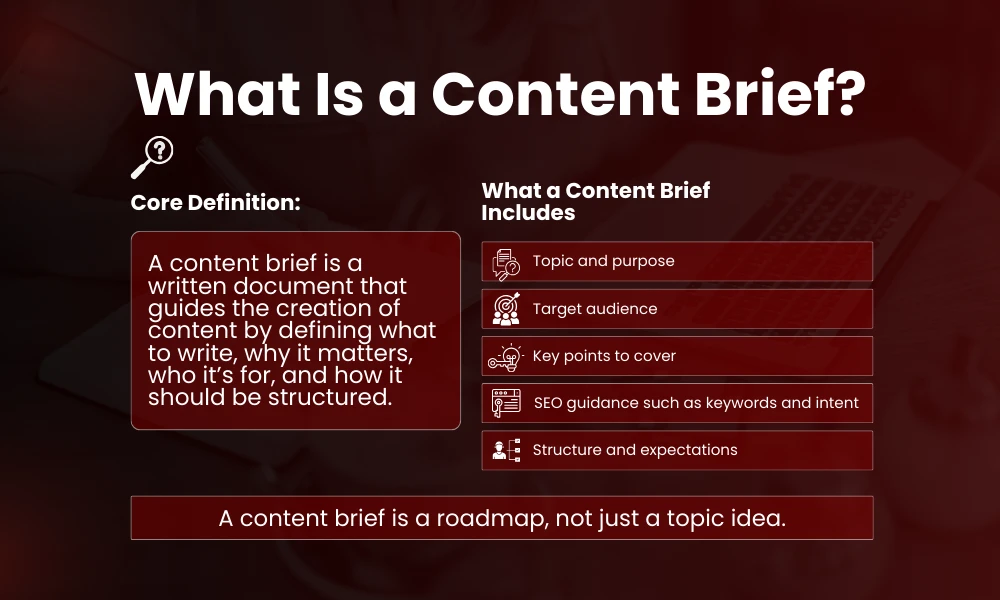
At its core, a content brief is a written document that guides the creation of a piece of content. It sets out what should be included, how the piece should be structured, who the audience is, and what the goals are. For SEO work, it also defines target keywords, search intent, and competitor context.
That’s the simple part.
A content brief is not just a title or a list of keywords. Good content briefs function as roadmaps for writers, editors, strategists, and sometimes designers or developers to ensure that what gets published is aligned with strategic goals and performs well online.
Put another way:
A content brief answers the question: “What exactly should be in this article, why, and how should it be structured?”
Why Content Briefs Matter More Than You Think
Even seasoned writers sometimes resist content briefs. It might feel like extra work, or like another document to fill in before you can get started.
But there are very real reasons content briefs matter:
1. They Clarify Purpose Before Writing
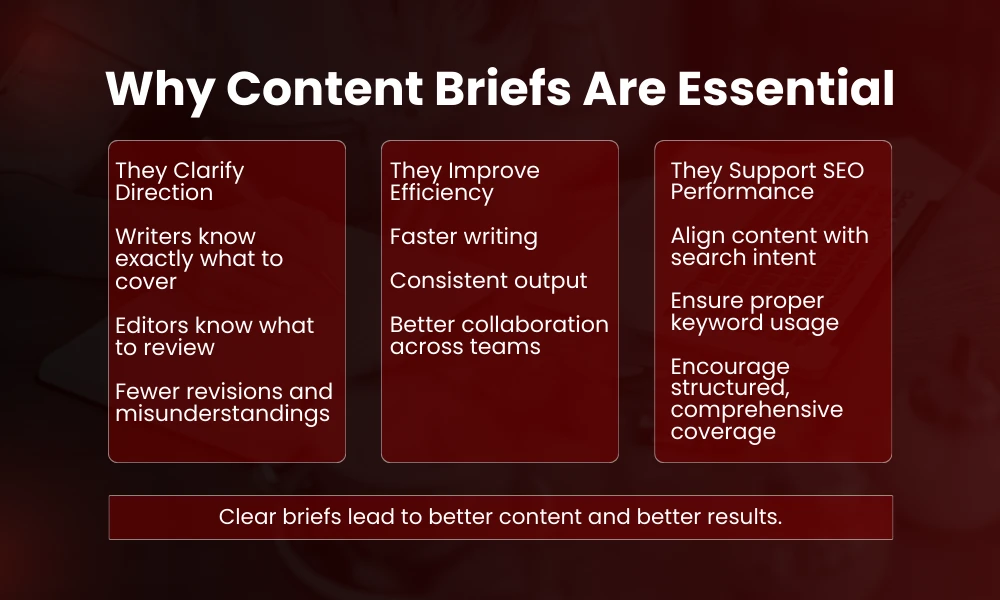
Without a content brief, writers often guess at what the topic should cover. That creates inefficiency. A detailed brief gives clear direction so writers and editors don’t waste time going back and forth.
Imagine asking five writers to write about the same topic without a brief. You would likely get five very different interpretations. A content brief means you only get what matches your strategy.
2. They Align Content With SEO Goals
Search engines don’t look at content randomly. That’s why understanding human search intent is critical when creating SEO-focused content briefs. They try to understand intent, what the searcher is trying to find. A strong content brief tells the writer:
- what keyword is primary
- what search intent needs to be satisfied
- how long the article should be
- what headings and topics must be covered
This kind of structure gives writers the context needed to match user expectations and rank better in search results.
3. They Reduce Miscommunication
On larger teams, the strategist, editor, subject matter expert, and writer might all have different perspectives on what the article should be. Poor communication results in revisions and lost time. A content brief solves that problem upfront.
4. They Improve Productivity
Content briefs streamline workflows. Writers can start with clarity. Editors know what to check. Stakeholders understand what should be delivered. Everyone works more efficiently when expectations are documented.
5. They Boost Content Performance
SEO studies consistently show that structured content with clear headings, relevant keywords, and user-focused answers ranks better. Search engines reward content that is comprehensive, organized, and aligns with user intent. Over time, teams also improve results by applying content pruning, which involves updating, consolidating, or removing underperforming pages to strengthen overall site quality. A content brief creates those conditions before a single word is written.
What Goes Into a Content Brief?
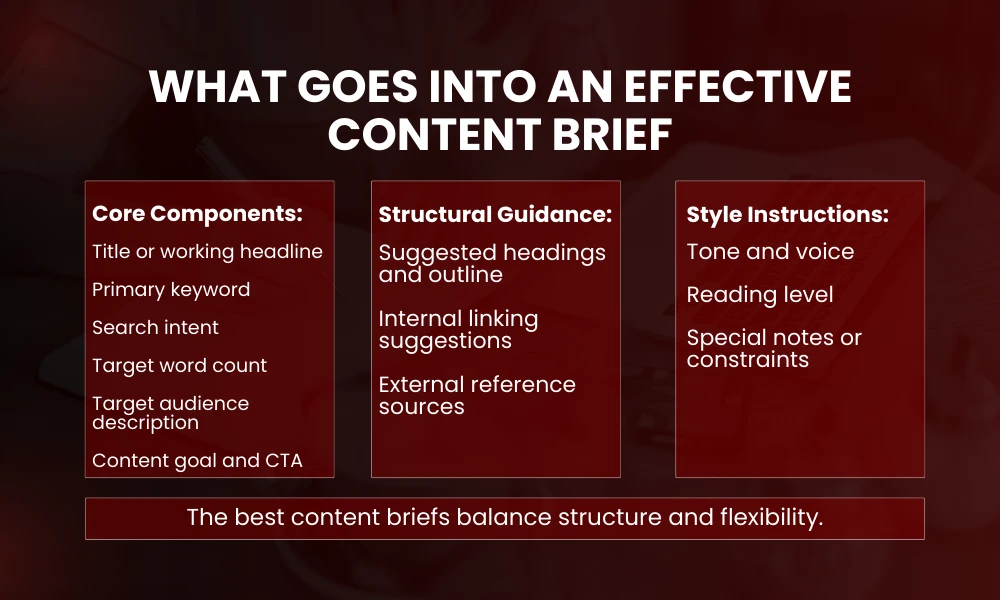
Now that you know what a content brief is and why it matters, let’s look at the core elements that most effective briefs contain.
I will walk you through these step by step.
1. Title and Suggested Headline
This is the proposed title for the piece, often optimized around your keyword. It’s the first impression of what the article will be about.
For example:
What Is a Content Brief? Definition, Examples & SEO Template
Titles signal to both writers and search engines what the piece should deliver.
2. Primary Keyword and Search Intent
The brief should clearly state the primary keyword, the phrase the article is targeting. This keyword selection should be backed by solid keyword research strategies, not guesswork.
In your case:
Primary keyword: what is a content brief
You also must define the search intent, why a user would search that term. Is the intent informational, commercial, transactional, or navigational? In this case, people want to understand what a content brief is and how to create one.
Knowing search intent ensures the content satisfies reader expectations.
3. Word Count Guidance
There is no single right word count, but the brief should include a recommended minimum and maximum. For example:
Target: 1800–2200 words
This helps ensure depth without fluff, and matches competitive landscape expectations. Top ranking articles for detailed concepts often exceed 1500 words. That is data-backed by SEO tools and benchmarks.
4. Target Audience Description
Who will be reading this content?
A good brief includes details such as:
- job roles (for example, content marketers, SEO specialists)
- experience level (beginners vs experts)
- problems this piece solves
- expectations and preferences
Understanding the audience helps tailor tone and depth, avoiding generic content.
5. Content Goals and Call-to-Action
Each content piece has a goal:
- educate the reader?
- drive newsletter signups?
- promote a product or service?
Your brief should tell the writer what the content should achieve. For example:
Goal: educate readers about what a content brief is and how to create one
CTA: invite readers to download a free content brief template
Clear goals maintain focus and help measure performance.
6. Header Structure and Outline
This is one of the most practical parts of the brief.
It shows the sections the article should include. Knowing how to properly structure blog posts helps ensure clarity for both readers and search engines. A typical SEO outline might look like this:
- Introduction
- What Is a Content Brief?
- Why Content Briefs Matter
- Key Components of a Content Brief
- Examples of Content Briefs
- Common Mistakes
- SEO Template
- Conclusion
Including headings ensures the article covers all necessary points and reduces the need for rewrites.
7. Internal and External Links
Good SEO practice encourages linking to your own relevant pages and to authoritative external sources. A brief can suggest:
Internal links:
link to related articles on your site
External links:
reference studies, tools, and SEO resources
Internal links help spread authority throughout your site and keep readers on your domain longer. External links provide additional context and credibility. This is a core principle behind building pillar content for SEO.
For example, internal linking can boost rankings according to SEO principles widely discussed by specialists.
8. Competitor References
One advanced element many briefs include is links to top ranking competitor articles. This helps the writer see:
- what topics competitors cover
- what they miss
- how to outperform them
These insights are typically uncovered through detailed SEO competitor analysis. A brief might include URLs of three or five articles currently ranking for the primary keyword.
9. Tone and Style Instructions
This section tells the writer how to sound:
- conversational and friendly?
- formal and authoritative?
- simple and beginner friendly?
Tone matters because it affects readability and audience engagement. Human readers prefer content that sounds like a person wrote it, not a machine.
10. Notes and Special Instructions
Anything else goes here:
- brand guidelines
- examples of preferred phrasing
- avoid overuse of jargon
- specific terms to include or exclude
This section helps reduce revisions after the writer submits the first draft.
Example Content Brief Template
You can use the following content brief template for SEO content.
Feel free to adapt it to your workflow.
Title:
What Is a Content Brief? Definition, Examples & SEO Template
Primary Keyword:
what is a content brief
Search Intent:
informational
Target Word Count:
1800–2200 words
Audience:
content marketers, SEO specialists, writers, digital marketers
Goals:
educate readers on content briefs, provide templates, examples, and best practices
CTA:
download content brief template
Outline:
- Introduction
- Definition of a Content Brief
- Why Content Briefs Matter for SEO
- Typical Components
- Examples and Use Cases
- Common Mistakes to Avoid
- SEO Template for Content Briefs
- Conclusion
Internal Links Suggestions:
link to related posts on content strategy and SEO templates
External Links:
link to authoritative SEO guides
Tone:
conversational and informative
This basic template gives writers everything they need to succeed.
Real Examples of Content Briefs
To make this more concrete, here are a few types of briefs with different purposes.
SEO-Focused Blog Post
This brief focuses on optimizing for search engines with:
- precise keyword usage
- detailed outline
- internal and external link suggestions
Best Use: organic traffic growth
Landing Page Brief
This brief focuses on conversion with:
- clear messaging
- strong calls to action
- persuasive language guidelines
Best Use: lead generation
Thought Leadership Brief
This type includes:
- supporting data or study links
- deep research topics
- expert quotes
- authoritative tone
Best Use: industry authority and backlinks
Common Mistakes to Avoid
Even experienced content teams can make errors when creating briefs. Here are some common pitfalls:
Too Generic
A brief that lacks specific direction leads to vague content.
Too Complex
Overloading with data and instructions can overwhelm writers.
Missing Internal Linking Guidance
If there is no direction for internal links, writers may forget to include them.
The goal is clarity, not perfection.
What Studies and SEO Data Say About Briefs
Although direct academic research on content briefs is rare, SEO industry surveys and reports highlight the effectiveness of structured guidelines in content performance.
For example, a Databox survey found that most content marketers include several key pointers in their briefs, such as primary keyword, title, content outline, and internal links.
SEO analysts also agree that organized content with thorough coverage of topics improves rankings and engagement. This is why many teams now prioritize data-driven content over assumptions.
Even user discussions among professionals underscore how structured briefs help align teams and reduce revisions.
Conclusion
So what is a content brief?
It is the foundation of high-quality content, a document that bridges strategy, creativity, and execution. It brings clarity to writers, aligns teams, supports SEO goals, and improves productivity.
Content briefs are more than a checklist. They are a foundational part of how brands create a winning content marketing strategy. They are an investment in quality content that earns traffic, satisfies readers, and supports your broader digital strategy.
Now that you have a template, examples, and a clear understanding of why they matter, you can start creating briefs that make content creation faster and more effective.
FAQs: What Is a Content Brief?
What is a content brief in simple terms?
What is a content brief? In simple terms, it is a document that explains what a piece of content should include, who it is for, and what it needs to achieve. It gives writers clear direction so they do not have to guess about structure, tone, or key topics.
What is a content brief used for in SEO?
What is a content brief in SEO? It is used to guide writers on keywords, search intent, headings, internal links, and content depth. An SEO content brief helps ensure the article matches what users are searching for and increases the chances of ranking on search engines.
What is a content brief vs a content outline?
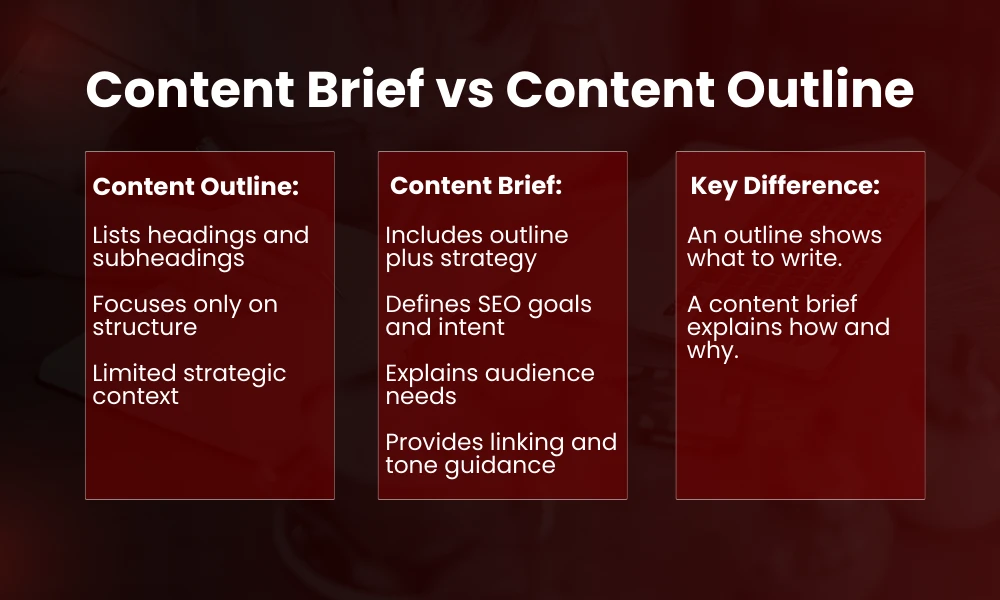
What is a content brief compared to a content outline? A content outline usually lists headings only. A content brief goes deeper by including goals, audience details, keywords, SEO guidance, tone, and linking instructions. The outline is just one part of the content brief.